The 19-year-old founder who dropped out of school to start a business has raised more than 2.5 million yuan in financing, and this AI exam preparation platform has garnered 50,000 registered users.
At the age of 19, he dropped out of the University of Chicago to start a business, secured about 2.54 million yuan in financing in less than a year, and attracted more than 50,000 registered users.
Recently, Makon AI, an AI education startup from Uzbekistan, has drawn widespread attention. The company mainly provides SAT and ACT exam preparation services for high school students in the United States, with a core founding team of only 3 members.
More notably, this is not the founder's first entrepreneurial attempt. At the age of 16, he founded an SAT training institution that has now served thousands of students from 24 countries. Despite the smooth development of the original business, he chose to suspend his studies and shift his main focus to AI products.
From traditional exam training to an AI exam preparation platform, why did this young company choose to start a new business, and how did it accumulate 50,000 users in the highly competitive US market?

Co-founder of Makon AI
01
Training business covers 24 countries,
Why turn to AI instead?
The founding team of Makon AI initially ran an SAT exam training business.
In the summer of 2024, 16-year-old Ashurov and his partner Kamoliddin Yakhshilikov co-founded SAT Makon, providing exam training for students planning to apply to US universities. At that time, the SAT had just completed a new round of digital reform. After rolling out digital exams in regions outside the United States in 2023, the SAT in the US mainland was fully converted to computer-based testing in March 2024.
This reform not only changed the exam format, but also shortened the exam duration from about 3 hours to 2 hours, and introduced an adaptive testing mechanism that adjusts the difficulty of subsequent questions based on the test-taker's performance in the previous stage. The adjustment of exam rules also created demand for updated preparation materials and targeted training.
Ashurov has first-hand experience of this. He grew up in Guliston, Uzbekistan, and later studied at a local presidential school. When preparing for the SAT, he found that students lacked sufficient learning materials and clear preparation guidance for the new exam format. At the same time, his partner Yakhshilikov had accumulated more than 4 years of experience in the SAT preparation field, familiar with exam content and student needs. The two then decided to establish their own training institution.
Different from traditional training institutions that rely on advertising investment and offline student recruitment, SAT Makon initially acquired customers through Telegram student communities. Ashurov has long been active in local student exchange groups and has built his own communities, allowing him to directly reach students with SAT preparation needs. With this channel, the business got off to a quick start. According to data disclosed by the founder, just a few weeks after the courses were launched, the monthly revenue reached about 5,000 US dollars, equivalent to about 33,000 yuan.
After that, SAT Makon continued to expand its student recruitment scope. A year later, this young training institution had begun to compete with peers that had been operating for three or four years. As of October 2026, its students came from 24 countries, numbering in the thousands.
However, as the business expanded, the limitations of the traditional training model gradually emerged. SAT Makon relies on teachers to provide courses, practice guidance and learning feedback. As the number of students increases, more teachers need to be deployed. After entering more national markets, teacher recruitment, course delivery and teaching quality management will also become more complex. Ashurov mentioned in an interview that if the original model is continued, hundreds or even thousands of teachers may need to be recruited in the future, and the continuous expansion of the team size will also increase the difficulty of management and quality control.
This prompted the founding team to look for new growth methods. From late October to early November 2025, Ashurov and his partner launched the independent project Makon AI, transforming links such as learning plan formulation, practice arrangement, progress analysis and answer tutoring into software functions, hoping to allow students to complete exam preparation with less manual guidance.
The original SAT Makon still retains training centers and online courses, which continue to be operated by the team. Ashurov chose to suspend his studies at the University of Chicago for at least one year, focusing on developing Makon AI with his partners, and brought in technical partner Asadbek Ne'matjonov as the Chief Technology Officer.
The two businesses have thus formed different operating models: SAT Makon continues to rely on teachers to provide training services, while Makon AI tries to serve a larger group of students through the AI system. Learning planning, error explanation and progress tracking that previously needed to be repeatedly completed by teachers can now be continuously provided by software.
However, reducing the dependence on the number of teachers only solves part of the problem of business expansion. For this newly established AI company, the more direct test is whether students can truly complete their exam preparation through the product, and how many people are willing to continue paying for it.
02
Behind 50,000 registered users,
the number of paying users is about 500
When opening Makon AI, students first need to complete a questionnaire of about 15 questions, filling in their current learning level, target score, preferred learning method, and the time they can devote to exam preparation each week. Subsequently, the system will assign exam preparation tasks to specific dates, and continuously adjust learning content according to the student's answer performance.
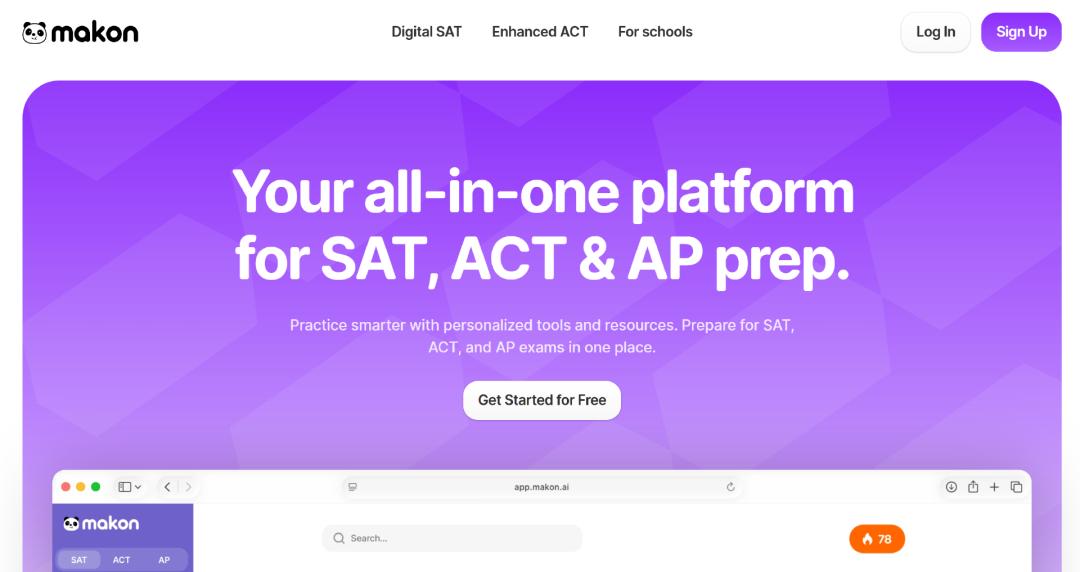
Taking SAT math preparation as an example, if a student repeatedly makes mistakes on a certain type of question, the system will increase relevant practice. When encountering a problem that cannot be solved, students can directly ask the AI teacher for hints, get step-by-step explanations or video analysis. The platform also provides full mock exams, timed training, vocabulary flashcards and other functions to help students familiarize themselves with question types and answering rhythms before the formal exam.
According to the official website, Makon AI's service scope has expanded from SAT and ACT to AP exams, with a question bank of more than 5,000 questions, some of which come from officially authorized exam materials, and the rest are independently developed by the team. The platform also introduces professionals who have obtained high scores in the exams to participate in content construction, and provides video courses produced by high-score teachers.
At the technical level, Makon AI does not train its own basic large models, but calls existing models through APIs, focusing development on learning data analysis and personalized recommendation systems. The team continuously records students' learning goals, practice results and error types, and adjusts subsequent learning tasks accordingly.
This set of products has accumulated certain data on usage effects. The founder revealed that according to the company's statistics on students' scores before and after exam preparation, after using Makon AI for three months, students' SAT scores increased by an average of about 150 points. Considering that the full score of the SAT is 1600 points, this improvement is quite attractive. However, no public sample size, controlled study and third-party verification results have been seen so far, and the actual score improvement effect still needs more data to support.
After the product was launched, the team quickly began to explore commercialization. Initially, Makon AI was mainly promoted through the founder's acquaintance network, and then carried out User Generated Content (UGC) marketing, trying to expand dissemination through social platforms. About 10 days after going online, the platform began to generate continuous revenue. In the first two months, its Monthly Recurring Revenue (MRR) reached about 12,000 US dollars, equivalent to about 80,000 yuan.
At present, Makon AI mainly adopts a subscription model, providing free basic services, and some advanced functions and higher usage limits require payment to unlock. According to the founder's disclosure, the price of individual subscriptions in different countries ranges from 39 to 59 US dollars per month, equivalent to about 261 to 395 yuan.
However, there is still a gap between user growth and paying user growth. According to data disclosed in October 2026, Makon AI has accumulated more than 50,000 registered users, of which about 500 are paying users, accounting for about 1% of the total registered users. This ratio is not equivalent to the user conversion rate in the same period, but it also reflects that the company's current paying user scale is still relatively small.
At the same time, the founding team has not disclosed the latest monthly revenue, user activity and subscription renewal rate. The previously achieved MRR of 12,000 US dollars is only the operating data in the initial stage of product launch, which cannot directly represent the current revenue level.
For Makon AI, preliminary progress has been made in attracting students to register, and the next problem is how to expand the scale of paying users. Especially in the United States, there are already a large number of mature SAT preparation products, and official institutions also provide free learning resources. How much extra value an AI exam preparation tool with a monthly fee close to 400 yuan can provide will directly affect students' payment choices.
03
SAT preparation enters campuses,
AI companies compete for the school market
The US market that Makon AI is betting on is seeing new competition directions.
Data released by the College Board in September shows that more than 1.95 million high school graduates in the class of 2026 took the SAT. Among them, 65% of test-takers took the exam at school through the SAT School Day program. In the 2025-2026 academic year, more than 10,000 schools across the United States have offered this exam program.
The entry of exams into campuses has also driven exam preparation demands on the school side. Schools need to arrange practice based on students' exam performance, identify weak knowledge points, and track subsequent learning effects. Compared with courses purchased by students themselves, exam preparation services for schools also need to provide functions such as teacher management, class analysis and unified teaching support.
This market has already attracted examination institutions to accelerate their layout. The College Board is deepening its cooperation with Khan Academy, launching Khan Academy Districts services for school districts, integrating official SAT practice questions, learning data analysis and teacher support into school teaching. In May 2025, ACT also announced a strategic cooperation with MasteryPrep to launch the new version of ACT Online Prep, providing online practice, personalized learning paths and student performance analysis for schools and school districts.
The exam organizers' direct participation in exam preparation services has also raised the threshold for third-party products to enter the school market.
Makon AI has already begun to try in this direction. The founder revealed that the company currently has two ongoing B2B cooperation projects with US schools, and related businesses generate thousands of dollars in revenue every month. The official website shows that its school version supports teachers to create classes, assign practice, track student performance, and provide learning analysis reports. The paid Classroom Pro is an annual subscription, with a seat fee of 329 US dollars, equivalent to about 2,200 yuan.
The school business provides Makon AI with an additional source of revenue beyond individual subscriptions, but this direction is still in its early stage. The company has not disclosed the number of covered students and the scale of contracts of partner schools.
From the perspective of the US market, the competition in AI exam preparation has extended to the school teaching link. For new entrants, acquiring individual users can rely on product promotion, while entering schools requires adapting to the requirements of teaching management, content quality and institutional procurement. With the continuous enrichment of official free exam preparation resources, the ability to acquire school customers and generate continuous revenue is becoming an important path for AI exam preparation companies to expand their business.
This article is from the WeChat official account "Duojing" (ID: DJEDUINNO), written by Xie Qi, and published with authorization from 36Kr.