Has the new AI cloud myth been shattered? Star stocks have plummeted, major cloud vendors are canceling orders, and forecasts indicate that 80% of the related players will not survive for more than four years.
The AI computing power track is witnessing a stark contrast of boom and bust!
The demand for AI computing power remains red-hot, yet Neocloud, the once high-flying new-type cloud service providers, is now hit by a round of market sell-offs, with share prices of multiple listed enterprises plummeting. A Gartner report even directly asserts that 80% of Neocloud enterprises will cease independent operations by 2030.
In this wave of turmoil, CoreWeave, hailed as Nvidia's "favored child", has fallen into the dilemma of "double blow on stocks and bonds". Its share price has plunged by more than 23% in the past 8 days, down 55.7% from its peak level this year; the latest publicly disclosed total liabilities have reached 720.46 billion US dollars (equivalent to about 4812 billion RMB).
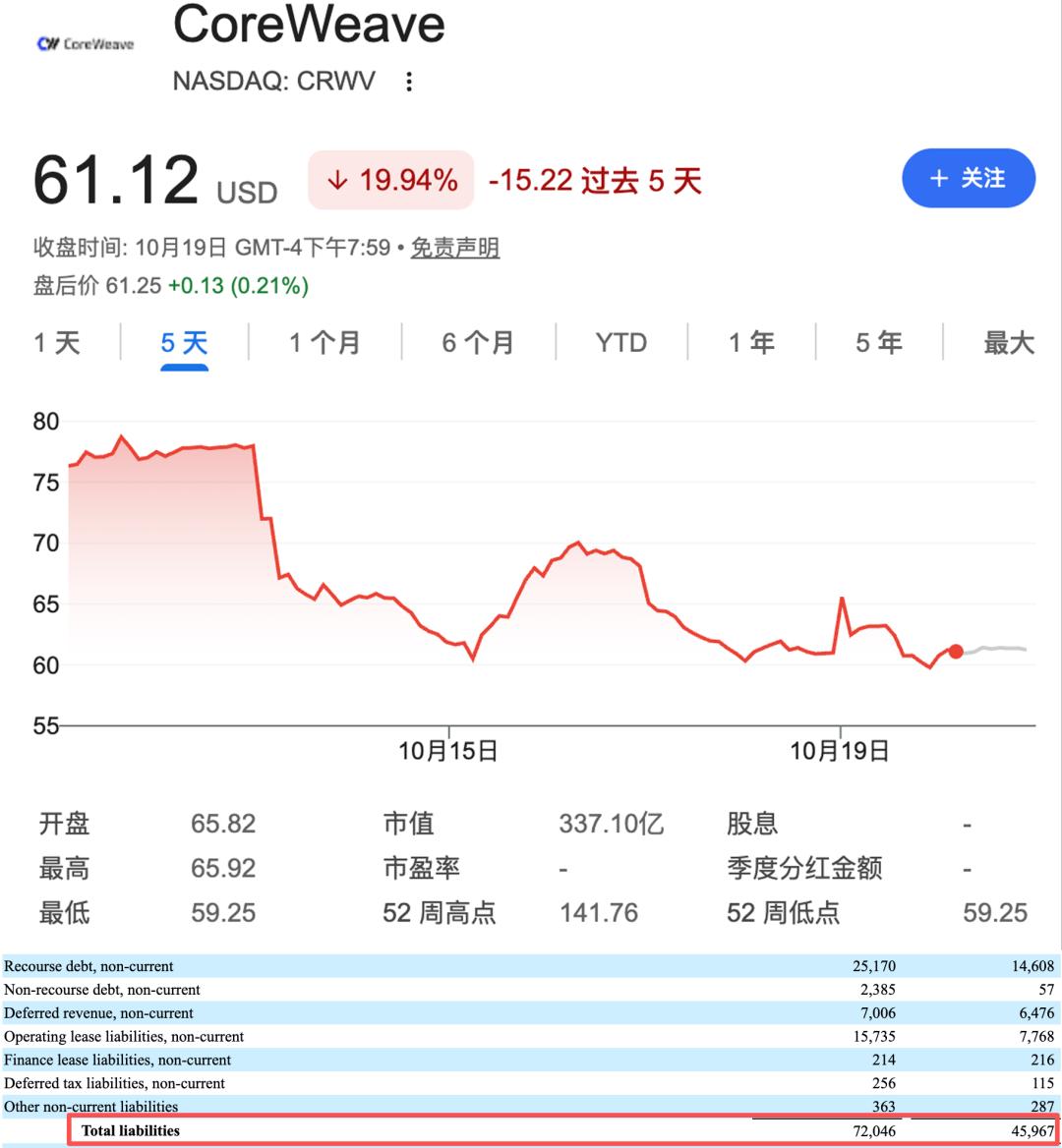
▲CoreWeave share price changes (upper) CoreWeave total liabilities (lower) (Source: Google Finance, CoreWeave financial reports)
Neocloud enterprises at the critical node of IPO have also been affected: Firmus cancelled its IPO plan due to failure to obtain sufficient subscription; Nscale was reported to have shelved its IPO due to changes in its cooperation with Microsoft.
However, Bloomberg broke the news today that Nscale is negotiating a 450 billion US dollar (equivalent to about 3005.6 billion RMB) large computing power order with Anthropic, and the implementation of this transaction may become the key support for it to restart its IPO.
Against the trend of skyrocketing AI computing power, these new cloud service providers born for large models have filled the computing power supply gap of traditional cloud service providers, and once stood at the highlight moment of capital, getting large financing and non-stop orders, with many enterprises rushing to IPO one after another and their share prices rising all the way.
But now the hidden risks of their business model of mortgaging orders and expanding production by borrowing are gradually magnified.
As the Neocloud sector triggers panic in the AI computing power market, Jensen Huang, founder and CEO of Nvidia, and many top Wall Street institutions have taken action to calm the market, arguing that the market reaction is excessive and the panic sentiment is overestimated.
Even so, the doubts about Neocloud's business model still need time to be verified. For the trillion-level AI infrastructure capital expenditure, it remains to be seen whether it can generate sufficient revenue in the future to bear the high debt pressure of these enterprises.
01.
CoreWeave's share price plummets by more than 23%
The latest total liabilities reach 720.46 billion US dollars
Neocloud is facing the crisis of frustrated IPOs and plummeting share prices, high debt crisis and credit crisis.
1. Multiple enterprises have delayed their IPOs, and CoreWeave's share price has dropped by more than 23% in 8 days
The trigger of this wave of Neocloud crisis was on October 9, when Firmus announced the withdrawal of its 50 billion US dollars (equivalent to about 333.96 billion RMB) IPO application. The company believes that affected by market fluctuations, this listing plan with planned financing of 50 billion US dollars failed to obtain sufficient subscription from investors.
Another British enterprise Nscale also faced blocked IPO. On October 18, the British Daily Telegraph reported that Microsoft will cancel a cooperation agreement with Nscale, which may mean that the latter's multi-billion-dollar IPO plan will suffer a major setback. But the report did not explain the reason why Microsoft withdrew from this project.
Then from October 12 to October 19, many listed Neocloud enterprises were sold off: CoreWeave plunged 23.91%, Nebius's share price fell 18.96%, Core Scientific fell 8.59%...
2. Debts continue to expand, CoreWeave's total liabilities reach 4.8 trillion RMB
To make matters worse, the debt scale of Neocloud manufacturers is continuing to expand, and the existing revenue is difficult to cover the debt pressure.
Taking CoreWeave as an example, its public financial data shows that the company's total liabilities were 5.109 billion US dollars in 2023 (equivalent to about 341.23 billion RMB), reached 45.967 billion US dollars by the end of 2025 (equivalent to about 3070.18 billion RMB), and as of the end of June 2026, the total liabilities even soared to 720.46 billion US dollars (equivalent to about 4812 billion RMB).
From the perspective of its revenue and net profit data, although the company's revenue growth rate is impressive, the profit pressure is still not small, which is far from enough compared with its liabilities. In Q2 of this year, CoreWeave's revenue increased by about 112% year-on-year to 25.75 billion US dollars (equivalent to about 171.99 billion RMB); its net loss was 6.26 billion US dollars (equivalent to about 41.81 billion RMB), with a loss of 1.14 US dollars per share (equivalent to about 7.61 RMB).
3. Facing credit crisis, the default risk in the next five years is as high as 64%
In addition to high debt, CoreWeave is also facing a credit crisis, which is related to two key indicators: Credit Default Swap (CDS) and yield. Reuters cited data from S&P Global Market Intelligence showing that CoreWeave's 5-year CDS spread once exceeded 1100 basis points, which means its default risk in the next five years is 64%.
The higher the yield, the more the market believes that the company has high risks and dare not lend money to it. Chamath Palihapitiya, founder and CEO of American investment firm Social Capital, posted CoreWeave's yield change chart on the social platform X. The coupon rate of the company's bonds maturing in 2032 was fixed at 9.625% when issued, and the intraday yield once rushed to 15.1% recently.
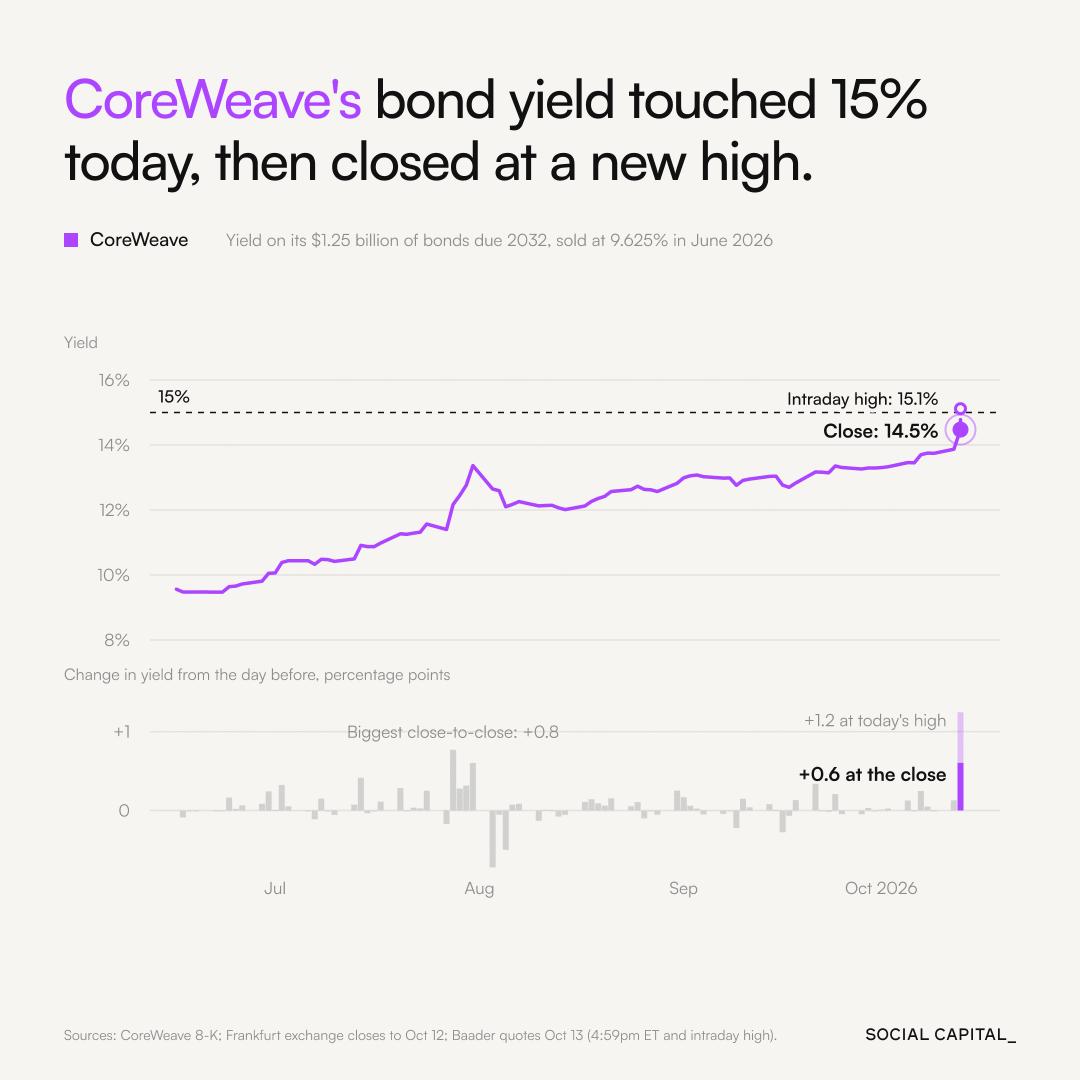
▲CoreWeave's yield change chart (Source: X)
The market shock lasting for more than a week has even spread to large AI cloud service providers such as Oracle. The core reason is that investors have doubts about the large-scale expansion of data centers and the business model of Neocloud enterprises.
02.
Gartner predicts that by 2030, more than 80%
of Neocloud enterprises will cease independent operations
This requires clarifying Neocloud's business model first.
After ChatGPT ignited the large model arms race, the demand for computing power exploded exponentially. However, hyperscale cloud vendors such as Microsoft and AWS were previously designed for general businesses, and could not quickly provide computing power resources for large model companies. Therefore, Neocloud emerged as the times require.
The business model of such enterprises is to first obtain long-term computing power framework agreements from model enterprises, use orders and GPUs as collateral to raise debt financing from private credit institutions, then lock in Nvidia GPU quotas and build intelligent computing centers.
They will charge rent monthly after the computing power goes online, and then use the rent to cover interest, operation and maintenance costs, hardware depreciation and repay debts. For these AI enterprises that expand through borrowing, whether they can earn enough money in the future to cover their high financing costs is the key point of current industry doubts.
Regarding the future development of Neocloud, Gartner, a world-renowned market research institution, has given the answer. On October 15, Gartner mentioned in a report that by 2030, it is expected that 80% of Neocloud enterprises will stop independent operations.
It is stated in the report that in the next few years, the revenue obtained by enterprises will not be enough to support all planned AI capital expenditures. Will Sommer, senior director analyst at Gartner, said that AI enterprises are expected to invest nearly 1 trillion US dollars in AI infrastructure this year (equivalent to about 6.68 trillion RMB), and it is predicted that an additional 6 trillion US dollars (equivalent to about 40.07 trillion RMB) will be invested between 2027 and 2030.
To break even, AI data center operators need to achieve a cumulative revenue of 8.5 trillion US dollars (equivalent to about 56.77 trillion RMB) by 2030, so as to cover the announced capital expenditure, financing cost and 12% return on invested capital (ROIC), which is regarded as the minimum requirement for invested capital.
In fact, the total AI revenue of enterprises and consumers during this period is expected to be no more than 3.6 trillion US dollars (equivalent to about 24 trillion RMB). In addition, most AI-native enterprises adopt an asset-light business model, so Gartner predicts that the revenue that computing power operators can get may be less than half of this scale.
According to Gartner's forecast, if AI infrastructure investment continues the current trend, more than 4 trillion US dollars (equivalent to about 26.71 trillion RMB) of asset value will face the risk of write-down by 2032, and ROIC will not reach 12% until the end of 2032 at the earliest.
The Neocloud enterprises are the most affected by the above situation.
Because hyperscale cloud service providers have large and highly diversified revenue sources, which are sufficient to reasonably support years of AI investment. Neocloud enterprises must obtain returns from AI-optimized Infrastructure as a Service (IaaS) and related platforms as soon as possible to maintain operations.
Several executives of Neocloud enterprises told foreign media The Information that in a few years, only 7 to 10 of the hundreds of Neocloud enterprises that are currently preparing to go online will remain. However, they believe that industry consolidation is usually a feature of a mature market, and this trend is inevitable.
03.
Jensen Huang publicly speaks for CoreWeave
Wall Street analysts believe the panic is excessive
This wave of Neocloud crisis has also pushed Nvidia to the focus of the market.
On October 15, when CoreWeave was hit by the "double blow on stocks and bonds", Jensen Huang, founder and CEO of Nvidia, stated in an interview with Bloomberg that CoreWeave no longer needs further credit support from Nvidia.
In fact, Nvidia has taken actions before to help CoreWeave. Documents submitted by CoreWeave to the SEC on September 15 show that if CoreWeave cannot sublease GPU computing power to customers, Nvidia agreed to lease back the corresponding capacity; the agreement disclosed at that time corresponds to about 6.3 billion US dollars (equivalent to about 420.78 billion RMB) of lease income, and the agreement is valid until April 13, 2032.
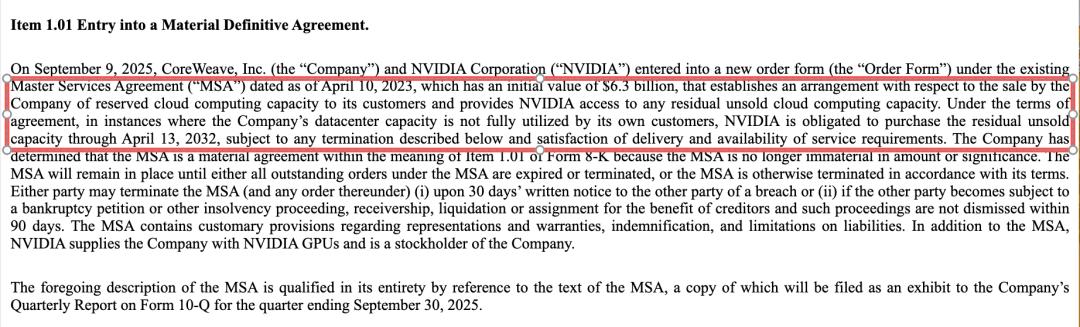
▲Documents submitted by CoreWeave to the SEC (Source: SEC)
In addition, according to people familiar with the matter cited by The Information, Nvidia hopes to provide additional equity investment, chip quotas, credit support and customer resources for Neocloud enterprises to refute skeptics.
The team led by Nico Caprez, son-in-law of Nvidia founder and CEO Jensen Huang, and long-term vice president Raj Mirpuri is also helping Neocloud enterprises find sites with available power supply.
The Information believes that given that Nvidia has adjusted its credit support plan, if the capital market deteriorates significantly, Nvidia will most likely quickly take action to help Neocloud vendors.
Now many Wall Street institutions have spoken out for Neocloud enterprises one after another, arguing that investors' panic is excessive. Goldman Sachs, Bank of America (BofA), Jefferies, Deutsche Bank and other institutions have reiterated their buy ratings or raised their ratings from neutral to buy.
On October 19, Bloomberg cited the view of JPMorgan Chase analysts that despite debt concerns, CoreWeave's business remains robust. CoreWeave relies on long-term take-or-pay customer contracts to lock in computing power demand, and the project itself has stable returns. The cash consumption and rising debt are phased phenomena brought about by active expansion, rather than deterioration of asset fundamentals.
Goldman Sachs, Bank of America (BofA), Jefferies, Deutsche Bank and other institutions have reiterated their buy ratings or raised their ratings from neutral to buy. Ajay Rajadhyaksha, global research chairman of Barclays, believes that investors should not extend the recent debt challenges faced by CoreWeave to the view of the entire AI capital expenditure cycle.
04.
Large model vendors sign excess orders to avoid risks
Neocloud still needs to guard against the mismatch between computing power supply and demand
It is worth noting that in addition to the debt crisis, Neocloud has another major potential risk that a large number of new data center projects have strong speculative attributes.
Today, according to people familiar with the matter, Nscale, the AI cloud service provider, is negotiating a computing power supply cooperation with Anthropic, and the value of this transaction is about 450 billion US dollars (equivalent to about 3005.6 billion RMB).
On October 19, an investor who invested in data center power supporting projects said in an interview with The Information that Anthropic deliberately signed data center leases exceeding its actual demand, to avoid the situation that some sites cannot be implemented due to equipment, manpower and power supply bottlenecks, and to prevent uncertainties at the local policy level at the same time.
Not only that, market analysts also have doubts about this round of expansion wave. Some market analysts suspect whether the data center projects announced in various places will really be implemented. According to the calculation of Bernstein analysts cited by Bloomberg, only 35% of the announced data center capacity in North America will eventually be completed.
But if all the above projects are put into operation, the industry may build computing power capacity far exceeding the real demand of customers. Another executive of a Neocloud enterprise believes that it is inevitable that computing power supply will exceed demand.
For Neocloud enterprises, they may face the dual pressure of debt pressure and mismatch of supply and demand expectations in the future.
05.
Conclusion: Neocloud enterprises born from the computing power gap
Stand at the eve of industry consolidation
Neocloud enterprises were born from the supply gap where traditional large-scale cloud vendors cannot adapt to the demand of large model clusters, but their borrowing expansion model will eventually be tested by the reality of cash flow, financing cost, GPU depreciation and supply and demand cycle.
In the future, as this track gradually matures, the industry will move towards consolidation later, some players will be acquired or exit directly, and a few players with software stack, power resources and long-term stable customer structure will remain, forming a complement with hyperscale cloud vendors. In the second half of the computing power competition, the key to competition is not only who can get GPUs faster and sign long orders, but also who can convert heavy asset investment into sustainable capital returns.
Source: Gartner, Reuters, Bloomberg, The Information