How much of iFLYTEK's AI expectations have been fulfilled?
Is iFLYTEK Undervalued? Liu Qingfeng, its chairman, thinks the answer is yes.
At the performance briefing held at the end of April this year, he stated, "The company's market capitalization should reach a higher level. We need to make the tough path of domestic chips fully transparent to all stakeholders, and clearly demonstrate its commercial logic. We also need to strengthen the focus of industrial strategy, and enhance the connection and resonance between core capabilities and market hotspots."
The implication is that as the only scarce AI target in China at that time that achieved full-stack deployment of domestic computing power chips from training to inference, iFLYTEK deserves a higher market cap. Back then, iFLYTEK's market capitalization was around 115 billion yuan. Two quarters later, the commercial logic of this path is still under verification, and its market value has dropped to 87.8 billion yuan, down more than 40% from the stage high at the beginning of the year.
During the same period, the AI narrative in the capital market went through a full cycle of expansion and correction. Zhipu AI and MiniMax, which went public at the beginning of the year, once surged and have now fallen significantly from their highs. The market's valuation of AI companies is shifting from storytelling to the stage of counting Tokens and tracking ARR. In this coordinate system, there are divergences in the market's "AI expectations" for iFLYTEK.
After the market closed on October 19, iFLYTEK released its Q3 2026 financial report. During the period, the company achieved operating revenue of 6.564 billion yuan, a year-on-year increase of 7.99%; net profit attributable to shareholders was 226 million yuan, a year-on-year increase of 31.05%; the cumulative net profit attributable to shareholders in the first three quarters was 21.8872 million yuan, turning losses into profits year-on-year. However, after excluding non-recurring gains and losses, the company still recorded a loss of 126 million yuan in the third quarter, with a cumulative loss of 763 million yuan in the first three quarters.
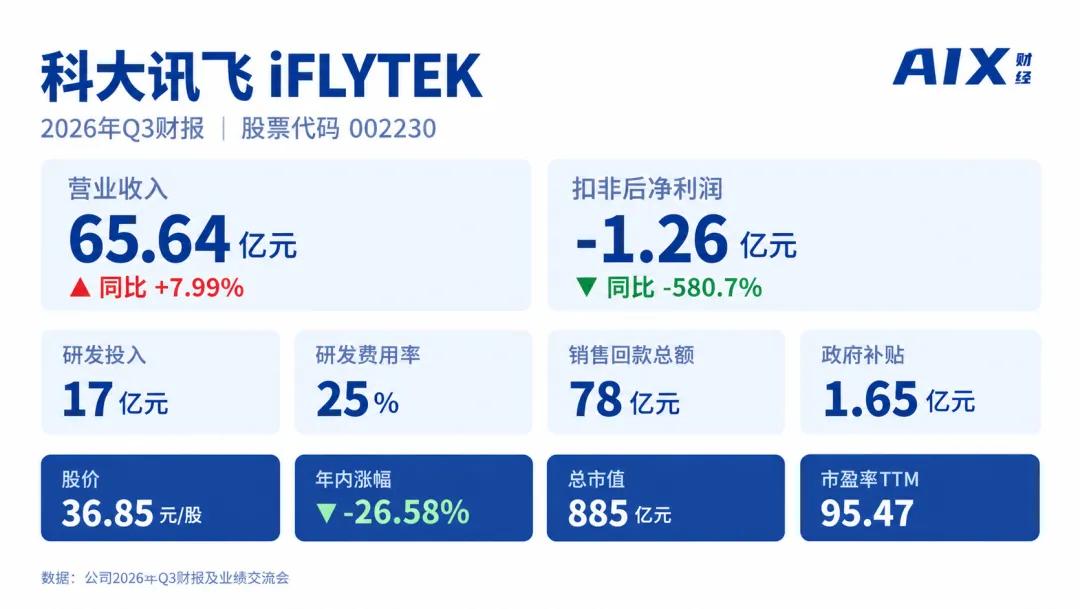
These are a set of steady figures. The year-on-year revenue growth rate decreased by about 2 percentage points, which is mainly the result of the active adjustment of business structure; negative non-GAAP net profit is not new in iFLYTEK's financial history. Its profit has always shown extremely strong seasonality, with investment concentrated in the first two or three quarters and centralized realization in the fourth quarter.
The highlight in the financial figures is reflected in cash flow: the net cash flow from operating activities in the first three quarters was 264 million yuan, a year-on-year increase of 115%, and the sales repayment in the third quarter was 7.794 billion yuan, with a relatively obvious improvement in both the repayment cycle and cash flow.
Apart from the figures, the expectations around the company still focus on AI, including the full-stack autonomous and controllable general large model base, AI applications, and AI hardware. Some of these expectations have begun to be fulfilled, while many are still hidden under the surface.
01. AI is still in the investment period, cash flow has improved significantly
iFLYTEK has a diversified source of revenue, but the quarterly financial report usually does not disclose the performance of each segment in detail, so we can only roughly infer the progress of each business from the overall operation of the company.
The company's revenue in Q3 was 6.564 billion yuan, a year-on-year increase of 7.99%, and the growth rate slowed down by about 2 percentage points compared with 10.02% in the same period last year. Breaking down the quarterly figures, the main reason for the slowdown in growth is the active contraction of G-end business. The revenue of G-end business in Q3 decreased by 2.39% year-on-year, and the company's expression in the quarterly report is "actively contracting smart city business".
Although G-end business can provide iFLYTEK with a stable revenue source and scale support, due to problems such as highly customized projects, low gross profit margin, and long repayment cycle, it is not suitable to bet too many resources on it, and resources should be concentrated in fields with higher returns.
The two high-gross-margin tracks of smart education and smart medical care both achieved growth of more than 20% in Q3. This approach of exchanging revenue growth rate for structural quality has suppressed the book growth rate in the short term, but the direction is in line with the company's strategic goal of "strengthening the C-end, deepening the B-end, and selectively developing the G-end".

Source / Official Weibo account of iFLYTEK
The performance on the profit side can better reflect the company's current investment priorities.
The net profit attributable to shareholders in Q3 was 226 million yuan, a year-on-year increase of 31.05%. On the surface, it is "increasing revenue and profit", but non-recurring gains and losses contributed a large part: the government subsidies included in the profit or loss in the current quarter were about 165 million yuan, and the fair value change income of financial assets was 248 million yuan. The two items together contributed most of the profit. After non-GAAP adjustment, the loss was 126 million yuan, while the profit in the same period last year was 26.24 million yuan, a year-on-year decrease of about 150 million yuan. The company attributed this to the increase in R&D investment. The R&D investment in Q3 exceeded 1.7 billion yuan, an increase of nearly 400 million yuan year-on-year, accounting for more than 25% of operating revenue.
From a horizontal comparison, the R&D expense ratio of A-share software companies is generally in the range of 15%–20%, and iFLYTEK has pushed the R&D expense ratio to around 25% for several consecutive quarters. Vertically, the total R&D investment in 2025 was 5.364 billion yuan, accounting for nearly 20% of revenue, and the expensed R&D in the first three quarters of 2026 alone reached 3.85 billion yuan.
The money is mainly invested in the iteration of the Spark large model, including the optimization of training efficiency of the full domestic computing power base, the expansion of multi-modal capabilities, and the "cloud + edge" integrated solution to be released on October 22. This is a strategic investment that suppresses current profits, but the management is betting that after the gap in model capabilities narrows, the three monetization paths of API calls, industry solutions, and edge-side hardware will be opened up.
Apart from the income statement, the cash flow statement sends a more positive signal. The sales repayment in Q3 was 7.794 billion yuan, an increase of over 700 million yuan year-on-year; the net cash flow from operating activities in the first three quarters was 264 million yuan, a year-on-year increase of 115%. The significance of this set of data is that it verifies the phased results of "selectively developing the G-end". The balance of accounts receivable increased slightly from 16.3 billion yuan at the beginning of the year to 17.8 billion yuan, indicating that the repayment quality of new revenue is improving, and the historical burden has not continued to deteriorate.
Putting these sets of figures together, the Q3 financial report presents a typical appearance of a company in the "strategic investment period": actively adjusting the structure on the revenue side, suppressed profits by R&D investment on the profit side, and emerging signs of improvement on the cash flow side.
These characteristics are neither good nor bad in themselves. The key lies in the final input-output efficiency, that is, whether the Spark large model can convert the 25% R&D expense ratio into measurable revenue growth in the next few quarters.
02. What expectations still need to be fulfilled?
The day after the financial report was released, on October 20, iFLYTEK's stock price fluctuated slightly after the market opened, closing up 1.72%, and its market value reached 88.25 billion yuan. However, there is still a gap compared with the stock price high of 63.55 yuan at the beginning of the year. A large part of the expectations priced in during the AI market rally at the beginning of the year has not yet been fully fulfilled.
If this valuation gap is to be filled, iFLYTEK still needs to answer three questions. First, what is the performance of the new model to be released soon?
At the 1024 Developer Festival on October 22, iFLYTEK will release the brand-new "cloud + edge" iFLYTEK Spark large model. The key points of the official preview are "newly upgraded edge-cloud integrated solution based on full domestic computing power base", "newly upgraded multi-modal human-computer interaction technology" and "promoting the transition from capability opening to value co-creation with Token + Agent". This is an important iteration after Spark X2.5, and also the latest progress display of the company on the path of full domestic computing power.
iFLYTEK previously disclosed at the April performance briefing that the mainstream domestic chips at that time had shortcomings in video memory capacity and bandwidth compared with NVIDIA H200, and it was expected that the Ascend 950 chip to be released in Q4 2026 would achieve benchmarking in key performance. This means that the Spark X2 series is trained on a hardware platform with limited performance, which makes the performance of the new model more meaningful for verification.
Liu Qingfeng has repeatedly emphasized before that only iFLYTEK's Spark model uses domestic chips from the training stage, unlike other companies that only adapt at the inference stage. This label is scarce in the industrial environment with limited computing power, but whether the scarcity can be converted into commercial premium depends on the performance of the new model released on October 22 in benchmark tests and real scenarios.

Source / Official website of iFLYTEK
The second question to answer is whether iFLYTEK can optimize its revenue structure and increase the gross profit margin of the open platform while maintaining the high gross profit margin of its education business.
The open platform is the part of iFLYTEK's AI commercialization map that can most directly reflect AI capabilities. It includes the call volume of model APIs and Token consumption, which is also the most important indicator when the market prices AI companies currently. In 2025, iFLYTEK's MaaS (Model as a Service) revenue was 385 million yuan, a year-on-year increase of 263%; in the first half of 2026, the revenue of large model API and MaaS platform services increased by about 70% year-on-year.
The growth rate is not slow, but the absolute value is still very small. For reference, Zhipu AI disclosed in September this year that its MaaS ARR was 1.8 billion US dollars (about 128 billion yuan), and MiniMax's ARR in August also reached 800 million US dollars.
The gap at the market capitalization level is more intuitive.
A brokerage analyst who has long focused on Hong Kong-listed technology and internet companies told *AIX Finance* that calculated based on the expected MaaS ARR at the end of this year and the current market value, Zhipu AI's market value is about 32.3 billion US dollars, and the latest ARR expectation at the end of the year is 3 billion US dollars, corresponding to a P/ARR of about 10.8 times; MiniMax's market value is about 8.8 billion US dollars, and the ARR expectation at the end of the year is consistent with the 1 billion US dollars at the beginning of the year, which has never been raised during the period, corresponding to a P/ARR of about 8.8 times.
Looking at iFLYTEK with the same framework, even if we value iFLYTEK's MaaS business at MiniMax's conservative multiple, the valuation contribution corresponding to the annual revenue of 385 million yuan is only about 3.8 billion yuan, which accounts for a very small proportion of the total market value.
This means that if the market continues to price AI assets with the P/ARR framework, iFLYTEK needs to achieve an order-of-magnitude jump in the revenue volume of its open platform to obtain meaningful valuation support in this dimension.
However, this measurement method is not completely suitable for iFLYTEK. The P/ARR framework is more suitable for pure model companies such as Zhipu AI and MiniMax that focus on MaaS as their main business. In iFLYTEK's revenue structure, industry applications such as education, medical care, and automobiles account for the majority, and the valuation logic of these businesses is closer to traditional PE or PS. The difficulty for iFLYTEK is that its AI revenue is real, but it has not yet been presented in the form most recognized by the capital market at present.
If iFLYTEK wants to consolidate its AI positioning in the eyes of investors, when investors get used to measuring the value of AI companies by Token consumption and ARR, the company needs to prove that it is also competitive in this dimension, so that the market can price it with the coordinate of an AI company rather than a traditional software company.
The last question to answer is whether iFLYTEK can continue to balance the revenue structure of G, B, and C ends, and let the B-end and C-end support the growth while contracting the G-end.
This is what the company has been doing for the past two years. The goal of this transformation path is also very clear: G-end projects are highly customized and have slow repayment, while C-end hardware has a high degree of standardization, good cash flow, and large brand premium space. The learning machine is one of the most successful single products in the C-end, winning the double first place in sales volume and sales amount of high-end learning machines across the country for four consecutive years. However, the marketing investment on the C-end is relatively high, and the market ceiling of hardware such as learning machines, translators, and voice recorders is not high, so new categories such as AI glasses and overseas markets are needed to open up incremental space.
The B-end is another front. iFLYTEK has maintained the first place in the industry in the number and amount of winning bids for large model projects of central SOEs and state-owned enterprises in 2024 and the first half of 2026, and this part of revenue is classified as enterprise AI solutions. However, B-end projects also face the problems of high customization, long delivery cycles, and fierce price competition.
Back to the original question: Is iFLYTEK undervalued?
In Zhipu AI's prospectus for its listing at the beginning of the year, iFLYTEK was once listed as the first in the industry in terms of revenue scale at that time. More than 10 months have passed, leading AI companies have gone through a complete cycle from market capitalization expansion to correction, and the market's valuation of AI companies is becoming more rational and stricter. The performance of the new model, the commercialization path of edge-cloud integration, and the implementation progress of the Token + Agent ecosystem will all directly affect the market's re-pricing of the company's "AI expectations". iFLYTEK still needs more operating data to prove that it is the one that is undervalued.
This article is from the WeChat official account "AIX Finance", written by Wang Hanxing, edited by Wei Jia, and published with authorization from 36Kr.