Tomato Novels has decided to shut down all its AI-related services.
Tomato Novel has "gone crazy".
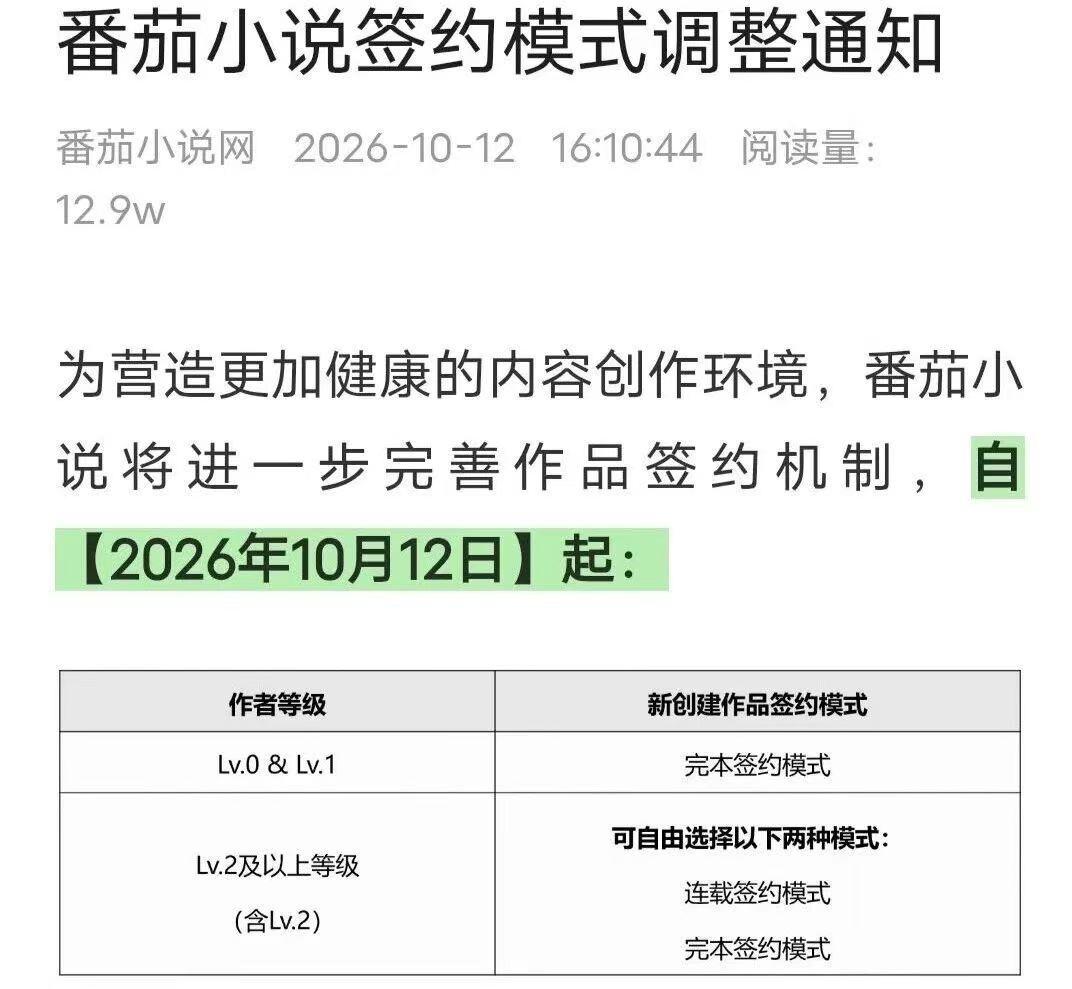
A few days ago, Tomato Novel released a platform announcement, whose core content is only one sentence: Notice on the adjustment of the signing mode: For works newly created by Lv.0 and Lv.1 authors from now on, only "full-work completion signing" is available; works created before this announcement will not be affected. According to the rules of full-work completion signing, authors need to finish writing the entire book first, reaching 150,000 or 300,000 words according to the main category of the work, before they can apply for signing.
This means that authors affected by the new regulation have to bear the creative investment of the whole book first. Works under the full-work completion signing rule will not be displayed to readers on the platform before signing, and there will be no royalty income for this book. Previously, authors could observe readers' feedback while writing during serialization, but now this trial-and-error process has to be completed by authors themselves.
Discontent from authors has also followed: Writing has already taken up a lot of their time, but whether the work can be signed and get recommended can only be known at the very end.
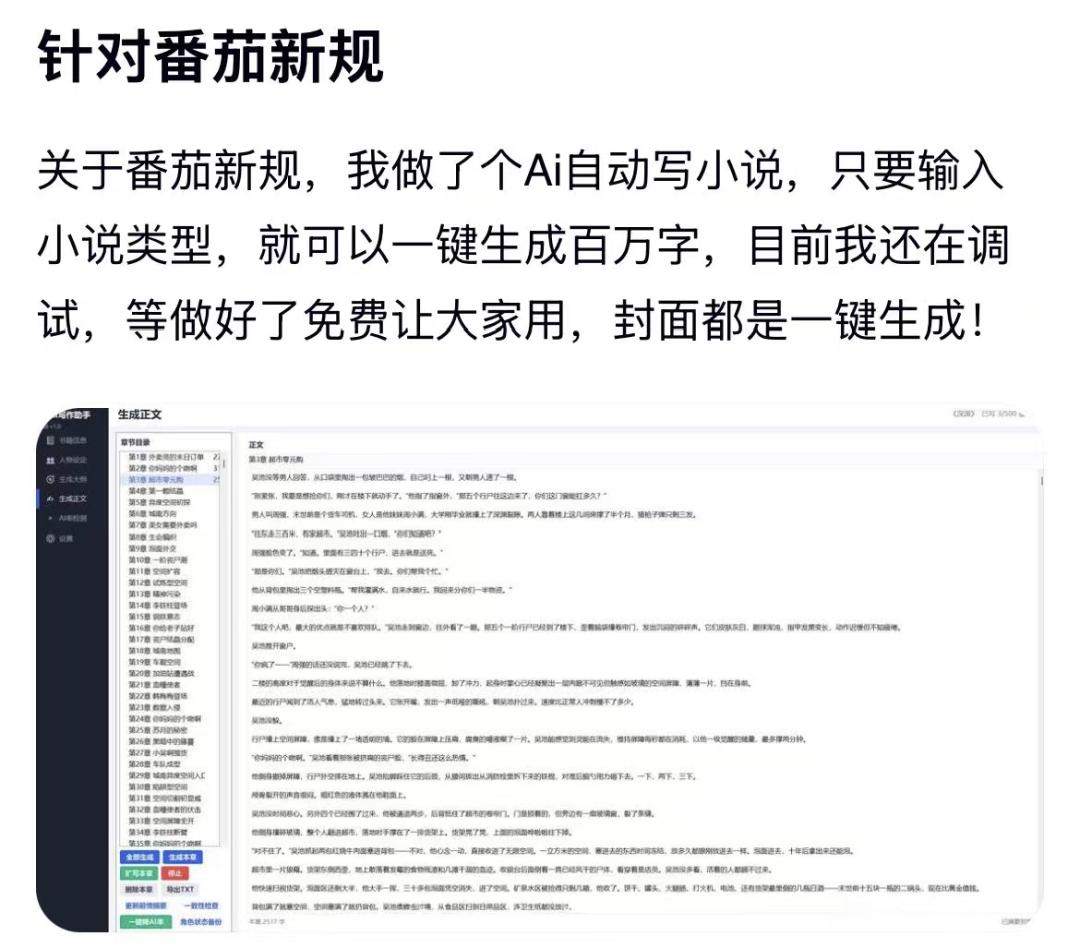
However, things quickly became weird. Some authors directly open-sourced their AI novel tools online: as long as you input the novel genre, you can generate millions of words with one click, which perfectly fits the new regulation of Tomato Novel. Other authors began to promote a new idea of "paying to work": tip 4500 yuan to your Tomato account, which can just raise it to LV.2 and quickly unlock the serialization permission...
Another countermeasure also emerged soon. A tool developer posted that he is debugging an AI tool that can generate millions of words by inputting the novel genre, and it will be provided for free after completion. This post at least reveals one problem of the new regulation: writing enough words means completely different input for batch generation tools and human authors.
I used AI to arbitrage on Tomato Novel
Tomato is probably the first platform on the entire network that has had its table overturned by AI. The trouble it faces is that AI has reduced the cost of mass-producing texts, but the platform still has to select readable stories from a huge number of submissions.
Back in 2024, Tomato's attitude towards AI was "taking the lead in supporting it". The launch of the AI-assisted writing function followed a very simple logic: let machines help authors produce more content, so that the platform can earn more advertising fees. As a result, AI spread rapidly like a virus, and even reached the point of crowding out human writers. At the initial stage, Tomato had already launched the internal test of the AI-assisted writing function, allowing machines to assist authors in conceiving plots and continuing writing. The platform hoped to improve creation efficiency, but the same tools could also be used to generate a large number of low-quality novels with repetitive plots and contradictory narratives.
In March last year, the number of new books for first review on Tomato in a single day jumped directly from about 400 a year earlier to 5606, a year-on-year increase of 1302%. By 2026, the number of new books stored in the library every day has remained stable at more than 5000, and the platform itself admitted that "almost all of them are generated by AI in batches". The "all-nighters" pulled by human authors are like hand looms encountering assembly lines in front of codes. By April 2025, Tomato had put forward in the signing process announcement that it would strengthen the review of low-quality content that uses AI to generate large sections of text, follows formulaic plots and has chaotic narratives, and take measures such as refusing to sign and removing such works from shelves.
The results produced by AI authors are far more than just "writing fast". A blogger finished a 200,000-word novel with AI in two days, uploaded it directly to Tomato, passed the 50,000-word signing and 80,000-word assessment all the way, and finally finished the whole book. The whole process was "only responsible for publishing, no need to type, no need to pad content, no need to use your brain". On Bilibili, someone dug up a Tomato author named @Su Yuansheng, who used AI to generate Tomato novels in batches, published 1500 works, and made a lot of money from Tomato's traffic. The tool side is even more surreal: some platforms claim to generate 5 million-word novels in 48 hours, with more than 6000 authors doing daily "creation" on it; there is also an AI long-form writing system specially designed for Tomato on GitHub, with clear selling points written: "signable, monetizable". More hidden arbitrage happens after signing. In a report by *Economic Observer*, a Tomato editor described that some authors write the setting and opening chapters by themselves, get the work signed and obtain recommendation resources, then hand over the subsequent content to AI, and start the next book.
Tomato wanted to use AI to lower the creation threshold, and the threshold did drop, far below the floor. What flooded in were not authors, but rampant AI. This practice takes advantage of the time difference of serialization review: the opening chapters are responsible for getting recommendations, but the subsequent content may have been written in a completely different way. Readers are following the same book, but the quality the platform sees at the time of signing may not be maintained until the end.
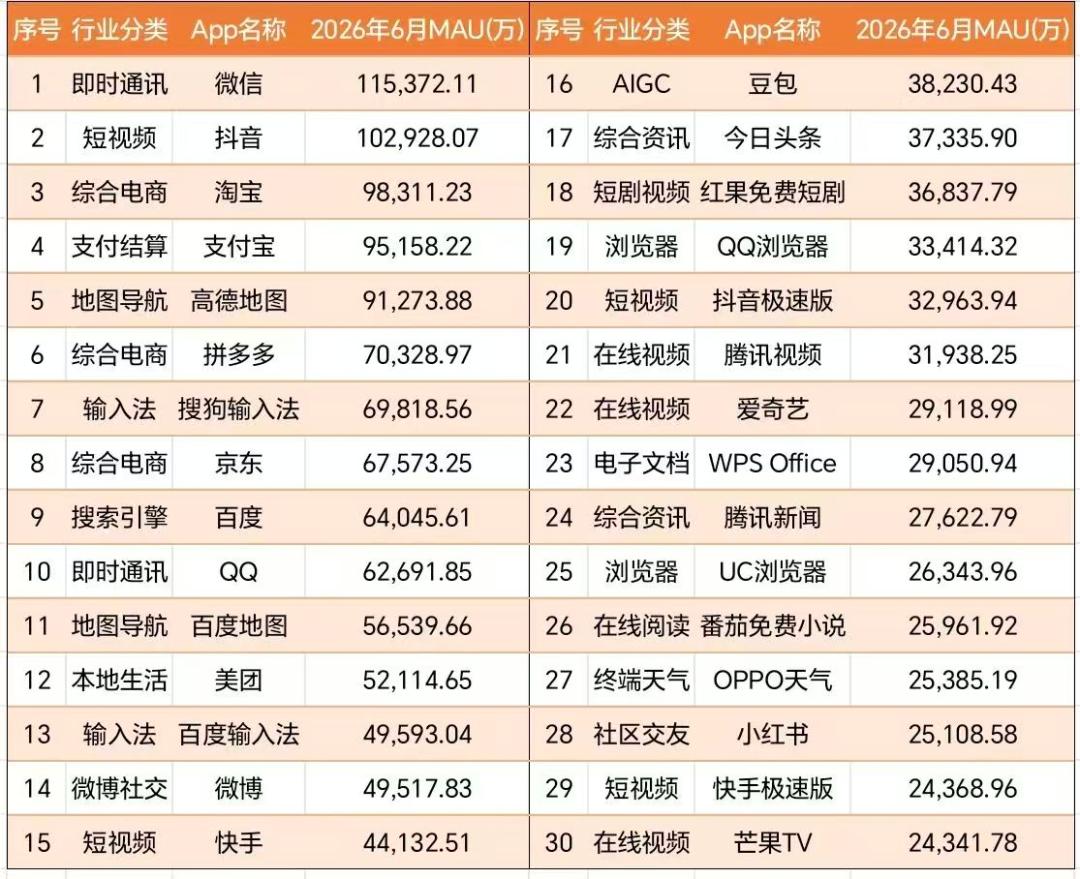
The supply side is exploding at high speed, but the traffic side is growing with difficulty. According to QuestMobile data, as of February 2026, Tomato's monthly active users are about 260 million, with a year-on-year growth of only 1.3%. The number of readers has barely increased, but books are pouring in at a tenfold rate. The only possible result is too many monks and too little porridge. The 36Kr report put it very bluntly: The influx of AI has led to "inflation" in the content ecosystem, and authors' revenue continues to "depreciate", with the money distributed to authors for each effective reading decreasing continuously. By February 2026, Tomato Novel had about 260 million monthly active users. The user base is very large, but authors still have to compete for recommendation slots and readers' time. For those who serialize their works carefully, the large number of new books has increased competition; for the platform, it is becoming more and more difficult to identify low-quality content.
Tomato has not tried to struggle. In November 2025, the platform changed the rule to allow only 1 new long-form work to be created per day for a single account, with a maximum of 3 per month, which is obviously aimed at studios that create accounts in batches; in February 2026, 855 violating accounts were disposed of, and the review was continuously tightened in May. The governance announcement in May 2026 revealed that the platform had rejected 112,700 low-quality books, and continued to reject more in June.
But the speed of rejecting signatures cannot keep up with the speed of AI generation. A Tomato HR admitted to the media that the number of works uploaded every day is too large for editors to identify with naked eyes, so AI is mainly used to review whether the works are generated by AI. Can Tomato's AI beat the authors' AI? The industry is not optimistic that the review itself has to rely on machines. The above report quoted an HR who was once responsible for Tomato's recruitment as saying that the number of submissions is too large, and AI is mainly used to judge the quality of works and whether they are generated by AI. The platform's response listed three means: technical monitoring, manual review and reader reporting.
We believe that the real root cause of Tomato's problems is not AI, but the "emotionless" relationship between Tomato and its authors. The AI training clauses are stuffed into the agreement, the rules are changed arbitrarily, the unit price of revenue keeps falling, the review is handed over to machines, and the signing threshold is raised to an extremely high level - the platform treats authors as a parameter in the traffic pool, so naturally authors will not take the platform as their home. Authors need to know why their works are rejected and whether there is still a chance after modification; the platform needs to prevent the situation where the opening chapters written by humans pass the review, but the subsequent content is replaced by batch-generated content. What the two sides are arguing about is whether the review can find these problems and give specific reasons.
You talk to me about the ecosystem and long-termism, but I only talk to you about how much I can arbitrage from this book. So on Tomato, as long as you can make money, there are no restrictions on any wild methods, including batch opening of books with AI, publishing 1500 works by one person, and using open-source tools to generate millions of words with one click. Tomato uses algorithms to govern authors, and authors use AI to govern Tomato. Neither side talks about emotions, only about cashing out.
If an author can get recommendations by constantly publishing new books and get returns more easily than maintaining the quality of a single book, he will be motivated to continue to study the rules. No matter how high the platform raises the threshold, those who abide by the rules will also have to bear the new costs together.
This is a two-way consumption without emotion. In this game, there are no creators, only two systems arbitraging each other. Full-work completion review allows the platform to see the entire book, reducing the space for the situation where "the opening passes the review but the subsequent content gets out of control". However, low-level authors also lose the choice of writing part of the work first and then continuing to invest after getting signed.
The "leader's dilemma" of Tomato Novel
The pervasive AI is not just a loophole in the rules, but also the result of Tomato, as the "number one player", failing to build a real moat. Tomato already has a huge scale of readers. What needs to be solved next is how to retain high-quality works and authors who are willing to write for a long time.
From a data perspective, Tomato has long won the crown of the number one novel platform. In 2026, it has about 120 million daily active users and 260 million monthly active users, accounting for more than 80% of the free reading market; Qidian's entire platform has 134 million monthly active users, and paying users have dropped from 9.2 million to 8.2 million. At the digital level, this is not competition, but absolute crushing.
In June 2026, Tomato Free Novel had about 260 million monthly active users. On the other hand, the average monthly paying users of China Literature's own platforms and Tencent's self-operated channels in the first half of 2026 dropped from 9.2 million in the same period of the previous year to 8.2 million. Both free and paid platforms are competing for readers, but the income arrangements for authors are differentiated.
But after becoming the number one, Tomato did not know where to go instead.
In June 2026, Tomato launched the "Revelation Plan", selecting 1 to 2 books from millions of authors every quarter, and pouring all the platform's traffic into them, aiming to replicate blockbusters of the level of *Slash God* and *Eternal Night at Ten Days*. *Time Stop at the Start* was pushed from 1 million readers to more than 3 million, but after the recommendation resources were withdrawn, its popularity fell back to the original level; *Maiden of Langya* was forcibly pushed to 2.2 million readers, but the number of people urging updates was only 12,000. When new books cannot be boosted, the platform turned to forcefully promote the already completed *Ghost Dormitory*, which gained more than 2.4 million fans in three days and pushed it to the top of the popularity list. A platform with 120 million daily active users, in the end, the only strong card it can play in its "god-making" effort is an old completed book.
Inviting top writers to join did not solve the problem either. Tian Can Tu Dou signed with Tomato, and his work *The Supernatural Being* had more than 1 million readers within three days of its launch, peaking at more than 10 million, ranking first in the hot search list by a huge margin. Then the data plummeted to more than 2 million, and the net royalty in the first month was less than 100,000 yuan. Wang Yu's *Star Road and Immortal Trace* has long hovered between 90,000 and 180,000 readers on Tomato, and it needs Tian Can Tu Dou's "favor recommendation" in the live broadcast to briefly double to 360,000. The writer who created *Legend of the Cultivation God* cannot even get natural traffic on the free platform.
The answer sheet of IP adaptation is also unsatisfactory. The top IP *Eternal Night at Ten Days* was adapted into a low-quality short drama, which caused widespread dissatisfaction among original fans; most of the short dramas cooperated with Douyin are sweet pet and counterattack themes, with good revenue sharing figures but low scores on Douban for a long time. Tomato has a copyright library of 1.5 million works, but it cannot come up with a single adapted work that can prove its strength.
This is the "number one dilemma": Tomato has won all the traffic it can win, but it has never been able to prove that it can produce content that people "have to come to Tomato for".
In fact, this is not a problem unique to Tomato. In the commercial field, there is a term called "latecomer advantage". Latecomers can grow at a high speed by imitating the business model of the industry leader and superimposing the advantages of their own new business forms. However, when the latecomer becomes the number one, it is easy to fall into a "confusion period", lose its goals, and make more mistakes the more actions it takes.
Qidian, which is often compared with Tomato, has entered a "lying flat" period. As many comments say, online novels have long passed the dividend period, Qidian's monthly active users are shrinking, paying users are leaving, and the ceiling is clearly visible. However, the willingness of Qidian's paying users to pay is still rising, *Xuanjian Immortal Clan* can firmly occupy the first place in the monthly ticket list for two consecutive months; new books have 36,000 first orders within 8 hours of launch, and works with more than 10,000 orders keep emerging. Its god-making machine has not stopped, but the gods it creates are no longer well-known outside the circle. However, Tomato's god-making machine has not even learned how to create a real god that belongs to itself.
Fundamentally, the "primacy" of the two platforms is different. Qidian is an IP-oriented platform, where readers pay for authors; Tomato is a traffic-oriented platform, which makes money from advertisers' placements. Therefore, readers and authors are not very important to Tomato. An author told us that editors who communicate with authors and readers all year round on Tomato do not have high permissions, while operations staff who care about traffic and revenue have much higher permissions. This time, modifying the author submission rule is also one of the many "confusing" operations of the operation team in recent years.
The fundamental conflict between traffic logic and creation logic lies here: Tomato treats readers as DAU and authors as production capacity. This relationship is very self-consistent in the advertising model, but it is inherently insufficient when it comes to "high-quality content".
Tomato Novel has no dream
From a data perspective, with 260 million monthly active users and 120 million daily active users, Tomato Novel is a national-level App that can easily stand out as an independent company. But in ByteDance's business map, its position can be summed up in one sentence: the test field for IP, the upper reaches of traffic, and the raw material workshop for Hongguo Short Drama.
Tomato is not unprofitable. According to industry data cited by Tech Planet, Tomato Novel's revenue in 2025 exceeded 45 billion yuan, Hongguo Short Drama's revenue exceeded 15 billion yuan, and the total scale of the Tomato ecosystem is approaching 60 billion yuan. Judging from the numbers alone