Institutions forecast that Beijing's office market will stabilize in 2028.
At present, Beijing's office market is undergoing a decade-long in-depth adjustment, fully entering a period of systematic reconstruction marked by "re-pricing". According to data from the *2026 Beijing Office Market White Paper* released by JLL, as of the third quarter of 2026, the city-wide vacancy rate remains at around 17%, ranking the lowest among all first-tier cities in China. Meanwhile, rents continue to decline. By the end of the third quarter, the average rent of Grade A offices across the city dropped to RMB 198 per square meter per month, with a cumulative decrease of nearly 50% in 8 years from the historical peak at the end of 2018. Among them, the average annual year-on-year decline in rents in 2024 and 2025 exceeded 16%, reflecting the continuous downward shift of the market's psychological baseline.
Data source: JLL Research Department
JLL believes that this deep rent correction is not a short-term fluctuation, but a rational return that conforms to the macroeconomic transformation and industrial structure upgrading, which is essentially the "re-pricing" of office assets. What supports the "re-pricing" trend is the structural change in the supply-demand relationship. Beijing's Grade A office market is welcoming its third supply peak after 2008 and 2019. From 2026 to 2030, it is estimated that more than 1 million square meters of new high-quality office space will be added, concentrated in the core area of CBD and Wangjing, which will directly divert and compete for the renewal and investment attraction of existing stock projects.
This round of supply expansion is further reshaping the balance between supply and demand. The cyclical dividend of extensive growth relying on location and hardware advantages has faded, and the market has stepped into the deep water zone of game in a structural "tenant's market". The market is being reconstructed from five dimensions: reconstruction of pricing logic, the rent anchor point shifts downward, and the market seeks a new equilibrium; reconstruction of supply-demand relationship, new supply superimposed with enterprises' increasingly rational demand, the tenant-dominated pattern is strengthened; reconstruction of decision-making logic, enterprises' site selection is no longer limited to location and rent, but turns to comprehensive evaluation of space efficiency, operation efficiency and full life cycle cost; reconstruction of demand pattern, overall demand remains prudent, but artificial intelligence, high-end and high-tech industries release structural opportunities; reconstruction of competition flow, project competition extends from comparison in the same area and of the same grade to cross-region, cross-category and cross-grade games.
With the deepening of adjustment, the downward pace of rents in Beijing's office market has stabilized significantly, and the micro market cycle has shifted from rapid decline to a slowdown bottom-finding stage. It is expected that the overall market rent decline will narrow to 6-7% in 2026, and gradually stabilize and hit the bottom by the end of 2028.
Data source: JLL Research Department
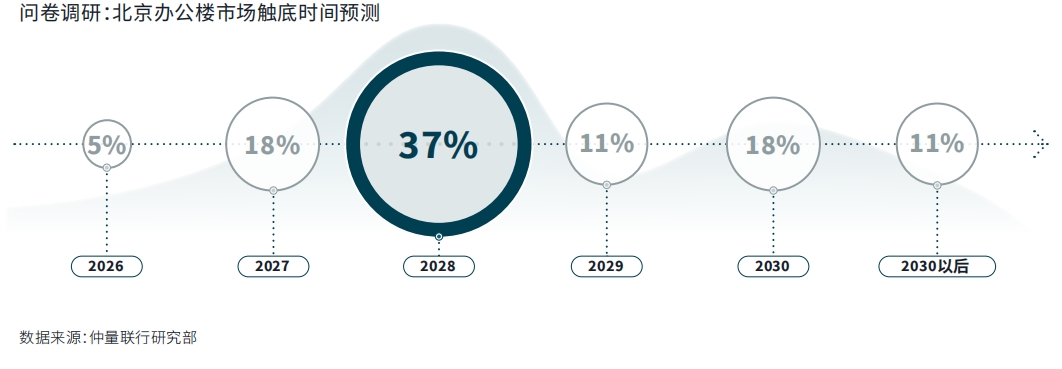
In the process of the overall market bottom-finding, there is a significant cycle "time difference" between the eastern and western office markets in Beijing. In 2026, the western market has taken the lead in bottoming out and stabilizing, and more than half of Grade A assets recorded flat or positive rent growth in the first three quarters. Some projects with core locations or superior quality are almost fully occupied, driving a substantial increase in rental quotations.
Take Zhongguancun as an example, the cumulative rent decline from 2019 to 2022 is only about RMB 5 per square meter per month, and most projects have little willingness to cut rents. In the third quarter of 2026, the rent growth rate of Grade A offices in this region turned positive from negative, with an average month-on-month increase of 2.4%. At present, the vacancy rate of mainstream projects in the core area of Zhongguancun remains below 10%, and some are even almost fully occupied. High-quality enterprises frequently expand continuously in the buildings or surrounding projects, and the vacant space is often quickly absorbed once released.
In contrast, affected by the dual impact of new supply entering the market and prudent demand, the overall rent in the eastern region is still in the channel of in-depth adjustment. The eastern core business districts are generally facing great pressure of de-stocking and vacancy. In the past period of time, the rent game between owners has become increasingly fierce, but this also provides a rare window for enterprises to optimize costs and upgrade. At present, tenants in the eastern market have unprecedented requirements for space efficiency. Super Grade A assets are continuously absorbing upgrading demand from surrounding buildings, helping enterprises realize the simultaneous advancement of cost management and office space.
Data source: JLL Research Department
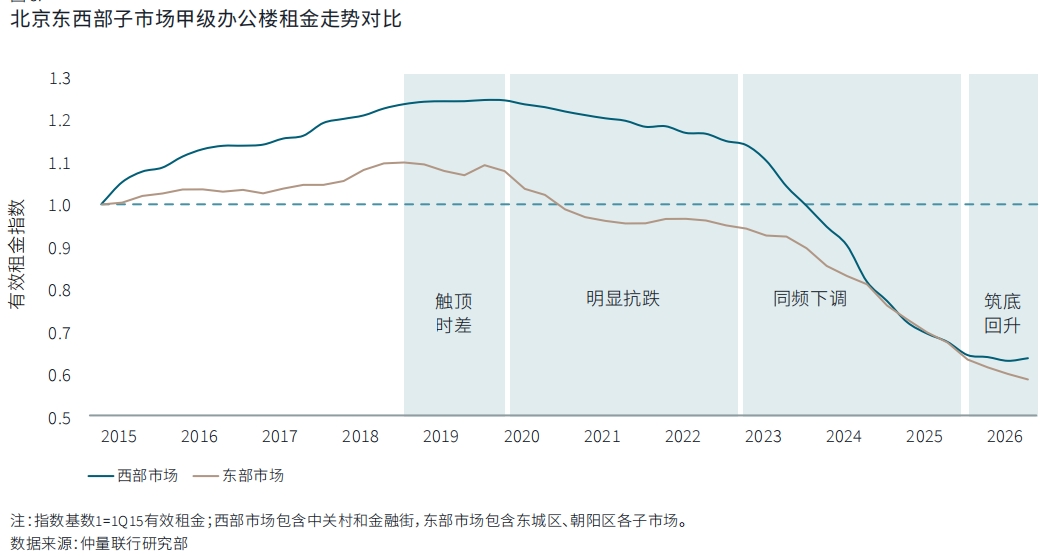
The white paper survey shows that 37% of surveyed enterprise tenants predict that the market will hit the bottom in 2028, and owners' expectations are also concentrated in this time window. 2028 is regarded as a key node for Beijing's office market to substantially bottom out and stabilize. Regional expectation differences are obvious: enterprises in the western market have stronger confidence in taking the lead in stabilizing in 2026-2027; most tenants in the eastern market anchor the bottoming time in 2028 and beyond. Although nearly 40% of tenants judge that there is still 5% to 10% downward space for rents, the market's expectation of a sharp drop in rents has narrowed significantly.
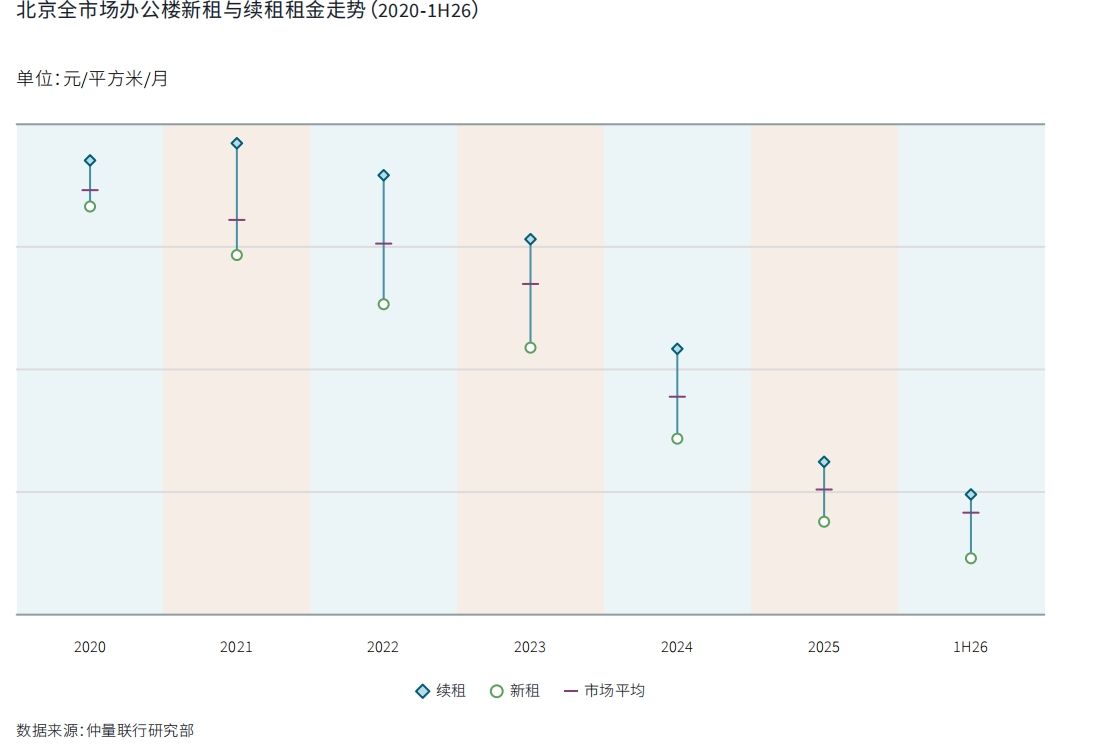
According to other statistics, in recent years, the rent gap between new leases and renewal leases in Beijing's office market has continued to narrow. After 2019, new lease rents peaked and fell first, and renewal rents also entered a downward channel after a period of high-level operation. By 2025-2026, the average rent gap between the two has been greatly reduced from RMB 60-80 at the peak to RMB 20-30. This process has weakened the economic driving force of relocation, and the profit space for tenants to achieve significant rent savings through relocation has been greatly squeezed. When the rent gap between new leases and renewal leases narrows to the current range, the book rent savings brought by relocation are often difficult to cover the friction costs of relocation itself, including large one-time expenses such as restoration costs, decoration costs and complicated hidden costs. Therefore, tenants' motivation to stay in the original location is significantly enhanced, and the market fluctuation caused by comfortable relocation will gradually tend to be stable.
Ji Ming, Senior Director of JLL North China Research Department, said that the positive signal of the current market is that the expectations of both supply and demand sides are gradually becoming rational. High-quality tenants no longer simply wait for the so-called "absolute bottom" of the market, but take the initiative to lock in office space in combination with their business plans for the next three years; the core goal of owners has shifted to increasing occupancy rate and optimizing tenant structure. The consensus of expectations is supporting the market to stabilize at the bottom smoothly, and Beijing's office market is moving from in-depth adjustment to a new equilibrium.