In 2027, Chinese manufacturers only won half of the Dutch residential energy storage market.
On September 23, Sungrow announced that its latest all-in-one residential energy storage system, PowerHarbor, has been officially launched for sale in Europe, with the Netherlands selected as its first stop.
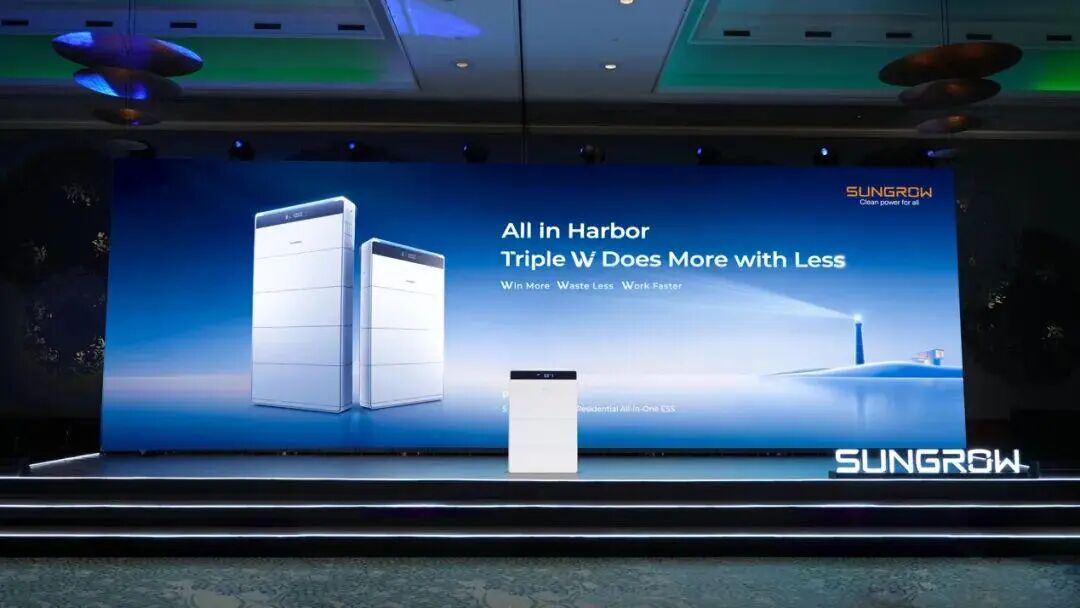
Product image of PowerHarbor. Image source: Sungrow
Why the Netherlands, instead of familiar major residential storage markets like Germany?
Because in just over two months, Dutch households will "have no choice but to buy home batteries".
Around 3 million households in the Netherlands have installed solar panels on their rooftops. For more than two decades, they have been enjoying a favorable policy:
Excess electricity generated during the day is fed into the grid; when there is a shortage of power at night, they draw electricity back from the grid. They can store as much as they take out, with almost no handling fees charged. The grid acts like a free power bank.
On January 1, 2027, this free power bank will be taken away.
Going forward, for each kilowatt-hour of electricity fed into the grid during the day, the law only guarantees a return of just over 40 euro cents; but buying one kilowatt-hour of electricity at night costs around 1.9 euros. After deducting various fees charged by power companies, the electricity fed to the grid by many households is almost given away for free.
The most cost-effective solution is to install a residential storage battery at home: store the excess electricity during the day for self-use at night.
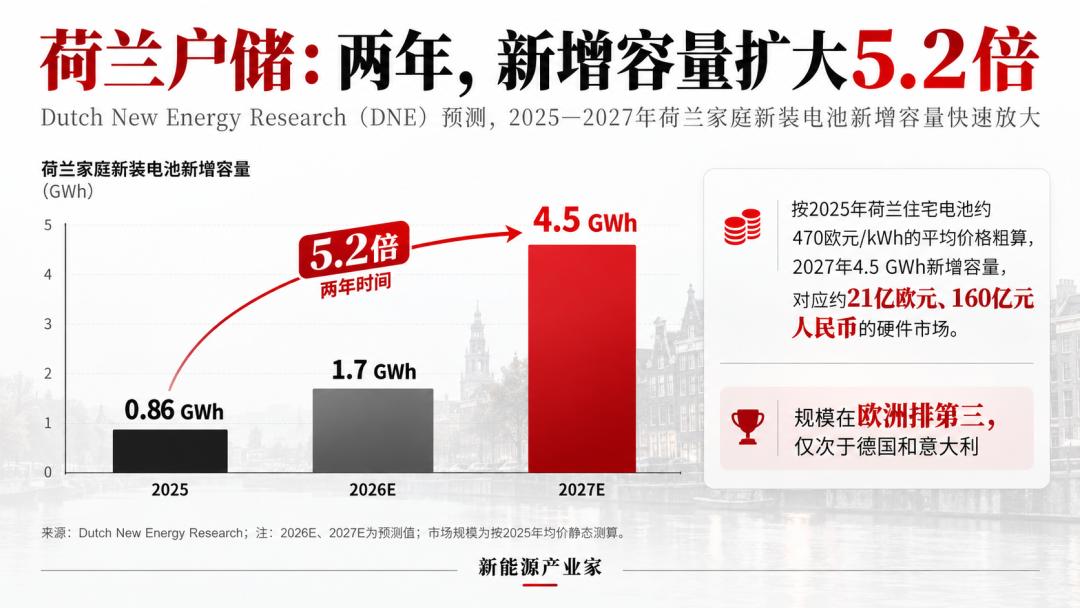
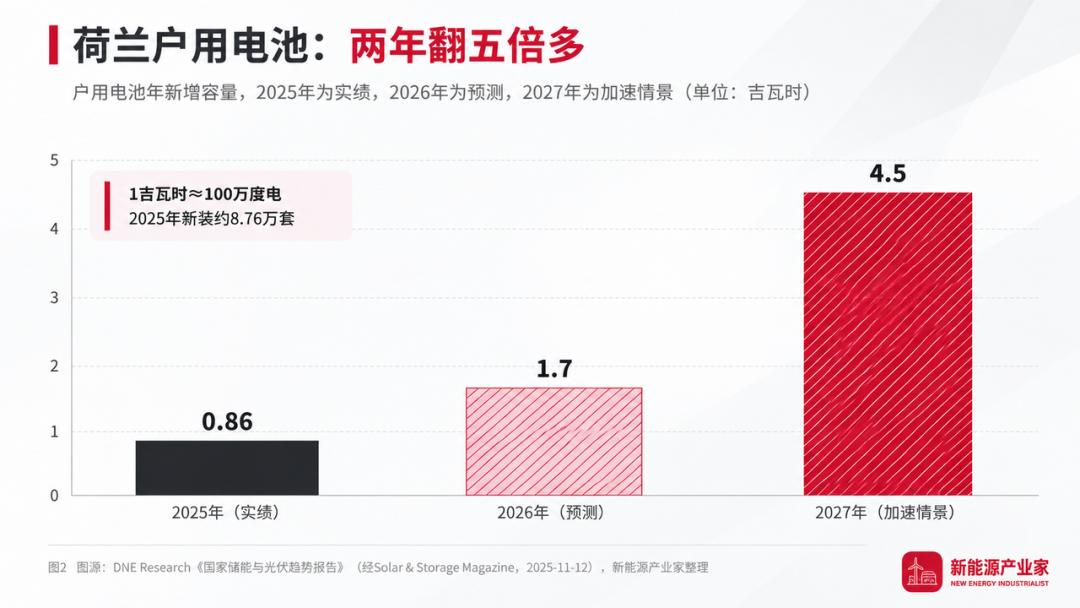
Therefore, Dutch research institute Dutch New Energy Research forecasts that the new installed capacity of residential energy storage in the country will skyrocket from 0.86 GWh in 2025 to 4.5 GWh in 2027.
A 5.2-fold increase in just two years.
By that time, based on the average price of around 470 euros/kWh for residential batteries in the Netherlands in 2025, the 4.5 GWh of new capacity in 2027 corresponds to a hardware market of approximately 2.1 billion euros, or 160 billion RMB. This scale ranks third in Europe, only smaller than that of Germany and Italy.
Chinese manufacturers have already taken the lead in this business. According to information from New Energy Industrialist, the two best-selling residential storage brands in the Netherlands at present, Votai and Sungrow Power Supply's residential storage brand Sinexcel, are both from China. Now, Sungrow is also entering the market.
But when these Chinese-made batteries are actually installed in the basements of Dutch households, a deeper business reality emerges: the delivery of hardware is only the beginning.
When to charge the battery, when to discharge it, and who to sell the excess electricity to at a high price — these issues that determine profit margins are not decided by Chinese manufacturers.
The right to set these rules is held by local Dutch power companies.
For example, an enterprise called Frank Energie does not manufacture a single battery itself, but it remotely manages more than 14,000 household batteries made by other manufacturers on the cloud every day. This is a bit like Didi: it does not manufacture a single car, but decides where the car goes and how much to charge for each order.
Selling batteries is certainly profitable, but it is a highly competitive one-off transaction; those who hold the scheduling rights earn a steady stream of "toll fees" over time.
In the feast of European energy transition, Chinese manufacturers, with their exceptional manufacturing capabilities, have won the first half of the "hardware selling" game.
But the truly lucrative, compound-return second half of the energy storage business, as well as the other half of the large profits, are still firmly in the hands of those who send electricity bills to Dutch households every month.
01 In 2027, why do people have to buy batteries
By the end of 2024, around 3 million households in the Netherlands had installed photovoltaic systems. For more than two decades, almost none of these households needed batteries.
The reason is a policy implemented in 2004 called net metering.
Excess electricity generated during the day is fed into the grid, which can be offset 1:1 when the household uses electricity. The grid is equivalent to a free power bank, where users can store as much as they take out without paying any handling fees.
This "power bank" can no longer sustain the operation. There are too many photovoltaic systems installed, and at noon in summer, there is so much excess electricity that there is nowhere to send it.
In June 2025, the Dutch wholesale electricity price dropped below zero for 127 hours, which means that power generators had to pay others to take their electricity, and still could not sell it.
But power companies still have to record accounts for photovoltaic users at a retail price of more than 1 euro per kWh. Part of this loss-making business is ultimately passed on to neighbors who have not installed photovoltaic systems.
Before the legislation was finalized, power companies took action first. Since the end of 2023, they have successively charged a "feed-in feedback fee" to photovoltaic users: the more electricity users send to the grid, the more fees they have to pay.
According to a three-year fixed contract from a large power company in December 2025, if a household sends 2400 kWh of electricity to the grid every year, it has to pay more than 400 euros in feedback fees alone, equivalent to more than 3000 RMB.
Users even have to pay extra to send electricity to the grid, and Dutch photovoltaic users have experienced the cost of doing good deeds in advance.
The government also wants to reform the policy, but the process has been full of twists and turns.
The gradual phase-out plan was rejected by the upper house of parliament in February 2024. Only ten months later, the upper house passed a new plan: completely cancel the net metering policy on January 1, 2027, and the electricity fed back to the grid before 2030 will be settled at no less than half of the tax-exempt electricity price.
But for battery sellers, the gradual phase-out and the one-size-fits-all cancellation bring two completely different market rhythms.
In Germany, the proportion of new photovoltaic systems equipped with batteries has exceeded 90%, and this ratio has risen step by step over about ten years. Ted Tan, head of large-scale energy storage business development at Votai, said that the Netherlands is "more like a switch, either on or off".
Once the switch is flipped, the value of one kWh of electricity is immediately divided into two different levels.
Zonneplan, a Dutch electricity retailer that started its business by selling photovoltaic systems, gave an example: for an electricity contract with a tax-included price of about 0.24 euros per kWh, the tax-exempt electricity price is about 0.11 euros.
From 2027, for each kWh of electricity fed into the grid, the legal minimum settlement price can only be half of the latter, about 0.055 euros, which is more than four times lower than the price of buying one kWh of electricity.
The actual situation is even more unfavorable.
Zonneplan conducted a price comparison in June 2026. After deducting the feedback fees, in the fixed contracts of large electricity retailers, the net income per kWh of electricity fed to the grid is mostly less than 1 euro cent.
Giving away almost all the electricity for free during the day and then buying it back at more than 20 euro cents per kWh at night, this kind of transaction cannot last for a single day in any market.
The value of batteries lies exactly in this price difference.
An average household can only directly use about 30% of the photovoltaic electricity it generates. After installing a battery, this proportion can be increased to 65% to 70%.
Demand has arrived ahead of schedule.
In the second quarter of 2026, about 21,400 new residential batteries were newly registered by grid companies, more than double the number in the same period of the previous year. Only about 40% of the stationary batteries will be registered, so the actual installed volume is much larger.
Now that the reasons for buying batteries are clear, Dutch households will next choose which brand of battery to purchase.
02 Why Chinese batteries sell the best
Roeland Nagel, co-founder of local Dutch residential storage brand Sessy, said that Chinese enterprises are pouring into the Dutch market in batches. When visiting industry exhibitions now, you can see dozens of brands one after another in the exhibition halls.
On the hardware side of the Dutch residential storage market, Chinese manufacturers have basically taken the dominant position.
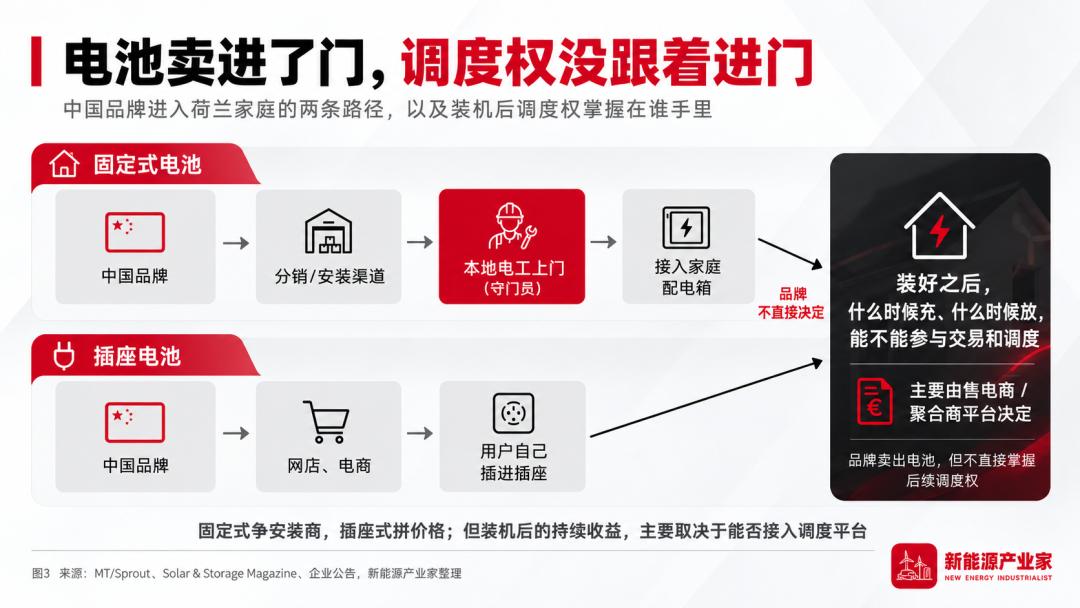
Before residential storage batteries can enter Dutch households, they have to pass the first threshold: electricians.
To connect the battery to the distribution box, users can only invite local electricians to their homes. Which brand the electrician is accustomed to installing largely determines which brand the user ends up buying.
Nick Vriend, a Dutch installer who has already installed Sungrow's new product, put it more directly at the launch event: the bottleneck of the Dutch residential storage market is the time of the installation technicians.
Therefore, Chinese manufacturers have put a lot of effort into serving electricians.
One of Votai's major strengths is after-sales service.
It set up its European branch in Frankfurt, Germany in 2015. Its service team based in Germany trains local teams in various countries, and promises to respond to consultations within 5 minutes and provide 24/7 all-day service.
When it opened its office in the Netherlands in September 2025, it cited data from research institute Mordor Intelligence, stating that it had captured 28.8% of the Dutch 5-20kWh residential storage market share in the first half of 2025.
According to news from New Energy Industrialist, Votai ranks first in the Dutch stationary residential storage market, and Sinexcel is very likely to rank second. The two together have captured about 40% of the market, and both are selling high-end products, not mainly relying on low prices to grab orders.
Sungrow has directly written faster installation speed into its product design.
For Sungrow's PowerHarbor, battery modules can be stacked and installed without external cables, and one module can be plugged in in about 10 seconds; the backup power unit can be clipped onto the standard distribution box guide rail and installed in about 20 seconds.
The faster a set of batteries is installed, the easier the installation process is to standardize. In the residential storage market, installation time itself is a selling point.
There is also a type of residential storage battery that does not require an electrician at all.
This product is called a Plug-in Home Battery. It comes with a plug, can be used by directly inserting it into a household socket, and the purchasing experience is similar to buying a home appliance online. It is also the fastest-growing segment in the Dutch residential storage market in 2026.
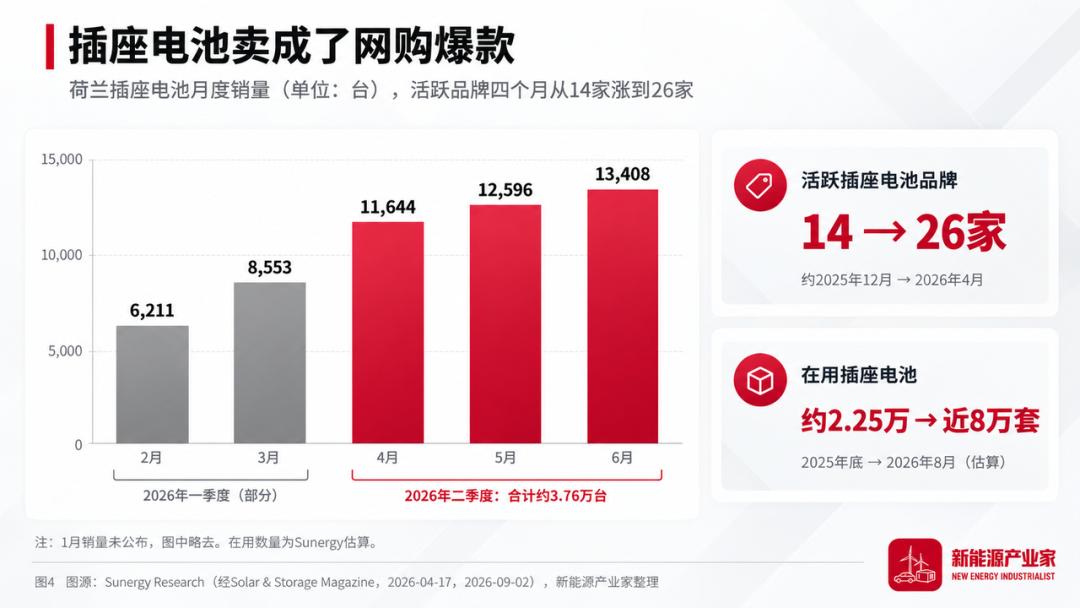
In the first quarter of 2026, nearly 20,000 plug-in batteries were sold in the Netherlands, and the number of active manufacturers rose from 14 to 26 in just four months. By the second quarter, the single-quarter sales volume doubled again.
With more players entering the market, the only remaining competition is price. Industry insiders call this market segment "kiloknallen", which means selling products by the kilogram at discounted prices.
By early September, the capacity of a large plug-in battery only sold for more than 240 euros per kWh, equivalent to about 2000 RMB; for stationary batteries that require an electrician to install, the same 1kWh of capacity usually costs 6000 to 8000 RMB.
The top-selling brands, Marstek, Anker and EcoFlow, are all from China.
Even the leading traditional residential storage brand can no longer sit still. In September 2026, Votai, which has installed more than 10,000 residential storage batteries in the Netherlands, launched its own plug-in battery.
No matter through the electrician channel or the plug-and-play channel, the money Chinese manufacturers earn from selling batteries is one-off. The moment the battery is installed in the wall, the transaction is completed. After installation, when to charge, when to discharge, and who to sell the electricity to are not decided by the brand.
These matters are determined by the power company that sends electricity bills to Dutch households every month.
03 How much can a battery earn in a year? Who gets the money?
Let's first do the math: how much money can a user earn in a year by installing a residential storage system in the Netherlands.
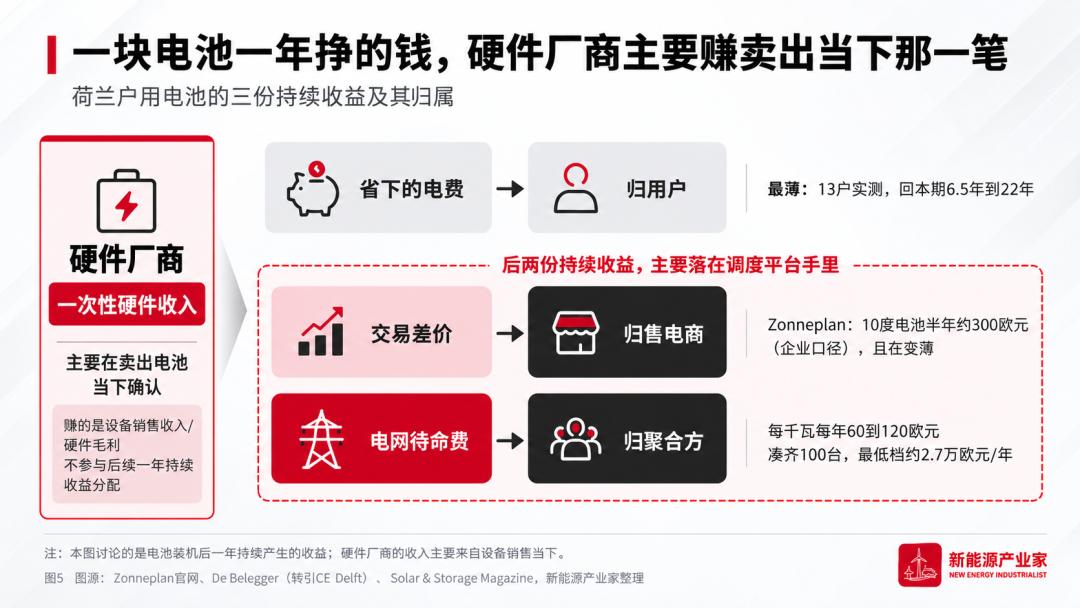
The easiest part to calculate is the electricity bill saved by using self-generated electricity.
The Dutch Homeowners Association commissioned research institute CE Delft to track the real electricity consumption data of 13 households for one year. For two sets of configurations that prioritize self-use, the payback period of residential storage systems ranges from <