Apple's major news triggers a pre-emptive rally in the A-share Apple industrial chain sector.
Apple made a major official announcement, and related concept sectors immediately saw a dramatic surge.
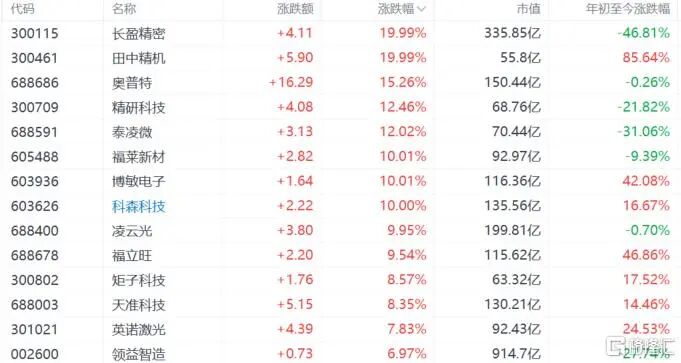
On Tuesday, the consumer electronics and Apple concept sectors staged a full-scale strong rebound.
As of press time, A-share companies Changying Precision and Tanaka Seiki hit the 20% daily limit, Fuli New Materials and Kesun Technology have recorded two consecutive daily limit gains, Bomin Electronics closed at the daily limit, Lingyi Zhizao rose by more than 7%, Lens Technology gained over 4%, while Foxconn Industrial Internet and Luxshare Precision increased by more than 2%.
Touchscreen MacBook Is Coming
The direct trigger for the market rally is Apple's major official announcement of its new product launch event.
The company confirmed that it will hold a keynote event themed "Pro and tell" in Los Angeles on October 28, Eastern Time.
The biggest highlight of this event is undoubtedly the expected official launch of Apple's first touchscreen MacBook.
In addition, the entry-level MacBook Pro equipped with the M6 chip, the new iMac and the OLED version of iPad mini may also make their debut together.
This round of rise is not purely driven by news catalysts.
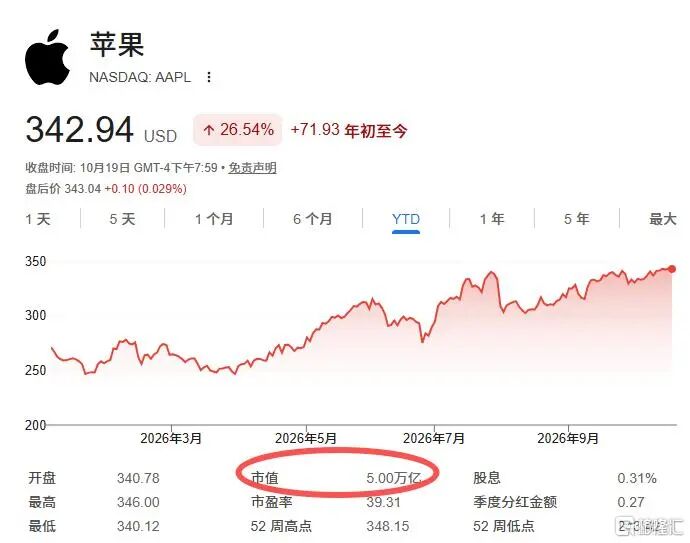
While the technology sector has been mired in widespread downturn, Apple has crossed the $5 trillion market cap threshold.
Last week, the US stock market benchmark pulled back, and AI giants including NVIDIA and Microsoft fell collectively, while Apple's stock price strengthened against the trend.
The company's total market value even broke through $5 trillion in one move, ranking firmly as the world's second most valuable enterprise right after NVIDIA.
More rarely, the 2-month rolling correlation between Apple and the Nasdaq 100 Index has turned negative for the first time, a situation that has never happened in the company's history.
This abnormal trend essentially reflects that capital is repositioning its allocation.
The market has started to diverge on capital-intensive computing power AI, and a large amount of capital has begun to shift to defensive hardware assets under the "light AI" track with solid cash flow and controllable investment.
And Apple has become the core target of this round of capital reallocation.
What also supports market confidence is Apple's successive new product cycles.
Since the beginning of this year, Apple's new products have been launched one after another.
It first launched its first foldable phone iPhone Duo, then released the HomeView smart home hub, and now it is ushering in a major innovation in the Mac product line.
After new CEO Tim Ternes took office in September, the update pace of Apple's hardware products has accelerated significantly.
At present, Apple is at a critical node of product structure transformation.
The upcoming touchscreen MacBook breaks Apple's past indifferent attitude towards touch-enabled notebooks.
This in itself is a signal that not only conforms to the PC interaction trend, but also further strengthens the Mac business.
At present, Mac has become the highest-performing hardware segment in Apple's AI strategy.
Not long ago, Apple also reached a cooperation with Meta to integrate large language models into high-end Mac Studio, and on-device AI is being rapidly implemented.
Is the Apple Supply Chain Ushering in Valuation Repair?
At present, Wall Street investment banks are bullish on Apple.
Morgan Stanley recently maintained its "overweight" rating on Apple with a target price of $355.
The bank pointed out that the demand for Apple's hit foldable phone iPhone Duo is extremely strong, with the global average delivery period reaching 14 weeks, setting the longest waiting period for a new Apple phone in nearly a decade, and orders have been scheduled until January 2027.
The super-long waiting time, on the one hand, proves that the replacement demand for foldable models far exceeds expectations, and on the other hand, reflects the severe shortage of initial production capacity.
Data shows that the assembly volume of iPhone Duo in the second half of this year is only 7 million units. Facing the 1.5 billion existing iPhone users, the supply gap is very obvious.
Moreover, there is no short-term production increase plan, and part of the production capacity schedule has been postponed from the third quarter to the fourth quarter.
In addition, a research report from JPMorgan Chase pointed out that Apple plans to spend heavily to secure TSMC's 1.4nm production capacity in advance, and the 2028 iPhone is expected to be the first batch of models equipped with A-series chips based on this process.
The bank believes that locking production capacity in advance is also regarded as a key measure for Apple to cope with AI computing power competition.
With Apple's new product cycle continuing to heat up, the entire Apple supply chain is directly driven to usher in valuation repair.
Links including foldable screens, notebook touchscreens, structural components and PCBs are seeing new demand, and A-share industrial chain companies are welcoming dual benefits from orders and market sentiment.
In the short term, the new product launch event will become the next important catalyst; in the medium and long term, the production capacity ramp-up of the iPhone foldable model and the shipment growth of the touchscreen Mac model will determine the sustainability of the consumer electronics sector's rally.
This article is from the WeChat official account "Gelonghui Finance Hotspot" (ID: glh_finance), written by Lin Chunmu, and authorized for release by 36Kr.