Revisiting Dyna Robotics: After 300 days of being schooled by real-world deployments, they found the Scaling Law for robots.
"The most boring robot in the world." That was the headline of a recent New York Post report, but the founders of the company in question consider it "the highest praise a robotics company can receive" — the company is named Dyna Robotics.

After seeing countless cool videos of robots dancing, boxing, and performing other flashy feats, Dyna does seem very "boring": its previously released Dyna-1 was designed primarily to fold towels and clothes. After the launch of Dyna-2, the new robot Taku enters the laundry room, silently puts dirty clothes into the washing machine, operates the device, takes the clothes out, sends them to the dryer, and finally retrieves, folds, and places them on the shelf.
Co-founder Jason Ma says: If a robot is actually put to real work, it is naturally supposed to be "boring". Behind this "boredom", real-world deployment is the "only metric for evaluation" for robots. In Jason's view, the reason why robots cannot be put into practical use is not that they lack legs or hands, but that the model and the entire system are not good enough.
To enable robots to work better, Dyna has also reselected its model path: shifting from VLA (Vision-Language-Action model) to WAM (World Action Model), expanding the pre-training data to 1 million hours of first-person human videos. They found that as the volume of human video data increases, the model's prediction of robot actions that it has never seen during pre-training also becomes increasingly accurate.
Do these explorations mean that robots are approaching their own "GPT moment"? In this episode of our video podcast, a year and a half after our last visit, we return to Dyna Robotics. We talk about the setbacks, lessons, reflections and optimizations that Dyna has experienced over the past two years from the perspectives of technology and deployment. We also hope to understand the ongoing changes and trends in embodied intelligence in Silicon Valley through Jason's sharing.
Below is our conversation with Jason.
Will Robots Have a GPT Moment?
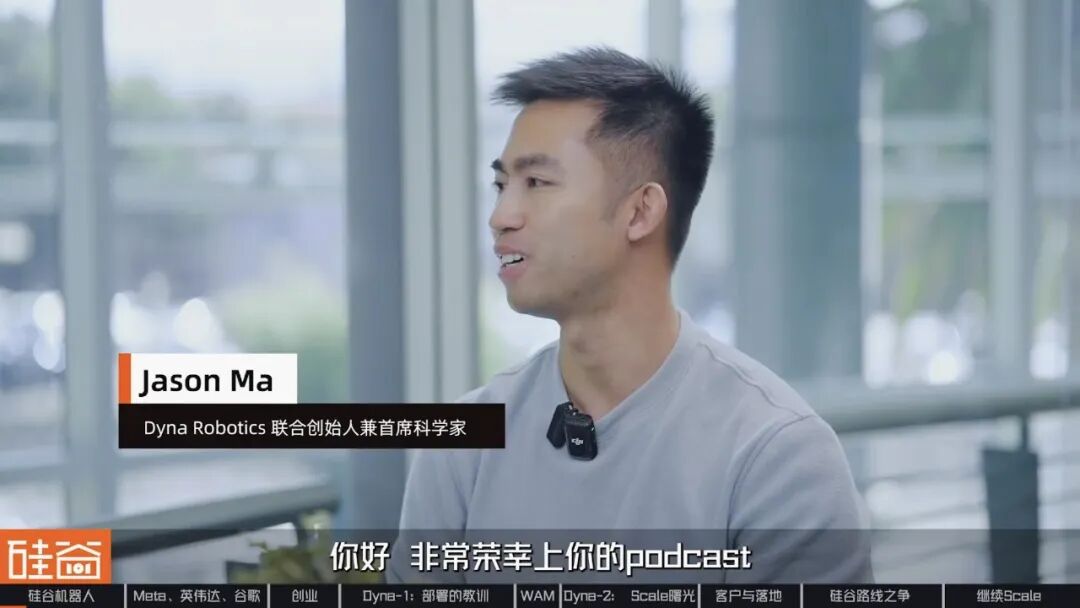
Chen Xi: Hello Jason, welcome to *Silicon Valley 101*.
Jason: Hello, it's a great honor to be on your podcast.
Chen Xi: For this interview, we also invited Junwu, who works in the robotics industry, to serve as a special co-host, hoping to conduct more in-depth discussions on some professional issues.
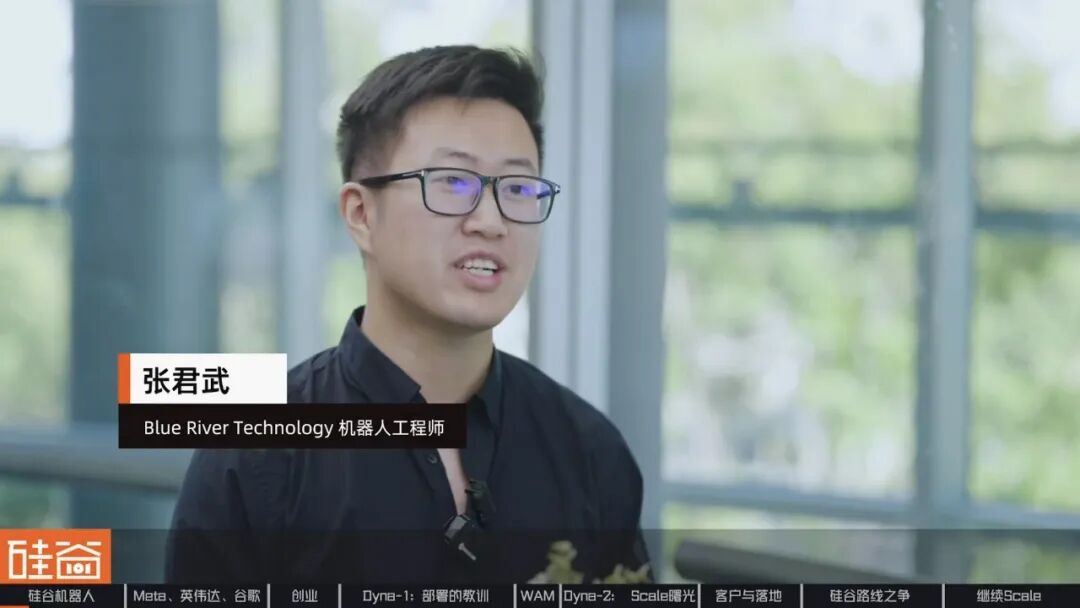
Zhang Junwu: Hello, I am currently working as a robotics engineer at Blue River Technology.
Chen Xi: Dyna has recently released a series of new products, and the robotics industry in Silicon Valley is also very active, with many companies launching new models and new demos. Do you think the robotics industry has reached a new milestone? Why are there so many concentrated releases recently?
Jason: I think to continue advancing the development of general-purpose robots, at least one or two more breakthroughs are still needed. Many companies are following roughly the same general direction: first, to expand the scale of data, and then to develop certain capabilities of the model. It is also possible that the summer vacation is a good time for releases, so everyone has launched their new products.
The entire robotics field is now gradually moving from demos to real commercial deployment, and our company has done a lot of work in this regard. So I think this is a very exciting time to be working on robotics.
Chen Xi: From your perspective, what stage is the robotics industry in now? If we compare it with LLM (Large Language Model), some people say that it is almost at the GPT-3 moment, is this comparison valid?
Jason: I think it is probably between GPT-2 and GPT-3. Purely from the perspective of data scale, the amount of data owned by robots is still smaller than that of the language model at the GPT-3 stage.
But robots are different from language models. You can have a very powerful robot model that completes specific scene tasks under instructions; a language model that cannot chat fluently with you actually has no practically usable capabilities. Therefore, in terms of product form, it may not be so important whether robots have a "GPT moment".
Zhang Junwu: There is also a saying now that the robotics industry may not necessarily have a "GPT moment", because the forms of robots and the specific tasks they handle are quite different. Do you think such a moment will come, or does it depend on the situation?
Jason: I think it depends on the situation. Before the era of embodied intelligence, we can look at autonomous driving. No one in the autonomous driving field has ever mentioned the concept of a "GPT moment". Waymo and Tesla were already able to make good demos more than 10 years ago, but the gap between the demo and the real deployment where you can hail a Waymo vehicle in San Francisco is still very large.
The process of iterating in the real world is relatively long. Although there are many better technologies now than in the early days of self-driving cars, this process still has to be experienced. It certainly cannot be like the language model: everyone already has mobile phones and computers, and as long as they can access the ChatGPT website, they can use this kind of intelligence. In the embodied field, how to make intelligence usable is a very difficult problem in itself.
Why Does Dyna Develop Both Models and Hardware Simultaneously?
Chen Xi: You just said that there have been advances in both data and models. Are these two advances the ones that have pushed robots one step further?
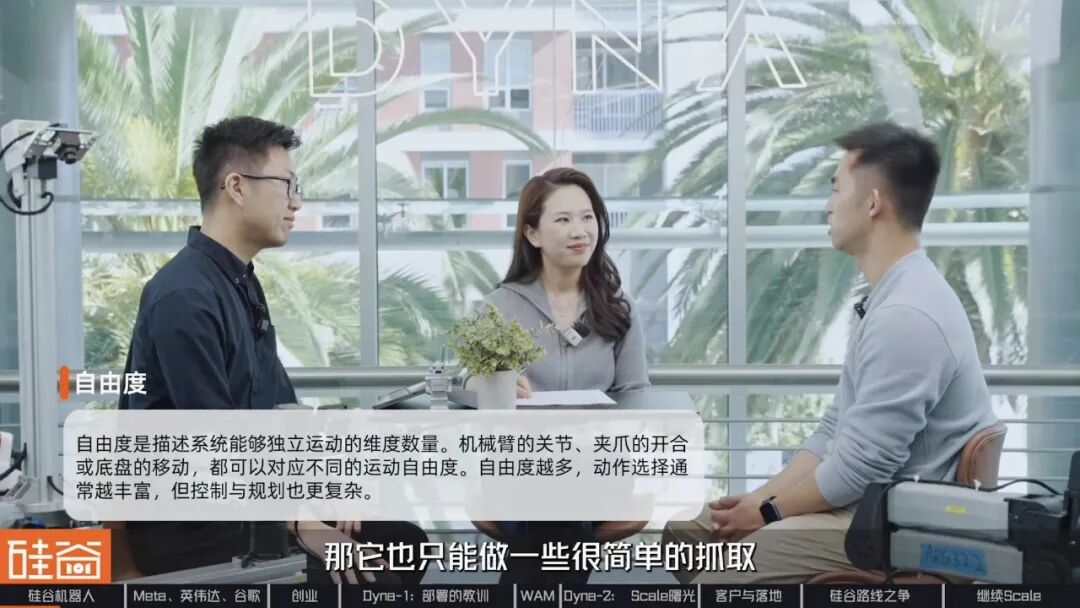
Jason: These two points are very important, but there is another particularly important thing, which is hardware. Without hardware, no matter how powerful the model is, you cannot feel its value. If the hardware is just a small robot with only 5 degrees of freedom, it can only do some very simple grasping tasks.
In the embodied field, models, data and hardware must progress together to finally create a product that different people and thousands of households can use.
Chen Xi: Does hardware mainly refer to the robot body, the supply chain, or motion control?
Jason: First of all, it refers to the robot body. The supply chain also plays a big role in expanding the scale of the robot body. There are many different robots now, but in the design process, we need to incorporate some concepts from machine learning and artificial intelligence, as well as the insights from model training and deployment, into the hardware iteration process. Finally, being able to form a closed loop is a huge barrier.
Chen Xi: Your co-founder York previously divided the industry into three factions: one is model-first, which only focuses on the "brain", such as Physical Intelligence, also known as π; the second is hardware-first, which only develops the robot body; the third is integrated integration, which does everything. Dyna belongs to the third category, developing both the brain and the body at the same time. Why did you choose this path?
Jason: Because when you finally deploy robot intelligence, what customers pay for is not just the model, the model is only part of the entire technology stack. When we talk to customers, they don't care at all whether we use VLA (Vision-Language-Action model) or a world model, and they don't even know what these are. What they ultimately care about is whether the robot can complete complex and diverse tasks in their own scenarios.
From this perspective, I think we must develop the brain and the body together to achieve the best results. From a technical point of view, it is also very difficult to separate the two and create a very general-purpose product. In the real world, physical intelligence can only achieve good results when the brain and the body are connected together. Just like humans, our brain is also adapted to our own body.
Chen Xi: I think Dyna is a very pragmatic company. From the demos and the design of the robot body, it can be seen that you are very restrained, not pursuing flashy demos or movements, but designing the roadmap from very specific commercial scenarios such as folding towels and clothes. Why is that?
Jason: From a purely academic point of view, there are so many things that can be done in the robotics field, and any topic can take several years to research. But I think robot learning technology has reached a stage where commercialization is possible, and now it is very necessary to start from the product, think about which problems must be solved, and which problems are not particularly important to solve right now.
This can help the entire team prioritize properly, ensuring that during the process of technology R&D and the company's growth in the past two years, we can make more correct technical judgments and choices at every node.
You can also feel from our past demos that all the capabilities we develop are what we think are truly necessary for real deployment, not just for shooting a flashy video. This field is very hot now, and many people may take a more demo-oriented approach, but I think that would put the cart before the horse.
We start from the ultimate goal of developing, producing, and deploying tens of thousands of robots, think about which technical problems must be solved starting from today, and use that to determine the technical roadmap of the entire team.
Zhang Junwu: I would like to follow up on the co-design of hardware and the experience you gained at the customer site. I have also worked on logistics and picking tasks before, and customers have very high requirements. Did you decide to develop your own hardware from the very beginning, or did you decide that you must make your own hardware after you had certain lessons at the customer site?
Jason: Both. Starting from first principles, to make a general-purpose robot, you must first think about where the data comes from and what data to use for training, and then guide the hardware design based on that.
We have now released Dyna-2, and we used a large amount of first-person human data for pre-training. If pre-training is to learn from humans, then during deployment, the more human-like the robot's form is, the better the transfer effect will be.
But when making a humanoid robot, you have to weigh whether to make legs and whether to make dexterous hands. We chose a very good trade-off point in the middle: semi-humanoid plus a chassis. This form can be deployed starting from today, and can also get great benefits from training with human data. This is our idea of designing hardware starting from first principles.
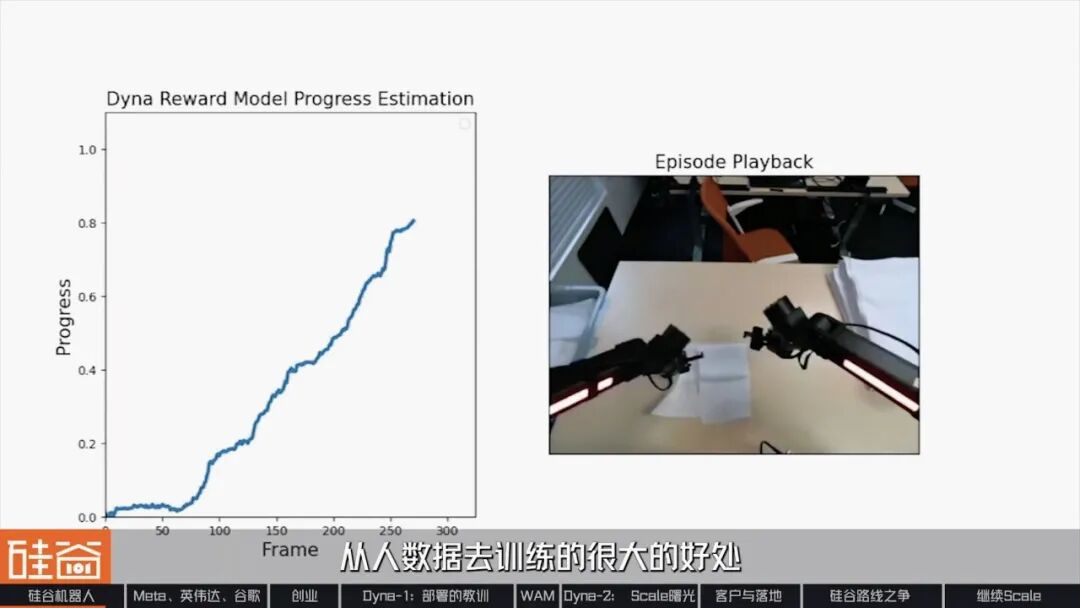
Chen Xi: You didn't make a full humanoid, no bipedal legs, no dexterous hands, but you think the current form is already capable of deploying to do many things?
Jason: Yes, the current form can already do many things. If it cannot be deployed now, it is not because there are no legs or no hands.
We are also doing a lot of dexterous hand research internally, but it is purely basic research for now, and we have no plans to deploy dexterous hands yet. Because the maturity of dexterous hand hardware is not yet at a state where it can be directly deployed.
Chen Xi: The movements in your demo just now looked very smooth, but some demos with dexterous hands actually make the movements slower. Is that also one of your considerations?
Jason: Operating or teleoperating with dexterous hands is much more difficult than with grippers, and it is also very difficult to increase the speed of teleoperation. So demos with dexterous hands are usually slower.
Chen Xi: You just said that the reason why it cannot be deployed is not because of hands or feet, is it because the model is not good enough?
Jason: I think the entire system is not good enough. As we mentioned in our deployment blog post, whether a system can be deployed not only requires the model to perform 100% correctly, but also requires a lot of Observability.
You need to know what the model did that day, what the robot did, and whether there are problems such as resource contention on the robot's computer. These are all very important for deployment. So every time we update the robot and update the model, we will do all these work well to ensure that we have Observability at the real customer site.
Zhang Junwu: You talked about the influence of robot form on Cross-embodiment transfer, and also mentioned the "GPT moment" and internet-scale data volume, we will continue to discuss these later.
AlphaGo and the Starting Point of Research
Chen Xi: I am also very interested in what you learned during deployment. Let's review from the very beginning: your taste and choices in research may have laid the foundation for Dyna's technical roadmap. When did you start to be interested in robots?
Jason: Since the first year of my PhD. My supervisor works on robotics and reinforcement learning, and the University of Pennsylvania also has the GRASP Laboratory, which is a very large robotics research center. When I first started my PhD, I originally wanted to study reinforcement learning.
Chen Xi: Because you were already working on reinforcement learning when you were in college?
Jason: I didn't do a lot of research in college. At that time, I was exploring different directions, but I thought reinforcement learning was very logical, so I wanted to continue my PhD to study it.
Earlier, I grew up in China and played a lot of Go when I was a kid. When AlphaGo first came out, I was in the 12th grade in the US. I thought this thing was amazing, it could solve such a difficult game, so I decided that I must study it in college. Later I found it very interesting, so I continued to pursue my PhD.
Chen Xi: AlphaGo defeated Lee Sedol when you were in high school. What did that match mean to you?
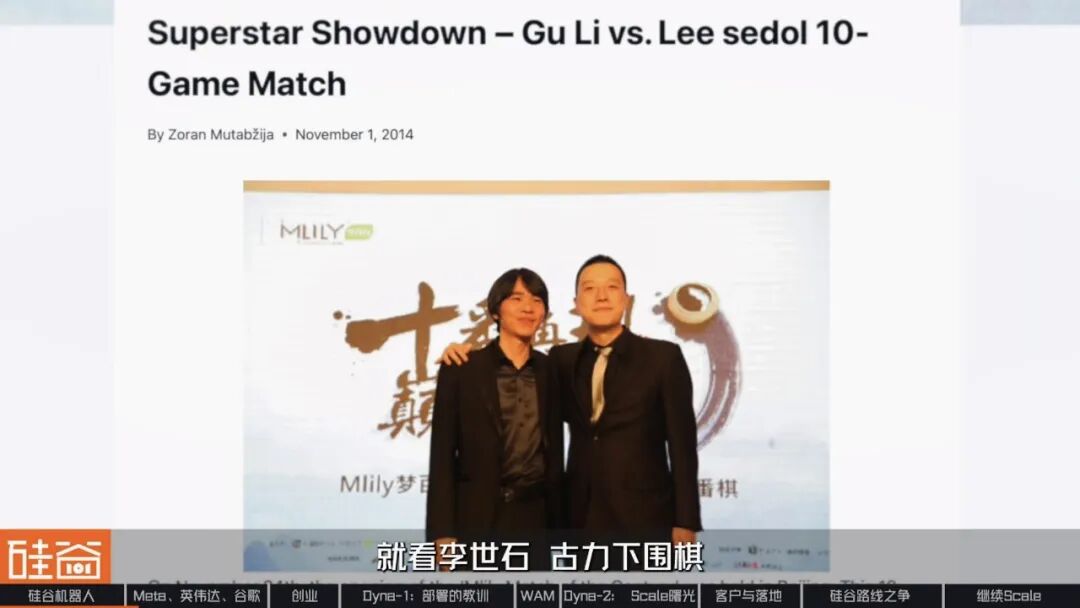
Jason: They didn't just play one game, they played five games. I was very surprised that AlphaGo might have defeated Lee Sedol 4 to 1. I was very young when I watched Lee Sedol and Gu Li play Go, so it was incredible to see Lee Sedol defeated.