A new AI "thunderclap" strikes? This time in South Korea...
This Tuesday, another data center company was publicly "slapped in the face" by the market, and this "flop" took place in Seoul.
Data center infrastructure firm Elice Inc. saw its share price plummet sharply on its first day of trading after listing in South Korea, as widespread market concerns over the sector's outlook dragged down its performance.
In early Tuesday trading, the Seoul-based new cloud service provider saw its share price drop as much as 33% to 61,000 won. Less than half an hour after the market opened, 300 billion won of "paper wealth" vanished completely. The stock trades on South Korea's tech-heavy KOSDAQ market. If the decline continues, it is set to post the worst first-day performance among large-scale South Korean IPOs.
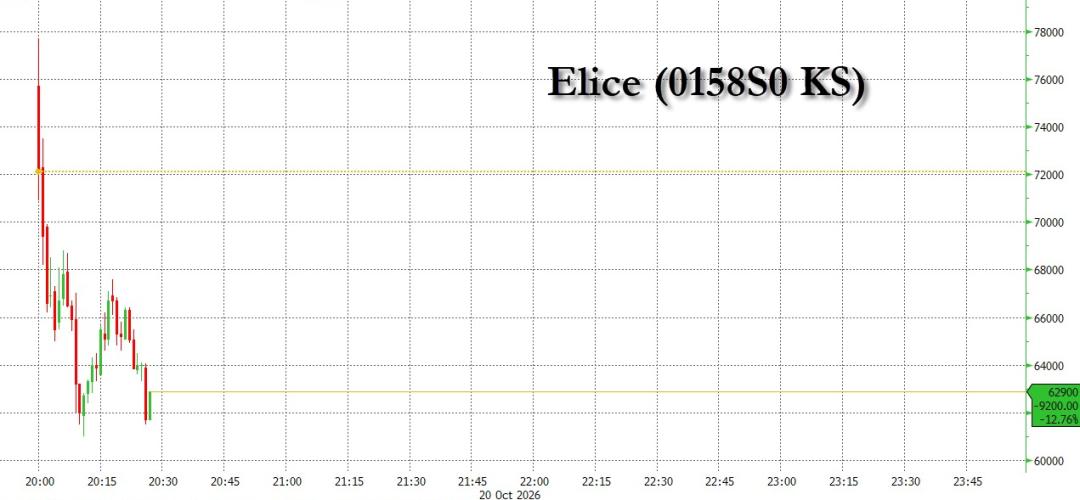
Elice raised 201 billion won (about $151 million) through this IPO, with the offering price set at 90,500 won per share, the upper end of the previously announced price range, giving it a post-listing market cap of over 1 trillion won. The IPO drew over 400 times subscription from retail investors.
The first-day listing performance reflects that investors' enthusiasm for this sector is cooling off after a series of global setbacks.
Before trading officially kicked off, Elice had successfully drawn strong demand from South Korea's "ant army" of retail investors, who poured in about 10.3 trillion won in subscription funds, resulting in over 400 times oversubscription. If the 33% decline in share price holds, this will likely mark the worst first-day performance among South Korean IPOs raising more than $100 million, surpassing the 30% first-day drop of W-Scope Chungju Plant Co. when it listed in 2022.
Hans Stege, head of investment research at PrePublic Equity Partners, said: "Elice's listing drew strong retail subscription demand, which proves that investors are eager to get exposure to this sector, where demand for AI infrastructure will undoubtedly surge in the coming years. But this infrastructure boom also requires a well-functioning debt market. That's exactly why we are seeing the market scrutinize cash flow and capital structures far more closely now."
Well-known financial blog site zerohedge pointed out that against this backdrop, investors can easily feel how dramatic this flop is: under South Korea's IPO rules, the legal trading range for a stock on its first listing day is 60% to 400% of its offering price. That means Elice's downside limit is 54,300 won. At its intraday low, the stock was only 13% away from hitting the downside limit, and a full 83% below the upper trading cap — a scenario that was almost certainly never mentioned in its prospectus marketing pitches.
A Breathtakingly Poor Performance
Many analysts noted that Elice's dismal first-day performance stands out not just because people worry that yet another bubble-driven trade may end up failing, but more crucially, unlike almost all its peers, Elice is actually profitable, yet the market still does not seem to be fully buying into its story...
To win over investors, Elice emphasized in its prospectus that its revenue in the first half of this year surged 200% year on year to 34.4 billion won. The company posted an operating profit of 10.3 billion won in the same period, and its EBITDA (Earnings Before Interest, Taxes, Depreciation and Amortization) rose more than 11 times to 23.2 billion won. Analyst Douglas Kim wrote in a report published on Smartkarma that the company's 2026 sales are expected to grow 83%, with an operating margin of around 33%.
Kim Dojoon, CEO of Zian Investment Management, said Elice's financial structure is different from that of its US peer CoreWeave, so there is no need for investors to treat it as a "particularly high-risk" firm. However, he added: "It remains to be seen whether the company can maintain its current profitability."
Founded in 2015, Elice was started by three students in the PhD program at KAIST, one of South Korea's top science and technology universities. The firm originally operated as a programming education platform, before pivoting to become an AI cloud infrastructure service provider offering products including servers, liquid-cooled chips, cloud computing and network equipment, and software. It later developed a modular data center platform equipped with high-density power supply systems and advanced liquid cooling technology, specifically designed for high-performance AI chip clusters.
A successful IPO would have helped lift the South Korean IPO market out of its doldrums. While fundraising activities in other parts of Asia have grown sharply, South Korea's primary market has remained sluggish. According to data compiled by Bloomberg, new listings in the Seoul market have raised a total of $1.4 billion since the start of 2026, compared with over $3 billion in each of the previous three years. Meanwhile, SK Hynix completed the largest-ever US stock offering by a foreign company.
Elice's IPO is the largest IPO on South Korea's KOSDAQ market this year, second only to K Bank Co.'s $337 million offering in March among all South Korean IPOs.
According to the company's CEO Jae Won Kim, backed by venture capital firms including Vertex Ventures and Altos Ventures, Elice plans to use the proceeds from the IPO to build more AI data centers at home in South Korea and overseas. Mirae Asset Securities Co. and Samsung Securities Co. acted as lead underwriters for the IPO.
A New Setback for the Global New Cloud Sector
Elice's embarrassing first-day listing performance also reflects that investors' enthusiasm for the new cloud sector is cooling off after a series of global setbacks.
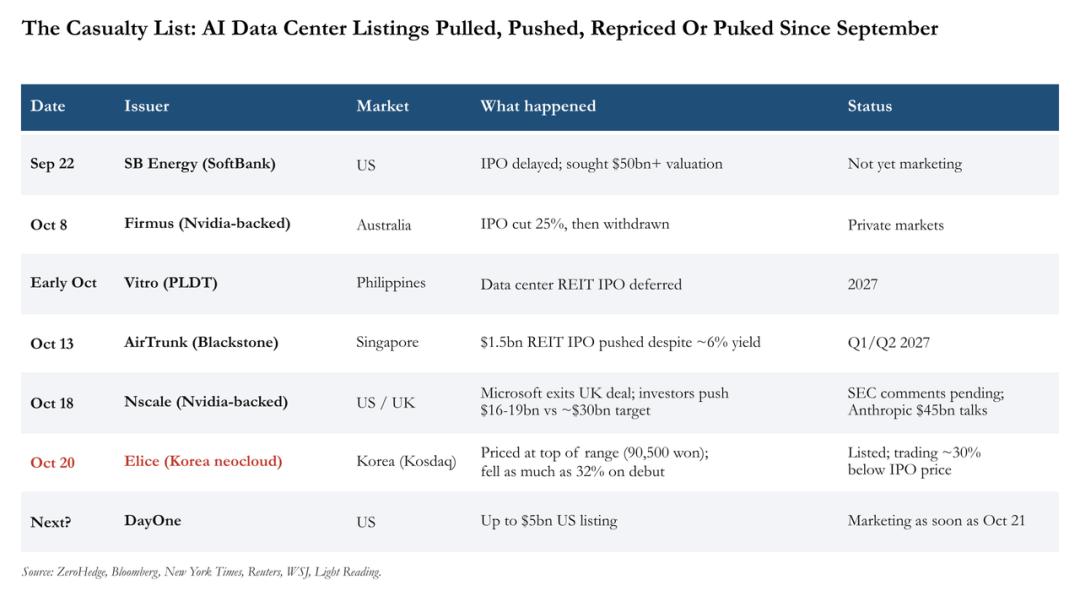
Zerohedge notes that Elice is just the latest name on a growing list that is long enough to deserve a separate directory. A string of "bad news" has piled up over the past four weeks or so:
SB Energy: The SoftBank unit postponed its IPO aimed at raising funds for the world's largest data center on September 22.
Firmus: This Nvidia-backed Australian operator cut its IPO price by 25% before pulling the listing plan entirely on October 8, after it sought a valuation of A$437 billion via what can best be described as "creative" valuation metrics, nearly three times its private valuation in August.
AirTrunk/ Vitro: Blackstone-owned AirTrunk pushed its $1.5 billion Singapore REIT to 2027 even after raising its payout ratio to 6% on October 14, while PLDT-owned Vitro also delayed its own data center REIT.
Nscale: Microsoft pulled out of its UK project partnership with the firm, while secondary market prospective investors demanded that the company slash its inflated $300 billion valuation by half.
CoreWeave: Its share price has plunged by more than half from its peak in May, and its bonds fell into distressed territory last week, with credit default swaps (CDS) implying a roughly 63% probability of default within five years.
Albert Yong, managing partner and chief investment officer of Petra Capital Management, said: "Elice is listing at a time when market sentiment towards AI infrastructure firms has weakened, especially in the US. Investor sentiment for the AI infrastructure sector has been highly volatile, and often disconnected from fundamentals."
In terms of broader regulatory headwinds for the industry, South Korea is reviewing whether the proposed IPO of SK Hynix's subsidiary Solidigm in the US will be classified as a "dual listing". At present, some South Korean lawmakers are pushing for stronger protection for minority shareholders.
Analysts pointed out that to be fair, few people are actually questioning the demand for computing power itself right now. The real critical pain point lies in the capital chain.
On this front, Morgan Stanley gave a far more sober warning in its latest research on AI capital expenditure: the free cash flow gap between hyperscalers and new cloud vendors will hit its worst point in 2027, and if lease liability repayments are included, the funding gap will approach $600 billion.
In other words, the year with the most staggering capital expenditure bills will also be the year with the most severe funding gap, and every dollar of that sum will have to be raised from somewhere. Judging from the cases of Firmus, AirTrunk, Nscale, and now Elice, the public equity market is increasingly unwilling to be that source of funding, at least not at the prices that sponsors want. That leaves only the option of raising capital via debt — and that window is also closing at a visibly rapid pace.
This article is from the WeChat official account "CLS", author: Xiaoxiang, published with authorization from 36Kr.