Goldman Sachs: Once Again Substantially Raises the Global AI Server Forecast
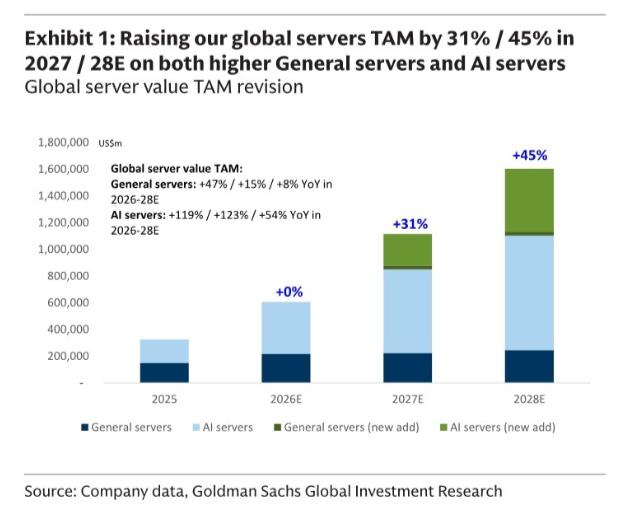
Goldman Sachs Global Server Team released a report on October 18, with only one core conclusion: raise the global server value TAM forecasts for 2027E and 2028E by 31% and 45% respectively, and both AI servers and general-purpose servers are revised upward simultaneously.
If you only see the two figures "31% and 45%", you will read this report too superficially.
Its real value lies in presenting a self-consistent causal narrative: why price increases have turned into positive factors instead of negative ones, why changes in product structure are more important than shipment volume itself, and how all these factors will finally land on specific supply chain targets.
To break it down, the full argument unfolds along a four-level chain:
Rising investment in AI infrastructure (starting point) → product portfolio optimization and rising memory cost (two amplifiers) → substantial upward revision of CSP expenditure and server TAM (result) → all links of the supply chain benefit (implementation).
The subtlety of this chain is that it reinterprets the component price increase, which is usually regarded as "negative news" by the market, as "a confirmation signal of strong demand"; it also switches the narrative of the server industry, which is usually measured by the number of units, to the measurement by "value structure".
With this understanding, all the subsequent figures in the report are logically reasonable.
The report points out that the three clues of CSP capital expenditure, Fabless shipment and wafer foundry capacity are all rising at the same time, jointly confirming that generative AI infrastructure investment is in an upward cycle.
In other words, the downstream capital for "purchasing computing power", the chip "shipment volume", and the upstream "expanded production capacity" confirm each other, and there is no isolated evidence from a single data source.
It is precisely based on this starting point that Goldman Sachs has the confidence to make a substantial upward revision for 2027-2028 — because the basis for the upward revision is the real capital flow on the demand side, rather than a simple price assumption.
Rackization and ASICization will reshape the value structure, which is the most insightful part of the report, including two parallel clues.
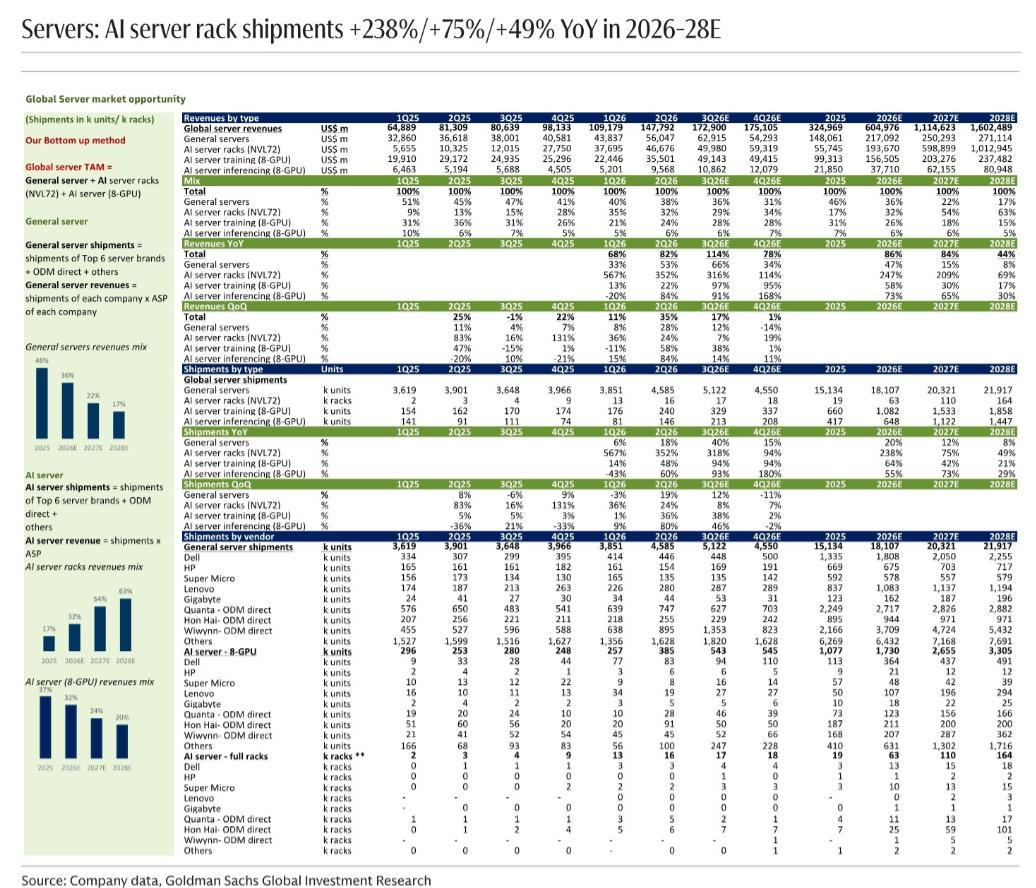
The first clue is rackization. The shipment forecast for rack-level AI servers (NVL72 equivalent, covering NVIDIA and AMD platforms) is 63,000 / 110,000 / 164,000 racks for 2026-28E, with an upward revision of 13% / 5% / 1% this time, and the year-on-year growth rate is as high as +238% / +75% / +49%.
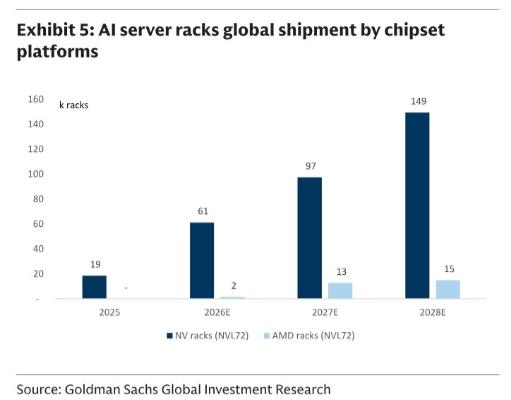
The essence of rackization is "the leap of unit value": one rack integrates more GPUs, larger heat dissipation and power supply systems, and its value density far exceeds that of traditional servers.
When the industry's shipment structure tilts towards racks, even if the growth of the number of units is limited, TAM will expand at a higher slope — this is the first meaning of "better mix".
The second clue is ASICization.
The shipment of 8-GPU AI servers (GPU + ASIC caliber) is revised up to 1.73 million / 2.655 million / 3.305 million units for 2026-28E, with an upward revision of 10% and 29% respectively for 2027/28E, which is mainly driven by the rising demand for cloud vendors' self-developed ASICs.
The implied demand for AI chips thus reaches 18.36 million / 29.17 million / 38.28 million units (year-on-year +84% / +59% / +31%). The global ASIC penetration rate in 2028E is about 58% (about 60% as stated in the text), of which the figure for global first-tier cloud vendors is about 49%, and that for Chinese cloud vendors is as high as 92%.
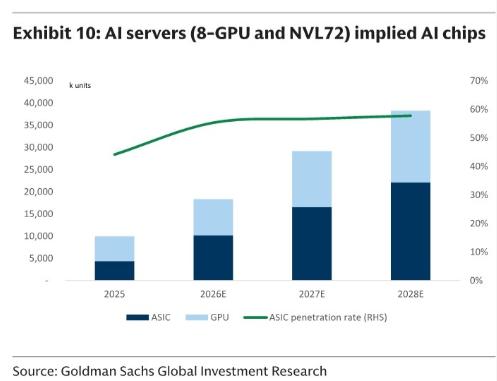
The structural judgment conveyed by this set of figures is that AI computing power supply is moving from "single supply by NVIDIA" to the dual-track of "GPU + self-developed ASIC", and cloud vendors' self-developed chips have become an important marginal source of this upward revision.
There is also a detail that is easy to misread at the intersection of the two clues: Goldman Sachs lowered the 8-GPU shipment forecast for 2026E by 7% (implying a corresponding -3% change in AI chips), on the grounds that leading American cloud vendors are shifting to higher-density rack solutions.
This is not a weakening of demand, but "changing the way to cut the same cake" — the coexistence of short-caliber contraction and long-caliber expansion just shows that Goldman Sachs regards 2027-28 as the main battlefield for the realization of AI server value.
Furthermore, Goldman Sachs answered the most concerned question of the market: Will the memory price increase erode demand?
The answer is no, and the path is clear.
On the one hand, the rise in memory cost directly pushes up the ASP of the whole server, and both general-purpose and AI servers are affected — the report clearly "raises both shipment volume and ASP" for general-purpose servers, and the shipment growth rate of general-purpose servers for 2026-28E is expected to be +20% / +12% / +8%.
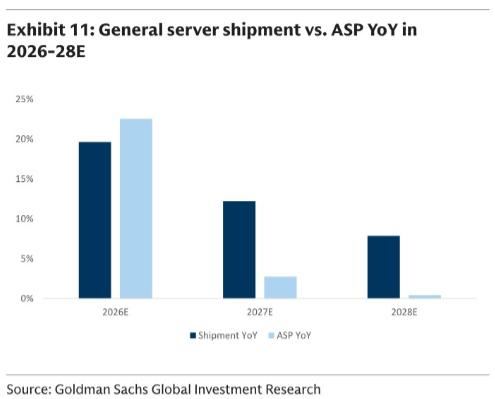
On the other hand, from the downstream perspective, CSPs do not compress their procurement budgets due to component price increases, but include the price increase in capital expenditure and continue to expand the total scale — thus the price increase changes from a "cost item" to an "expenditure item", becoming the second engine for TAM upward revision.
In the AI cycle of short supply, price increase is a thermometer of demand intensity, not an enemy of demand.
Finally, the two amplifiers converge at the TAM level: on the AI side, rackization and ASICization reshape the value structure; on the general-purpose side, the spillover of AI loads (the new generation of CPUs are designed for Agentic AI workloads) superimposed on the memory price increase raises the ASP.
Therefore, the value of general-purpose servers is revised up by 17% / 11% (2027/28E), and the value of AI servers expands synchronously, which sums up to the 31% / 45% upward revision of the global server TAM.
This upward revision is not "betting on a single hit product", but "structural upward adjustment" — the overall value curve shifts upward, which is why the two figures of 31% and 45% are more weighty than the single-point shipment data.
The end of the logical deduction is the list of investable targets. Goldman Sachs gives the buy portfolio according to the value chain links:
•ODM/assembly: Foxconn, FII, Wiwynn, Wistron — the direct undertakers of rackization volume release;
•Optical modules/silicon photonics: Innolight, Eoptolink, LandMark, VPEC — interconnection increment brought by the improvement of rack density;
•CCL/PCB: Shengyi Technology, EMC, Shenghong Technology, GCE — beneficiaries of layer upgrade of high-end AI servers;
•Heat dissipation/structural parts: Cooler Master, FSP, Auras (liquid cooling), HIWIN (guide rail) — essential parts for high-power racks;
•Upstream core links: TSMC (foundry), ASMedia (Fabless), MPI (probe card), WinWay (socket), etc.
The complete logic of this report can be condensed into one sentence: the upward investment in AI infrastructure is the starting point, product portfolio optimization (rackization + ASICization) and rising memory cost are the two amplifiers, which jointly drive the substantial upward revision of CSP expenditure and server TAM in 2027-28, and transmit to all links of targets along the value chain.
It should be noted that the squeeze of component price increase on CSP cash flow and the realization rhythm of AI commercialization are two variables that need to be tracked independently later.
This article is from the WeChat official account "Gelonghui Finance Hotspot" (ID: glh_finance), written by Gejira, and authorized for release by 36Kr.