Elon Musk is going to give every child in the United States one share of SpaceX: Is this a capital allocation experiment?
On October 19 local time in the United States, Elon Musk posted a very short post on social platform X: "Next year, I will give 1 share of my SpaceX stock to every child in the United States. This is only the first of many gifts."
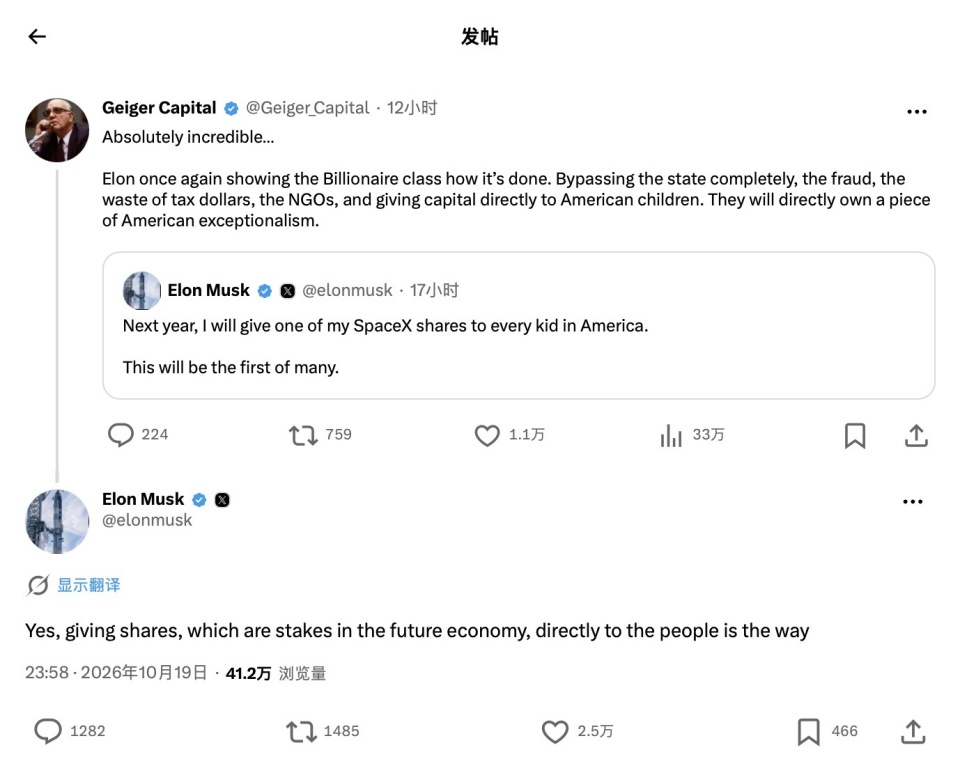
Later that afternoon, he added a second statement: "Yes, giving stocks that represent future economic interests directly to the public is the right path."
According to Musk, this is just the start of a series of future stock donation plans. In his view, instead of distributing wealth indirectly through institutions such as foundations, it is better to hand over stocks representing future economic interests directly to the public.
The potential scale of this commitment is quite staggering. CNBC (Consumer News and Business Channel) pointed out in its report that based on an estimate of about 73 million people under the age of 18 in the United States, if each child receives 1 share of SpaceX stock, the total book value of the donated shares is about 10.8 billion U.S. dollars, calculated at the latest closing price of 147.96 U.S. dollars on the public market on Monday, October 19.
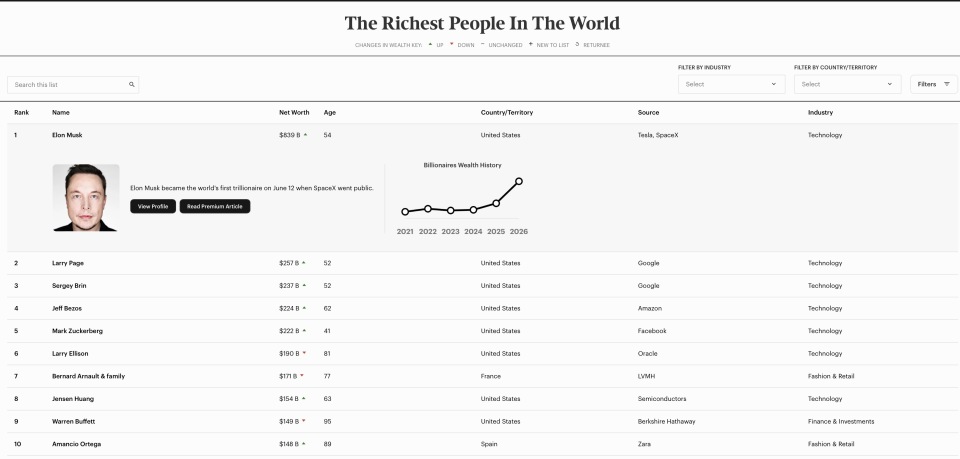
Forbes Global Billionaires List
This gift is equivalent to about 1.3% of Musk's latest net worth. According to the latest real-time rich list data from Forbes, Musk's personal net worth has climbed to 839 billion U.S. dollars. According to a detailed report by CNBC citing regulatory documents, Musk, as the largest shareholder of SpaceX, directly holds about 4.8 billion shares personally; if unvested equity incentives and options are included, the total number of shares under his control reaches 6.4 billion, corresponding to about 48.4% of Beneficial Ownership and more than 82% of absolute super voting rights.
After SpaceX completed its IPO in June this year, its market capitalization at the close of October 19 has exceeded 2 trillion U.S. dollars. For Musk, who holds billions of shares, taking out 73 million publicly traded shares is not a difficult move in terms of shareholding scale.
However, there is still a considerable gap between the book value and the actual delivery.
Up to now, this initiative is still at the verbal level: there are no exact details on how to determine the eligibility of recipients, who will hold the stocks in custody, how to handle relevant taxes, when the recipients can sell the stocks, and even whether Musk will announce a formal legal plan and complete the transfer on schedule.
A single tweet has thus led to a deeper issue: when top tech billionaires have accumulated unprecedented wealth, can directly distributing corporate equity to the public become a new way to share technological dividends? Can it also undertake the social responsibilities carried by traditional charity and public welfare?
01 Why does Musk want to give away stocks?
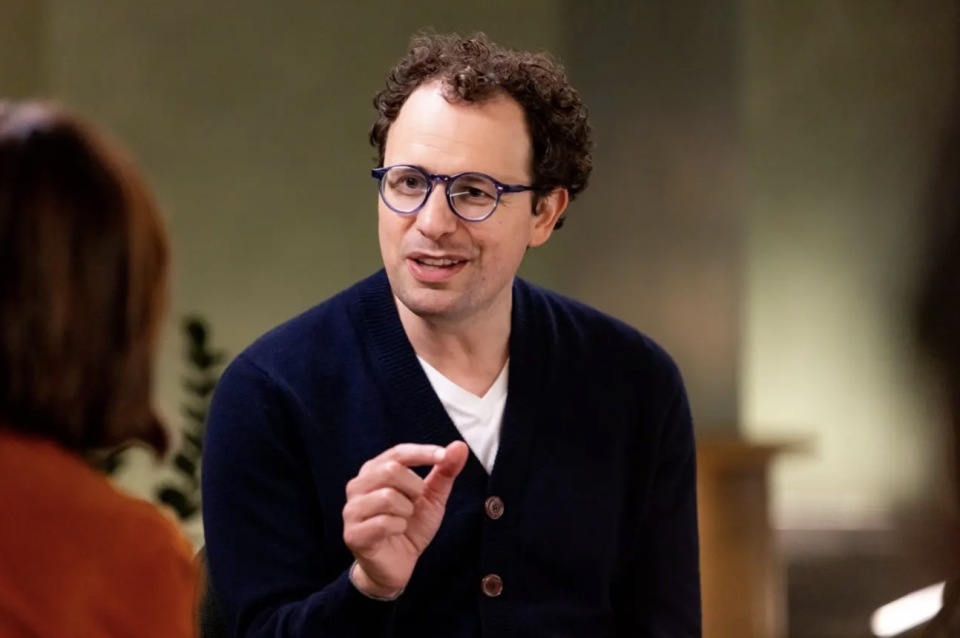
Dario Amodei, CEO of Anthropic
To understand Musk's statement, we first need to look at his direct confrontation with AI company Anthropic over wealth distribution.
On October 18, Anthropic, the AI giant that is preparing for its listing, officially announced the establishment of the "Public Benefit Fund". The plan intends to initially inject 5% of the company's equity into this wholly-owned public welfare fund, which will be used to explore donations to non-profit organizations and subsidies for specific groups, to study and respond to the automation replacement impact brought by the popularization of AI technology on the labor market.
Moreover, Anthropic has also set a dynamic additional mechanism: every time the company's valuation increases by 50%, the board of directors can choose to add up to 2% of the equity to the fund, so that the public equity ratio can eventually reach a maximum of 20%.
This model essentially inherits the "trust governance" idea of traditional Silicon Valley elites, by establishing a professional and independent foundation intermediary, the council will distribute wealth according to social pain points in the next few decades.
However, shortly after the release of this plan, it drew a direct counterattack from Musk. Under Anthropic's post, Musk replied directly: "I suggest giving the shares directly to the public." He then added that this is exactly what he is going to do next.
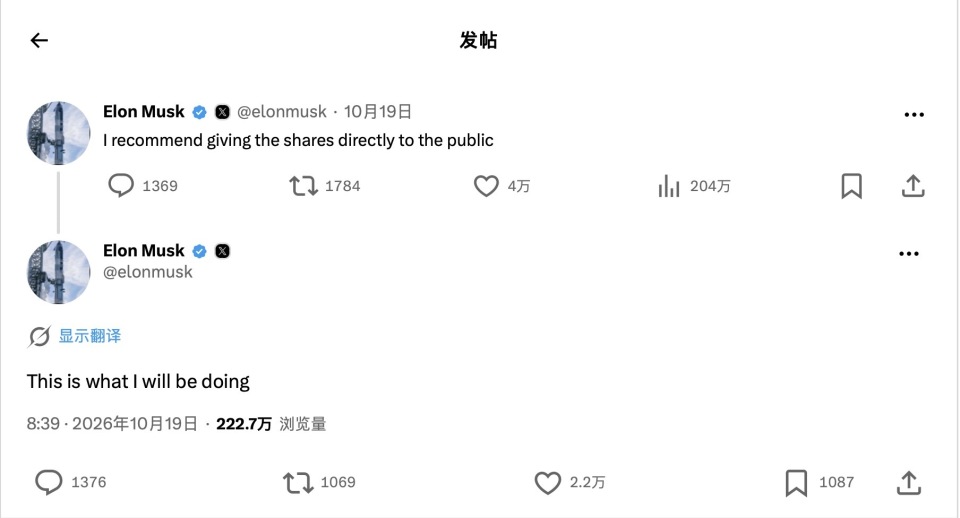
Musk posted on X to criticize Anthropic for setting up a Public Benefit Fund
Shortly afterwards, on the morning of October 19, Musk officially launched the plan to give 1 share of SpaceX stock to every child across the United States on X, and further clarified his position that afternoon, stating bluntly that distributing stocks representing future economic interests directly to the public is the right path.
The divergence between these two ideas is extremely profound. Anthropic relies on professional institutions to manage assets uniformly, trying to allocate resources indirectly through public welfare projects and fund councils; while Musk tries to completely eliminate foundations and administrative intermediaries, distribute stocks representing future economic interests directly to individuals, and reconstruct the wealth distribution form with "universal shareholding".
Apart from the divergence in distribution ideas, Musk's statement is also extremely penetrating in communication. At that time, the persistently high energy consumption of AI data centers and the squeeze of automation on jobs were making the entire technology industry shrouded in social anxiety; SpaceX had also repeatedly caused controversies before due to restricting Starlink services on the Ukraine battlefield.
Faced with these complex controversies, Musk put forward the extremely simple and direct concept of "one share per person", which quickly brought the focus of public opinion back to the field he is best at - making the public believe that everyone can directly share the dividends of future technological development.
The policy environment also provides a connection opportunity for it. The U.S. Treasury Department previously launched the "Trump Accounts" system for minors, leaving a channel for the private sector to inject capital into children's investment accounts. If Musk's stock donation plan is connected with this account, it can indeed find a smooth implementation carrier.
For Musk, this move is not only a counterattack against competitors, but also provides a stage for him to shape his personal image of "breaking the traditional charity routine".
02 Why do some people support "direct stock distribution"?
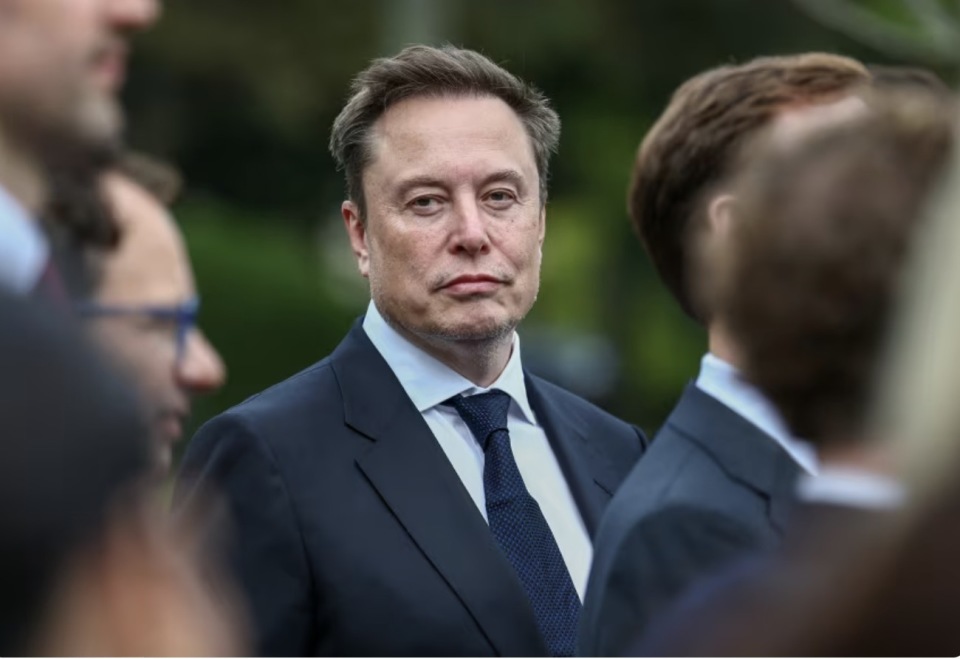
On social networks, Musk's proposal sparked heated discussions among Silicon Valley liberals and right-wing communities. Supporters are not only concerned about the amount of the stock, but a new distribution possibility: can wealth distribution break out of the framework of traditional charity and government redistribution?
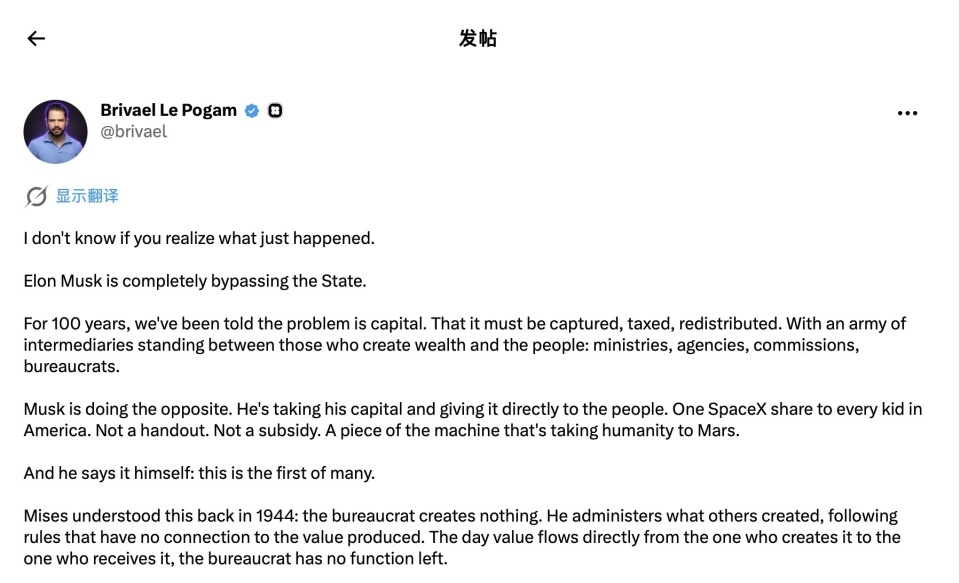
The view of tech commentator Brivael Le Pogam represents the core logic of this group. In his view, traditional societies are accustomed to carrying out "redistribution" (version 1.0) through taxation and bureaucratic institutions. In this process, expensive administrative losses and institutional budgets often erode the actual value of welfare; while what Musk is trying is the "direct capital distribution" (version 2.0) where capital creators directly distribute means of production to the public, advocating to remove intermediaries and let value flow directly to recipients.
The appeal of this logic lies in allowing ordinary people to share the long-term growth of top technology companies. In the past, high-valued core assets like SpaceX were basically monopolized by founders and top institutions. If tens of millions of children can directly hold its equity, they can not only share the asset appreciation, but also establish an "owner's perspective" on the future economy.
Well-known macro financial analysis account Geiger Capital and others also believe that this method bypasses the government and various intermediary institutions, reduces intermediate losses, and allows children from ordinary families to directly hold a stake in a technology company with long-term growth potential.
However, one point must be clarified: holding equity does not equal obtaining stable social security. Stocks are essentially forward-looking assets that cannot generate cash flow in the short term, and it is difficult to ease the immediate living and medical pressure of low-income families. Even for a company with a market value of 2 trillion U.S. dollars, its stock price will still fluctuate affected by the macro economy, and a single stock can hardly become a reliable economic guarantee for children in the future.
Therefore, although "direct capital distribution" provides a new idea, it is essentially an asset accumulation tool, which cannot be directly equated with basic security.
03 The stock donation experiment has caused widespread anxiety
Faced with this verbal promise worth tens of billions of dollars, mainstream financial media, the legal community and the progressive camp have also put forward many tit-for-tat doubts.
The first is the lack of implementation details and the controversy over identity definition. At present, this initiative lacks any formal legal agreement, custody rules and tax handling plans.
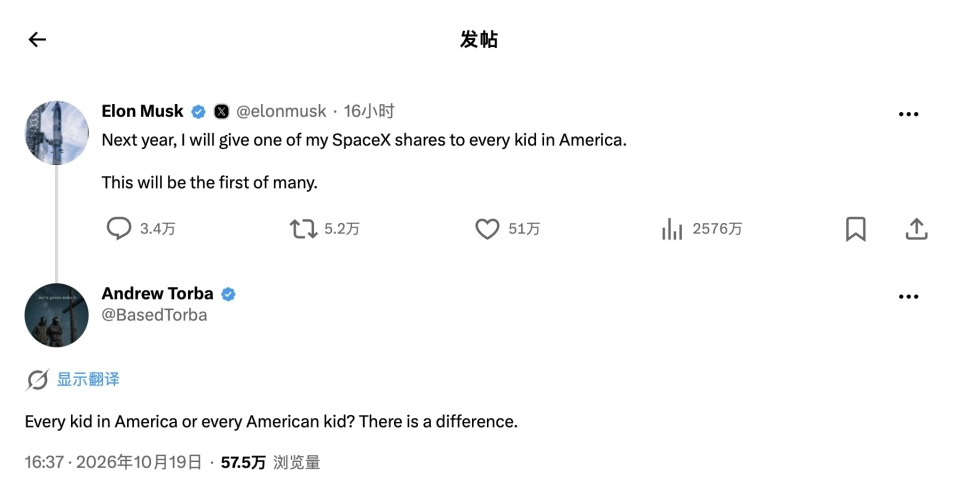
What is more controversial is the scope of beneficiaries: on the X platform, conservative leaders such as Andrew Torba publicly asked, does "Every kid in America" refer to all children living in the United States (including minor immigrants), or only children with U.S. citizenship? This definition not only affects the coverage, but is also extremely politically sensitive.
Another reason why the outside world remains cautious about Musk's initiative stems from his past performance flaws in public welfare commitments.
For example, when he co-founded OpenAI in 2015, he promised to provide huge funding, but after investing about 38 million U.S. dollars, he withdrew his capital due to control disputes; in 2021, he claimed that he would donate 6 billion U.S. dollars if the United Nations World Food Programme (WFP) produced a transparent plan, but the donation came to nothing after the WFP released the plan; investigations into the tax filing documents of the Musk Foundation also showed that it failed to meet the 5% minimum qualified public welfare distribution standard required by federal tax law for consecutive years, and more than half of the funds flowed to related entities.
These historical records make the outside world doubt whether this initiative is another low-cost public relations statement.
Deeper criticism comes from the institutional level. Faced with "billionaires giving away stocks", the progressive camp put forward a straightforward rhetorical question: "Why not tax Musk directly?"
The core of this criticism is that public welfare such as basic education, medical care and social assistance should be built on a stable, transparent and democratically authorized tax and transfer payment system, rather than relying on the optional gifts given by a very small number of billionaires based on personal preferences. If public welfare is replaced by stocks selectively distributed by individual billionaires, it will not only bring great uncertainty, but also easily blur the boundary between private capital and public governance.
From a single tweet to a multi-billion dollar initiative, Musk has once again placed a core issue in front of the public: in the era of rapid development of AI and aerospace technology, how on earth can ordinary people share the wealth brought by technological progress?
Direct distribution of equity provides an idea different from traditional charity for this issue, but it is also accompanied by huge implementation suspense and institutional controversies. For the 73 million potential recipients, what really matters is not how much this gift is valued on the day of announcement, but whether it can be actually delivered and what it can ultimately change.
Special translator Wu Ji also contributed to this article
This article is from "Tencent Tech", author: Joanne, editor: Xu Qingyang, published with authorization from 36Kr.