QuestMobile 2026 Q3 AI Application Market Development Report: The user base of AI-native Apps hits 546 million. The three core entrances are converging to undertake service delivery covering life and office scenarios, and the two main development lines drive the evolution of the market landscape.
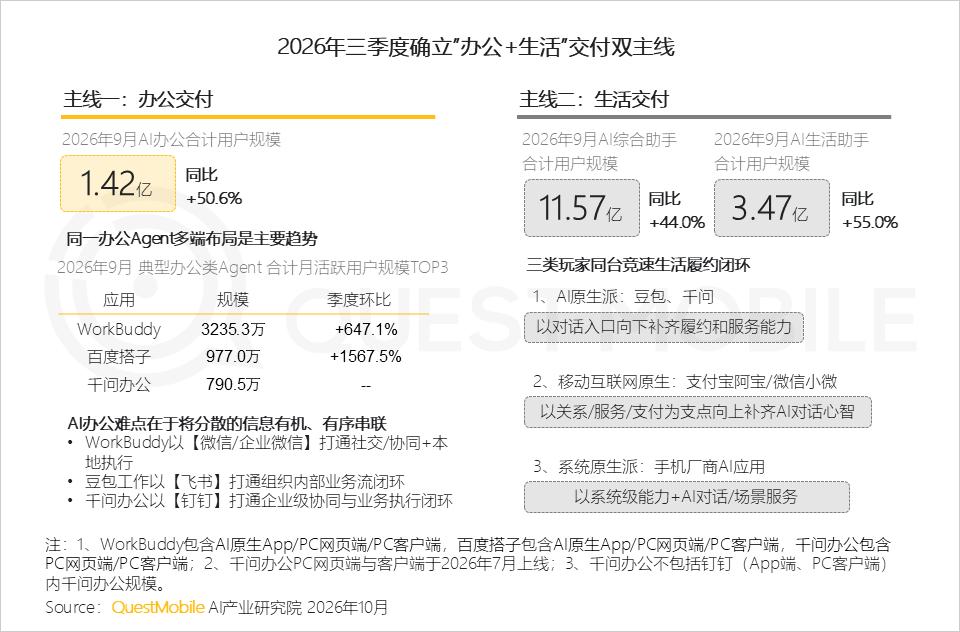
Today, we are sharing the 2026 Q3 AI Application Market Development Report with everyone. As analyzed earlier, the AI "watershed" has taken shape in 2026, with "office" and "daily life" evolving into two completely distinct development lines, each advancing toward its own closed-loop direction, and the strategic priorities of all market players have become clearer. According to QuestMobile data, as of September 2026, the user scale of comprehensive AI assistants has reached 1.157 billion, a year-on-year increase of 44%. Among them, the user scale of AI life assistants reached 347 million, up 55% year on year; meanwhile, the monthly active user scale of AI office products has hit 142 million, a year-on-year growth of 50.6%, with the user bases of WorkBuddy, Baidu Dazi, and Qianwen Office reaching 32.353 million, 9.77 million and 7.905 million respectively.
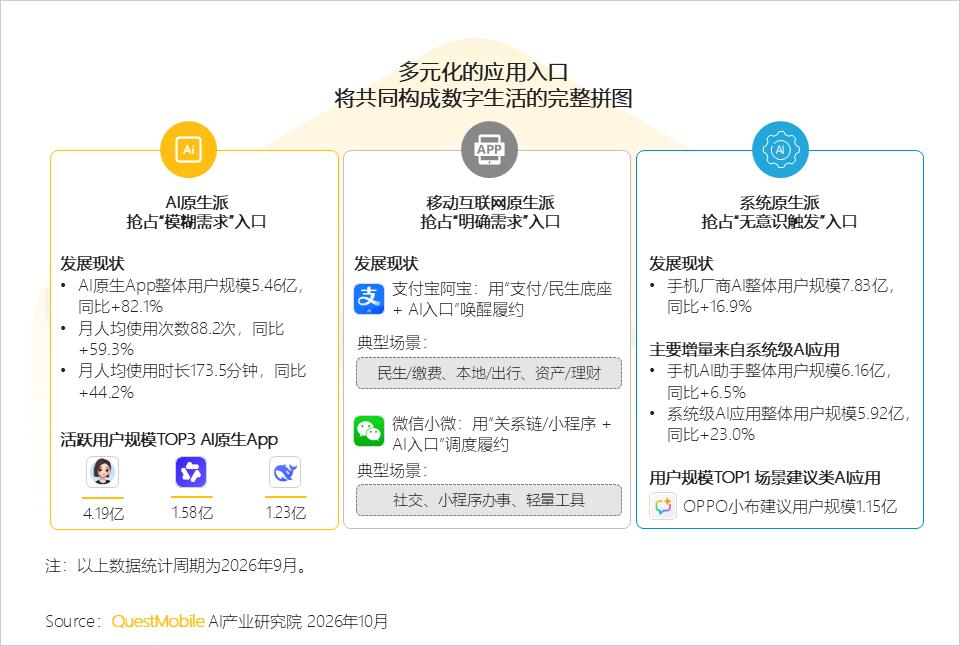
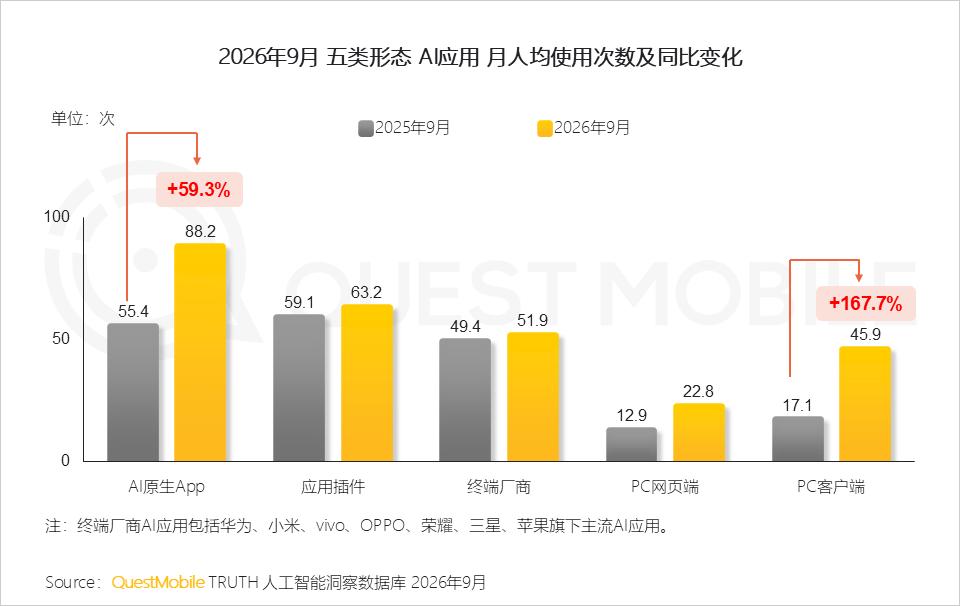
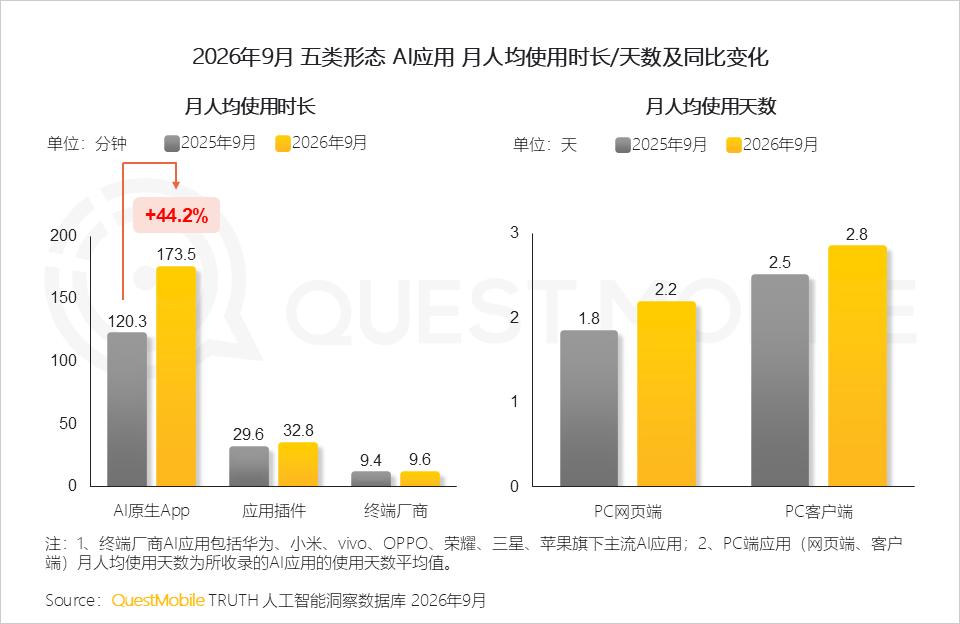
From the perspective of development routes, the previously diversified exploration path of "entrance competition" is becoming increasingly clear, and the "three major entrances" model is converging: First, AI-native Apps seize the market of "vague demands", with 546 million monthly active users, a year-on-year increase of 82.1%, the monthly per capita usage times reaching 88.2, up 59.3% year on year, and the monthly per capita usage duration reaching 173.5 minutes, a year-on-year increase of 44.2%. The monthly active users of Doubao, Qianwen, and DeepSeek stand at 419 million, 158 million and 123 million respectively;
Second, mobile internet native players use "payment/social relationship chain + AI entrance" to capture the clear demands of users within platform-type Apps. For example, Alipay strengthens AI entrance wake-up and service fulfillment in scenarios such as "public services/payment, local services/travel, and assets/wealth management", while WeChat Mini Programs strengthens scheduling and fulfillment for social interaction, government service processing and lightweight tools. The participation of tech giants coupled with application focus has pushed the monthly active users of AI plug-in forms to 639 million.
Third, terminal manufacturers rely on the underlying system to strengthen the "unconscious trigger" of mobile AI assistants, solve the "difficulty of active invocation", and promote the establishment of an "efficient fulfillment path" through scenario-based suggestions. The total industry user scale has reached 783 million, a year-on-year increase of 16.9%. Among them, the monthly active users of OPPO Breeno Suggestions and vivo Jovi Suggestions are 115 million and 62 million respectively, up 139.9% and 33.9% year on year. In particular, the monthly per capita usage duration of OPPO Breeno Suggestions has increased by 185.0% year on year!
In addition to the above, AI life assistants and AI office have become the biggest variables in the industry's development: AI life assistants continue to evolve toward "service delivery", while AI office continues to develop toward "full-scenario embedding". Especially for AI office, two core characteristics determine the logic of subsequent deep AI adoption and commercial closed loop:
On the one hand, the cross-terminal and cross-entrance usage logic and experience of AI office are breaking the previous "three major entrances" logic and becoming the core variable on the application side. A typical manifestation is the rise of office Agents, of which the AI-native App side sees a year-on-year growth of 518.4%, and the PC client side sees a year-on-year increase of 512.2%;
On the other hand, the usage depth of AI office is evolving from "single connection" to "cross-domain connection" and "global connection", expanding from content and communication to task, schedule and process management, and finally targeting "full-scenario integration", which will become the core of "AI tool stickiness" for individuals and organizations……
What are the specific details? You may refer to the full report.
2026 Q3 AI Application Market Development Summary (I)
2026 Q3 AI Application Market Development Summary (II)
1
2026 Q3: Deliver Growth Through Execution Capability
Native Apps and PC Clients Jointly Define the Dual Main Lines of AI Interaction
1. The AI application market in Q3 shows a clear shift: independent entrances that can form self-contained closed loops, and system-level entrances close to the final delivery point continue to expand. The growth logic driven by delivery capability enters the fulfillment period in Q3 and will last until the end of the year
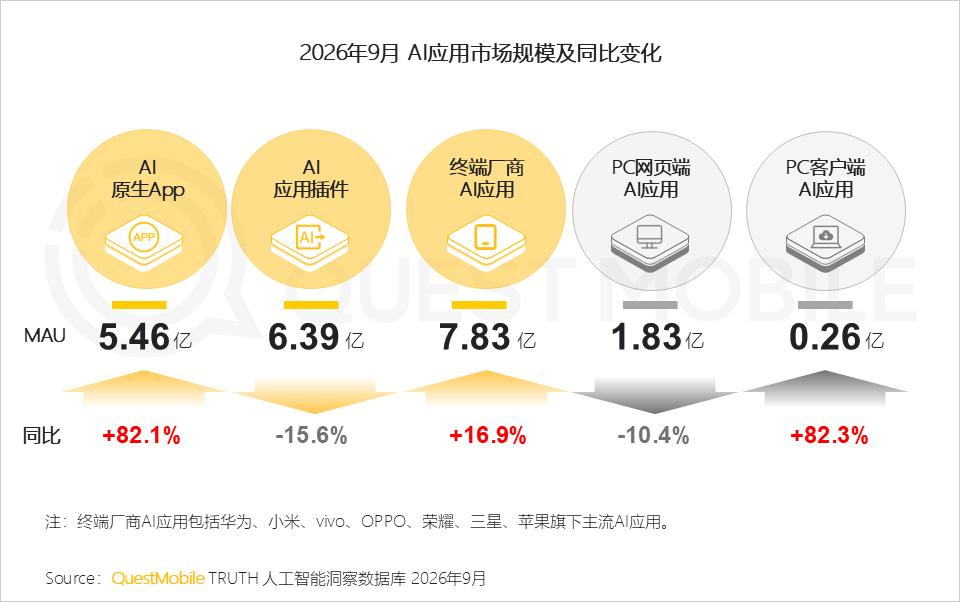
QuestMobile data shows that in September 2026, the monthly active users of AI-native Apps reached 546 million, up 82.1% year on year; AI applications from terminal manufacturers reached 783 million, a year-on-year increase of 16.9%, and PC clients reached 26 million, up 82.3% year on year.
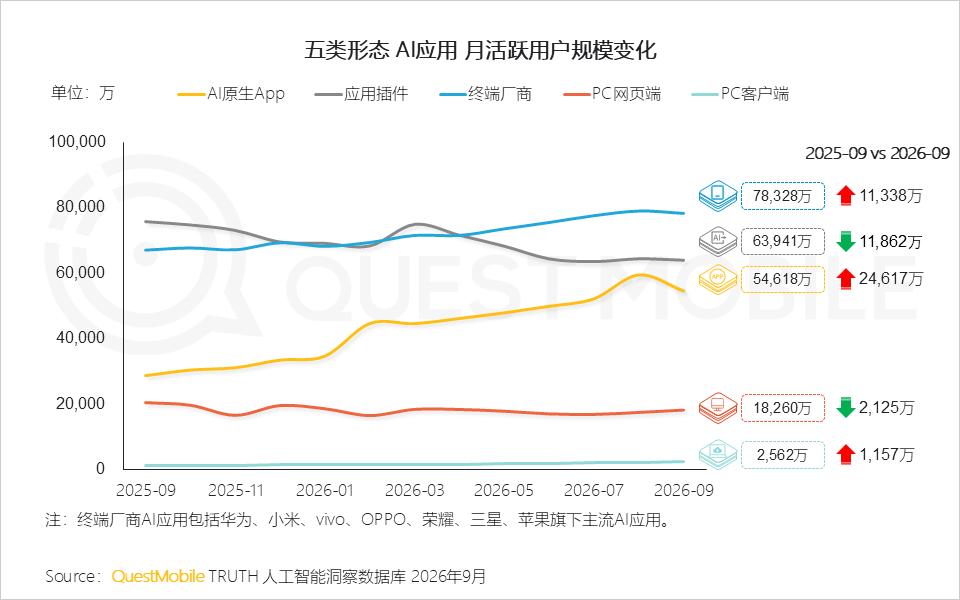
2. By observing five types of applications along the timeline, the second quarter of this year is a clear watershed: the slope of AI-native Apps rises sharply, defining the mass-market closed loop. The PC client side has added 11.57 million users compared with the same period last year, reflecting the independent demands of professional scenarios
Although the two trends are different, they both point to a structural shift in user behavior: users are moving from multi-level transit entrances to the independent AI form with the shortest path.
3. The pattern of the TOP 10 AI tracks also sends the same signal: the role transformation from Q&A tools to execution subjects
QuestMobile data shows that in September 2026, the total user scale of comprehensive assistants, productivity office tools and life assistants reached 1.157 billion, 142 million and 347 million respectively, up 44.0%, 50.6% and 55.0% year on year. The three tracks correspond to three growth logics respectively: entrance expansion, process embedding and service fulfillment.
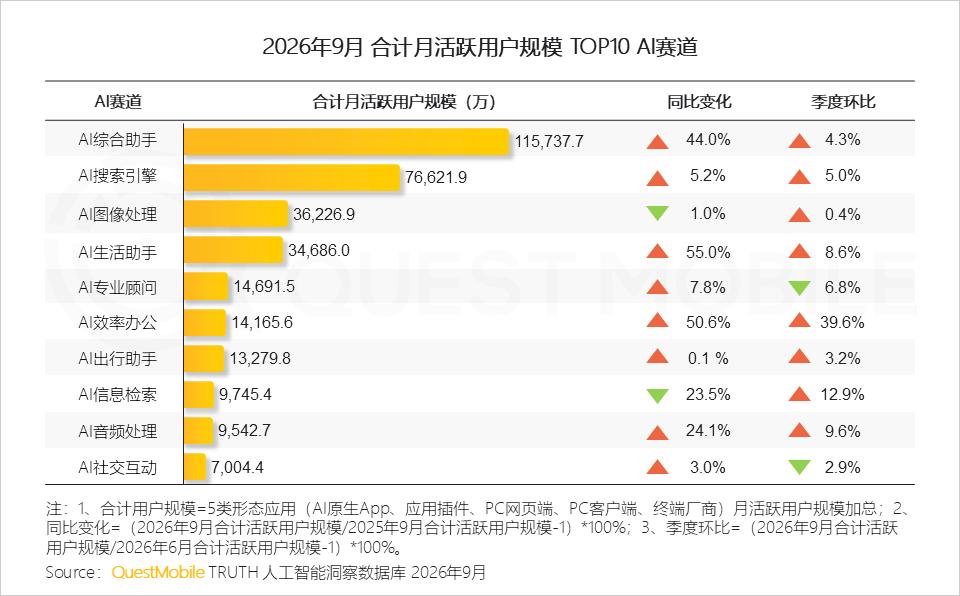
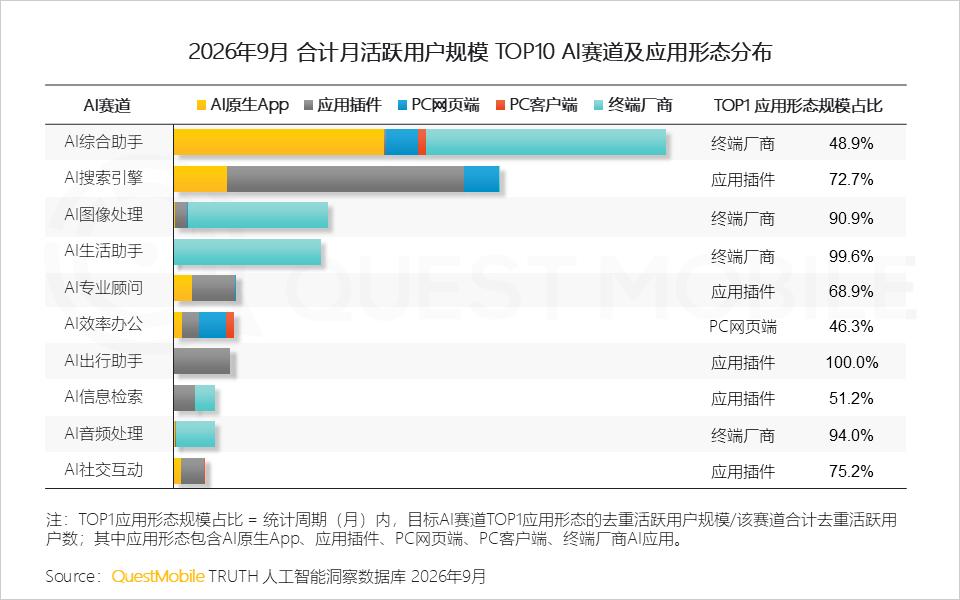
4. Form concentration reflects the de-intermediation trend, but de-intermediation does not mean simplification to a single form: delivery complexity determines the direction of form evolution. The deeper the link, the more diversified and mixed the form tends to be, as seen in comprehensive assistants and productivity office scenarios
QuestMobile data shows that the comprehensive track is jointly led by terminal manufacturers and AI-native Apps, with a market share of 48.9% and 42.7% respectively. AI office is still in the "cross-device transition" stage, and the delivery closed loop is undergoing in-depth reconstruction from the web (46.3%) to the client (12.8%).
5. From the perspective of usage frequency, heavy-duty scenarios on PC and high-frequency access on mobile terminals constitute the current dual main lines of AI interaction: PC clients are accelerating penetration with a year-on-year growth rate of 167.7%, while AI-native Apps maintain a 59.3% growth rate with an absolute frequency of 88.2 times per month
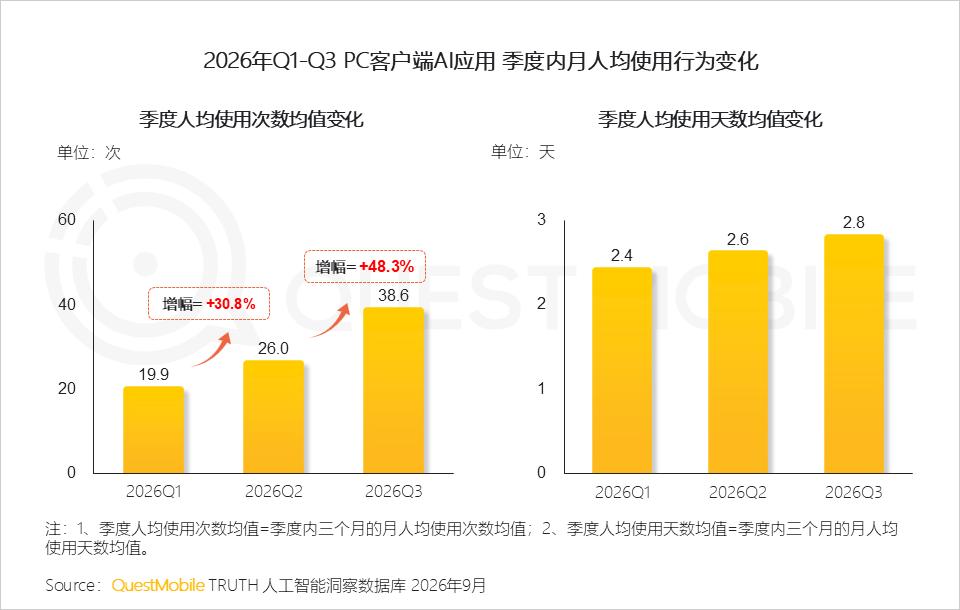
6. The "dual main lines" of AI interaction are simultaneously transformed into deeper user retention: the per capita usage duration of AI-native Apps has increased to 173.5 minutes, and PC clients highlight their productivity value with an average active usage of 2.8 days per month
When AI is integrated into users' stable daily habits, the deep barriers of independent AI forms will build irreversible migration costs for users.
7. AI-native Apps experienced a natural filtering process triggered by the ebb of Agent craze in Q3, the average quarterly per capita usage times dropped from the Q2 peak to 86.6, while the average duration remained at 174.1 minutes
The contraction in frequency does not mean user churn, but essentially an optimization of user structure: AI-native Apps have completed the natural stratification of user value during the craze ebb.
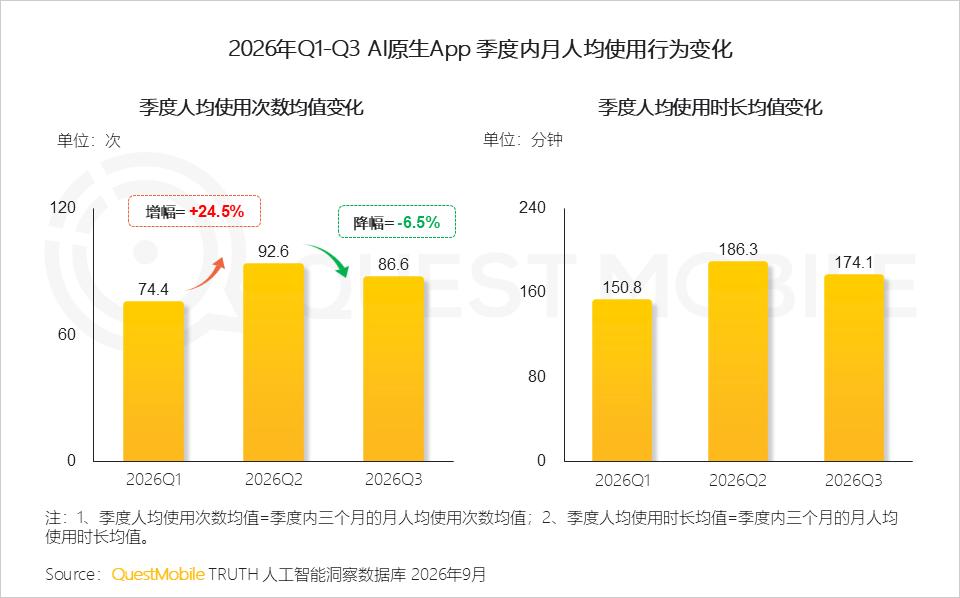
8. PC clients are in the deepening period of productivity penetration driven by office Agents: the average quarterly per capita usage frequency has increased from 30.8% to 48.3%, and the number of active days has steadily increased to 2.8, with frequency expansion and stickiness precipitation advancing in parallel
2
Multi-terminal Collaboration Is the Standard Configuration for AI Office, and the Connection of Fragmented Scenarios Is the Core Barrier for AI Delivery
1. QuestMobile data shows that AI office is rapidly migrating to "dedicated terminals", and Q3 is a key inflection point: PC clients and AI-native Apps have seen a fivefold year-on-year explosion, with highly overlapping growth curves. The multi-terminal collaborative AI office model is becoming a standard work configuration
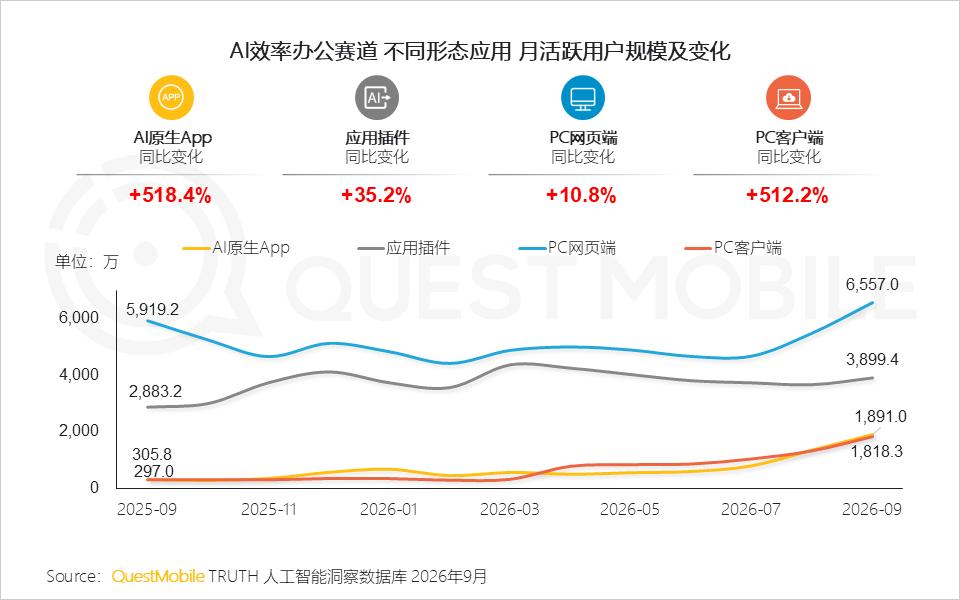
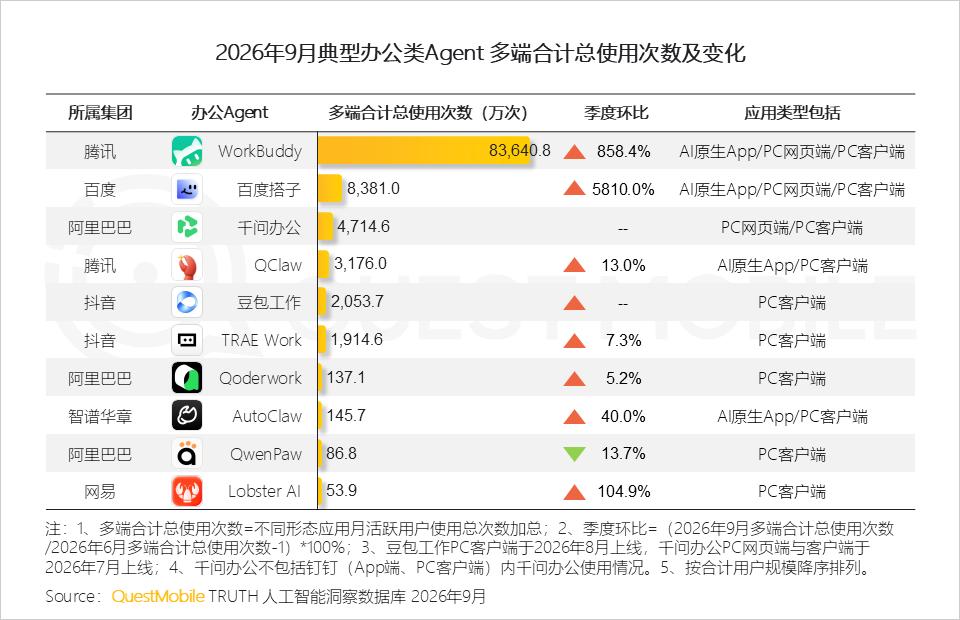
2. Tencent, ByteDance, Alibaba, and Baidu are accelerating the multi-terminal layout of the same office Agent, which essentially aims to embed full scenarios into fragmented work flows. The feasibility of the multi-channel strategy depends on whether the interaction logic of each terminal is redesigned and whether the form is adapted: adaptation means successful implementation
QuestMobile data shows that in September 2026, the total active users of WorkBuddy reached 32.353 million, Baidu Dazi 9.77 million, and Qianwen Office 7.905 million.
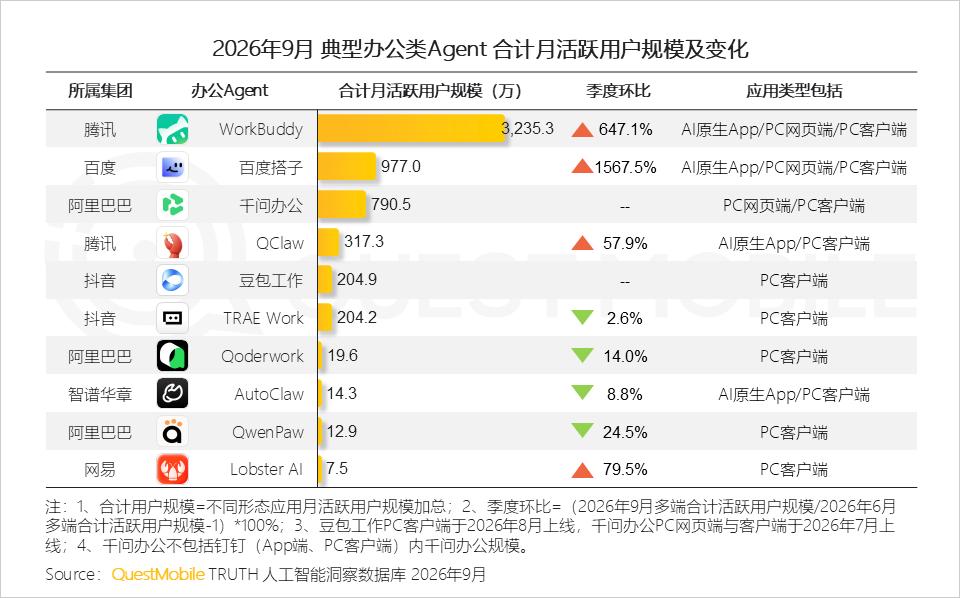
3. Usage frequency can prove that office Agents have the feature of "high delivery perception": once users run through their first closed-loop scenario, stickiness will most likely be established in a short period
4. Daily office work can be broken down into five core elements: content, communication, system, organization, and external resources, which are nested in four major scenarios. Therefore, the real difficulty of AI office lies in "connection": that is, to connect the information scattered in different elements and reassemble it according to scenario demands
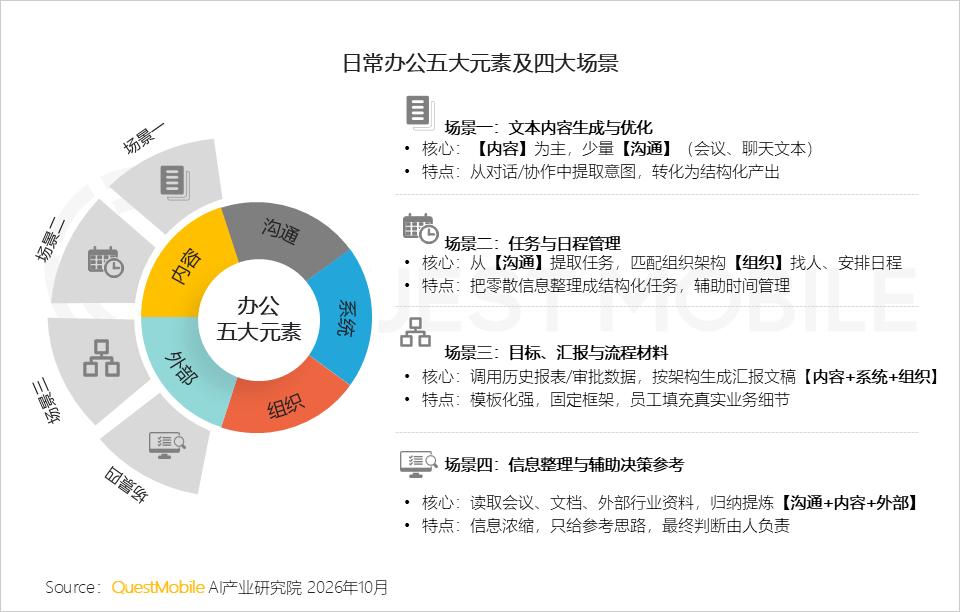
5. The connection location determines the capability radius: the more elements connected and the larger the span, the higher the delivery value and the higher the switching cost. At present, mainstream AI office applications are still concentrated in single-point content