How to build up enough confidence to say "no" without relying on luck
Shen Translation Bureau is a translation team under 36Kr, focusing on technology, business, workplace, life and other fields, and focusing on introducing new technologies, new perspectives and new trends from abroad.
Editor's note: Trading time for salary has a rigid ceiling. For ordinary people to earn enough confidence to say no, the key is not to compete on diligence, but to obtain asset ownership and zero-permission leverage. This article is translated from foreign sources.
There are a few things that are never in short supply on the Internet, and one of them is people who teach you how to get rich quickly.
This is the most basic market economics: as long as there is demand, supply will keep coming in endlessly.
In 99% of cases, these people get rich by peddling the "get-rich dream", and have never made money by the methods they teach.
This is an age-old scam that has existed for far too long.
But in 2018, a very wealthy venture capitalist decided to publicly release the "secrets of wealth" for free.
Naval Ravikant posted a long thread of 40 tweets on Twitter.
He named it *How to Get Rich (without getting lucky)*. To this day, it remains one of the best public resources on this topic.
I recently re-read that thread of tweets, and this article is my notes from it.
What Do You Really Want?
Status, money, or wealth?
Many people think money and wealth are the same thing... but they are not.
Wealth is productive ownership, such as businesses, programs, investments, and other assets that generate value without requiring your continuous labor input.
Money, on the other hand, is an IOU that society gives you. You created value in the past, and money is the storage carrier for that value.
It represents the obligation of society to redeem value for you in the future.
In essence, it is an accounting mechanism we use to transfer claims on wealth.
So be sure to distinguish between the two: you may get a lot of money, but you may not have actually accumulated considerable wealth; while others hold a large number of productive assets, but very little of their net worth may be cash on the books.
Now let's talk about the third thing: status. Naval defines it as your relative position in the social hierarchy.
Long before humans got business running and found better ways to reward the people who created the most value in the tribe, society already had this "status" mechanism in place.
It is still engraved in our cognition to this day, and now we even use money to show off status. But status is exactly the thing you should avoid most, because it is a zero-sum game.
It is essentially a game of relative ranking: when someone rises to second place, someone else must necessarily fall to third place.
Wealth is completely different.
Wealth can be created. The fact that I own a productive asset does not prevent you from creating assets of your own.
Wealth is a positive-sum game.
1. Specific Knowledge
Specific knowledge is often highly technical or creative, cannot be outsourced, and cannot be automated.
— Naval
The first step is to make yourself irreplaceable. Scarcity is one of the most important attributes of value.
So when I say "become irreplaceable", I don't mean that you have to master a specific skill.
It's not that simple.
You may be highly skilled, but still very easy to replace.
If a skill can be condensed into a syllabus and taught to thousands of people in batches, sooner or later thousands of people will line up to do it and replace you.
Once scarcity disappears... you become a commodity that can be swapped out at will.
Specific knowledge is different. It is the product of the intersection of your curiosity, personality, experience and talent, and it is almost always learned through practice, not by rote memorization of theories.
Even if it can be taught, it is done through apprenticeship, one-on-one on-site teaching while doing. Humans understood this truth thousands of years ago... but this craft is almost lost now, though I digress.
So just telling people to "go learn a valuable skill" completely misses the point.
The real advantage is that you can do a valuable thing in a way that is deeply tied to you personally and cannot be easily stripped away by others.
Programmers who can write code are certainly useful, but a programmer who also understands design, architecture, and human nature is on a completely different level.
Every single one of these capabilities may be learnable on its own; but when you combine them, plus your personal life experience and belief system, it becomes very hard to replicate.
So don't strive to be number one in a certain track, make yourself a one-of-a-kind track.
But here's the problem... you may master truly valuable specific knowledge, but only get a small share of the value you create.
You could be an unknown genius, while someone else owns the company, takes all the credit and most of the profits. Steve Jobs didn't personally build the iPhone, but the glory went to him, and the money went to his company.
At the end of the day, being valuable is not enough, you must tie yourself to your work.
2. Accountability
Embrace accountability, and take business risks under your own name.
— Naval
In 2005, Michael Burry bet his reputation to short the US real estate market... it seemed crazy at the time, but he did it anyway.
In 2008, his bet paid off, and his reputation skyrocketed by several orders of magnitude.
The reality is that everyone wants the dividends when their judgment is right, but no one wants their name to stay on the decision signature column when things go wrong.
And taking accountability requires you to take both.
When you put your name on something, your reputation is directly linked to the outcome.
Everyone will know if you are wrong; everyone will also see it if you are right. Taking accountability creates a leading leverage effect in front of you.
Every right step you take builds up your track record. People you work with later don't have to evaluate you from scratch, your past achievements have already spoken for you.
Of course, this is a double-edged sword, but it is precisely this willingness to publicly take risks that builds the credibility you need to take on greater responsibilities later.
But accountability also has a ceiling. To maximize its value, you have to play by your own rules.
Think about musicians: their name is signed on every piece of work they create, but record labels and distributors take an absurdly large chunk of the profits they generate.
The same thing can happen to you.
Suppose you are exceptionally talented, you put your name behind decisions, and you take responsibility for the results.
However, no matter if your work creates $100,000 or $10 million in value, you get the same salary.
So we run into another problem.
3. Ownership
You cannot get rich by renting out your time, you must own equity.
— Naval
I have no prejudice against getting a salary, but the problem here is a math problem.
Your input and output are tied together... work one hour, get paid for one hour; once you stop working, your income stops.
This applies to almost everyone: high-charging lawyers, even higher-charging surgeons, and consultants who charge you $10,000 for a fancy PPT that tells you things you already knew... all of them are the same.
As long as your income is tied to time, there is a hard upper limit on how much money you can make.
Naval's point is that huge wealth often appears when this tie is broken — that is, when your income is no longer strictly limited by the working hours you personally put in.
Ownership is the solution.
Equity in a company.
Software.
Intellectual property.
Media (such as a newsletter).
Investments.
A product.
The core is to create or acquire something that can continuously generate value after the initial work is completed.
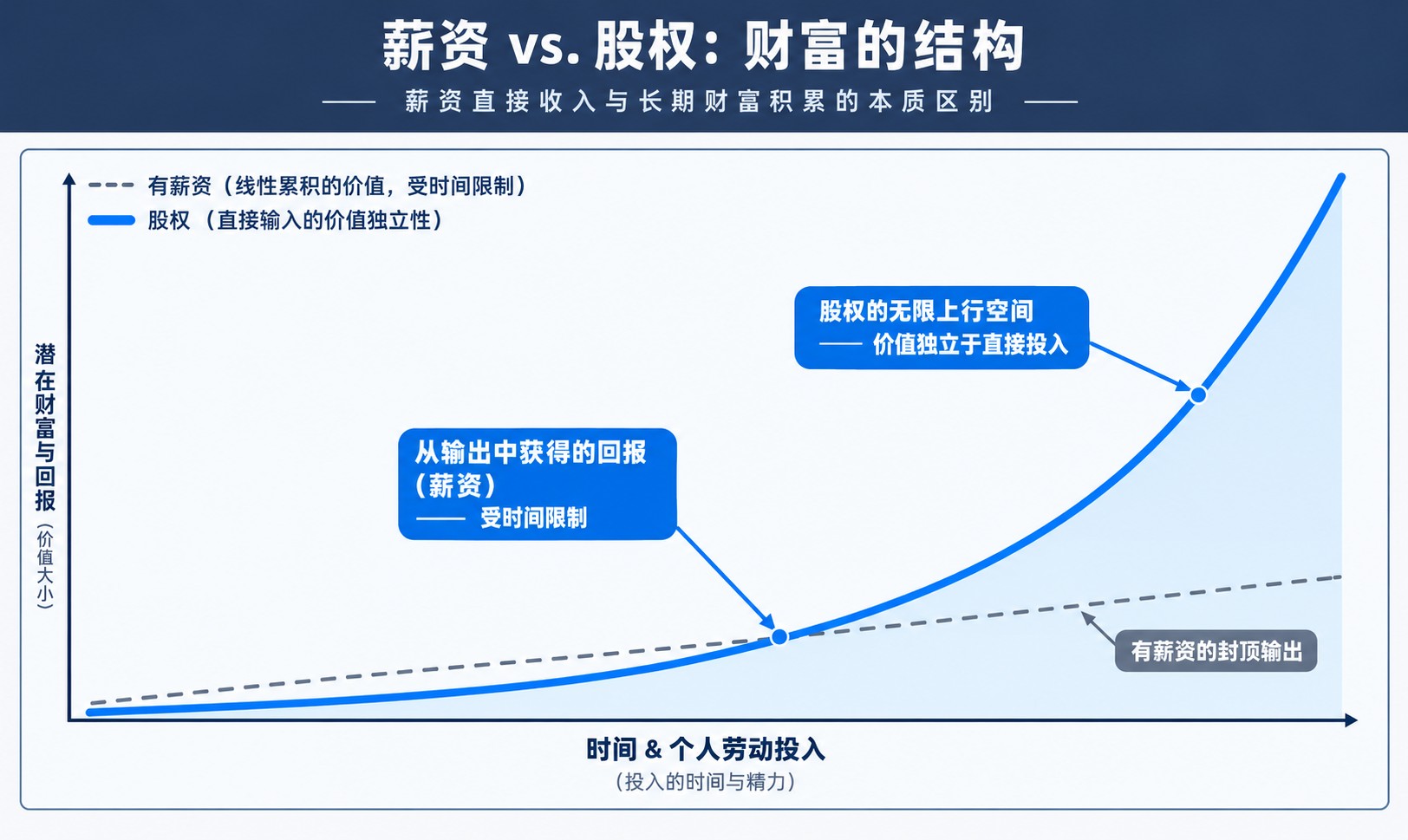
However, don't think that ownership is magically better in every scenario. If you have ever run a company, you definitely know what I mean.
Ownership means greater risk.
Everyone gets paid before you. A bad month for the company changes nothing for other people, only you have to carry it, because they are still waiting for their paycheck.
But as much downside risk as there is, there is just as much upside potential.
The only problem is that this return is not guaranteed; to get it in your pocket, you need something more refined than unrefined knowledge.
4. Judgment
Judgment requires experience, but it can be accelerated by learning basic skills.
— Naval
Knowledge and judgment are not the same thing.
Knowledge is information that you have internalized and understood, that's why it's called "knowledge".
Judgment is how you make decisions based on the information you already have.
The more mature your judgment is, the less information you need to make decisions.
Which markets should you enter?
What ads should you run and when?
When should you grit your teeth and hold on, and when should you cut your losses in time and exit decisively?
There are no ready-made answers to these questions, and there never will be.
This is why judgment takes time to settle.
You have to keep making decisions, observe the consequences, correct deviations in time, and slowly make fewer mistakes.
When I started writing this article, I originally ranked "judgment" as the 5th step, not the 4th. I posted a status about this on Substack, and a reader pointed out the problem. After we discussed it, I found that he was right, so the current order came to be.
This small mistake only took me a few minutes to correct. But if you are running a billion-dollar company, a company with 10,000 employees, or an audience of 50 million, a similar misjudgment can be catastrophic.
Conversely, a brilliant decision is the same, just in the opposite direction.
At the beginning of your career, society does not trust your judgment enough to put too many chips on you.
Over time, as long as you prove that you are right often enough, you will be entrusted with bigger decisions.
More capital.
More people.
More attention.
Greater responsibility.
Your judgment may only improve slowly.
But the consequences it brings can be amplified exponentially.
Which brings us to that multiplier.
5. Leverage
Give me a lever long enough and a fulcrum on which to place it, and I shall move the world.
— Archimedes
10.5 million light-years... that's how long the lever a person needs to move the Earth would be. I know you must be curious about that, so I got that out of the way first.
Back to business. Without leverage, even the most outstanding ability is limited by the limits of one person's physical strength and time.
You might dig faster than everyone else, but the amount of dirt you can move with your own two hands is limited after all.
Naval divides business leverage into three categories: labor, capital, and products with near-zero replication cost (code and media).
Labor leverage is easy to understand: 100 people can do more work than 1 person. Capital leverage is similar: as long as the judgment is correct, more capital supporting it will amplify the outcome of being right.
But the problem with labor and capital is that they require permission from others: you have to get 100 people to agree to work for you, and persuade the rich Uncle Tom to wire $300,000 to your AI startup.
Code and media are different.
"Code and media are permissionless leverage."
Writing code, writing articles, recording podcasts, uploading vlogs, none of these require anyone's approval.
And once created, they can be replicated infinitely at almost zero cost.
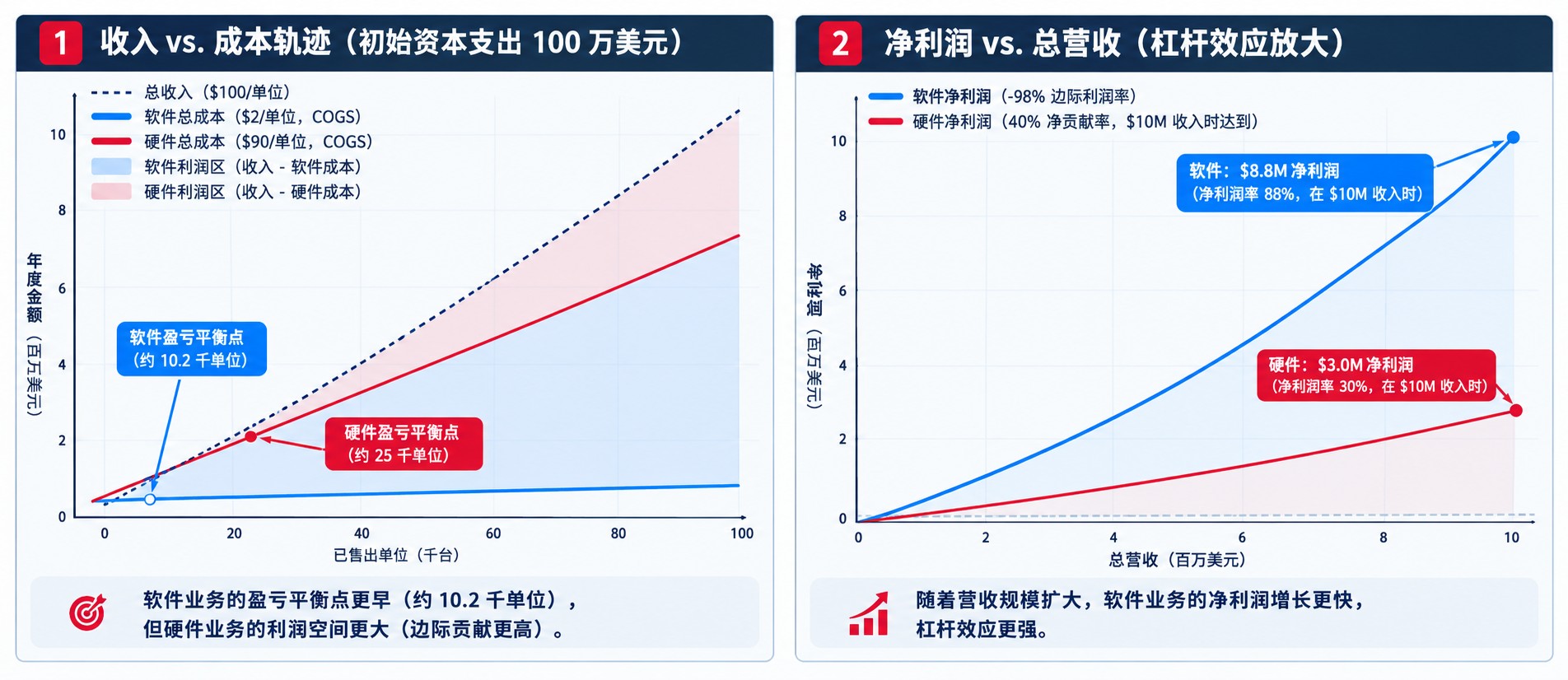
Profit margin expansion comparison: When revenue scale reaches $10 million, restricted by physical cost of goods sold (COGS), the net profit margin of hardware business is about 30% at maximum, while the net profit margin of software business can reach 88%.
Your article can reach hundreds of thousands of readers, but you only need to write it once.
However, leverage itself is neutral. You have to point it in the right direction, otherwise it will just amplify everything it touches.
It just amplifies the outcomes of who you already are, by a lot.
Naval calls it the multiplier for judgment.
So far, every step is... for lack of a better word, "visible", or relatively easy to identify.
You have specific knowledge, you put your name behind your work, you own the returns (and also take the risks), you hone your judgment, and you acquire and apply leverage in the process.
At this point, you already have money.
But to truly accumulate wealth and have that "fuck you money", you can't start over again and again, you have to let what Einstein called "the eighth wonder of the world" work its magic.
6. Compounding
All the returns in life, whether in wealth, relationships, or knowledge, come from compound interest.
— Naval
To be honest, compounding is very boring, but only in the early stage.
Everyone knows a little bit about compounding... and everyone only thinks about it when talking about money.
Put money in the S&P 500, retire with a million dollars in 30 years.
But the scope of compounding goes far beyond that, I would even dare to say that it is the lifeblood of this entire framework.
Let me explain.
Compounding rewards consistency.
Knowledge compounds, because new ideas attach to things you already understand... eventually weaving a web of specific knowledge.
Relationships compound, because trust eliminates friction. Partners who have successfully cooperated for ten years can make decisions far faster than two strangers who need contracts, checks, and repeated confirmations.
Reputation compounds, because every good outcome makes people slightly more willing to bet on you the next time.
Capital compounds, for mathematically obvious reasons.
And all these forms of capital can start to stack on top of each other and generate returns together.
Your knowledge brings better opportunities.
These opportunities hone your judgment.
Good judgment builds your reputation.
Reputation attracts capital and talented people.
They give you greater leverage.
Leverage creates greater results.
Greater results expand your ownership and reputation.
Then the flywheel turns another circle.
At some point, you will hear people say you are lucky. Don't blame them, because to be honest, from the outside, it really does look like luck