Manus's Survival Paradox
In the summer vacation of 2009, Ji Yichao, who had just finished his second year of high school, started developing a third-party iOS browser and named it "Mammoth". In November of the same year, he completed the final beta version of the first-generation product. In December 2010, Mammoth was officially launched for sale on Apple's App Store. Ji Yichao was solely responsible for design, programming, testing and operation.
According to Ji Yichao's recollection in Zhang Xiaojun's Business Interview, from the first-generation product to the last version, the Mammoth browser brought him a total income of more than 300,000 US dollars. At that time, many domestic users did not have international credit cards and could not purchase the software, so he simply cracked his own software and uploaded it to domestic forums for free use.
Apple provides the operating system, development tools and sales channels, while Ji Yichao is responsible for developing products and finding users. A high school student turned his technology into a business with the help of the application ecosystem built by Apple.
Sixteen years later, the computing platform has been updated. Ji Yichao, co-founder and chief scientist of Manus, together with Xiao Hong, founder and CEO of Manus, built Manus. The company does not train foundational models, but calls external models such as Anthropic's Claude and Alibaba's Qwen, and builds these models into agents that can open web pages, write code and deliver files. Launched in March 2025, its annualized recurring revenue exceeded 100 million US dollars eight months later. In October 2026, the company completed a financing of more than 500 million US dollars with a valuation of about 4 billion US dollars.
There is a similar thread running through the experiences of the two. Ji Yichao sold software on Apple's system, Xiao Hong developed tools on the backend of WeChat Official Accounts and WeCom, and later the two worked together to build browser plugins and agents on large models. Large companies build basic capabilities, and they find the unfilled gap between capabilities and users, and turn it into products. This approach can be called dependent innovation.
Most of the external debates about Manus focus on whether the "shell-wrapping" model has technical value. What is more worthy of research is actually the three changes that dependent innovation itself has undergone in the large model era: the window left for dependents is getting shorter and shorter; the position occupied by dependents is exactly where the platform will go next; for every additional business a dependent does, it has to pay more money to its future opponents.
Manus has built a big business with this methodology, and it has to answer these questions earlier. Its success has made the market see the value of agents, and also put it in the market that model companies are ready to compete for. This is the survival paradox of Manus, the common situation of this generation of application companies built on large models, and even the success and dilemma of a technology entrepreneurship model.
01
The Real Asset Is the Time Window
In December 2019, WeCom 3.0 was launched, integrating WeChat's address book, Moments and group chats. Xiao Hong judged that those third-party plug-in tools for managing customers on personal WeChat would be rectified sooner or later, so he launched Weiban Assistant based on the official WeCom interface half a year in advance.
At the end of May 2020, WeTool, the largest third-party plug-in management tool on personal WeChat, was shut down. He wrote an article guiding customers to migrate to Weiban, which was sent at 2 a.m. When he got up at 6 a.m. to check, the number of views had exceeded 100,000. After that, without any marketing, hundreds of companies came to seek cooperation on their own every day.
Two years later, the same thing happened again. According to the review on the website Woshipm, the project of Monica was established on November 20, 2022, ten days earlier than the release of ChatGPT.
After the launch of ChatGPT, the founder of AI writing company Jasper said that he wanted to empower every input box on the Internet, while Jasper itself paid more attention to enterprise customers. Based on this, Xiao Hong decided to develop browser plugins for ordinary users. Monica achieved an annualized revenue of more than 10 million US dollars in more than ten months.
Manus is the third attempt. When it was released on March 5, 2025, there were very few products that allowed ordinary users to watch AI operate the computer on its own and complete a task from beginning to end. ChatGPT did not add the agent mode until the middle of 2025. Manus only opened invitation codes, and within a week, the waiting list reached about 2 million people.
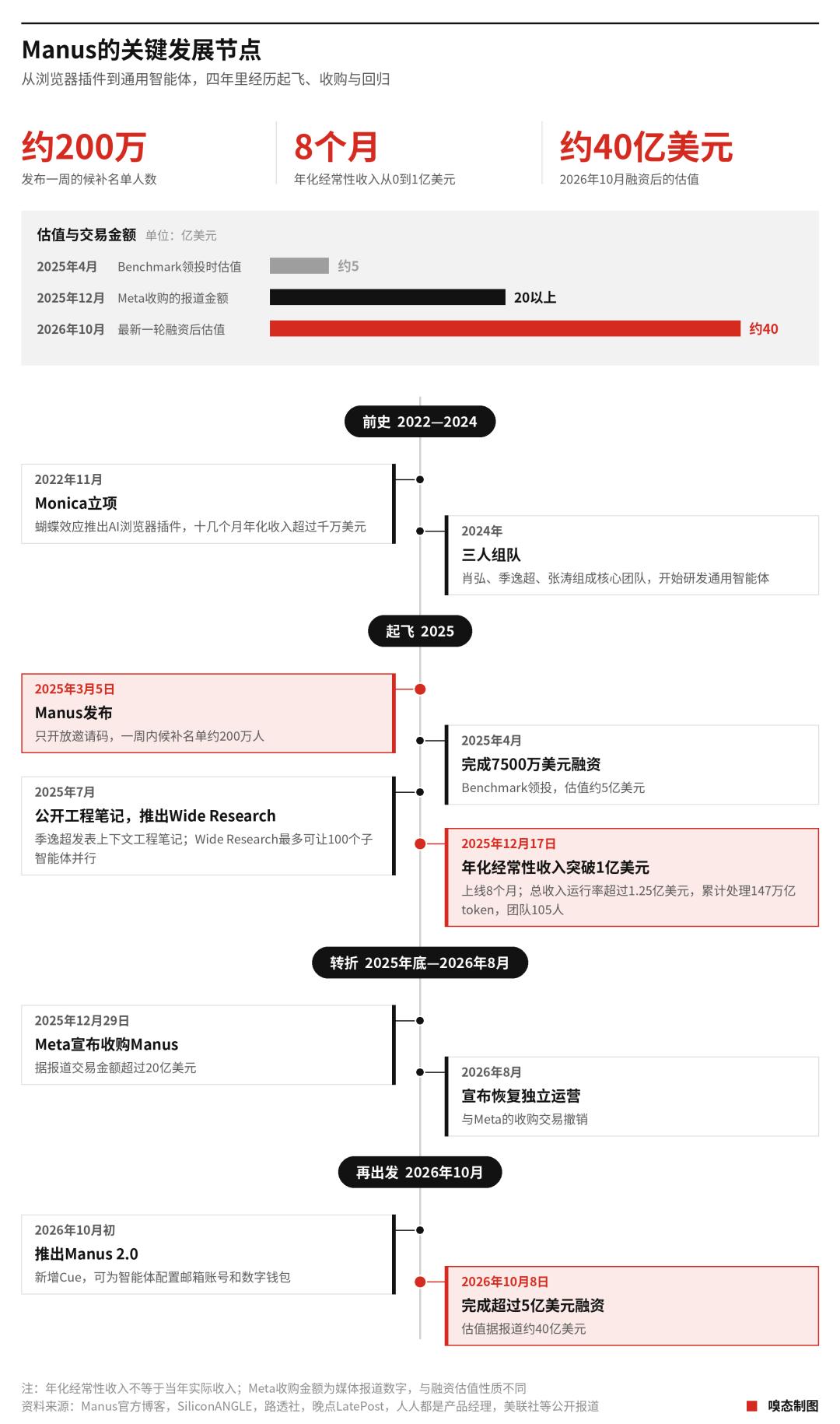
These several shifts all rely on the same ability: to stand in the position that the platform will need before the next change of the platform arrives. Weiban was launched half a year earlier than the shutdown of WeTool, the project of Monica was established ten days earlier than the release of ChatGPT, and Manus was launched before many model companies launched mature general agent products.
The company's engineering system is also designed to seize time. In his engineering notes in July 2025, Ji Yichao explained that one of the reasons why the team chose to bet on prompt engineering instead of training its own model is that improvements can be launched within a few hours instead of waiting for several weeks. In order to find a better organization method, the team completely rewrote the agent framework four times. After the release of Manus, the open source community quickly put together OpenManus, which can replicate most of the functions in the demo, but did not replicate this iteration speed.
For this kind of entrepreneurs, the time difference is the first capital. Launching products in advance can bring revenue, users and opportunities for trial and error. But the window itself cannot retain people. Real assets need to be accumulated before others catch up.
Investors have long been asking how long this business can last. During the period of Yiban, the team's total financing did not exceed 8 million yuan. Liu Yuan, partner of ZhenFund, later said that Xiao Hong was almost rejected by every venture capital firm in China, and he once helped Xiao Hong create a group with more than 130 investors. Investors kept asking where the barriers were.
Launching products earlier than others can explain the growth, but cannot answer what to do when competition comes. It was not until the window of the large model era was large enough to hold hundreds of millions of dollars in revenue that Benchmark led a $75 million Series A round at a valuation of about $500 million in April 2025.
The time difference will disappear. The problem Manus is facing today is that the depreciation speed of this kind of asset is getting faster.
02
The Time Window Is Getting Shorter
Putting several platforms experienced by this team together, we can find a clear rule: the leading time of some products is indeed much shorter than in the past.
Yiban focuses on official account typesetting. In 2017, ZhenFund invested in Nightingale Technology. In the following years, typesetting has always been the business of third-party tools, and Yiban relied on this business to survive until the company was sold. WeTool had a completely different fate: it managed customer relationships on personal WeChat, which touched the account and marketing order that WeChat cared most about. Once the platform changed the rules, it disappeared overnight.
Monica's window was about more than a year. In 2023, it grew rapidly with browser plugins. By 2024, products with their own models such as Doubao and Kimi have successively launched browser plugins, and competed head-on with Monica in functions such as video summarization and Q&A next to search results.
Manus's lead in some product capabilities was soon challenged. At the time of release, it used the score of the GAIA benchmark test as a selling point. By the middle of 2025, Writer's Action Agent got about 61% on the hardest third level, exceeding Manus's 57.7%.
In the same period, ChatGPT added the agent mode. In February 2026, Perplexity launched Perplexity Computer and switched to usage-based pricing at the same time. Its annualized revenue rose from 305 million US dollars to 450 million US dollars within one month. In a year and a half, agents have changed from a selling point of a few companies to a key product direction of many model companies.
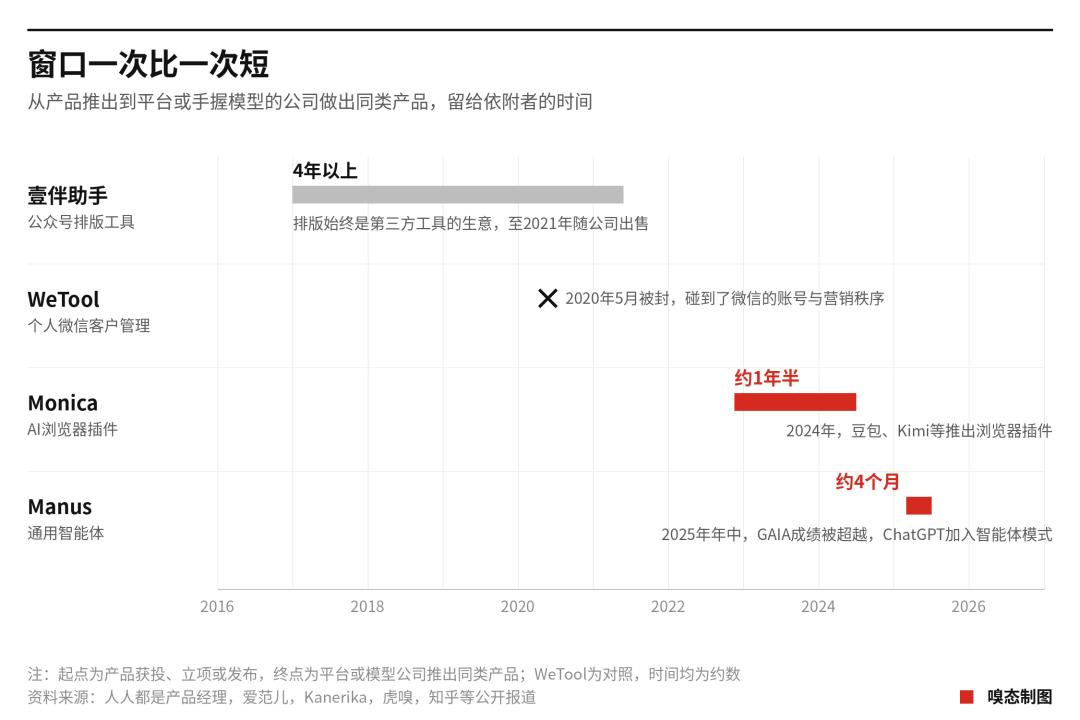
There are two reasons for the shorter window.
The first reason is the rhythm of the platform. There is no unified cycle for the rule adjustment of the WeChat ecosystem and model iteration; but the capability update of large models is frequent enough. Every time a new version is released, the capabilities obtained by all accessors rise synchronously. The progress borrowed by Manus is also borrowed by others at the same time. It is increasingly difficult to retain users only by functional advantages.
The second and more important reason is how far the position of the dependent is from the main track of the platform. Typesetting is far away from WeChat's main social business, so it can survive for a long time. WeTool touched the core of WeChat, so it died quickly. Agents are right on the main track of model companies. Models are being trained to be better at calling tools and operating computers, and agents are the most direct commercial form of model capabilities. Anthropic's annualized revenue rose from about 9 billion US dollars at the end of 2025 to 47 billion US dollars by mid-May 2026, and programming and agent tools such as Claude Code are the main driving force.
This corrects a common saying. People often say that startups verify the market for the platform, and the platform decides to enter only after seeing the success. This does happen in some platform markets. However, in the large model era, model companies are bound to move towards the agent step. The development of agents by model companies has its own technical route and commercial motivation. Manus proved the demand, but it cannot be concluded that it changed the product plan of the giants.
The programming tool Cursor also faces a similar situation. It builds product experience with the help of external models, and at the same time has to compete with programming tools launched by model companies. The business structures of the two types of companies are similar, but the revenue scale, cost structure and customer retention cannot be directly compared.
Thus, we see a possibility from this competitive relationship: in the large model era, the closer an application company is to the main track of model companies, the faster it grows, and the shorter the window. Manus and Cursor stand closest to the main track, where growth and risk appear at the same time. Moving fast does not mean being able to hold the position for a long time.
03
The More User-Friendly the Product Is, the More Money You Pay to Your Opponents
When relying on Apple, every time Ji Yichao sold a copy of Mammoth, Apple got revenue through the App Store share; the actual applicable rate of Mammoth in those years still needs to be verified. This money is calculated as a proportion of revenue, and the share ratio is the same no matter whether the product is well made or how much users use it. When relying on WeChat, Xiao Hong mainly faced the rules of the platform, and he did not need to pay WeChat according to the number of articles published by Yiban's users every day.
Large models have changed this relationship. Models are charged by tokens, and the more you use, the more you pay.
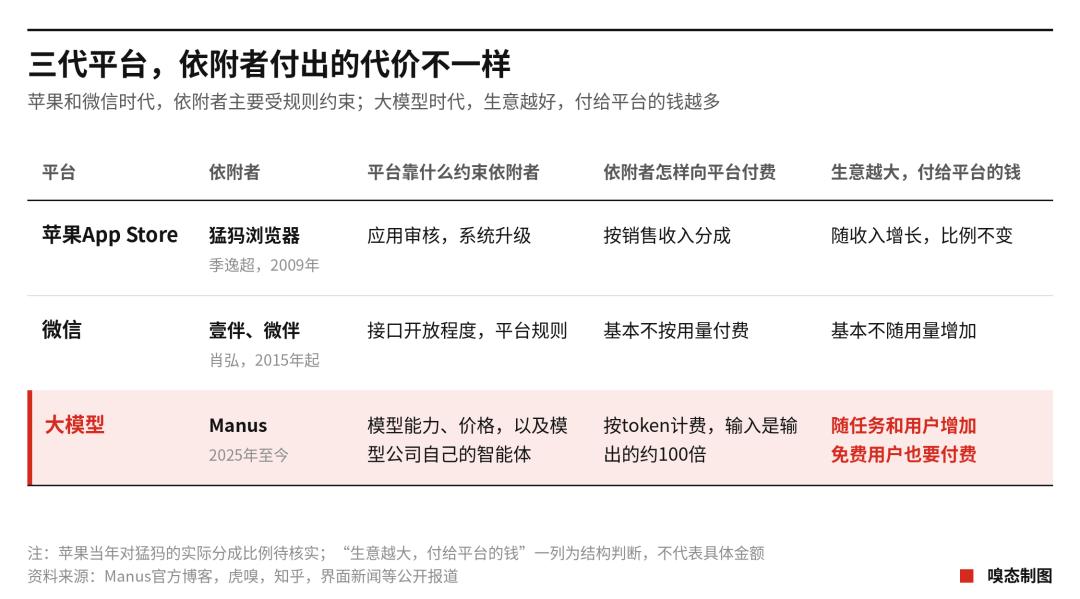
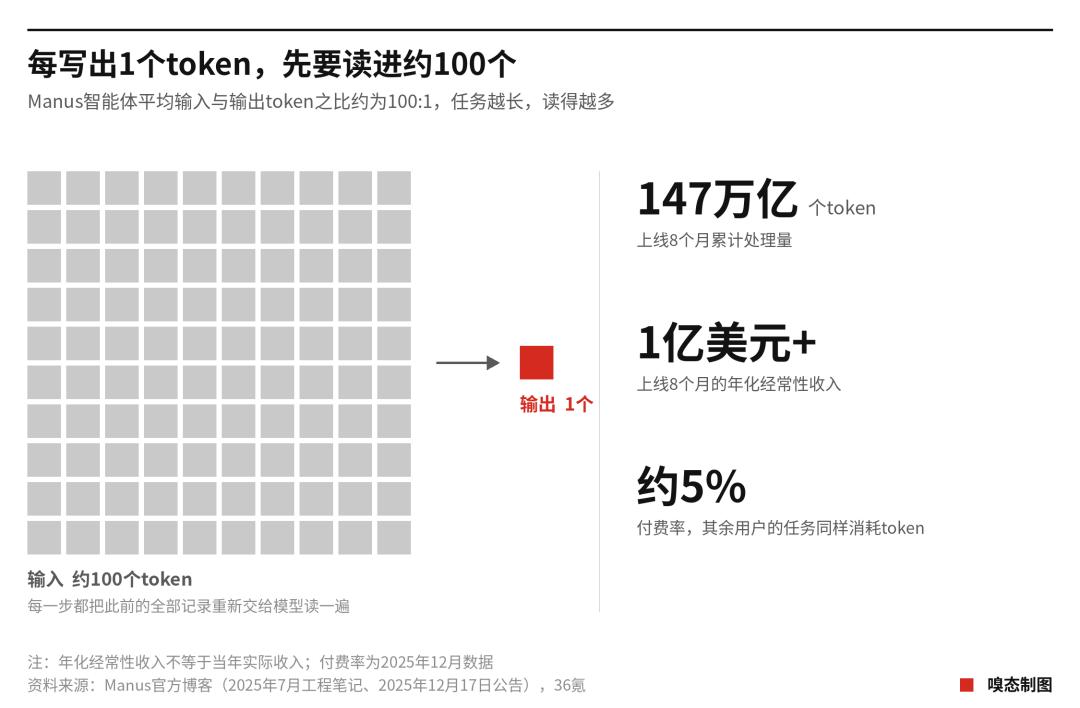
Agents are the most token-intensive usage scenario. Ji Yichao disclosed in his engineering notes that every step taken by the agent requires re-delivering all previous records to the model for reading, and the average ratio of input tokens to output tokens in Manus is about 100 to 1.
The longer, more complex and more autonomous the task is, the more tokens it consumes. Manus launched Wide Research in July 2025, which allows up to 100 sub-agents to work at the same time. The stronger the product capability, the larger the call volume. By December 2025, it had processed more than 147 trillion tokens in eight months.
This adds a usage-based bill to the dependent relationship. The growth of product usage usually increases the model call expenditure; but the unit cost may also decrease due to caching, routing and model price reduction. Whether the revenue can cover the call cost determines how much the growth is worth.
Manus not only purchases capabilities from upstream, but also competes with some upstream companies downstream. The supplier's quotation, model performance and self-owned product strategy will all affect its profit.
Free users make this relationship more obvious. According to 36Kr's report, in December 2025, Manus had 4.5 million registered users, more than 200,000 daily active users, and a paid rate of about 5%. Free users also bring reasoning and operating costs. With the rapid growth of users, revenue conversion and cost control must keep up.
Therefore, in his notes, Ji Yichao called the KV cache hit rate the most important single indicator for the deployed agents. The price of cache-hit input is only a small part of the normal input. The team makes the context only append without rewriting, stores long web pages and PDFs into files and only keeps the path in the context. These engineering designs improve the speed and also reduce the reasoning cost. The most important engineering indicator of a company is also a bill between it and its suppliers, which in itself illustrates the nature of the dependent relationship.
Multi-model scheduling is an important bargaining tool for Manus, but not the only one. Cache efficiency, task splitting, usage procurement and pricing will also affect the cost. It calls multiple models such as Claude and Qwen at the same time. Xiao Hong's team did this during the Monica period, and the backend will automatically select the most cost-effective model combination according to the task type. As long as the capability gap between several models is not large, Manus can suppress the price between them.
In the large model era, in addition to rule dependence, continuous cost dependence has been added. Dependents in the WeChat era worried about the platform changing rules, and today's application companies also have to pay model call fees continuously. The larger the scale, the more important cost control is. Manus has not disclosed its gross profit margin, and the outside world cannot know how much revenue this "rent" has eaten, but the structural direction is clear.
04
Those Who Are Good at Leaving Now Need to Stay for the First Time
Looking back at the experiences of the two founders, we can also see a more hidden thread. Both of them put down old products in time when technology and market shifted.
Ji Yichao's Mammoth was removed from the shelves during the system upgrade. His company Peak Labs launched the search engine Magi in November 2019. Ji Yichao later said on a podcast that the team had compared it with Google head-on, and its accuracy was over 89%. Six months later, GPT-3 came out. He recalled in his engineering notes that the model trained by the team itself lost its meaning almost overnight. He turned to the application layer on top of the models.
When Xiao Hong started his business in Wuhan, he encountered successive setbacks in several directions such