Pet Economy: Premature Decline Ahead of Its Prime
In the ranking of consumer value in the investment industry, young girls > children > young women > the elderly > dogs > men.
This long-circulating joke indeed became a footnote to the explosive growth of the pet market in previous years.
That was the golden age of China's pet industry. After more than 20 years of accumulation, a huge total number of pets was formed. Young pet owners upgraded the identity of their pets to "family members", and emotional value promoted the upgrading of pet consumption.
Chinese pet enterprises that originally focused on overseas OEM businesses have turned to the local market one after another and launched their own brands. Whoever dominates the brand business dominates the market, and whoever wins the Chinese market wins the future. With growing revenue and rising profitability, they have blazed an upgrading path for China's pet industry.
However, 2025 became a watershed for China's pet industry. The first half was booming, while the second half suddenly entered a cold winter. Since last year, the growth rate of the pet industry has declined, the listed companies have seen a collective drop in performance, and the sector has suffered a valuation crash.
Behind the plunge from the peak, what on earth happened to China's pet market? On the surface, the extreme involution behind the market boom has spread from overseas to the domestic market. The drop in gross profit margin coupled with the rise in expenses has greatly reduced the profitability of the pet industry.
Fundamentally, in the domestic pet market that has been highly expected by all, with the quiet arrival of the pet stock era and the pet aging trend, industrial upgrading has entered a more difficult second half. An orchard that is prematurely ripened by capital is destined to hardly have a good harvest.
Pet Market: Plunge from the Peak
Last year, almost the entire consumer market was envious that the pet industry achieved an independent explosive growth trend in the weak consumption recovery stage.
From the end of 2024 to the middle of 2025, the pet sector ushered in an epic market rally, during which the share prices of leading companies such as Fuzhou Pet and China Pet Co., Ltd. rose several times. At the Shanghai Pet Fair in August, the exhibition hall area and the number of exhibitors hit record highs. During the 618 and Double 11 shopping festivals last year, the performance of leading pet brands surged, and new brands emerged in endlessly.
However, if you plunged into this market at the peak last year, you may get great disappointment this year.
In the second half of last year, the pet market had already begun to cool down, but the market trend had not been fully transmitted to the end. By the first half of 2026, the industry had completely shown a completely different state.
During the 618 shopping festival in 2026, the overall growth rate of pet brands declined significantly, the leading camp was solidified, and no new brands entered the TOP10 list. It was not until the pet sector released its first-half performance report that the crisis really attracted market attention.
In the first half of this year, Fuzhou Pet achieved an operating revenue of 3.543 billion yuan, a year-on-year increase of 10.01%, and the net profit attributable to shareholders was 191 million yuan, a year-on-year decrease of 49.57%.
Another pet food giant, China Pet Co., Ltd., recorded an operating revenue of 3.281 billion yuan from January to June 2026, and the net profit attributable to shareholders was 127 million yuan, a year-on-year decrease of 37.63%.
Almost none of the listed pet companies behind Fuzhou Pet and China Pet Co., Ltd. were spared, with collective performance decline, and some even saw double drops in revenue and net profit.
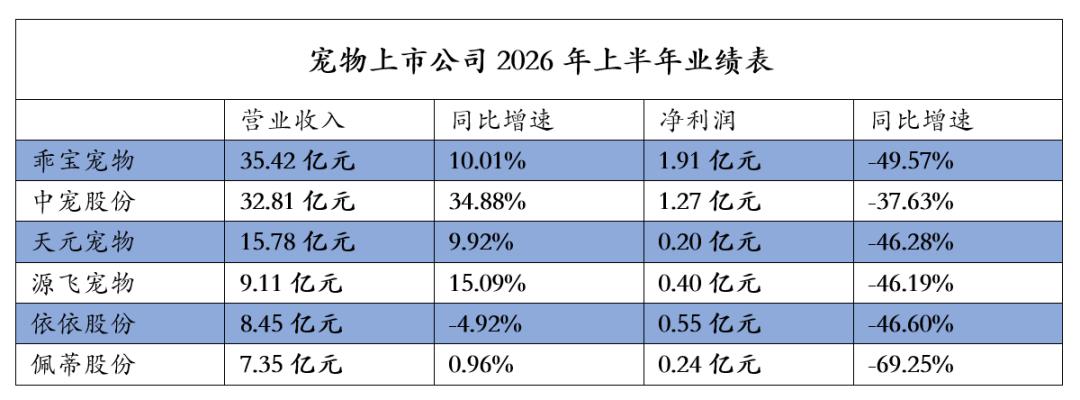
The pet sector, which was highly sought after in the first half of last year, turned downward collectively in the second half, and has now fallen back to its original level. The leading company Fuzhou Pet saw its share price drop from more than 120 yuan at the peak in May last year to less than 40 yuan now.
The 2026 White Paper on China's Pet Industry shows that the consumption market size of urban pets (dogs and cats) in China reached 312.6 billion yuan in 2025, and the industry has entered a normal stage of low growth.
The cold market has directly affected the attitude of capital. In October last year, Yiyi Co., Ltd., the leading pet hygiene products enterprise, launched an acquisition of Gaoyejia (+ Xu Cuihua), a dark horse in pet food and supplies. However, 4 months later, the transaction was called off because the actual operating performance of the target company deviated from expectations.
The pet market plunged from the peak to the bottom almost overnight. What decisive factor led to this?
30 Years, Two Revolutions
Most people do not know that the concept of pets has only existed in the daily life of Chinese people for 30 years.
In 1992, China Small Animal Protection Association was founded, and the concept of "pet companion" emerged in China. Small animals that originally took functional roles such as house watching and guarding had their family status confirmed.
However, in the more than 20 years after that, the pet market and the pet industry were like two parallel lines, with almost no intersection.
The number of pets in China is huge and keeps growing, but the overall consumption capacity is quite limited. In the memory of most post-80s and post-90s generations, the cats and dogs at home can live by eating leftover food. The capacity of the pet consumption market dominated by dog food, cat food and pet supplies is limited, and it is occupied by foreign brands such as Nestlé Purina and Mars Royal.
Regions such as Shandong and Zhejiang took advantage of the by-products of chicken and duck slaughtering industry and the industrial advantages of foreign trade small commodities to form the pet industry at an early stage, but it mainly developed in the form of OEM and ODM processing.
After more than 20 years of development, the new generation of pet owners gradually upgraded their companion pets to "family members", and the projection of emotional consumption in pet scenarios has promoted the upgrading of China's pet consumption, bringing industry-wide growth opportunities.
Chinese pet enterprises, whose main business was originally OEM export, have launched a round of industrial upgrading focusing on the Chinese market and brand business. Among them, Fuzhou Pet has grown into a representative enterprise.
In 2006, Qin Hua, who once worked at Fengxiang Group, a leading chicken processing enterprise, founded Fuzhou Pet in Liaocheng, Shandong. Like most pet enterprises at that time, Fuzhou Pet was also rooted in OEM export business in the early stage.
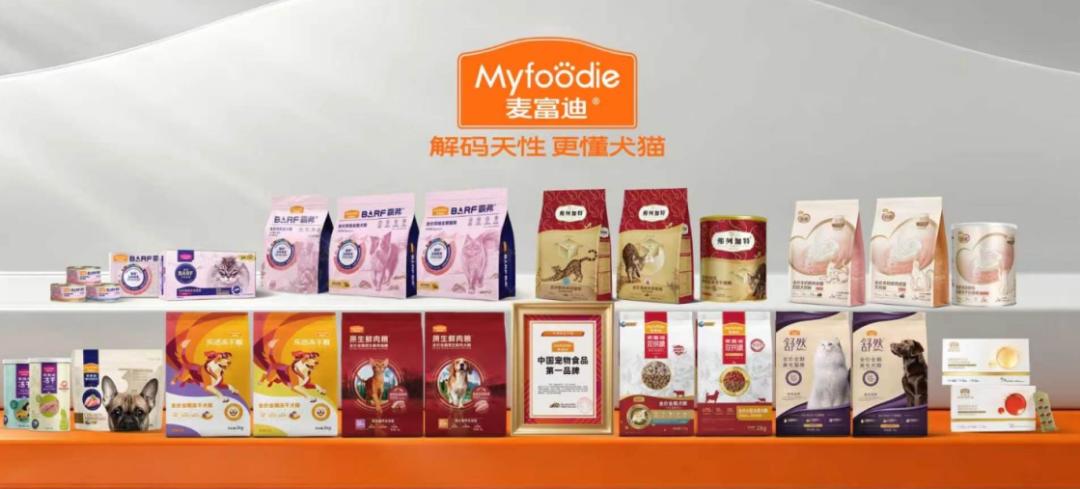
To pursue higher business value, Fuzhou Pet started brand transformation and focused on the local market. It founded the mid-to-high-end brand Myfoodie in 2013, launched the high-end cat food brand Fregate in 2018, acquired the American high-end pet brand Waggin' Train in 2021 and continued its overseas operation, and founded the ultra-high-end dog food brand Wangzhenchun in 2024.
By 2025, the revenue proportion of Fuzhou Pet's own brand business has exceeded 73%, and the proportion of OEM business is only 26%. The gross profit margin of the brand business is more than 40%, and some are even higher than 50%, far exceeding the level of about 30% of the OEM business. The overall gross profit margin of the company exceeds 40%, which is far higher than the overall level of the pet industry.
Behind Fuzhou Pet, there is a collective rise of local Chinese pet brands. China Pet Co., Ltd. has brands including Wanshi, Lingxian and Zhenzhi. Petty Co., Ltd. has brands such as Chieneng, Jueyan and Haishijia. Tianyuan Pet has the brand Petstar. Yuanfei Pet launched three own brands PIKAPOO, Halewei and Legend Elf at one go in 2024, and Yiyi Co., Ltd. also has own brands such as Leshichong and Yiping Huafang.
Since China's pet industry has found its own upgrading direction, why did it encounter collective difficulties since the second half of 2025?
Full-scale Involution Is Inevitable
The most direct reason for the growth dilemma of the pet industry and the performance decline of leading companies is related to the overseas business of the pet industry.
Although the leading companies in China's pet industry have taken the domestic market and brand business as their main directions in recent years, their fundamental business is still overseas, which is determined by the history of industrial development.
Since last year, affected by factors such as geopolitics and industry competition, the export of pet food and supplies has been blocked. Data shows that China's pet food export volume reached 10.102 billion yuan in 2025, a year-on-year decrease of 427 million yuan, and the export volume was 361,300 tons, a year-on-year increase of 26,300 tons.
Compared with the decline in the growth rate of the total volume and the drop in the total amount, the impact of price drop on the industry is more critical. In 2025, the export price of China's pet food decreased by 11% year-on-year.
Involution not only exists in the overseas market, but also in the domestic market.
The rise of the local pet market was followed by a round of pet brand wars, and a large number of new brands rose with the help of e-commerce or live streaming e-commerce channels. Especially on platforms such as Douyin and Kuaishou, a few popular pet videos will immediately bring a surge of orders.
Take Xu Cuihua under Gaoyejia as an example. It was founded in 2022, its revenue exceeded 75 million yuan in 2023, reached 260 million yuan in 2024, and became one of the leading brands in the cat litter segment in 2025.
However, in the cruel market competition, even if Xu Cuihua later consolidated its moat through product iteration and self-built production capacity, it still cannot escape the logic of price-driven competition.
Many people became users of Xu Cuihua through Li Jiaqi's live stream. The average consumption price there is much lower than that of Xu Cuihua's products, which are originally positioned as good quality and affordable.
Not only the cat litter market where Xu Cuihua is located, but the entire pet market has been filled with the smoke of competition in recent years. This vicious industry competition is reflected in the financial reports of listed companies as an overall decline in profitability.
In the first half of 2026, the overall gross profit margin of several listed pet companies declined to varying degrees, among which China Pet Co., Ltd. was the most serious, with a drop of 5.38 percentage points, falling below 30%.
On the other hand, the construction of own brands means rising sales expenses. In the financial reports of the above companies, it is a common situation that the growth rate of sales expenses is higher than the growth rate of operating revenue.
Finally, the decline in gross profit margin coupled with the rising sales expenses led to the overall profitability of China's pet industry starting to decline since last year, and the problem was fully exposed in the first half of this year.
Therefore, the current situation of the pet market is that enterprises that still take OEM export as their main direction have seen double declines in revenue and profit, such as Yiyi Co., Ltd. Those enterprises with excellent brand transformation rely on domestic business to support revenue growth, but their profitability has shrunk significantly, such as Fuzhou Pet.
This is a mid-term turmoil in which China's pet industry is passively involved under the global involution of the pet market. Next, can the situation turn for the better?
Premature Aging, Market Transition
According to the plan of leading companies in China's pet industry, gradually replacing overseas OEM business with domestic brand business can complete the core upgrading of China's pet industry.
However, greater potential crises have gradually emerged, putting overwhelming pressure on China's pet industry.
China's pet group has been formed for a long time, but the pet market was born too late, so that as soon as the market took shape, the pet scale entered a stock era with low growth rate.
Data shows that the number of pet dogs in China was 53.43 million in 2025, up 1.6% from 2024, and the number of pet cats was 72.89 million, up 1.9% from 2024. In the previous 5 years, the average annual compound growth rate was about 4.6%.
Moreover, this seemingly emerging market has initially entered the aging stage. The proportion of dogs and cats over 7 years old in China is close to 20%, and it is expected to enter a concentrated aging cycle in the next 5-10 years.
For a market where the growth rate of the scale of potential core consumers is declining or even shrinking, it is difficult to form effective growth space only by increasing the unit price per customer to maintain the market scale.
For enterprises, under the background of the stock era, in a market with extremely scattered products and channels, it is also very challenging to expect to maintain competitiveness by increasing market concentration.
The capital market is used to applying the pet market experience of Europe, America, Japan and South Korea to the Chinese market to estimate the huge pet ownership and individual economic value, but ignores the reality of China's pet market.
In terms of previous indicators such as market growth rate and market concentration, China's pet market is in the early stage of development; but from the perspective of stock characteristics and market trends, China's pet market has entered the second half of development.
In the prematurely