Burn, Token: The Major Capital Efficiency Test for Cloud Vendors in the Agentic Cloud Era
Computing power is the hardest admission ticket to the AI era. Tech giants holding abundant cash flow naturally have the confidence to continuously increase capital expenditures.
From training large models to supporting the large-scale deployment of tens of thousands of Agents, cloud vendors are launching a computing power arms race, trying to seize the commanding heights of the Agentic Cloud era with massive infrastructure construction.
But capital is not an infinite supply of bullets. When continuous capacity expansion collides with a long return cycle, the vigorous expansion of computing power may turn into a high-risk capital gamble at any time.
Behind the tear between optimistic expectations from the industry and bearish sentiment in the secondary market, the real test is not how much money can be invested, but whether the invested capital can be converted into sustainable returns.
This article will focus on analyzing
- Why does the implementation of Agents force cloud vendors to complete a full-stack rewrite of the architecture?
- What explicit costs has this computing power arms race brought?
- How can domestic chip substitution and business model iteration improve ROIC?
- What is the watershed for the second half of the Agentic Cloud era?
Do tech giants really have infinite bullets to support the almost endless capital expenditures in the AI era?
In the second quarter of 2026, the combined single-quarter capital expenditure of three domestic tech giants Alibaba, Tencent and Baidu reached 1.31852 trillion yuan, a year-on-year surge of 114% compared with 615.83 billion yuan in the same period last year. By breakdown, Alibaba's single-quarter capital expenditure was 676.78 billion yuan, up 75% year-on-year; Tencent's was 527.84 billion yuan, up 176% year-on-year; Baidu's was 113.90 billion yuan, with a year-on-year increase of nearly 200%.
The core variable driving this round of trillion-level heavy investment is the accelerating deployment of AI intelligent Agents. As enterprise AI moves from the model pilot stage to the large-scale commercial operation of tens of thousands of Agents, traditional cloud computing architecture can no longer support the explosive and continuous reasoning demand, and Agentic Cloud has thus become a new track that global cloud vendors are collectively betting on.
At the Yunqi Conference in Hangzhou on September 22, Wu Yongming, CEO of Alibaba Cloud, announced that the scale of Alibaba Cloud's data centers will exceed 20GW by 2032.
This power scale is equivalent to the full-load operation of 20 large nuclear power units, which is by no means a small goal. According to Goldman Sachs' calculation, the current deployed computing power scale of Alibaba Cloud is about 5-6GW, and it was only 2GW in 2022, which means that Alibaba needs to expand its computing power base tenfold within ten years.
The market's reaction to this figure is split in a very interesting way. Goldman Sachs, Citi and UBS all regard it as the most incrementally valuable information at the Yunqi Conference, and re-evaluate Alibaba Cloud's long-term revenue space. Calculated based on the potential of trillion-level external revenue per GW, 20GW is an anchor sufficient to rewrite the valuation model.
But on the other hand, Alibaba's US-listed ADR has retreated by more than 40% cumulatively since October 2025, and it once fell by more than 4% in pre-market trading after the release of the August financial report.
The vigorous expansion of computing power on the industrial side and the optimistic profit forecasts of investment banks are in sharp contrast with the cautious voting with their feet in the secondary market.
The essence of the divergence is not that the long-term value of the AI cloud is in doubt, but that under the paradigm shift of cloud computing moving from the first half of selling resources to the second half of Agentic Cloud that outputs intelligence, cloud vendors have placed unprecedented capital expenditures, but no one really knows when and by what path this money will be recovered.
Agentic Cloud is rewriting the underlying logic of the cloud: reasoning replaces training, stateful tasks replace stateless requests, and the Token economy replaces the traditional resource economy. Sky-high capital expenditures have become an irresistible trend, but scale is no longer the king of winning. ROIC, free cash flow and GPU utilization are the new lifelines of competition.
Part.1
The Admission Ticket to Agentic Cloud
The Mandatory Full-Stack Rewrite
To understand why this round of investment is so fierce, we must first understand a fundamental change: the main consumers of the cloud are changing from humans to intelligent agents, and cloud services are shifting from providing resources and computing power to outputting capabilities and intelligence.
Before 2023, the cloud industry was collectively anxious, as the mobile internet dividend peaked, the growth rate of enterprise digitalization slowed down, and no one knew where the next growth engine was. At that time, no one expected that the answer would come in such a drastic way.
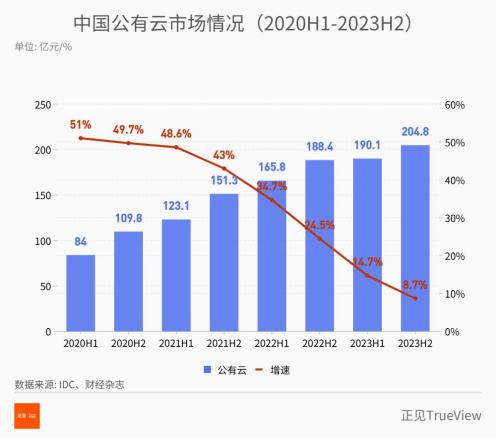
The sudden emergence of ChatGPT opened the door to the era of large models, but at that time the main load on the cloud was concentrated on model training, and the demand for computing power would drop after the training task was completed.
The real industry inflection point is not 2023, but 2025. In the words of a senior executive of Tencent Cloud: DeepSeek detonated the market in the first half of the year, and Agents took over in the second half of the year, significantly increasing market vitality.
Behind this, the identity of cloud vendors has completed a switch: from water sellers in the digital age to gatekeepers of computing power in the AI era. Water sellers sell standardized general resources that all market participants can buy; while gatekeepers of computing power sell access to scarce computing power, which is the pre-requisite base for AI business operation.
The financial implication of this identity switch is huge, which means a reshuffle of the industry's bargaining power.
Overseas market data provides a reference. Barclays' research shows that for every $100 of revenue earned by US AI large model companies, about $35 to $40 eventually flows to AWS, Azure and Google Cloud. Cloud vendors take about $10 to $20 of operating profit from it, corresponding to a profit margin of 35%-45%.
In other words, the more prosperous AI applications are, the larger the profit share that cloud vendors take. Model companies compete on prices in the front office, while cloud vendors count their money in the back office.
Signals in the Chinese market are also flashing simultaneously. In the second quarter of 2026, the revenue of Baidu AI cloud infrastructure, Kingsoft Cloud, and the FBS segment where Tencent Cloud is located increased by 50%, 30.8% and 9% year-on-year respectively; Alibaba Cloud's AI-related product revenue maintained three-digit growth for 12 consecutive quarters. Data from the China Academy of Information and Communications Technology shows that in 2025, the public cloud large model Token call volume in China reached 2000 trillion, a surge of more than 16 times compared with 114 trillion in 2024.
The real technological qualitative change took place in 2026. Google launched the Agentic Cloud strategy at the Next'26 conference, Alibaba Cloud completed the full-stack intelligent upgrade, Amazon launched AgentCore, and Microsoft Foundry Agent Service was officially commercialized.
The four leading global cloud vendors aligned their actions in a similar window period, and this synchronization is rare in the history of cloud computing. Forrester summarizes this round of transformation as enterprise AI is moving from the pilot era to the era of large-scale management.
This is a thorough generational architecture iteration. The China Academy of Information and Communications Technology points out that typical Agent tasks follow the multi-round closed-loop logic of "perception-reasoning-action-feedback". Reasoning runs through the whole process, triggering dozens of chain calls and tool execution, and the task life cycle extends from the millisecond level to minutes, hours, or even days.
In contrast, the traditional cloud-native architecture was originally designed for short-cycle, stateless, replaceable work units. After the task calculation is completed, the container is immediately recycled and destroyed. There is a fundamental mismatch between the underlying logic of the two.
The practical pain points caused by architecture incompatibility are very prominent. There is a widely circulated typical case in the technical community: an intelligent agent program takes 4 hours to process 400 documents, and an error occurs when running to the 301st document. Due to the lack of a checkpoint mechanism, the entire task can only be re-executed in full; once the network is interrupted, all intermediate running states are lost directly.

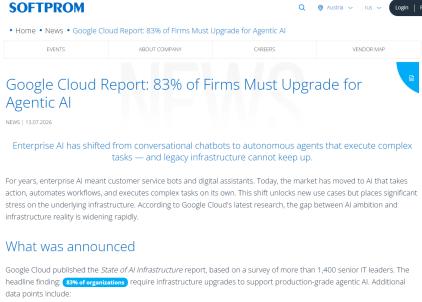
Google Cloud's survey also shows that 83% of enterprises believe that existing infrastructure cannot support the implementation of production-grade Agentic AI.
Another core watershed of Agentic Cloud is that reasoning load is replacing training and becoming the mainstream business on the cloud. Gartner predicts that 55% of AI-optimized IaaS spending in 2026 will be used for reasoning business, and this proportion will further rise to 59% in 2027.
The cloud resource consumption pattern has thus changed, from one-time, pulse-like training investment to uninterrupted continuous operating expenses. Countless Agents continuously initiate Token calls, just like a factory that never stops working.
This also explains why cloud vendors must carry out full-stack reconstruction instead of simply adding GPUs. Every layer of chips, scheduling systems, storage, runtime, and reasoning platforms needs to be redesigned for long-cycle, stateful, high-concurrency reasoning tasks.
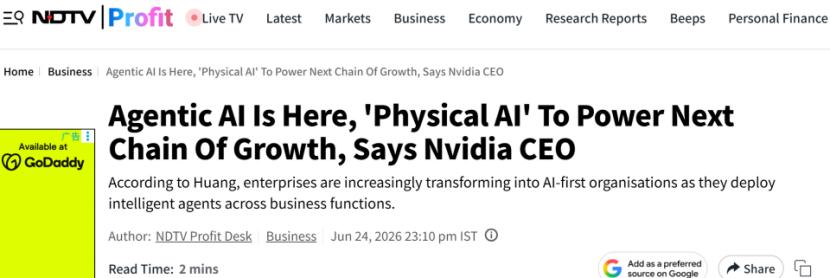
Jen-Hsun Huang said plainly at the annual general meeting in June: Traditional data centers provide services such as storage, and today's AI factories are used to manufacture tokens, and each token is a profit unit.
Agentic Cloud is not a progressive upgrade that simply adds GPU hardware and modifies part of the code, but a complete full-stack rewrite covering chips, scheduling, storage, runtime, and reasoning platforms.
Part.2
The Cost of Full-Stack Rewrite
Under the Pressure of Sky-High Bills
Translating the full-stack rewrite into financial language is the steep rise of the capital expenditure curve.
According to Goldman Sachs' calculation, Alibaba Cloud will expand its data center scale from the current 5-6GW to 20GW, adding 1-2GW each year in the next few years, with annual capital expenditures of about 200-300 billion yuan; it is expected to reach 209 billion yuan, 243 billion yuan and 260 billion yuan respectively from 2027 to 2029.
ByteDance raised its full-year 2026 capital expenditure plan to more than 200 billion yuan, with the highest investment intensity in China.
Overall, Morgan Stanley predicts that the capital expenditure of China's core cloud vendors and major internet companies will reach 995 billion yuan in 2026, a year-on-year increase of 121%, far higher than the 41% growth rate in the United States in the same period. From 2026 to 2030, China's AI-related capital expenditures will total 8.5 trillion yuan.
The same is true globally. TrendForce updated its calculation in October: the nine major cloud vendors Google, Amazon, Meta, Microsoft, Oracle, Byte, Tencent, Alibaba and Baidu have raised their 2026 capital expenditures to more than 957 billion US dollars, and may exceed 1.5 trillion US dollars in 2027.
Massive numbers are easily reminiscent of an arms race. But if you look closely at the structure, you will find that this round of investment is different from any previous cloud expansion.
In the past cloud expansion, the competition was about computer room area, number of servers, and bandwidth capacity, with the core being economies of scale. The larger the scale, the lower the unit cost and the higher the marginal profit. This is a linear narrative.
But in this round of Agentic Cloud, the competition is about how many Tokens can be produced per unit of computing power, how many Agents can be carried per unit of Token, and how much revenue can be converted per unit of Agent, with the core being capability density.
This is a non-linear narrative. Capital investment can be doubled, but if the capability density does not meet the standard, business output will not grow proportionally, and even negative returns may occur.
The most direct result brought by the high bill is the collective pressure on corporate cash flow.
In August, Alibaba quantified the AI computing power return cycle for the first time. CFO Xu Hong said that computing power services equipped with self-developed chips generally achieve break-even in three years; according to the five-year life cycle of the equipment, after breaking even, it will take at least two more years to generate positive free cash flow.
In other words, from large-scale investment to the real recovery of cash, it will take five years even under optimistic circumstances.
In the second quarter of 2026, the combined net outflow of free cash flow of Alibaba, Tencent and Baidu was 664.24 billion yuan.
Tencent's free cash flow was -138 billion yuan, the first time in history to turn negative, mainly from 51.4 billion yuan of prepayments for computing power procurement. Alibaba's net outflow of free cash flow in fiscal year 2026 was 466.1 billion yuan, and it continued to outflow 446.7 billion yuan in the first quarter of fiscal year 2027. In the past four quarters, Alibaba's AI+ cloud segment capital expenditure was about 1200 billion yuan, and there are 541.36 billion yuan of signed but unpaid payments.
Domestic internet giants, once famous for their abundant cash flow, have collectively seen red on their books. According to the research report of Minmetals Securities, the ratio of AI capital expenditure to corresponding revenue of five leading cloud vendors soared from 59.2% in 2023 to 128.3% in the first half of 2026. Capital investment has exceeded twice the corresponding revenue, and a large amount of costs have been advanced.
At the same time, the risks of idle computing power and overcapacity continue to rise. Data from the National Data Administration shows that as of June 2026, there are more than 500 intelligent computing centers in operation in China, and nearly 400 projects are under construction or planned. Zhang Jin from Tencent Cloud publicly mentioned at the MWC26 Intelligent Data Center Summit that the average utilization rate of intelligent computing centers across the country is only 20%-30%, and the utilization rate of some enterprise-level intelligent computing centers is less than 10%.
Data from the China Academy of Information and Communications Technology also shows that the actual utilization rate of domestic intelligent computing resources in 2025 was only 36.8%. For every 100 yuan invested in computing power construction, about 70 yuan of corresponding resources are idling.
Based on a survey of 3412 participants,