Going head-to-head against DeepSeek, MiniMax M3.1 Flash is officially released, delivering an output TPS of over 200, with its price cut to half of the original.
The anonymous model Space Bunny that has taken the AI community by storm has finally been claimed!
Reported by Zhidx on October 19, MiniMax has just officially released M3.1 Flash, positioned as a lightweight model optimized for Coding/Agent, with a 1 million-token context window.
Almost at the same time, on October 17, DeepSeek V4.1 Flash-1017 was launched. (Liang Sheng flipped the table again! The new DeepSeek model outperforms GPT-6, and the era of wish-based programming is coming)
According to the benchmark test results of M3.1 Flash, the model has achieved significant improvements in Agentic tasks, programming, Computer Use and cybersecurity capabilities, and is basically on par with DeepSeek V4.1 Flash-1017.
The price has further broken through the "kill line". The input price of M3.1 Flash is 1 yuan per million tokens, the output price is 4 yuan per million tokens, and the cache read price is 0.1 yuan per million tokens. According to the information released by the MiniMax team, the comprehensive usage cost of this model in Agentic tasks is 70% lower than that of the previous generation model.
The pricing of DeepSeek V4.1 Flash-1017 is 0.02 yuan per million tokens for off-peak input (cache hit), 1.0 yuan per million tokens for cache miss, 4.0 yuan per million tokens for output, 0.04 yuan per million tokens for peak input (cache hit), 2.0 yuan per million tokens for cache miss, and 8.0 yuan per million tokens for output.
The two sides are catching up in capabilities, and are unwilling to show weakness in price. With the successive launch of these two "Flash" models, domestic models have for the first time formed a "two strong" pattern in the Flash segment.
01.
Breaking down the hardcore report card: the king of cost-effectiveness
Multiple results exceed Kimi K3 and GLM-5.3
The community reputation accumulated by Space Bunny during its anonymous period has made the official version of M3.1 Flash carry extremely high expectations. So how are its actual results?
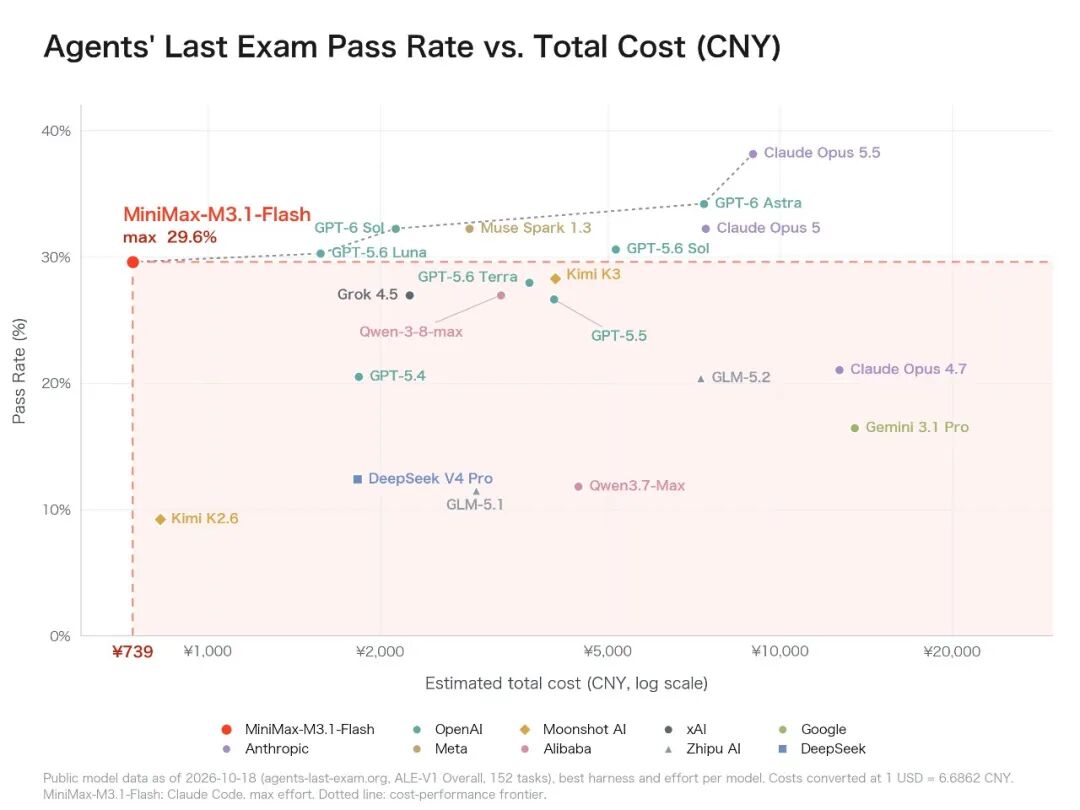
In complex tasks and automation, M3.1 Flash has achieved overtaking. In the Agents' Last Exam that evaluates long-range, multi-step real tasks of agents, M3.1 Flash achieved a pass rate of 29.6% and a cost of 739 yuan, which is at the forefront of the "low cost - high pass rate" range, with performance far exceeding models of the same price range.
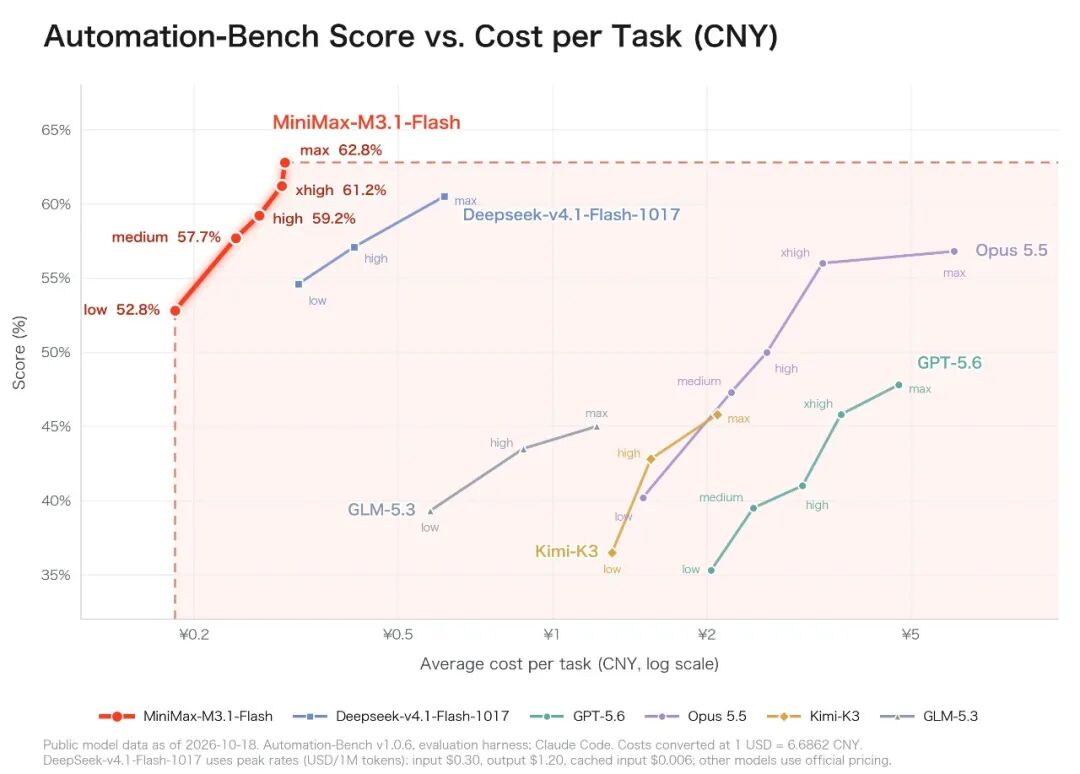
In Automation-Bench v1.0.6 that examines cross-application automation of real business processes, M3.1 Flash scored 62.2 points, overtaking DeepSeek V4.1 Flash-1017's 60.5 points, and leaving Opus 5 far behind.
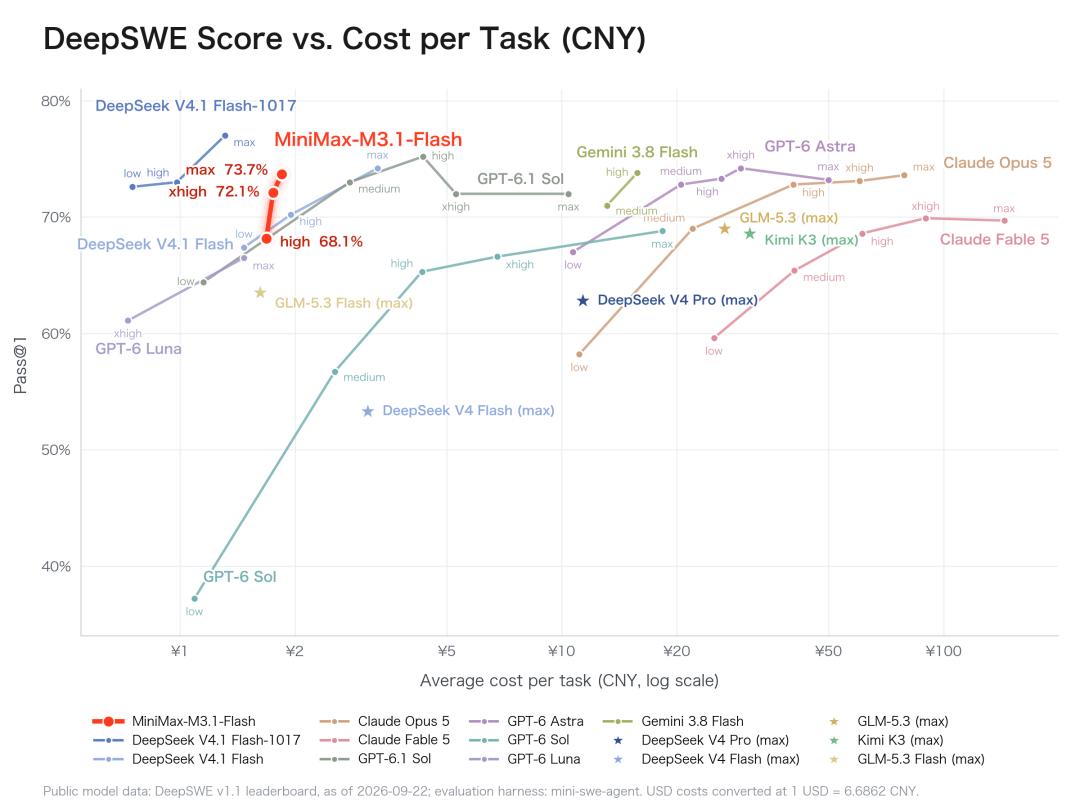
In the programming field, M3.1 Flash and DeepSeek V4.1 Flash-1017 have their own focuses. In the DeepSWE v1.1 test, DeepSeek V4.1 Flash-1017 scored 77.0 points, ranking first. M3.1 Flash scored 73.7 points, only 0.3 points behind Opus 5.
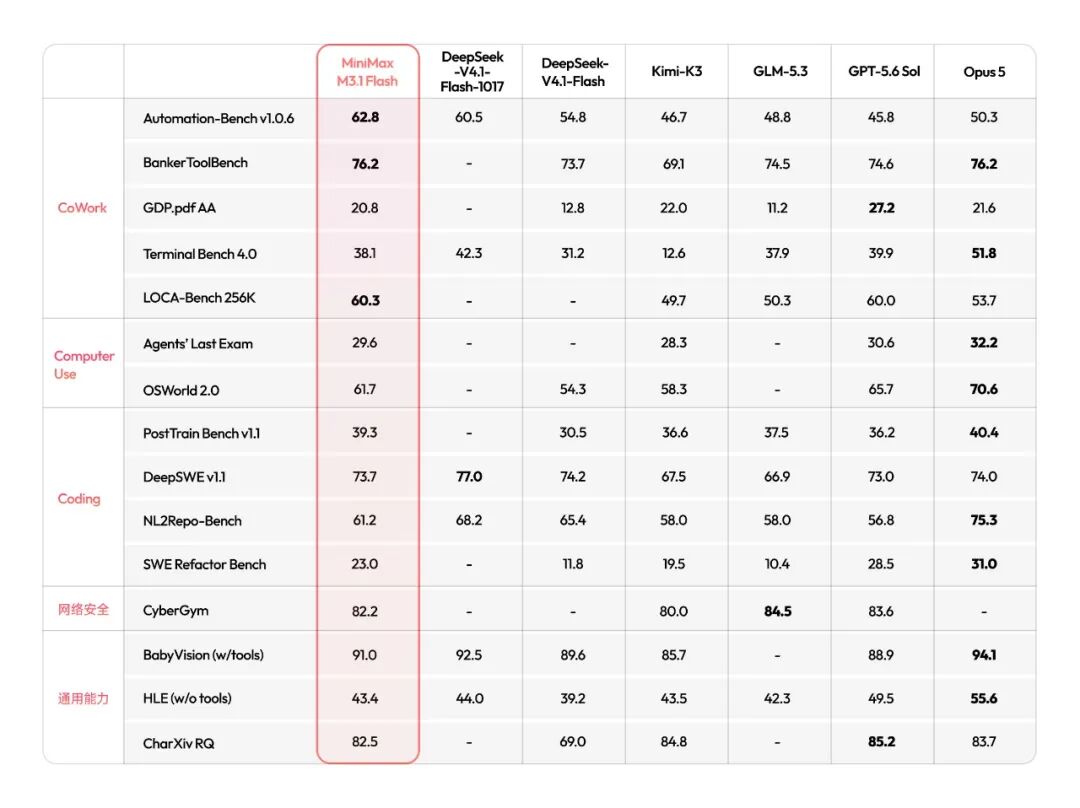
In the SWE Refore Bench code repair test, M3.1 Flash scored 23.0 points, which is directly more than twice the score of DeepSeek.
In the professional and security fields, M3.1 Flash also firmly ranks in the first echelon. In BankerToolBench for financial tool invocation, it ranked first tied with Opus 5 with 76.2 points; in the CyberGym cybersecurity test, it was in the first echelon with GLM-5.3 with 82.2 points; in the HLE w/o tools no-tool academic reasoning test, M3.1 Flash scored 43.4 points, slightly higher than DeepSeek V4.1 Flash-1017.
It can be seen from the list that M3.1 Flash is by no means a "unbalanced" model. Its performance in Agent and automation has even surpassed the industry's flagship large models.
The complete list is as follows:
02.
Released 48 hours apart
DeepSeek and MiniMax form a "two strong" pattern
DeepSeek V4.1 Flash-1017 and M3.1 Flash, both positioned as Flash, were released successively within two days, with such close benchmark test scores, which naturally makes people see a brand new pattern: two strong players standing side by side.
DeepSeek V4.1 Flash adopts a sparse MoE architecture with a total parameter count of 552B, but only 8B parameters are activated for input and 16B parameters are activated for output during inference. It outperforms the previous generation Pro version in both performance and speed, but the pricing is set very low. The release of this model directly shows developers the "flagship capability" of Flash models.
Following the breakthrough made by DeepSeek, M3.1 Flash has taken a step further.
When M3.1 Flash was still in the anonymous period, it firmly ranked second in the OpenCode call volume list and once ranked first on OpenRouter within just a few days after its launch.
Some netizens compared Space Bunny with Claude Opus 5, GPT-6 Sol and Gemini 3.8 Flash, using the highest thinking level to build a rocket launch scenario. The netizen said that Space Bunny only took three minutes, the final presentation effect is comparable to Opus 5, and the speed is also very fast.
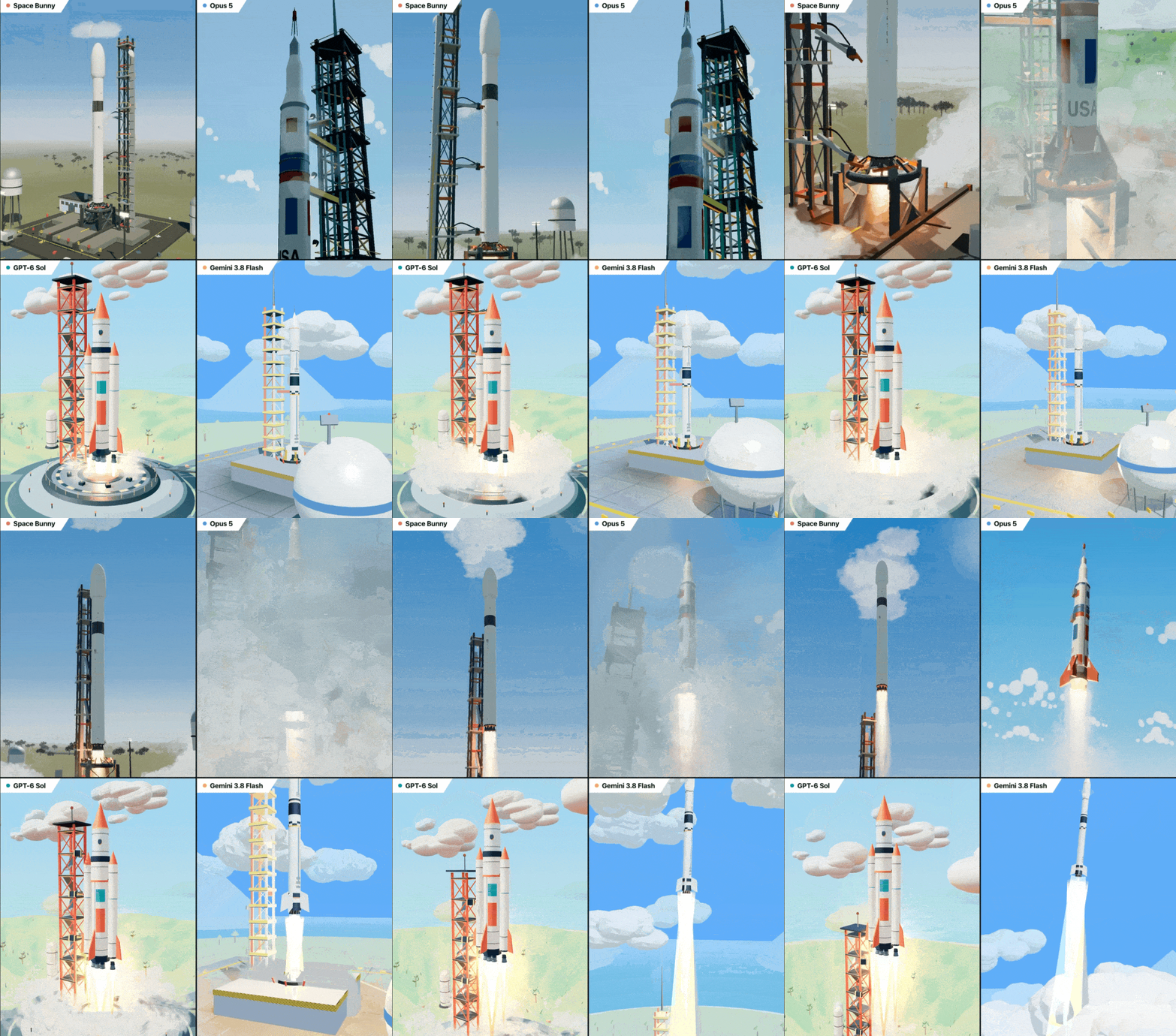
Zhidongxi also conducted an actual test as soon as possible, and believes that the effect of this model is close to GPT-6 Astra (the mysterious model "Space Bunny" is a hit, its effect is close to GPT-6 Astra, attracting 100,000 viewers)
The impressive response speed of Space Bunny during the anonymous period for developers has been fully retained in the official version. According to the MiniMax team, they have further optimized the inference efficiency of M3.1 Flash, adopted a more aggressive sparse attention architecture, the output speed in daily usage scenarios can reach 200+ TPS (Tokens per Second), and the median (P50) stably reaches 170+ TPS.
In terms of pricing, the input and output prices of M3.1 Flash are about half of the peak prices of DeepSeek V4.1 Flash-1017, and are on par with the off-peak prices.
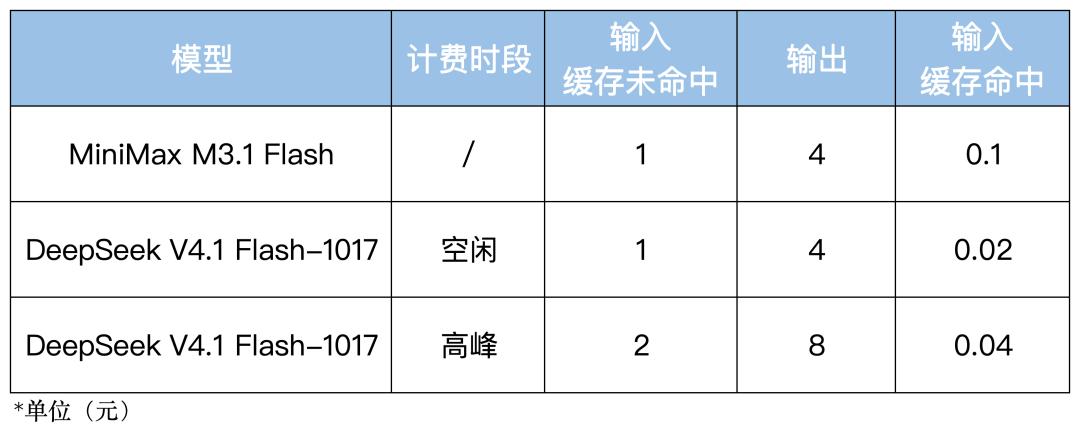
▲ Price comparison between M3.1 Flash and DeepSeek V4.1 Flash-1017 (chart by Zhidx)
It can be said that these two models are like two sets of tools with their own focuses in the developer's toolbox, developers can flexibly schedule them according to task requirements.
For example, when code generation efficiency and cache cost control are required, developers can choose DeepSeek V4.1 Flash-1017; when facing long-range Agent tasks, cross-application automation or multimodal-driven development processes, M3.1 Flash can be the first choice.
Previously, the outside world's impression of MiniMax may have mostly focused on the multimodal field. But whether it is the call volume dominating the rankings during Space Bunny's anonymous period, or the benchmark test report card of the official release of M3.1 Flash, it proves MiniMax's competitiveness in the Agent and automation direction, and also makes users full of expectations for the subsequent release of its Pro model.
03.
Conclusion: Flash models are on the table, no longer a "cheap alternative"
The two Flash models from DeepSeek and MiniMax have been launched one after another, showing the industry the strength of Flash models.
Flash models are tearing off the old label of "being a second choice only when the budget is insufficient". Judging from the benchmark test results, it can already be compared with flagship models in some core indicators, while retaining its inherent advantages in inference speed and cost.
From the perspective of cost-effectiveness, Flash models are perhaps the model type closest to real usage scenarios. Domestic models have for the first time formed a competitive pattern of "two strong players standing side by side" between DeepSeek and MiniMax.
For developers and enterprises, a high-quality option that can be scheduled on demand has been added to the model toolbox since then.
This article is from the WeChat official account "Zhidongxi" (ID: zhidxc), author: Wang Han, editor: Mo Ying, published with authorization from 36Kr.