DeepSeek's new model has been unveiled, and the amount users need to pay for AI services has been further reduced.
When the boundary between performance and cost is redrawn, model competition has entered a new algorithmic paradigm.
After a major crash, the truth behind the outage came to light, and on October 17, DeepSeek V4.1 Flash-1017 was officially launched.
Judging from the suffix of the model, it may seem like a minor version update, but its theme and direction are very clear: to continue reducing the cost of AI usage. What is even more unprecedented is that DeepSeek even released a schematic diagram of a "kill line" on its own. Of course, the original intention of this diagram may not be to "kill" competitors, but to highlight how low the AI usage cost is after this model update, and whether the success rate of the model can remain stable after the cost is drastically reduced.
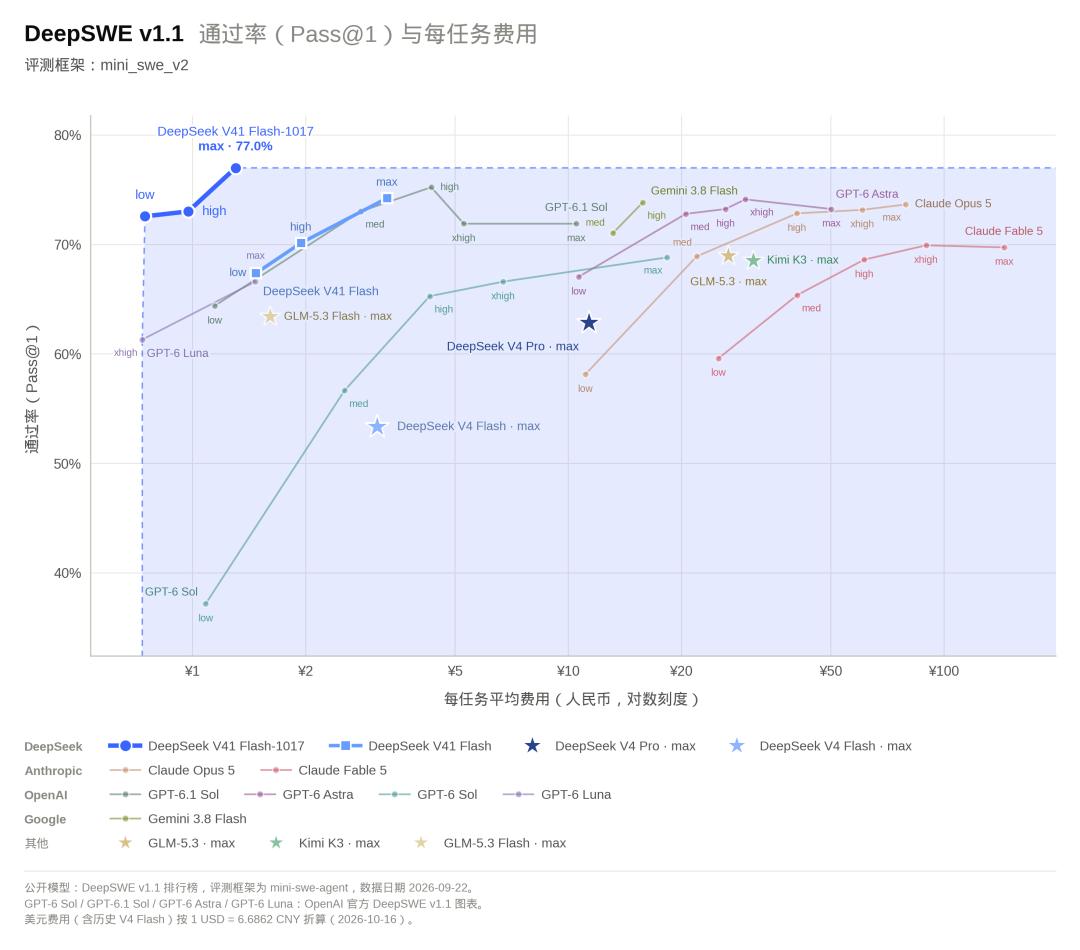
In the DeepSWE v1.1 evaluation chart released by DeepSeek, the highest Pass@1 rate of the new version reaches 77.0%. In horizontal comparison, the highest point of the previous version of DeepSeek V4.1 Flash is about 74%. It is more noteworthy that the highest score of the new version appears at a position where the average cost per task is about 1.3 yuan, which is significantly lower than many overseas models with similar performance in the chart.
This also raises a question that ordinary users should care about: when models can already complete complex programming tasks, how much intelligence should users actually pay for?
At present, DeepSeek V4.1 Flash-1017 has been updated to the official web page, APP and API. According to official disclosure, the new version not only improves the performance of multiple benchmarks, but also shortens the task running time and output length, and is optimized for frameworks such as DeepSeek Harness, Tencent CodeBuddy, and WorkBuddy. It should be noted that Tencent is the second prominently positioned partner appearing in DeepSeek's official tweet, with Huawei being the one before it.
At the same time, DeepSeek opens the Search and Fetch APIs of its self-developed search engine, integrating search and web crawling capabilities into the tool system that developers can call directly.
On the one hand, it delivers cheaper and more efficient task execution; on the other hand, it opens up more basic capabilities to the outside world. DeepSeek is trying to push model competition from a pure capability contest to more complete task delivery and cost competition.
01
Finding ways to make AI cheaper
Over the past two years, the large model industry has been accustomed to using ranking lists to explain competition.
Who has stronger reasoning ability, who gets higher programming scores, and who can take the lead in mathematics, knowledge Q&A or code tests, often constitute the most eye-catching narrative when a model is released. Parameter scale, training data and reasoning ability have therefore become the main criteria for measuring model progress.
But as models begin to enter the real software development process, pure scores are no longer enough.
A model that can answer programming questions and a programming agent that can understand requirements, call tools, modify code, run tests and repeatedly fix errors are actually two different products. The former mainly provides answers, while the latter needs to convert answers into deliverable results.
The cost has also changed accordingly.
What users buy is no longer just a number of Tokens generated by the model, but all the resources consumed in the final completion of a task. The longer the model thinks, the more frequently it calls tools, and the more retries it makes after failures, the harder it is for the final bill to be explained by the price of a single call.
The DeepSWE v1.1 chart displayed by DeepSeek this time just brings this relationship to the table.
The horizontal axis of the chart is the average cost per task, using a logarithmic scale; the vertical axis is Pass@1, that is, the proportion of passing a task in a single attempt under given evaluation conditions. Different reasoning gears of different models are placed in the same coordinate system, so that performance and price form a set of relationships that can be directly compared.
The highest point of DeepSeek V4.1 Flash-1017 reaches 77.0%. In contrast, the highest point of the previous version of DeepSeek V4.1 Flash is about 74%, and the marked point of DeepSeek V4 Pro is about 63%.
Many overseas models need to pay an average single-task cost of tens of yuan or even higher to obtain a pass rate close to that of low-cost models. DeepSeek V4.1 Flash-1017 pushes the highest pass rate to 77% while keeping the cost in a relatively low range.
This is the part of this upgrade that really deserves attention.
If a model only improves from 70% to 72% but requires a multiplied reasoning cost, its advantages may not necessarily be converted into commercial advantages. On the contrary, if the model can reduce the running time and output length while increasing the success rate, it will not only bring performance improvement, but also change the economics of per-unit tasks.
Of course, this chart cannot prove that DeepSeek has an advantage in all prices, all tasks and all frameworks. The reasoning gears, running frameworks and evaluation conditions of different models will affect the results, and the chart only presents the performance-cost relationship in specific tests.
But DeepSeek has already thrown the question to the industry: if higher task success rates can be achieved at lower costs, what do those models that rely on higher prices to maintain competitiveness need to show to justify their premium?
02
The real exam is not writing code, but delivering projects
If a 77% pass rate proves the progress of the model in specific tests, the project cases demonstrated by DeepSeek this time try to show where this progress may lead.
In the officially released cases, DeepSeek V4.1 Flash-1017 completed the 3D modeling of the Forbidden City, a web version racing game, a replica of the game Portal 2 based on the Godot engine, and a project that dynamically shows historical evolution through 3D scenes through DeepSeek Harness.
These cases have one thing in common: what users propose is not a programming problem with clear boundaries, but a complete project that needs to be built from scratch.
Taking game development as an example, the model needs to understand requirements, organize scenes and interaction logic, generate code, and gradually correct problems through operation and debugging. A seemingly simple game may involve collision detection, physical motion, camera control, level design and user interaction behind it. 3D modeling projects also need to process spatial structure, materials, lighting and scene organization.
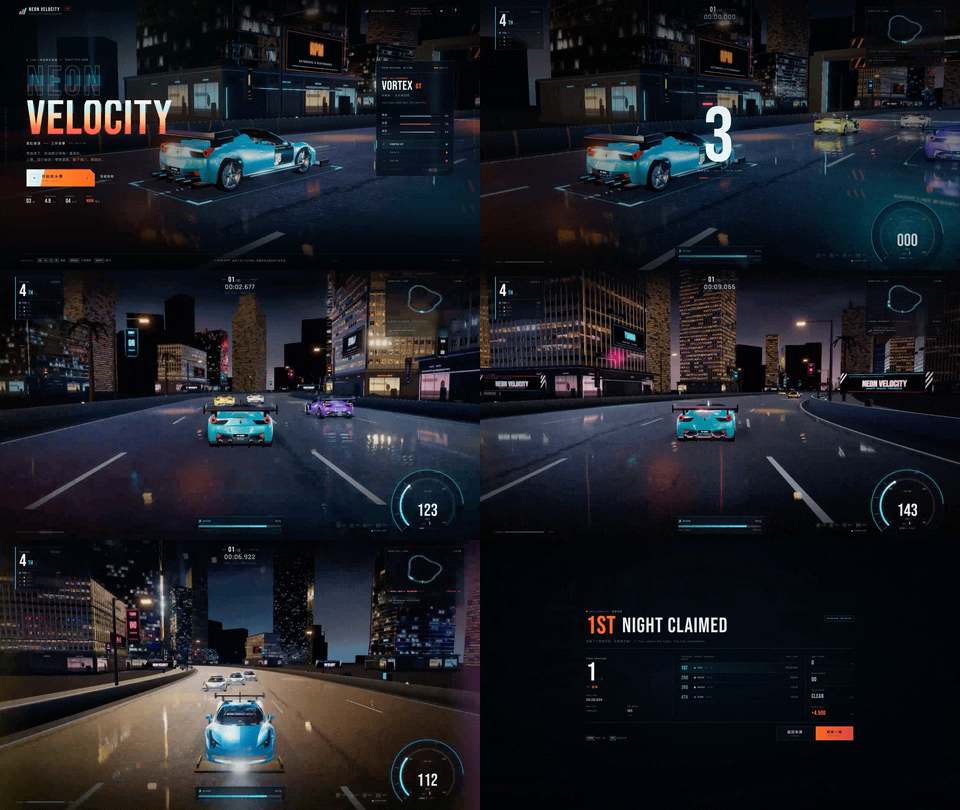
Figure | DeepSeek example: development effect of the web version racing game
This type of task is difficult to complete with only one generation.
What users really want is usually not a piece of beautiful code, but a work that can run, interact, and be modified continuously.
DeepSeek stated that the new version is trained through reinforcement learning based on self-feedback, which improves the ability to build complete projects from scratch in fields such as game development and 3D modeling, enabling the model to handle more "wishful" programming requirements.

Figure | DeepSeek example: Valley of Ages - dynamically showing the development process from prehistoric times to modern times with 3D scenes
The so-called "wishful programming" does not mean that users do not need to express their needs, nor does it mean that complex software can completely break away from engineering constraints. It points to a change in interaction mode: users do not need to master every technical detail in advance, they can first describe the results they want to achieve, and then let the model undertake more intermediate work from requirements to implementation.
In the past, users needed to know how to write code; now, users can first describe what they want to do.
The distance between the two determines how large a user group AI programming tools can reach.
This is why Harness is becoming an important part of competition.
The model itself provides reasoning and generation capabilities, while Harness is responsible for putting the model into a continuously working environment: organizing tasks, calling tools, managing contexts, executing code, reading results, and continuing to try after failures. Model capabilities determine whether it can solve problems, while the running framework affects whether it can solve problems in a stable and controllable manner.
This is not a topic that only DeepSeek faces. As programming agents evolve from code completion to project development, the collaboration between models and toolchains is becoming an important part of product capabilities.
DeepSeek specifically mentioned the optimization for frameworks such as DeepSeek Harness, Tencent CodeBuddy and WorkBuddy in this update, and recommends users to upgrade to DeepSeek Harness 0.2.1-rc.1 and above to get the experience adapted to the new model.
This means that the progress of the model not only occurs at the level of parameters or training methods, but also in its connection with the external software environment.
03
From model pricing to tool charging, DeepSeek starts to complete the other piece of the puzzle
There is another action in this update that is easily overshadowed by programming cases: DeepSeek opens its self-developed search API.
According to the official introduction, DeepSeek's search engine has long provided search capabilities for its web and API terminals, and can process a large number of search requests from all over the world. The Search and Fetch interfaces opened this time are used to retrieve web pages and crawl specified web content respectively, allowing developers to directly call relevant capabilities in their own applications and agents.
The price of both interfaces is 5 yuan per 1000 successful requests. The official documentation also states that billing is only triggered when the request is successful and valid results are generated. The free arrangement of calling search capabilities through tools such as Claude Code and Codex will be transferred to the charging mechanism after the two-week window specified by the official.
On the surface, this is an expansion of the API product line; placed in the context of the entire update, it has another layer of meaning.
To complete a real task, an agent often does not only need a smart enough model. It also needs to obtain external information, read web pages, call software tools, and organize these links into a continuous workflow.
As models begin to undertake more complex tasks, search, crawling and tool calls are no longer just auxiliary functions, but important infrastructure that determines whether tasks can be completed.
In the past, model vendors were more likely to build business models around Tokens: charging by call volume based on how much is input and how much is output. As agents move to more complex workflows, the cost structure is also becoming more diverse. Model reasoning, search, web crawling, code execution and repeated verification may all become part of the cost of a task.
DeepSeek opening Search and Fetch to developers means that its capabilities are beginning to move from inside its own products to external applications. Developers can integrate these interfaces into their own agent systems without fully relying on third-party search services.
But opening interfaces does not mean that a complete commercial ecosystem has been established. The stability of the interfaces, the quality of search results, call restrictions, the scale of developer usage, and the collaboration efficiency between these tools and the model will ultimately affect whether it can become a sustainable business.
It is especially worth noting that DeepSeek simultaneously emphasizes the relevance, authority and timeliness of search results, as well as the identification and filtering of SEO cheating, GEO manipulation and low-quality AI-generated content.
From this perspective, what DeepSeek is dealing with are different parts of the same problem: one end improves the model's ability to complete tasks, one end reduces the cost of task execution, and the other end supplements the external tools required by agents.
If the model is smarter but requires a large number of calls and retries, the cost advantage may be consumed; if the model is cheap enough but cannot stably complete complex tasks, low prices will be difficult to form real competitiveness; if the model can execute tasks but lacks reliable information acquisition and tool collaboration, the application boundary of agents will still be limited.
Real competition ultimately depends on whether these links can form an effective whole.
This road is not easy. As task complexity rises, users' requirements for reliability, response speed and delivery quality will also increase simultaneously. Low cost can lower the threshold for attempts, but it cannot automatically solve the problems of failures, errors and maintenance in complex tasks.
Therefore, this "kill line" drawn by DeepSeek, more accurately speaking, is a new competition benchmark.
It requires model vendors to answer no longer just "how much better is my model than yours", but "how much work can I actually complete for users within the same budget".
When model capabilities are getting closer, task cost, operation efficiency and tool ecosystem may become the key variables that determine the commercialization space. For users, this means that more work can be handed over to AI at lower cost; for the industry, it means that the price space once supported by the model capability gap may need to be reassessed.
This article is from WeChat official account "Phoenix Technology", author: Dale, editor: Dong Yuqing, published with authorization from 36Kr.