Shunwei Capital has invested in a PI from Peking University, who intends to use AI to "decrypt" the human brain.
The human brain emerges from the WAN space (Image source: LattixOrigin)
Article by Hu Xiangyun
Edited by Hai Ruojing
The human brain is one of the most complex systems evolved in nature.
The adult human brain is only the size of two fists, but contains nearly 86 billion neurons and an equal number of non-neuronal cells, which are connected to each other to form a huge and complex brain network, carrying all human intelligence, emotions, memories and self-awareness. This system is so exquisite that the biggest paradox of the human brain is that our brain is not smart enough to understand such a smart brain.
So, can AI do better?
This is what Lu Meng has been wanting to do for the past 15 years. From pursuing his PhD at the University of Cambridge in 2011 to serving as a senior researcher before returning to China in 2024, Lu Meng has been focusing on neurodegenerative disease research. Following the traditional neuroscience research paradigm, he has built many cell models and analytical algorithms to parse the action mechanisms of brain diseases and drugs at the molecular and cellular levels; he has also used imaging technology to track the changes in intracellular structure during disease progression or after medication.
But he later realized that this kind of research is like holding an embroidery needle, which can only anchor a very small micro scale, making it difficult to see the whole picture of the human brain, let alone restore the complete process of disease occurrence and spread.
Lu Meng thus came up with an idea: if the multi-scale information from molecules, cells, brain regions to the whole brain can be connected layer by layer, a "complete research system for understanding the brain" might be built.
This requires massive amounts of data and large-scale computing power to assist. Therefore, around 2017, Lu Meng tried to introduce AI into neuroscience research. But at that time, AI capabilities were still stuck in the computer vision stage, which was difficult to support cross-scale human brain modeling.
It was not until the emergence of large language models that Lu Meng was pleasantly surprised to find that "the self-attention mechanism of Transformer is highly compatible with biological information". "If we compare cells to long sentences, each gene is a word, and the environment where the cell is located is the context, which determines the level of gene expression and the state of the cell in the tissue. The underlying principles of large models and biological information are interconnected, which creates technical opportunities for building cross-scale human brain models."
Thus, after returning to Peking University as an assistant professor in 2024, Lu Meng officially launched this work and served as the chief scientist of AI4S company LattixOrigin.
36Kr exclusively learned that recently, LattixOrigin has completed a seed round of financing of nearly ten million US dollars. Investors include Shunwei Capital, Yunmu Capital, Xirius and Zhongguancun Capital. The funds raised in this round will be used to build a closed loop of dry and wet experimental verification, purchase computing power, form a team and other related purposes.
Lu Meng admitted that it is difficult to sustain the grand idea of landing this cross-scale human brain parsing with only the resources of university laboratories. In today's era when AI is sweeping everything rapidly, the cost of computing power and top interdisciplinary talents is rising; every step of model training and building a dry-wet experiment closed loop requires continuous capital investment. This is also an important reason why he chose to absorb external funds.
In Lu Meng's view, the relationship between AI and biology is undergoing a fundamental reversal. In traditional biological research, AI is more regarded as a tool embedded in the existing biological research process. The hypothesis of researchers is the starting point and also the end point, and the paths that can be explored are limited.
What he wants to do is "reorganize biological research from the perspective of AI". There is first high-quality, standardized data, and then let the model learn the underlying laws from massive information, rather than imposing human subjective presuppositions on the model.
It is understood that the LattixOrigin team has trained the first-generation DigitalBrain-M1 human brain basic model, which is highly consistent with radiomics in the functional analysis of some brain regions.
With subsequent model iterations, Lu Meng hopes that the DigitalBrain series of models can serve as the "GPT" of the human brain: when researchers develop drugs for brain diseases, they can rely on this system to quickly discover targets, analyze mechanisms, and find the optimal disease intervention path; further, it may even help humans understand intelligence itself.
All of these will become small consecutive steps on the long road to pick the "scientific holy grail" of the human brain.
Dialogue (edited):
Training 80 million brain cells to draw a "Google Map for the Human Brain"
36Kr: Can you first describe a picture of what changes the model can bring to scientists developing new drugs after it has the expected "cross-scale reasoning ability" in the future?
Lu Meng: Compared with the traditional research model, the model can help researchers discover disease targets and analyze mechanisms faster; in addition, it can predict what biological effects will occur after disturbing the targets, so as to find disease-causing genes more accurately, discover effective targets, and intervene in diseases earlier.
Take Alzheimer's disease as an example. In traditional Alzheimer's disease drug development, most targets focus on β-amyloid protein deposits, because this is the most obvious pathological feature in the brains of patients. However, when β-amyloid protein deposits appear, the brain has usually suffered substantial damage. Even if the deposits are cleared at this stage, the cognitive damage is difficult to repair. Therefore, the ideal situation is to complete the intervention before the clear pathological markers appear, and block the lesion from entering the irreversible stage.
If we can have a full-modal, multi-scale human brain model, we may be able to deduce the complete onset process of Alzheimer's disease: which brain regions the lesion starts from, and how it spreads to other brain regions? How does the whole course of the disease evolve, and when is the intervention threshold? This may help us find an earlier intervention node and block the lesion before it enters the irreversible stage. Its value is fundamental.
36Kr: In 2024, you joined Peking University. But before you started working on the DigitalBrain series of models, you spent more than two years polishing the dataset. Why did you do this "hard work"?
Lu Meng: The core bottleneck of brain disease drug development is that the model does not match the real human brain. In traditional methods, scientists mainly rely on animal experiments to infer changes in the human brain, but the physiological systems of the two are very different, resulting in a large number of targets that are effective in animals becoming ineffective in the human body. For example, mice do not spontaneously suffer from Alzheimer's disease, and even if the pathogenic gene is artificially transferred, only some symptoms can be simulated.
We believe that to better carry out brain science research and develop drugs for brain diseases, we must use real human brain data as the underlying fulcrum to build a basic human brain model.
In the early stage, we actually underestimated the difficulty of the project. The premise of building a high-quality model is high-quality data, but in the field of brain science, researchers cannot collect human brain samples on a large scale like animal experiments, and most of them can only obtain samples from hospitals. As a result, the global public human brain research data has always been very scattered, with a limited total amount, and lacks unified quality control and annotation standards. This is not conducive to model training.
Therefore, we decided to start by building a dataset, and then on this basis, train a basic human brain model that can complete cross-scale representation.
36Kr: What is the main source of the original data? Is there any exclusive self-collected data?
Lu Meng: To be honest, in the early stage, the team's cooperation foundation with domestic hospitals was relatively weak, and we mainly used public research data.
We have integrated more than 200 studies including the transnational joint scientific research project BICCN (Brain Cell Census Network), and the total amount of all original data is nearly 100 million human brain cells, ranking among the top in the world in scale. For horizontal comparison, the core research results data volume of BICCN published in "Science" in 2023 is 3.3 million, and the largest human brain dataset SEA-AD (2026) of the top brain science research institution Allen Institute is 6 million.
In addition, our data types are also extensive, covering more than 4000 donors with an age range of 0-96 years old, covering 165 brain regions of the whole brain and all cell types such as neurons, glial cells and vascular cells.
This magnitude and richness are sufficient for us to first train the first-generation DigitalBrain-M1 human brain basic model to explore the common underlying mechanisms and constraints of the human brain. In the future, we plan to promote cooperation with top medical institutions such as hospitals at home and abroad to further supplement characteristic data such as Chinese human brain data.
36Kr: If the core data sources are all public, what is the main value of your great efforts in this matter?
Lu Meng: The threshold of simple data collection and aggregation is indeed relatively low.
But we have carried out professional data "refinement". We refer to Allen's "gold standard" annotation system, perform unified de-batching, noise reduction, supplementary meta-information, and alignment to the same representation space for each study, to produce AI-ready standardized human brain datasets and form a training base.
At the same time, we have also developed a unique gene retrieval function. In the past, researchers could only understand the expression of a certain gene in local brain regions, and had to find the original slice map or expression matrix first, and then write code to process it by themselves, which took a long time and the conclusion was not necessarily clear. In our system, everyone can directly retrieve the accurate expression of any gene in various brain regions and various cell types of the whole brain like using a ride-hailing app, and can also select disease and age conditions. The data coverage and accuracy of DigitalBrain-Atlas are relatively leading in the industry.
This is like building a Google Map for the human brain to accurately understand the gene coordinates. This is of great significance for studying the human brain, locating pathogenic genes of brain diseases, mining related drug targets, and even brain-computer interface research. At present, we have open sourced nearly 17 million cells of standardized data for free retrieval and use by researchers around the world.
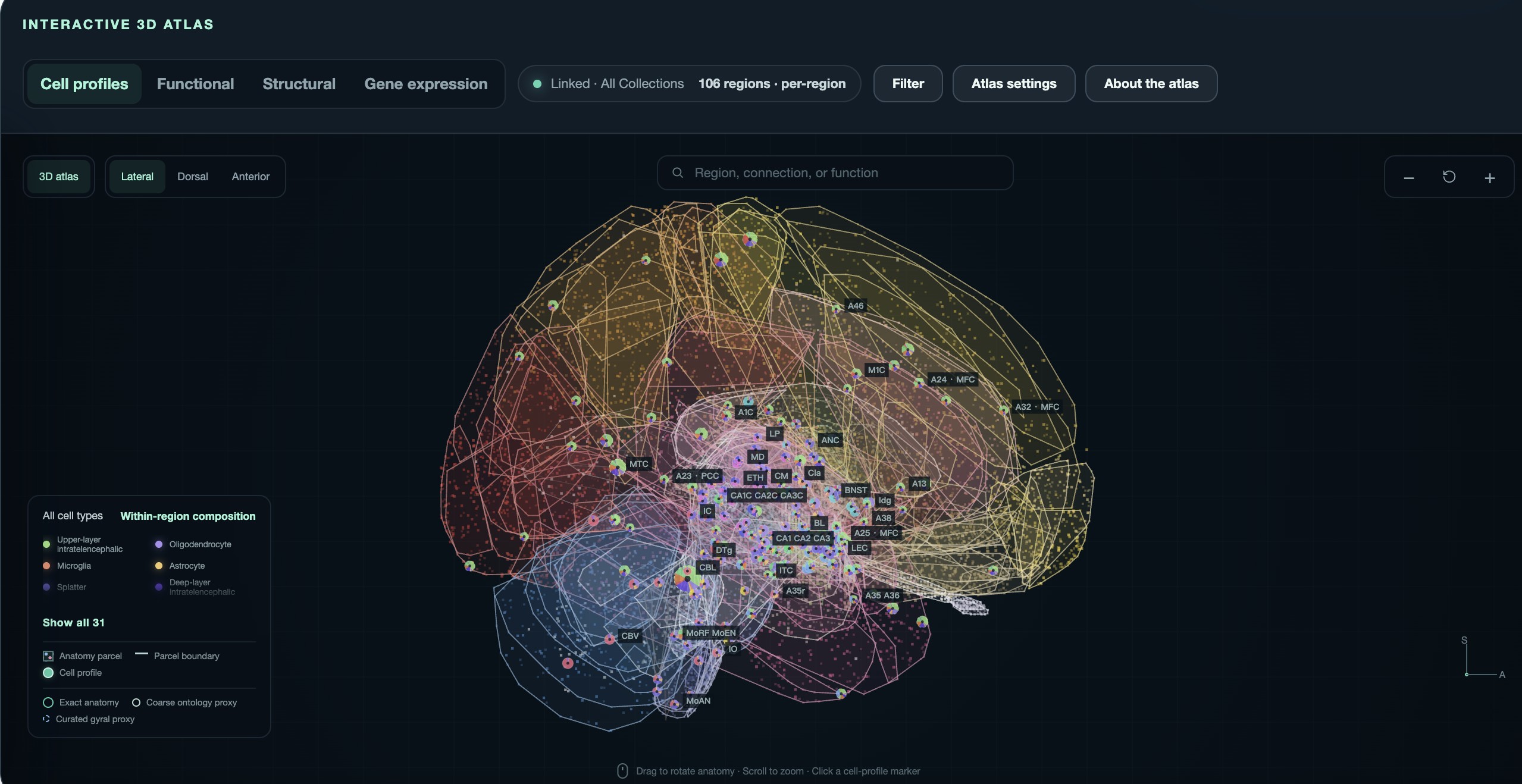
Image source: LattixOrigin DigitalBrain-Atlas (https://digitalbrain-human.com/)
36Kr: What are the main difficulties in "standardizing" various studies?
Lu Meng: The tedious part is that each dataset needs to be checked one by one. Although automated batch processing algorithms can also do this, they cannot solve all problems. For example, some datasets have problems such as mismatched file names and internal data, duplicate annotations, and annotation errors. Locating the source of errors in massive data points is like troubleshooting faulty parts from thousands of parts. To ensure quality, we will do manual review and verification one by one.
Scaling Law of the Human Brain Base Model
36Kr: How is the performance of the model trained entirely with human brain cell data now?
Lu Meng: Let's clarify a problem first: the model will not automatically realize cross-scale reasoning. In the pre-training stage, it outputs representation embeddings, which encode the biological information of genes and cells into digital vectors. The more biologically similar things are, the closer they are in this vector space. But this is the "basic product" of the model's understanding of biological information, and it cannot be directly used for complex tasks such as disease deduction and target prediction.
But interestingly, we used the representation of DigitalBrain-M1 to analyze the functional correlation between brain regions, and the results highly match the observations of traditional radiomics (fMRI).
The most typical are the two brain regions BA23 and BA32. They are both on the cingulate gyrus on the medial side of the brain. You can imagine that there is a C-shaped corridor in the middle of the brain, BA32 is in the front, BA23 is in the back, and they are not very close. But functionally, they both belong to the default mode network, responsible for activities such as recollection, introspection, and self-worth judgment. DigitalBrain-M1 only looks at the gene expression of thousands of cells, and has never seen brain imaging information, but it can identify that there is a functional correlation between these two brain regions, which shows that the model has captured the underlying biological laws of the cross-level brain network, which is an emergence of human brain structure, which makes us very excited.
Of course, the current achievement is only the matching of some brain regions, and the accurate matching of the whole brain cannot be achieved yet. We will develop adapters and decoders later to enable the model to directly perform reasoning and prediction.
36Kr: The model output results and conventional imaging results confirm each other, which shows that your technical path for studying the human brain is feasible?
Lu Meng: I think this at least proves that we have explored a correct direction.
36Kr: Following this idea, what is the subsequent iteration plan of DigitalBrain?
Lu Meng: Build the Scaling Law of AI4S, continuously expand the scale of the dataset, and increase computing power and parameter volume. Just like ChatGPT, GPT-2 was originally only a model that can continue writing text, but its real value lies in embarking on the correct line of Scaling Law, but its ability is not subversive enough. With the subsequent expansion of the scale of GPT-4 and GPT-5, the emerging reasoning ability and multi-modal ability enable the model to be applied to many application scenarios that were not expected in the small model stage.
In this dimension, DigitalBrain-M1 is equivalent to GPT-2, which is the first version for us to get through the technical route. The research and development of M2 has been launched, and we hope the model can emerge with stronger multi-scale human brain parsing capabilities.
36Kr: What else needs to be done to achieve these goals?
Lu Meng: Two closed loops need to be built. The first is the external ecological closed loop, which jointly builds datasets with hospitals; the second is to jointly build a dry-wet experiment closed loop with universities.
AI4S is not very different from pure AIGC. The former must rely on real experimental data to iterate the model. However, the data output efficiency of the traditional scientific research "small workshop" model is far from enough, so we need to rely on automation and robots to produce biological data at an industrial scale to support the implementation of Scaling Law.
Serve Research on Brain-Computer Interface and Other Fields
36Kr: In addition to new drug development, brain-computer interface is the long-term landing scenario planned by the company. But the impression of brain-computer interface is more about "reading brain signals, implanting electrodes, and stimulating the brain", which sounds like two different things from your "human brain model at the molecular level". How are the two connected?
Lu Meng: From the basic principles of biology, the structure and dynamics of all levels are determined by the most underlying gene expression, which is also our starting point. We hope that DigitalBrain can serve as a basic base model to support brain-computer interface and other large-scale human brain research. The core of brain-computer interface is actually to find accurate targets and use appropriate modes for stimulation regulation. Finding targets and predicting stimulation effects are exactly where