Focusing on on-orbit services and aiming to build a space robot cluster, Guoyu Xingchen has completed a nearly 100 million-yuan Series A round of financing, which is exclusively first released by 36Kr.
By | Azhi
The narrative of commercial aerospace is transitioning from "sending satellites into space" to the management and operation of satellites after they are launched into orbit.
Apart from the accelerated constellation construction, a clear signal is that the pressure of network replenishment for low-orbit constellations is also approaching. According to research data previously released by NASA's Goddard Space Flight Center, 583 Starlink satellites fell from extremely low Earth orbits between 2020 and 2024. To prevent loss of control and collisions, active orbit transfer and avoidance maneuvers of satellites have become increasingly frequent. According to the report submitted by SpaceX to the U.S. Federal Communications Commission (FCC) in July, Starlink satellites performed more than 200,000 avoidance maneuvers in only half a year.
When tens of thousands of satellites are gradually deployed in near-Earth orbits, the problem is put on the table: Who will be responsible for the "management, maintenance, refueling and debris clearance" in space?
Some players abroad have already verified the feasibility of this business. Japan's Astroscale started with debris removal, and was listed on the Tokyo Stock Exchange in 2024, with its revenue increasing about five times in four years. Italy's D-Orbit has verified customers' willingness to pay through more than 20 in-orbit transportation missions. The MEV-1 of U.S.-based Space Logistics completed the first commercial in-orbit life extension mission in 2020, extending the service life of a GEO satellite that had been working for 19 years by five years. According to the report of Fortune Business Insights, the global in-orbit service market is in a stable growth track, which is expected to grow from 3.18 billion U.S. dollars in 2026 to 6.87 billion U.S. dollars in 2034, with a compound annual growth rate (CAGR) of 10.10%.
As demand arrives, a large number of domestic players in this track have emerged. A company that has been making low-key layouts for four years is accelerating the in-orbit verification of its products.
36Kr learned that Guoyu Star (Shanghai) Aerospace Technology Co., Ltd. (hereinafter referred to as Guoyu Star) has recently completed a nearly 100 million yuan Series A financing, jointly invested by Yijing Capital, Fosun Chuangfu and Luyao Capital. Prior to this, Guoyu Star has completed three rounds of financing, with investors including institutions such as Yuanhe Origin, Houxue Capital and Shangqi Capital.
Founded in 2022, Guoyu Star's founder Zhang Long has more than 20 years of experience in aerospace scientific research, engineering management and enterprise management. He once worked in China Aerospace Science and Technology Corporation, deeply participated in major national projects such as China's manned spaceflight, lunar exploration and Mars exploration, successively served as chief designer of the model and director of the group, and served as president of Blue Arrow Aerospace from 2015 to 2021. The company's core technical team comes from the Innovation Academy for Microsatellites of CAS, China Aerospace Science and Technology Corporation, Tsinghua University and other institutions, and has the capabilities of aircraft development, launch mission operation and model engineering mission management.
Focusing on the in-orbit service field, Guoyu Star's core business covers in-orbit services (auxiliary orbit insertion/deorbit, in-orbit refueling, in-orbit maintenance), in-orbit assembly, space manufacturing and deep space development.
The space robot independently developed by Guoyu Star is the core carrier to perform the above specific tasks.
In Guoyu Star's definition, it is a space operation system integrating software and hardware, including four parts: body, perception, brain and execution.
Among them, the body (intelligent platform and combined power) realizes orbit maneuver and attitude adjustment; perception (multi-source integrated AI perception module) is used for accurate identification, positioning and guidance of cooperative/non-cooperative targets; the brain (on-board AI decision-making unit) can carry out local mission planning and autonomous decision-making under communication delay; execution (space dexterous manipulator and refueling interface) needs to complete complex physical interactions such as grasping, docking, maintenance and refueling.
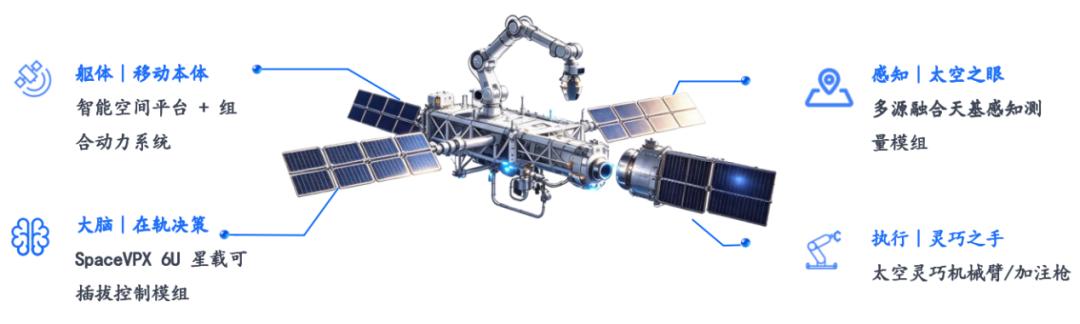
Guoyu Star Product Planning
On May 21 last year, Guoyu Star's self-developed verification satellite "Star Trace Source No.1" was successfully launched at Jiuquan Satellite Launch Center. It is the first new technology verification platform for in-orbit service and space-earth perception developed by a commercial aerospace company in China that has completed flight missions, with a total in-orbit duration of more than one year.
One progress is that Guoyu Star has been included in the supplier list of the national-level satellite internet constellation operator. Star Trace Source No.2 is planned to be launched in the first quarter of 2027, and its self-developed 7-degree-of-freedom manipulator will be added for in-orbit verification, which is also the last puzzle piece in Guoyu Star's core technology territory.
Four years of dormancy, a counter-consensus entrepreneurship
Back in 2022, China's commercial aerospace track had gone through the first cycle from overheating to cooling down, the market tended to be calm, and the epidemic further aggravated the external complexity that start-ups had to face. At that time, the mainstream narrative of the industry focused on rockets and satellites, and few commercial companies were involved in in-orbit services except for the "national team".
For an old aerospace professional with a background in rocket manufacturing, according to the inertia of experience and ability, the easiest way to "raise money" after starting a business may be to continue to make launch vehicles — to solve the problem of entering space first. But Zhang Long's choice was the opposite. He plunged into the in-orbit service track, which seemed a little cold and even counter-consensus at that time.
The judgment of the direction mainly comes from three levels. From the perspective of space security and national strategic direction, it is an inevitable choice for China to vigorously develop satellite internet, and in-orbit service has industrial foundation and user direction in the long run. Secondly, China's commercial aerospace has gone through a round of development cycles from its start in 2015 to around 2022, and the technical iteration and launch verification of rocket companies have accelerated, which means that the ability to enter space and the reduction of cost have entered an predictable stage. In the future, with the improvement of industrial maturity, downstream operation services will have higher added value and larger market space.
"When commercial companies started to make rockets in 2015, many people were not optimistic, but later facts proved that counter-consensus is exactly the opportunity of the early track." In Zhang Long's view, in-orbit service products have a development cycle, a verification cycle, and a cycle of being recognized by customers. It will be too late to intervene when the demand really explodes.
There is another more emotional version of the answer: "At that point in time, we really saw a beam of light, and we wanted to chase the light."
Wu Shufan and Rong Jiangang are as optimistic about this direction as Zhang Long. As the co-founder and chief scientist of Guoyu Star, Wu Shufan is an academician of the International Academy of Astronautics, a high-level overseas microsatellite expert introduced by the state, with more than 30 years of experience in academic research, technology development and industrial innovation in the aerospace field, and is in charge of the overall technical direction of the company. CTO Rong Jiangang once worked in the Innovation Academy for Microsatellites of the Chinese Academy of Sciences, participated in the control system work of major special projects such as the accompanying satellite of Tiangong-2 and the Space DaVinci Program, was employed as one of the first batch of core technical backbones of the Chinese Academy of Sciences and a member of the expert group of the Control Engineering Committee, and is good at engineering implementation and overall model management.
With the direction determined and the founding team established, when it comes to how to choose the specific route, Zhang Long's idea is: first figure out what scenarios to serve in the future, then deduce what products are needed, and finally supplement the key technology territory.
The team analyzed the core in-orbit service scenarios, such as auxiliary orbit insertion/deorbit, in-orbit refueling, in-orbit maintenance, in-orbit assembly and space manufacturing, etc. At the bottom, the core capability requirements are actually four, which can be simply summarized as having a pair of "hands" to operate, "eyes" to see, "legs" to move, and a "brain" to control.
"After analyzing the scenarios and requirements, and then looking at the supply chain, we found that we can't buy ready-made products. The platform, manipulator and core system all need to be developed by ourselves. Only self-development can improve the efficiency of technology iteration, grasp the voice of products, and realize continuous cost reduction." Zhang Long mentioned that Guoyu Star chose to independently develop the on-board intelligent control module, combined power system, visual navigation system and space manipulator — which also correspond to its four key products at present.
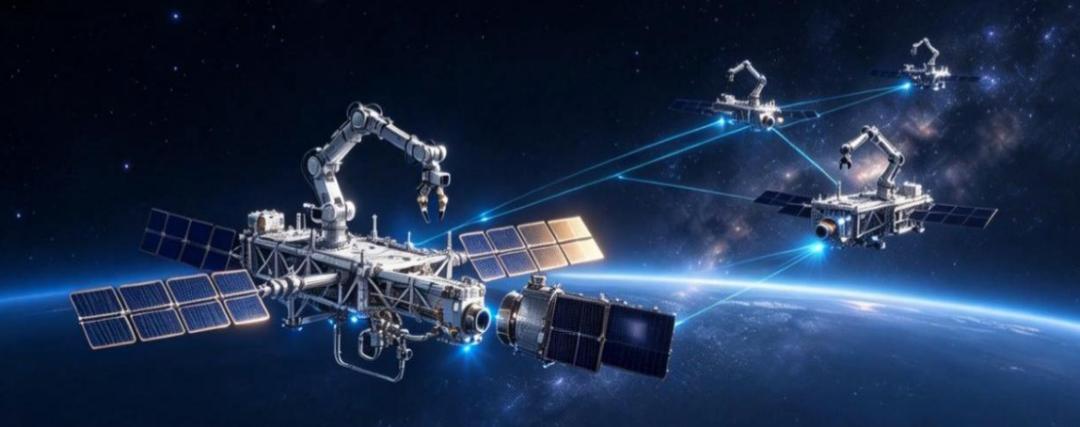
Guoyu Star Product Concept Map
Around the four major products, further decomposition leads to more in-depth technical directions such as space-based target recognition, autonomous navigation and precision measurement, dexterous operation of space robots, modular in-orbit replacement and refueling life extension, attitude-orbit cooperative rendezvous and docking control, formation flight, multi-agent cooperative control and intelligent operation technology, which clarifies the focus for the formation of Guoyu Star's early talent team. Extending outward, it corresponds to the service application scenarios with in-orbit service, in-orbit assembly, space manufacturing and deep space development as the core.
Up to now, the on-board intelligent control module, combined power system and visual navigation system independently developed by Guoyu Star have all completed in-orbit verification.
"The only one that has not been launched into space is this 7-degree-of-freedom manipulator. The ground mechanics experiment, EMC experiment and functional experiment have all been completed, and the final assembly is planned to be completed in the middle and early ten days of November." Zhang Long mentioned that according to the current downward trend of domestic rocket launch costs, through the self-development of core systems, the adoption of industrial-grade components and devices, and the team's original screening and verification methods, the cost of Guoyu Star's products after commercialization is expected to be reduced by more than half in the future compared with the current mainstream systems at home and abroad.
It is not just a technical test, the first flight should make money
On May 21 last year, Star Trace Source No.1 was launched at Jiuquan Satellite Launch Center and successfully entered the predetermined orbit. This is the first important milestone for Guoyu Star since its establishment three years ago. At that time, the company's team size was only 23 people.
This 100-kilogram-class platform carries 11 newly developed payloads from many users such as China Aerospace Science and Technology Corporation, China Electronics Technology Group Corporation, Chinese Academy of Sciences, and Northwestern Polytechnical University, including rapid prototyping material manufacturing, self-powered microsystem, domestic intelligent chip module, high-precision navigation receiver, star screen recording and shooting combination, medium-wave infrared remote sensing payload, etc.
"Why install so many payloads? On the one hand, we need to assess the ability of the on-board processing unit to respond to multiple payloads, and on the other hand, we are also making reserves for future applications on large constellations."
Zhang Long mentioned that "Star Trace Source No.1 has been in orbit for more than a year. In addition to the manipulator, the combined power system, on-board intelligent control system and visual navigation are all installed on it. First, the cooperative operation of these systems has verified the capabilities of autonomous planning orbit change, non-cooperative target recognition and other capabilities. Second, by carrying multi-user payloads, it also reversely verifies the platform's ability to respond to multi-payload, multi-task autonomous management and control, as well as the multi-order fulfillment service capability."
Before the launch, Zhang Long set three requirements for Star Trace Source No.1: the first flight must be useful, the first flight must be successful, and the first flight must make money. "We can't just do a technical test. We have to go into space with real customer tasks. We can't convince ourselves to use only investors' money to launch a satellite, nor can we verify the ability to sign orders and fulfill contracts."
In fact, whether it can be launched into space to complete the mission and whether it has successful experience is the first life-and-death line for commercial aerospace start-ups. Only real in-orbit operation can verify the real capability of products in the space radiation environment, expose problems, and through the accumulation of space environment data and mission experience, iterate the reliability of products and systems, and finally turn a flight into a replicable, deliverable and scalable capability.
It is reported that Guoyu Star's combined power system has completed the in-orbit flight assessment, optimized the second-generation product through data from multiple cold and hot start operations and extreme condition tests, and has completed the long-term thermal vacuum test and various environmental assessment tests.
In terms of the on-board control module, the team optimized the algorithm, analyzed and solved the problems such as short-term signal loss encountered by the No.1 satellite in orbit, strengthened the radiation resistance, and improved the system-level fault-tolerant design.
Aiming at the problems such as strong light interference encountered by the visual navigation system, the strong light suppression ability and anti-saturation imaging ability of the second-generation product have been improved through the ground strong light simulation experiment.
"The role of the No.1 satellite is to expose problems, and the fewer problems left after solving them." Zhang Long said that Guoyu Star's timetable for the next year is very clear: launch Star Trace Source No.2 in the first half of the year, and complete the first in-orbit verification of the manipulator and refueling interface; the development of Star Trace Source No.3 and No.4 has already started, and if the progress goes well, they are expected to be launched in the second half of 2027.
"The successful orbit insertion of Star Trace Source No.1 proves what space robots can do. But to really get through the business model, we have to build an in-orbit service constellation network. Guoyu Star is moving from single-satellite capability to the era of space robot clusters — only by reaching this stage, in-orbit service will no longer be an experimental project, but a scalable commercial closed loop." Zhang Long emphasized.
With the networking of the Star Trace Source series of satellites, Guoyu Star will be able to form service response capability in specific orbits — wherever services are needed, and whichever aircraft is closer, it will dispatch that one to perform the mission, forming normalized operation and service cooperation. Before that, Guoyu Star will generate revenue through businesses such as carrying commercial payloads on verification satellites and selling key components to support the company's operation.
A set of progress is that in terms of payload carrying business, Guoyu Star has signed orders of tens of millions of yuan; in terms of key component sales, multiple sets of combined power systems have been delivered, and overseas sales channels have been established; in terms of in-orbit services, Guoyu Star has been included in the supplier list of the national-level satellite internet constellation operator.
According to Zhang Long's disclosure, by the end of this year, Guoyu Star is expected to win a large-volume order and a national-level mission. "If these two things are also completed, I think we can give the team 100 points this year."
Back to the point of deciding to start a business in 2022, Zhang Long said they "saw a beam of light", but the 4 years of hard work of the team later represents the real second half of this sentence — on the way to chase the light, the first thing to pass through is the shadow.
Fortunately, this road is passable. In 2026, commercial aerospace has once again become a hot direction in the primary market, and in-orbit service has become one of the new narratives.
Guoyu Star stood on the starting line in advance, but it is still in the competition. Now this track is full of players. The next question is: who can make the narrative land more stably and quickly, and turn it into a real business.