The most important AI trend in 2027: It does not lie in new models, but in "results".
In mid-October, the stories coming out of Silicon Valley are still the same familiar few.
At its Investor Day, Anthropic announced that its revenue in Q3 is expected to hit about 16.8 billion US dollars, marking a more than 40% quarter-on-quarter increase, with its pre-IPO pace fully on public display; Meta continues to grab market share in the Muse and personal agent tracks, while OpenAI's Dots and various background-resident agents also made their presence felt in the same week... Models are getting stronger, valuations are rising, and the battle for Personal Agents across all players is in full swing.
The supply side is bustling, but on the other side, the numbers on corporate ledgers are far more calm.
Digest.Pro, a business media outlet, recently updated its report *AI Trends 2027: What Business Leaders Need to Know*, which makes its point clear at the very start: the most important AI trends in 2027 have little to do with new models, and everything to do with tangible results.
After two years of pilots, most companies have adopted AI somewhere in their operations, but only a small fraction can truly obtain measurable value from it.
IBM's data is straightforward: only 25% of AI projects can deliver the returns that executives initially expected, and even fewer, only 16%, can be scaled across the entire enterprise.
This gap will determine budgets, organizational structures and regulatory priorities, and will also sift out the truly important business trends from the noise.
Agents are entering real workflows, governance measures are catching up, and more and more companies want AI that they can control themselves.
Digest.Pro places its review of 2026 and several basic forecasts for 2027 on the same timeline, revealing a complete curve of AI trends: the technology has proven usable, but organizations have not yet proven that they can profit from it.
01
2026 confirmed the "usable" status, and pushed "usefulness" to the forefront
The AI trends of 2026 are less about breakthroughs, and more about consolidation.
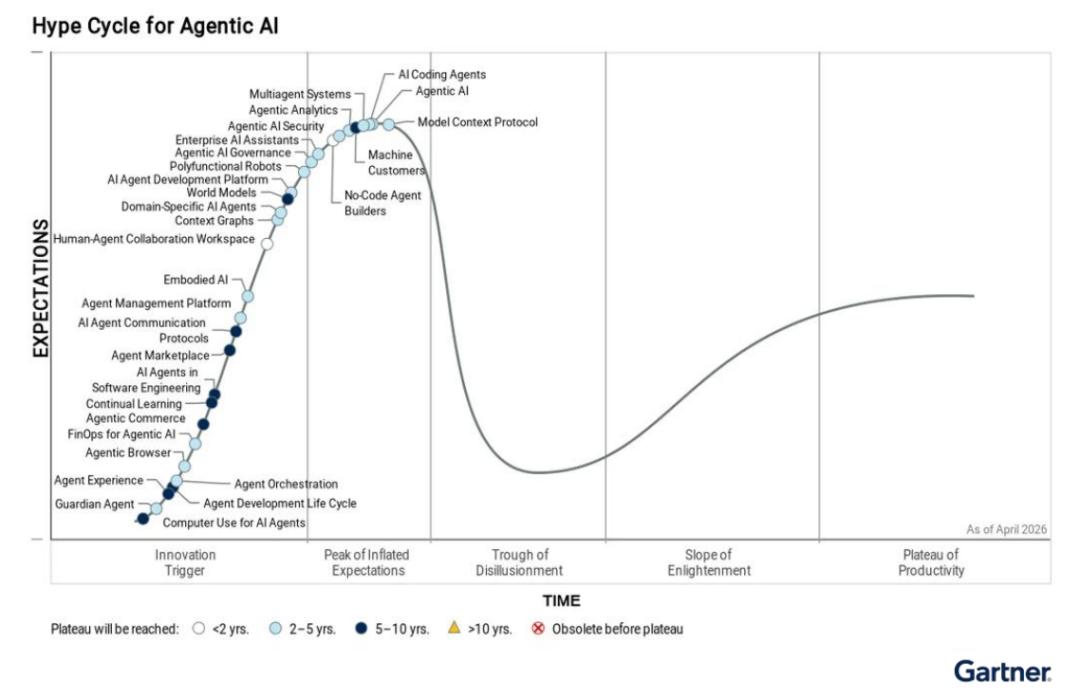
Agentic AI hit the peak of the hype cycle, but real-world deployment remains relatively low; spending continues to climb; coding agents have formed a formal market; the EU postponed the deadline for its strictest AI Act; the gap between adoption and results can no longer be ignored.
The first Agentic AI Hype Cycle released by Gartner in April 2026 placed it at the "Peak of Inflated Expectations"; a CIO survey in the same year showed that only 17% of organizations have actually deployed Agents.
On the spending side, Gartner predicted in May that global AI spending will reach 2.59 trillion US dollars, a 47% year-on-year increase.
On the market side, Gartner released its first Magic Quadrant for Enterprise AI Coding Agents on May 20, marking the shift from "code suggestions" to "Agents that can perform multi-step engineering work".
On the regulatory side, the EU reached an agreement on the AI Digital Comprehensive Act on May 7, 2026, and published it as Regulation No. 2026/1744 on July 24, extending the compliance deadline for independent high-risk systems from August 2, 2026 to December 2, 2027.
On the organizational side, IBM's 2026 CEO Survey shows that 76% of organizations already have a Chief AI Officer, compared with only 26% a year ago — this is the clearest signal that AI has moved from an IT issue to a business model issue.
Taken together, these numbers form the backdrop for 2027: the supply side is accelerating, adoption is spreading, but value is not keeping pace synchronously.
Several other surveys also confirm this point.
For example, BCG's *Build for the Future 2025* survey of more than 1250 enterprises found that only 5% are "future-type" and can capture AI value at scale; another 35% see some returns, while 60% see almost no change in revenue or costs after heavy investment; McKinsey's *State of AI 2026* (1719 respondents) shows that only 44% of organizations say AI has been expanded across the entire enterprise, and only 37% attribute any EBIT impact to AI.
The root cause is rarely that the model is not smart enough, but more often that ownership is unclear, and processes have never been redesigned around AI.
Mohamad Ali, Senior Vice President of IBM Consulting, said: "The CEOs who are actually getting results from AI transformation are not those who deploy faster, but those who are redesigning their organizations to bring the best people and the best technology together."
Therefore, the first decision for 2027 is not complicated: clarify which AI projects have clear business owners and measurable goals, and which ones should be shut down. Projects that cannot be stopped will only continue to consume budgets later.
02
Agents enter the scene, budgets and reviews become stricter
AI Agents can plan and execute multi-step tasks, call tools and data, instead of only responding to a single prompt. They top all trend rankings, but adoption data also explains why caution is necessary.
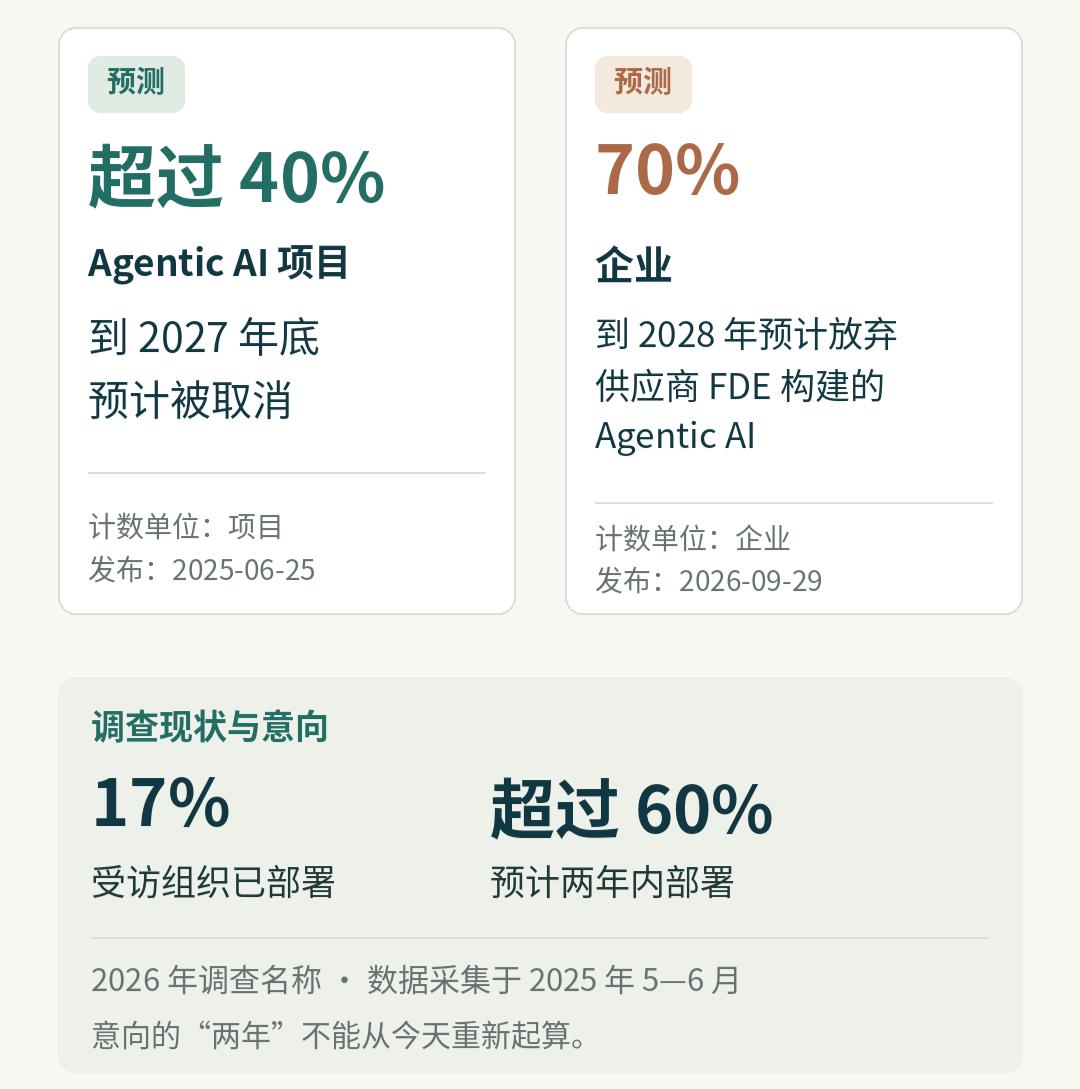
Gartner's 2026 CIO survey shows that 17% of organizations have deployed Agents, and more than 60% plan to deploy them within two years. McKinsey's 2026 survey shows that about 20% of organizations are scaling AI Agents, and this proportion rises to 40% for companies with revenue over 1 billion US dollars. At the same time, Gartner predicts that by the end of 2027, more than 40% of agentic AI projects will be canceled due to rising costs, unclear business value or insufficient risk control.
Agents are most suitable for processes with clear boundaries, complete documentation and clear handover points with humans, and coordinating multiple Agents will increase complexity.
Amanda Luther, Managing Director and Senior Partner at BCG, said: "Agentic AI is not a future concept — it is already reshaping workflows and redefining roles. Companies should see it as the next step to expand AI, not the starting point."
The more prudent approach for the current evolution of Agents is to first select two or three processes for testing, and clearly define where human signatures are mandatory.
The battle for personal assistants on the consumer side is already competing on who can do more work for users; on the enterprise side, the first problem to solve is supervision costs, and funding is also becoming stricter along the same line.
Global AI spending is still rising sharply — Gartner expects it to reach 2.67 trillion US dollars in 2026 and about 3.64 trillion US dollars in 2027, with over 45% going into infrastructure.
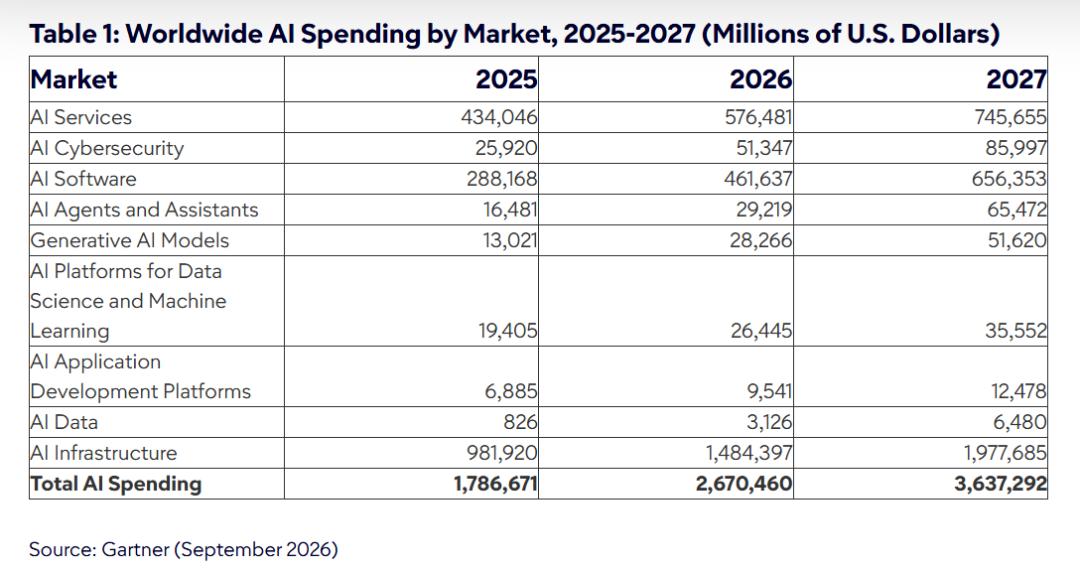
John-David Lovelock of Gartner pointed out that CIOs "face challenges in proving the value of AI investments".
Against this backdrop, corporate CFOs in 2027 will demand the evidence that any capital allocation should have: baselines, targets, payback periods, and the cost of running AI at scale (including inference).
Open innovation budgets will decrease, and milestone-linked phased appropriations will increase; many teams only calculated license fees when budgeting, but operating costs will be scrutinized in far greater detail.
Every AI investment must report which value metrics it delivers, and who signs off on it. These two things will determine the fate of the project earlier than the next model release.
Software engineering is, for example, the area where the impact of AI is most visible.
Gartner lists AI-native development platforms as a 2026 strategic trend, and predicts that by 2030, these platforms will drive 80% of organizations to evolve large software engineering teams into smaller, more agile, AI-augmented teams.
Under this framework, how to measure Agent engineering productivity, and how to adjust review and security gates, are rules that must be clearly defined in 2027.
03
Domain, sovereignty, governance, and humans all become design choices
General large language models are often insufficient for professional work with high requirements for accuracy, terminology and compliance.
Gartner lists domain-specific language models as one of the 2026 strategic technology trends, and predicts that by 2028, more than half of the generative models used by enterprises will be domain-specific.
The trend is shifting from chatting to getting work done, and the next wave will be models fine-tuned or grounded for scenarios such as financial analysis, contract review, and industrial operation and maintenance.
The cost of one confident error is very high.
The two main paths remain fine-tuning smaller models on corporate data, or connecting general models to corporate knowledge through retrieval.
The choice depends on data, accuracy requirements and costs, not ranking on leaderboards.
For each high-value use case, a separate decision is needed on whether a general model is sufficient, or a dedicated or grounded model is required.
Control over AI has also become a strategic issue.
In IBM's 2026 CEO Survey, 83% of respondents agreed that AI sovereignty is critical to business strategy.
Sovereignty means where data and models run, and which jurisdiction's rules apply.
Gartner summarizes this from the infrastructure side as "geographic repatriation": due to geopolitical risks, moving data and applications from global public clouds to sovereign clouds, regional providers or corporate data centers, and predicts that by 2030, more than 75% of European and Middle Eastern enterprises will geographically repatriate their virtual workloads, compared with less than 5% in 2025.
This drives private deployment — open source weight models and Agents run on infrastructure controlled by the company, especially in regulated industries; more control also means more responsibility for security and updates.
Which data and workloads must be placed under direct control, and which can safely run on shared cloud AI services, is also a design choice, not an afterthought patch.
Governance is lagging behind adoption.
Deloitte's *State of AI in the Enterprise 2026* (3235 leaders from 24 countries) shows that only about one fifth (21%) of organizations have mature agentic AI governance models, while 74% expect to use AI Agents at least moderately by 2027.
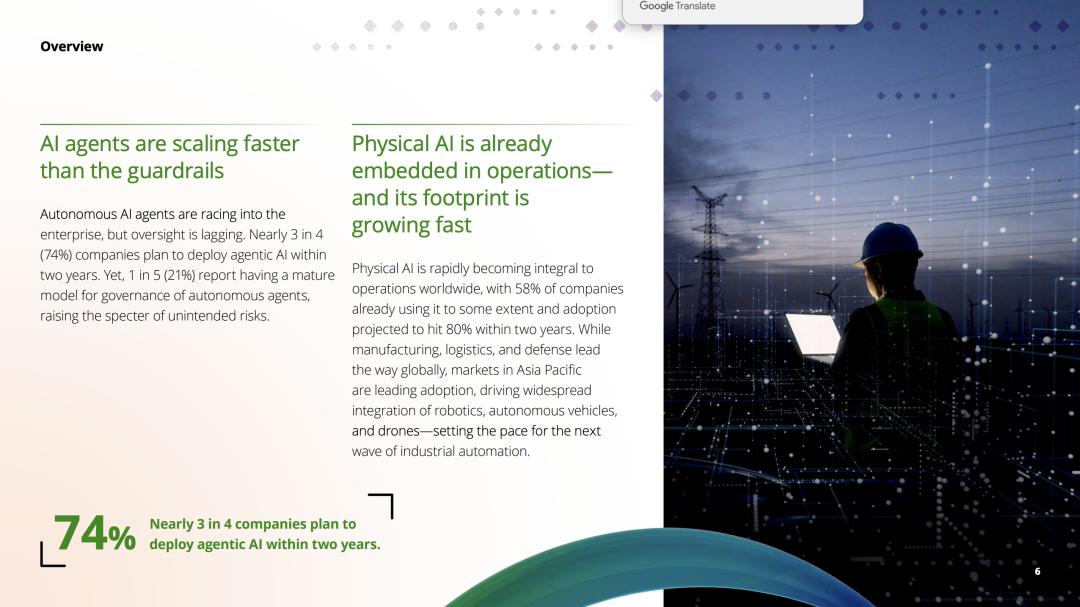
Deloitte *State of AI in the Enterprise 2026*
Mature governance means: clear boundaries for what Agents can decide independently, monitoring that can flag abnormal behavior, and audit trails for every step of action.
Without these, scaling Agents is equivalent to scaling unmanaged risks.
Regulation sets the outer boundaries — under the EU AI Act as amended by the Digital Comprehensive Act, transparency obligations will apply from August 2, 2026; independent high-risk systems must be compliant by December 2, 2027; high-risk AI embedded in regulated products will have until August 2, 2028.
The extension is a planning window, not an exemption.
Who owns AI risks, which systems fall into the high-risk category, and what the approval path for new Agents is, need to be written into the institutional rules in 2027, not just into PPTs.
Jim Rowan, US AI Lead at Deloitte, said: "Speed and governance should not be seen as opposing forces; if the right foundational capabilities are built in advance, the two can be aligned."
Organizations and people are the real bottlenecks.
IBM's 2026 CEO Survey shows that 76% of organizations now have a Chief AI Officer, compared with 26% a year ago; 64% of CEOs say they are willing to make major strategic decisions based on AI-generated inputs, which puts higher requirements on the quality and traceability of the underlying data.
A title alone cannot bridge the value gap.
For this role to function effectively, it must have real authority over cross-functional priorities and budgets, and the division of responsibilities with CIOs, CFOs and Chief Data Officers must be clearly defined.
The skills side is more acute: only 25% of employees currently use AI regularly, even though 86% of CEOs believe the workforce has the corresponding skills; CEOs also expect that between 2026 and 2028, 29% of the workforce will need retraining for different roles, and 53% will need upskilling in their existing roles.
Skill maps, retraining priorities, and who is responsible for "enabling people to use AI well" will directly restrict the scaling of Agents.
Shadow AI has also risen to the board level.
The data and compliance exposure brought by unapproved tools and Agents is evolving from "employees using them casually on their own" to a formal risk item.
Which uses must be included in formal governance, and how to detect and converge shadow usage, also require clear answers.
04
TideRush AI Perspectives
News from Silicon Valley in recent weeks makes it easy to feel that 2027 will still be a year of model wars, assistant wars and valuation wars.
What makes this Digest.Pro report more sober is that it shifts the lens from labs and financing news to corporate ledgers and organizational structures.
The trends listed in the full text can actually be summed up in three sentences:
First, adoption is no longer news, value is. The figures of 25% meeting expected ROI and 16% achieving scaling will not improve automatically because of Anthropic's revenue or Meta's download volume.
Second, Agents are the next step, not the starting point. The consumer side is already competing on who can do more work for users; the enterprise side must first clearly define boundaries, approval processes and supervision costs, otherwise Gartner's prediction that "over 40% of projects will be cut" will not just be a statistic.
Third, control, governance and people are becoming design choices as important as models. Sovereignty, private deployment, externally auditable evaluation, real authorization for the Chief AI Officer, and skill maps are no longer compliance appendices, but variables that determine whether capital can be converted into efficiency.
Domestic industry readers can check against these three aspects:
1. Are there real business owners in the enterprise taking responsibility for AI results?
2. Is the human approval boundary clearly defined for Agent projects?
3. Have domain scenarios and private, sovereign deployment moved from slogans to concrete roadmaps?
Models will continue to get stronger, and personal assistants will continue to compete for users. But the enterprise-side work will only truly start to be submitted in 2027.
*References
Digest.Pro *AI Trends 2027: What Business Leaders Need to Know*