17 years old, with an annual salary of 7 million.
A high school student has gone viral across the AI circle.
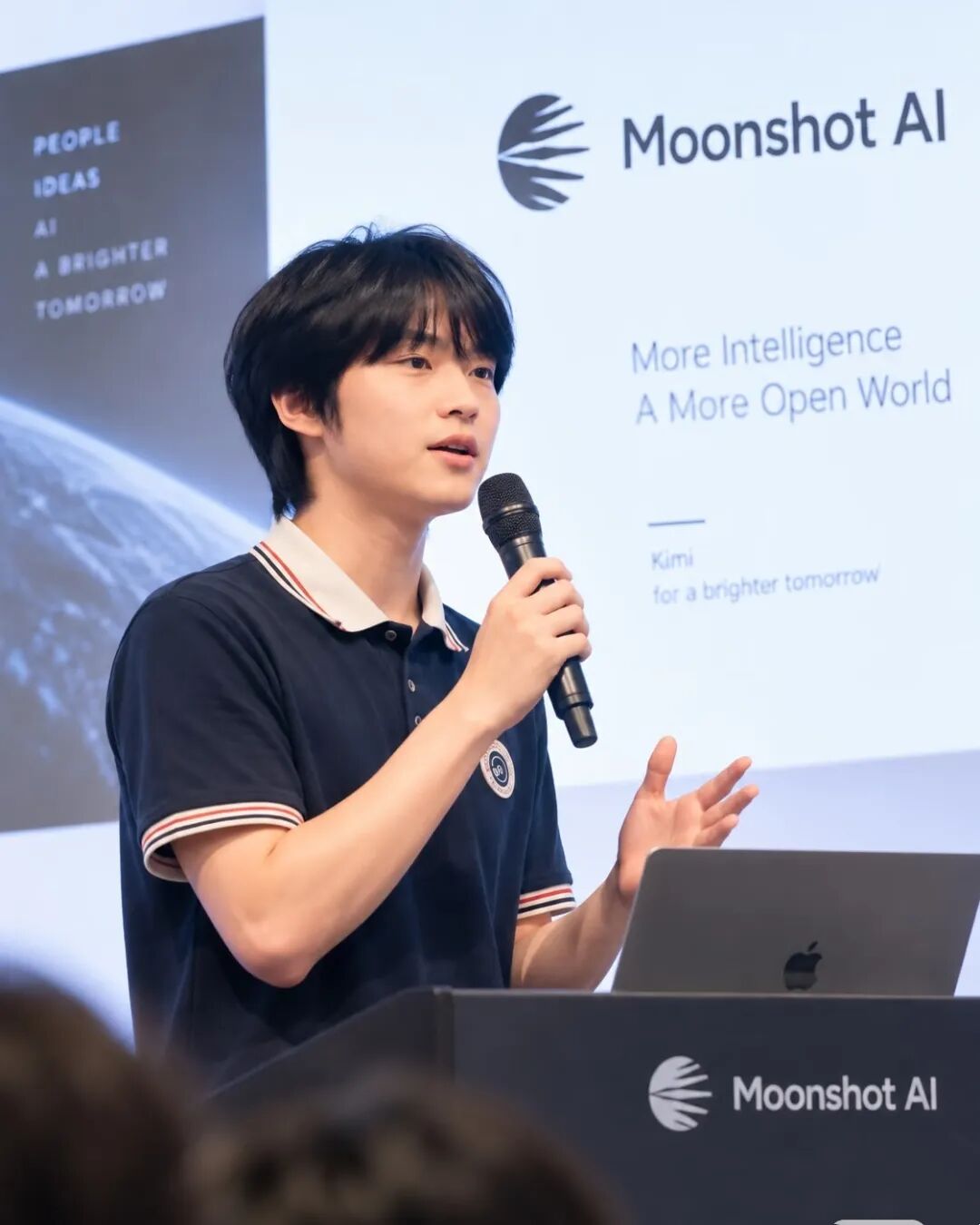
The incident started when 17-year-old Chen Guangyu posted a message to say goodbye to Kimi. In just a few lines, he did not explain the reason for his departure, nor did he announce his next destination. Speculations about where he would go immediately flooded in.
The last time Chen Guangyu drew public attention was in March this year. At that time, he was still a senior high school student, and participated in the paper Attention Residuals as a co-first author. The paper was reposted by Elon Musk, and the related technology was later applied to Kimi K3, making this teenager from Shenzhen an instant hit.
Almost at the same time, well-known Silicon Valley investor Deedy Das talked about an unnamed 17-year-old teenager: he held 5 job offers, all worth more than 1 million US dollars (about 7 million RMB). The overlap of age and experience quickly led the public to associate the case with Chen Guangyu.
17 years old, 5 offers, 1 million US dollars — these details are more than enough to show the magic of this era.
The 17-year-old teenager resigned
Reported to hold million-dollar offers
Chen Guangyu has left Kimi.
On October 15, this 17-year-old Shenzhen teenager posted a farewell message on social platforms, saying that the past year had been the best time of his life so far. Looking back on this experience, he said, "Thank you for everything, especially Du Yulun, who believed in me and hired a 16-year-old me back then."
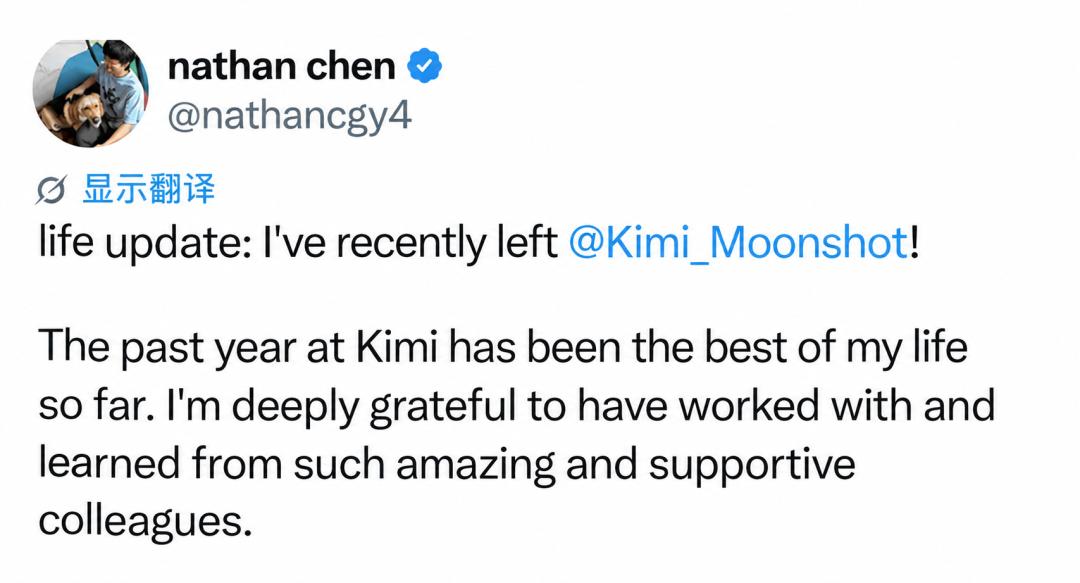
When he joined the company, Chen Guangyu was still a senior high school student. In March this year, his name appeared on the list of co-first authors of the paper Attention Residuals alongside Zhang Yu and Su Jianlin. Elon Musk later reposted the paper, calling it "impressive", which also drew public attention to this young intern in the Kimi team.
By July this year, Attention Residuals had been applied to Kimi K3, becoming one of the underlying technologies adopted by this 2.8-trillion-parameter model. Chen Guangyu also participated in the pre-launch preparations for K3. In his farewell post, he still remembered the days when he watched the World Cup while working with his colleagues.
Regarding the decision to leave, Du Yulun revealed that the two had several long conversations. Though reluctant to see him go, he still hopes that Chen Guangyu can explore as much as possible at this age and follow his new curiosity.
Chen Guangyu did not explain his next step in the farewell letter, only writing at the end: "There are more things worth exploring."
New job offers soon came in the comment section.
Sholto Douglas, head of scalable reinforcement learning at Anthropic, mentioned that he had just met Chen Guangyu last week, then half-jokingly asked: "Still planning to go to Carnegie Mellon University? Want to come work with me in San Francisco?"
"Thanks Sholto! I'm heading to the Bay Area." Chen Guangyu replied. Some people speculated that he would join Anthropic, but soon he gave a short reply: "no :)"
Few days before this farewell letter was sent, the news of a million-dollar annual salary offer had already made a 17-year-old teenager the focus of public attention.
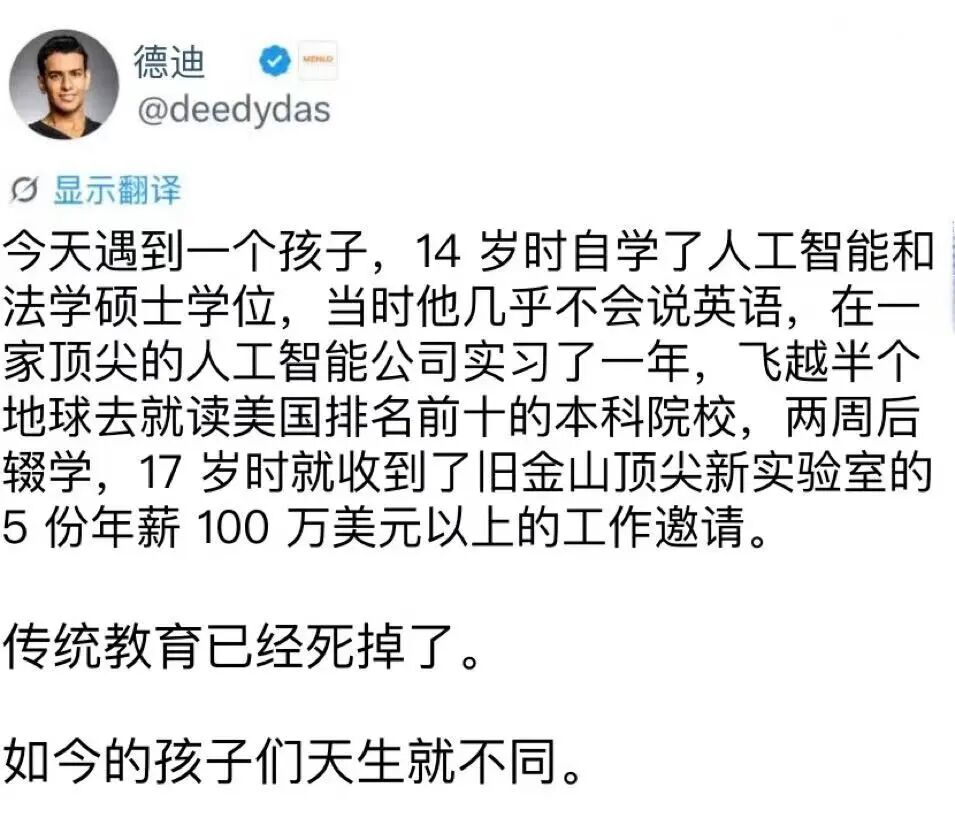
Last week, Menlo Ventures investor Deedy Das shared an experience of meeting a teenager. At the age of 14, when he was not yet proficient in English, he began to teach himself AI with the help of large models. After that, he interned at a top AI company for a year, traveled across half the globe, and was admitted to a top 10 university in the United States for his undergraduate study. Two weeks after enrollment, he chose to drop out.
According to Deedy, this 17-year-old teenager already had 5 job offers from top cutting-edge AI labs in San Francisco, all worth more than about 1 million US dollars.
17 years old, one year of internship experience, a million US dollars... When these pieces of information were put together, questions soon poured in, and some people linked this experience with Chen Guangyu.
However, Deedy did not disclose the teenager's name. In response to inquiries, Deedy relayed the teenager's reason for wanting to go to San Francisco: people there are all very capable, and they are doing exactly what they want to do.
"I just want to learn, and I don't care about money at all."
The most popular high school student comes from Shenzhen
Chen Guangyu's story starts in Shenzhen.
Born in 2009, he grew up in Shenzhen, studied at the former Shenzhen Nanshan School Affiliated to Peking University and BASIS International School Park Lane Harbour, and just graduated from high school this year.
Like most post-2000s generation, he is full of curiosity about the world. In middle school, he tried to register a Shopify store with his parent's identity, organized a youth open source community, developed a Crypto robot, and even dreamed of becoming a professional skier.
When preparing for college applications, Chen Guangyu paused those activities that were for admission purposes but he did not like, picked up an AI safety book that he had long wanted to read, and then read books about physics, the universe and Steve Jobs. Later he recalled in his blog that during those weeks, he learned only to satisfy his own curiosity, without having to prove anything to others. But when he saw his classmates busy preparing application materials, he would also feel anxious, worrying that what he was doing was meaningless.
The turning point came in February last year, when Chen Guangyu participated in a middle school student hackathon, bringing a project called ThirdArm — a concept of "the third mechanical auxiliary hand for humans". It was also because of this project that he got to know Dong Kehan, a founding team member of YC China and MiraclePlus. The latter gave him a far-reaching suggestion: focus on more cutting-edge technologies.
After that, Chen Guangyu began to use AI to study academic papers, track open source projects on GitHub, and gradually build up his understanding of machine learning. In his opinion, the method of following video courses from ten years ago to get started step by step is already too slow. "In this era, AI is the best teacher."
Soon, a technical blog post brought him a job offer. At that time, Chen Guangyu shared his research insights on DeltaNet. His social account only had 20 followers, but the article drew a reply from Yang Songlin, a researcher in this field, and was later seen by the CEO of Tilde Research, a Silicon Valley AI startup, who took the initiative to invite him for a call.
Two months later, 16-year-old Chen Guangyu received the company's offer, flew to Palo Alto, California alone, and started a seven-week internship.
The impact of this experience on him goes far beyond "joining an overseas company" itself. Dong Kehan once reminded him not to treat himself as an intern, but as a CEO: if this is your company, what would you do? This sentence later became his working method. Since then, the content he participated in has gradually expanded from technical issues to more complex topics, including operation setup, financing rhythm, investor communication and long-term strategic thinking.
The rest of the story is familiar to everyone. Chen Guangyu joined Kimi to continue his research on model architecture. Less than a year later, he decided to leave to explore new possibilities.
At the age of 17, many choices will definitely not be final. Just as the goal Chen Guangyu wrote on the homepage of his personal website: "Explore the possibilities of intelligence." As for where this road will lead, he is still moving forward.
Talents are recruited before graduation
The wealth stories in the AI industry have now been written into young people's payrolls.
It has been reported that domestic leading internet companies offer as high as 8 million RMB in annual salary for fresh graduates. A professor from the Department of Computer Science of Tsinghua University once revealed that doctoral graduates in the large model direction in his team can get an annual salary of more than 6 million RMB, and master's graduates can also get more than 1 million RMB. The eagerness for talent recruitment even extends to the graduation defense site: HR of a large company came with flowers to congratulate the admitted students.
Opening the official website of Anthropic, you can also find a public reference: the annual salary range for research positions in the pre-training direction is listed as 350,000 to 850,000 US dollars, and the specific treatment is related to the job level. These jobs are directly related to model architecture and large-scale training.
As for those young people who have already stood out, the offers are even more staggering. Mark Zuckerberg once personally called to recruit 24-year-old AI researcher Matt Deitke. To invite him to join, Meta's final compensation package was about 250 million US dollars for four years, with up to 100 million US dollars to be paid in the first year.
The founder of a tech giant personally sent an invitation to a young man in his twenties. The urgency of the talent war is obvious.
Extremely high offers only belong to a few people, but the logic of competition is not difficult to understand: with the rapid iteration of models and the uncertainty of technical routes, the joining of key researchers may bring new directions.
The recruitment time has also been advanced to before graduation. When Tencent launched the Qingyun intern recruitment this year, it specially encouraged lower-grade students to apply, stating that there is no upper limit for salary, and providing additional incentives for contributors with outstanding performance. Core businesses such as Hunyuan, Yuanbao and WeChat are open to interns, and outstanding interns have the opportunity to lead projects and work directly with technical leaders.
ByteDance's Seed team has written young people's research achievements on its recruitment page: some people have participated in the R&D of the Seedance 2.0 pre-training architecture less than a year after graduation; some are still interns, and their achievements have been applied to Doubao's online services and post-training of models. Qualified outstanding interns also have the opportunity to get "Doubao shares".
Waiting until graduation to recruit talents may already be too late.
Every generation has its own opportunities. An annual salary of nearly 10 million RMB is enough to change a person's life. Put into the R&D investment of AI companies, it is an early bet on the next breakthrough. The outcome of the competition is yet to be decided, and missing key talents may cost even more.
No one knows how long this high-salary trend will last. When people talk about opportunities of the times, they often think of entrepreneurship, financing and IPO. But for this group of young people right now, the opportunity has been embodied in a tangible offer.
This article is from the WeChat official account "Investment Circle", written by Wang Lu, and authorized for release by 36Kr.