What Elon Musk is striving relentlessly for is not parameters, but possibilities that humanity has never achieved before.
This time, the flying car and the new supercar are less of a product than another declaration, Elon Musk will not stop just because he has won many times, for his goal has never been to outperform rivals, but to break boundaries.
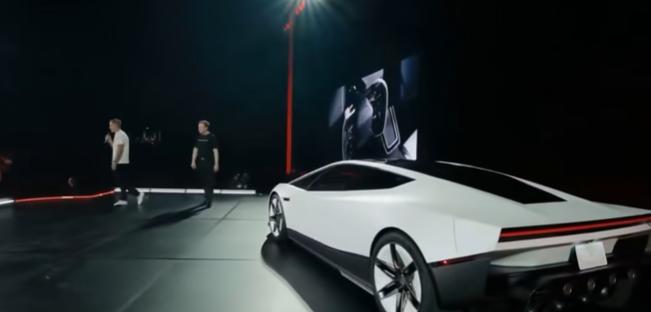
When Tesla's new-generation supercar and flying car concept vehicles reappeared in the public eye, the entire automotive industry, and even the entire technology sector, was once again hit by a shock — the kind of shock that only Elon Musk can create.
This kind of shock never comes from leading in a certain parameter, nor from a stunning design, but from a deeper, more indescribable feeling: Elon Musk has taken another step forward, while we are still standing still. Why can Elon Musk make the industry shocked again and again?
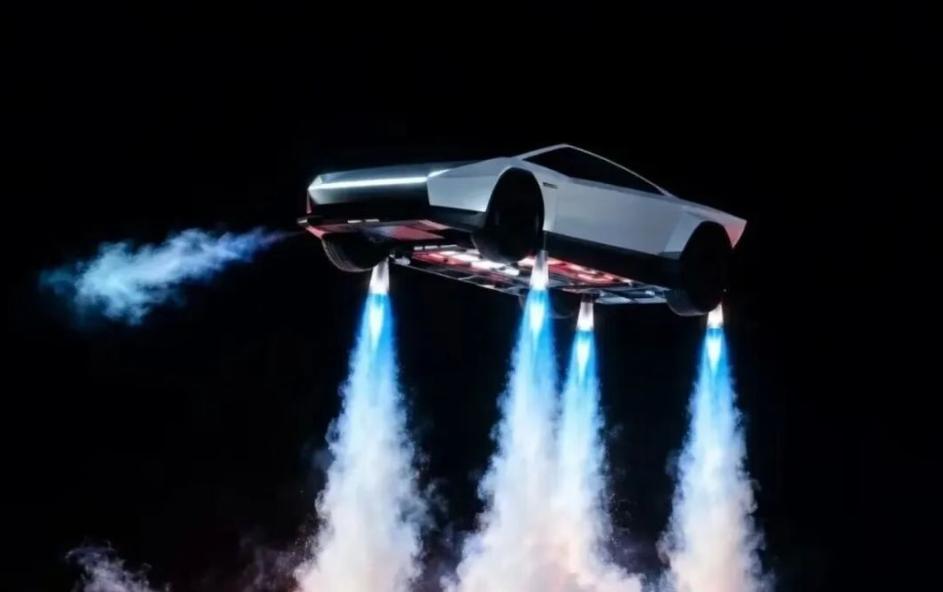
One success can be attributed to luck, two successes can be attributed to timing, but when this kind of "shock" continues from the original Roadster in 2008, Model S in 2012, Autopilot in 2015, the Starship program announced in 2016, to the Cybertruck in 2020, and all the way to today's supercar and flying car — it is no longer luck, nor timing, but a stable, replicable ability deeply rooted in decision-making logic.
The root of this ability lies neither in Elon Musk having more capital, nor in him mastering more advanced technology, but in a fundamental difference: commercial interests have never been Musk's only goal, nor even his primary goal. What he is truly obsessed with is the combination of commercial interests and technological breakthroughs: using commercial success to support technological revolution, and then using technological revolution to realize commercial value.
This point completely distinguishes him from almost all other entrepreneurs.
1
Elon Musk is not making cars, he is creating "breakthroughs"
The key to understanding Elon Musk is to understand the criteria he chooses to do one thing.
The decision-making logic of the vast majority of entrepreneurs is like this: how big is this market? What is the competition pattern? How much do I need to invest and how much can I earn back? This is a complete set of commercial rationality that has been repeatedly verified. But Elon Musk's decision-making logic is another set: Is this thing technically groundbreaking? Can it truly promote some fundamental progress of mankind?
This seemingly "non-commercial" standard precisely explains a rather confusing phenomenon in the automotive industry — why Tesla has not adopted the multi-product strategy for a long time.
In the golden decade of new energy vehicles, almost all Chinese car companies are frantically expanding their product lines: Class A, B, C, sedans, SUVs, MPVs, pure electric, plug-in hybrid, range-extended, launching more than a dozen or even dozens of new cars every year, using a dense product matrix to cover every price range and every segmented demand. This is a standard commercial play, and it is also the most proven and safest path for scale expansion.
What about Tesla? After more than ten years, the two models that really support its global sales volume are mainly Model 3 and Model Y. With Tesla's brand momentum, global channels, manufacturing capacity and cost control capabilities, it is fully capable of launching more than a dozen products of different sizes, different price points and different positioning to fill every segment and achieve faster and more thorough sales expansion. Even the once-rumored Model 2 — the truly mass-market affordable model that can achieve large-scale sales — was eventually cut.
Why?
Because Elon Musk never calculates the sales account, but the value account.
In his view, if a car is only "a little larger or smaller, a little higher or lower in price", its essence is just a variant of the same product, and what it can bring is just one more sales figure, not one more technological leap. This repetitive product extension has little value. Model 3 and Model Y are already enough to take on the responsibility of large-scale sales.
Instead, he directs all the energy, resources and organizational attention he saves to another direction: those things that are truly eye-catching, can bring brand-new breakthroughs, form absolute leadership by technical strength and product power, and finally bring huge commercial success.
Self-driving cars are like this, humanoid robots are like this, Starship is like this, Hyperloop is like this, and the latest flying car and supercar are also like this.
2
The three scales he uses to choose the battlefield
If you spread out all the projects Elon Musk is pushing forward, you will find a striking commonality: None of them are improvements to existing products, but replacements for existing paradigms.
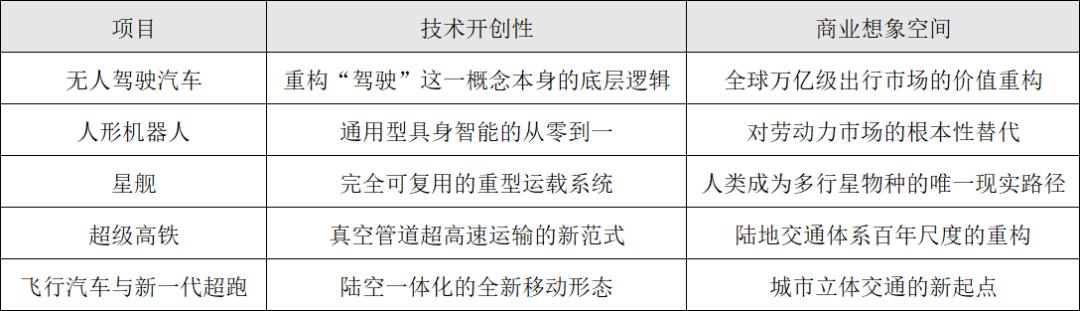
The common features of these projects are extremely distinct: each one is groundbreaking, each one doubles down on technology, and each one bets on the no-man's-land.
Then, what scales does he use to filter these battlefields?
First, whether it is difficult enough.
The more difficult the technical challenge is, the fewer people are willing to enter the field, and the fewer people can make it; once it is done, the leading advantage formed will be more difficult to shake. Followers can replicate a Model Y in a very short time, but no one can replicate a heavy-lift launch vehicle that can be recovered stably in the short term.
Second, whether it is fundamental enough.
What Elon Musk does is not to make cars run faster or make battery life longer, but to re-answer "what is a car", "what is energy", "how far can human beings go". Making breakthroughs on fundamental issues releases exponential value; making superficial improvements can only get linear marginal gains forever.
Third, whether it is long-term enough.
None of these projects can get returns in two or three years: it took more than ten years for Starship to go from concept to recovery, humanoid robots are still in the early stage, and Hyperloop was even once considered impractical by the mainstream engineering community. But Elon Musk is willing to accept this long-term uncertainty, because what he pursues is never the current profit, but the pattern of the world ten years later.
These three scales are exactly the mirror image of his decision to abandon the multi-product strategy: high-volume models belong to the "easy, superficial, short-term" field, which can be carried by the existing Model 3 and Model Y; groundbreaking products belong to the "difficult, fundamental, long-term" field, and all energy must be bet on them.
This also explains why Tesla seems to have "such a thin product line" but always stands at the commanding height of industry cognition — it exchanges a limited number of products for unlimited technical depth.
3
Commercial interests are a means, not an end
To understand Elon Musk, we must break a widespread misunderstanding: He does not care nothing about money.
On the contrary, he cares extremely about commercial success. Starship requires huge amounts of capital, Optimus requires huge amounts of capital, and Robotaxi requires huge amounts of capital — without continuous commercial success, all these technological dreams will be shattered overnight. Tesla's profitability and cash flow, SpaceX's launch orders and capital valuation are all fuels that support these dreams to continue to operate.
But in Elon Musk's value sequence, commercial interests are always in the position of means, not ends. This difference in positioning makes his behavior pattern essentially different from that of the vast majority of entrepreneurs:
When commercial interests become the only end, enterprises will naturally tend to minimize risks, choose tracks that have been verified, make improved products, use marketing and channels to seize market share, and pursue certain cash flow and predictable profit growth.
When commercial interests are only means, enterprises will tend to maximize technology, choose tracks that have not yet been verified, make paradigm-level products, use absolute technological leadership to create and monopolize a brand new market, and accept long-term high uncertainty calmly.
In the short term, these two modes are often interpreted as "risk-taking" or even "irrational"; but in the long cycle, the magnitude of returns they reach is completely different.
Model S was widely ridiculed as a "toy for the rich" in the year of its release, but as a result, it opened up the entire high-end electric vehicle market; Starship was ridiculed as "impossible to succeed" when it was first announced, but as a result, it reduced the unit cost of entering space by an order of magnitude.
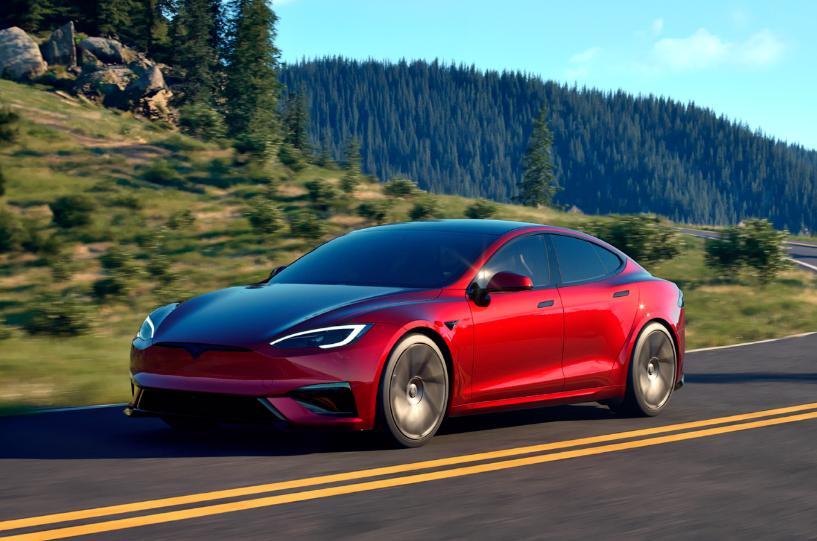
Every "impossible" that was once ridiculed has eventually become a new industry standard.
The reason why the industry is shocked again and again is precisely because it underestimates the boundary that the play of "taking business as a means of technological breakthrough" can reach every time.
4
Why can't others do it?
If this path is so correct and effective, why are there so few real followers? This is because there are three shackles locking them.
The first shackle is the instinct of the businessman.
The background of the vast majority of bosses is a businessman, and the nature of a businessman is to pursue profits — resources flow to places with certain returns, short cycles and low risks. This is not wrong in itself, and it is even the basis for the operation of the commercial world. But the problem is that when profit-seeking becomes the only criterion for judgment, everything that cannot be converted into profit within three years will be automatically excluded from the options.
The difference of Elon Musk is not that he does not pursue profits, but that in his value sequence, there is another layer above profit-seeking: the groundbreaking of technology, and the promotion of some fundamental problems of mankind. He is willing to bear a longer cycle, greater uncertainty, and more incomprehensible financial reports for this layer of things. Pure businessmen can't figure out this account — because in the eyes of pure businessmen, this is not an account at all.
The second shackle is the shackle of existing success.
Once an enterprise succeeds in a certain field, it will naturally tend to deepen and increase investment in that field, and use the accumulated capabilities to make marginal expansion — because this is the safest, most understandable, and easiest story to explain to the capital market. But this "safety" precisely means that it can never touch paradigm-level opportunities. Success itself has become its ceiling. The more successful an enterprise is, the harder it is to turn around and do something that "seems irrelevant to its main business and will not make money for ten years".
The third shackle is the shackle of imagination.
What most entrepreneurs do is to find better solutions within the existing framework; what Elon Musk does is to first question whether the framework itself should exist. When the whole industry is discussing "how to make batteries more durable", he is thinking about "how to reduce the cost of batteries to the point where fuel vehicles are completely extinct"; when the whole industry is optimizing "how to make a launch cheaper", he is thinking about "how to make rockets take off and land repeatedly like airplanes". Efforts within the framework and replacement of the framework are never at the same magnitude. This shackle is the most hidden, because it is not reflected in any external restrictions, but in the fact that a person can't even think of other options at all.
Then, what does Elon Musk rely on? He is not within any of these three shackles. His value sequence is higher than the profit-seeking instinct, his control over the company frees him from the kidnapping of the short-term will of capital, he actively abandons the path dependence of existing success, and his imagination never accepts the framework given by the industry.
This structural freedom is the real premise for him to adhere to long-termism in everything. This also confirms a cruel commercial law: those who promote the technological revolution are almost never pure businessmen, but pioneers who can bear long-term uncertainty and are willing to bet all their net worth on it.
5
Why is he not afraid of the risk of public opinion backlash?
A question that must be faced directly is: high-profile, radical, full of big words, and repeatedly "delayed" — if these traits are placed on any other entrepreneur, they will almost inevitably lead to devastating public opinion backlash. But why does Elon Musk put out "impossible to complete" promises again and again, and delay delivery again and again, but still maintain the industry's expectations for him?
The answer lies precisely in the core proposition of this article: His promises are never marketing words, but technological declarations.
When an entrepreneur promises pure commercial goals such as "doubling sales next year" or "increasing market share by five percentage points", once it cannot be fulfilled, the public will only see dishonest marketing; but when a person promises technological goals such as "making humanity a multi-planetary species" or "letting every family own a robot", even if the time is delayed again and again, the public will still see certainty in the direction — because he is really working hard, really trying, and really continuing to launch after repeated failures.
The difference is that the former uses promises to exchange for sales, while the latter uses promises to exchange for time. Once the former misses the deadline, it loses trust; even if the latter misses the deadline repeatedly, it still retains the public's trust in his technical judgment, because every delay is accompanied by a visible physical progress.
This is why he can calmly play the picture of failed recovery at the press conference: in other enterprises, this is a disgrace; in his case, this is the inevitable cost of exploration and a credible proof of the technical path.
Back to the original question, what does Elon Musk rely on to keep shocking the world?
The answer is not that he is smarter, nor that he is luckier. But he has always chosen the hardest, slowest, and most unprofitable path in the short-term financial sense — using commercial success to support technological breakthroughs, rather than using technology to serve the immediate return of capital.
In a commercial environment that generally pursues certainty, rapid realization and safety margin, this spirit is extremely scarce. It means:
Dare to cut off product lines that are clearly profitable, just because their existence is only a superposition of quantity, not a leap in quality;
Dare to shift resources on a large scale to areas that will not yield returns until ten years later when existing products are still making money;