Selling tokens, a new business that is not easy to make money from.
A group of companies doing business around "Token" are heading for the capital market.
On September 29, Jiuzhang Yunji, an AI infrastructure service provider, submitted its prospectus to the Hong Kong Stock Exchange, aiming to be the "first stock of intelligent computing new cloud". Earlier, Silicon Flow, an AI reasoning service provider, also submitted its listing application to the Hong Kong Stock Exchange at the end of June. In early October, according to media reports, Infimind has secretly submitted a listing application to the Hong Kong Stock Exchange. On the 12th of the same month, Infimind announced the completion of a 2.3 billion yuan Series C financing, with cumulative financing reaching 4.3 billion yuan. The company stated that both the single-round and cumulative financing scales have set new records in China's AI native infrastructure track.
The three companies have different business focuses, but all are betting on businesses related to Token.
Token is the basic unit for large models to process information. When a user asks a question to AI, the model needs to consume Tokens to understand the input and generate responses. Data from the National Data Administration shows that at the beginning of 2024, China's daily average Token call volume was about 100 billion, which will grow to 100 trillion by the end of 2025, and further exceed 140 trillion in March 2026. In just over two years, the daily average call volume has increased by more than 1000 times, with an increase of more than 40% in the first three months of 2026 alone.
Capital is placing bets, and players from different backgrounds are joining the market. But the more realistic situation is that Token demand continues to grow, price competition intensifies, and some models have cut prices significantly. For enterprises that have invested a lot of funds in purchasing computing power and building infrastructure, the increase in call volume does not necessarily mean profit growth. Jiuzhang Yunji's revenue reached 1.098 billion yuan in 2025, but more than 90% of it still came from intelligent computing infrastructure solutions. In 2025, Silicon Flow's revenue increased by more than 6 times, but its gross profit margin fell to -24%.
Who is running this business, and what profits are they making respectively? Is selling Token a good business?
01. Why are Token factories so popular?
The term "Token factory" became popular after NVIDIA CEO Jensen Huang's GTC 2026 keynote speech. In his vision, future data centers will no longer be warehouses for storing files, but factories that produce Tokens.
Different from directly renting out GPUs or servers, Token factories emphasize converting underlying computing power into directly callable model reasoning capabilities, and then charge customers through methods such as Token consumption. For example, computing power is production capacity, and Token is the product.
For enterprises, this saves a lot of trouble. In the past, assuming an enterprise wanted to build its own AI customer service system, it needed to purchase or rent servers, deploy models, and arrange technical personnel for maintenance. Today, it can directly purchase model reasoning services and pay according to the actual call volume, without having to worry about how the servers and models behind it operate. The usage here is usually measured by Token.
This model lowers the threshold for using AI, especially benefiting small and medium-sized enterprises, which do not need to invest a lot of money at one time to build computing power facilities.

Image source / pexels
Of course, the two models are not completely opposed. A Token factory can also provide computing power leasing, model deployment and API call services at the same time. The change is that some enterprises have begun to shift their business focus from selling computing power resources to selling the actual use value generated by computing power.
What drives this change is the transformation of the computing power demand structure.
In the past, a large part of AI computing power was used to train large models. As more and more people and enterprises use AI, reasoning demand is growing rapidly. The rise of Agent further amplifies this trend: AI has changed from answering questions to executing tasks, and behind a single user request, there may be multiple rounds of model calls.
This business also has considerable room for imagination. According to the calculation of CICC, under ideal conditions such as self-built computing power and Tokens can be sold at the assumed price, the theoretical gross profit margin of Token factories can reach 60%.
But there is a gap between theory and reality. Token price competition is fierce, and service providers must continuously improve computing efficiency to maintain profits.
Therefore, the core competitiveness of Token factories is not only how many GPUs they own, but also whether they can produce more Tokens with the same computing power on the premise of ensuring model effect, response speed and service stability. Computing power scheduling, reasoning acceleration, and model adaptation have thus become the key to competition.
In this efficiency competition, players from different backgrounds do not have the same starting point.
02. Who is exploring opportunities in Token factories?
All selling Tokens, current domestic players can be roughly divided into three categories: large Internet companies that own models and cloud computing platforms, AI infrastructure startups focused on reasoning services and computing power optimization, and enterprises that extend from traditional computing power businesses such as servers and intelligent computing centers to Token services.
The first category is cloud vendors such as Alibaba Cloud, Volcano Engine, and Baidu Intelligent Cloud, which are currently the dominant players in the Token market. Such enterprises not only have cloud computing infrastructure, but also self-developed large models and a huge customer base.
For example, Alibaba Cloud provides call services for models such as Tongyi Qianwen through the Bailian platform, and Volcano Engine provides services to customers relying on the Doubao large model and related platforms. Enterprise customers can complete the whole process from model selection, access to subsequent use on the same platform.
For large companies, Token revenue itself may not be the focus. They can package and sell Token services with cloud computing, storage, databases and other products. Even if the profit of the Token business is limited, as long as customers stay on their own cloud, they can obtain continuous revenue from cloud services in the future.
The scale advantage of this type of player is also very obvious. Frost & Sullivan data shows that in terms of annual Token throughput in 2025, Silicon Flow is the fourth largest Token supply platform in China, with a market share of 1.5%. The top three are Volcano Engine, Alibaba Cloud, and Baidu Intelligent Cloud, with a combined share of up to 87%. The domestic Token supply market presents a clear pattern of "dominated by large companies".
The second category is AI infrastructure startups such as Infimind and Silicon Flow. Such startups more directly take Token supply and reasoning services as their core business direction.
They usually do not develop general large models by themselves, but provide services around links such as model deployment, reasoning acceleration, and computing power scheduling. To put it simply, what they need to solve is how to make different large models run faster and cheaper on different chips, and provide these capabilities to downstream customers.
For example, Silicon Flow provides developers and enterprises with call services for multiple models through the model cloud platform; Infimind emphasizes heterogeneous computing power scheduling, model reasoning and AI infrastructure service capabilities.
They mainly make profits by providing model reasoning services, between service revenue and costs such as computing power: they purchase or rent computing power from upstream, and charge customers according to Token usage after reasoning optimization. In addition, they also do private deployment projects for large enterprises and institutions.
A primary market investor who has long focused on the AI industry told "Dingjiao One" that the opportunities for independent reasoning service providers mainly come from two aspects: first, the diversification of the model and chip ecosystem. Enterprise customers do not necessarily only use models from one company, nor do they want to be bound by a single cloud platform; second, reasoning efficiency. If independent service providers can reduce the unit Token cost with the same hardware and the same model, they can establish certain competitive advantages.
However, such enterprises also have shortcomings, he pointed out, "Large companies are also continuously optimizing reasoning efficiency, and open source reasoning frameworks are also improving. If the advantage gap of a startup is not large, it will soon be caught up."
In his view, large companies have already mastered models, computing power and customers. Independent reasoning service providers have opportunities, but the space is not wide enough.
The third category is enterprises extending from traditional computing power infrastructure to Token services, including some intelligent computing center operators, computing power service providers and industrial chain enterprises.
Jiuzhang Yunji is a representative of them. The company used to be mainly engaged in intelligent computing infrastructure solutions and intelligent computing cloud service businesses, helping customers build intelligent computing centers and providing computing power services. In the first half of 2026, the company began to provide the Alaya Token service billed by Token usage, encapsulating computing clusters and third-party large language models into standardized API interfaces, and customers obtain reasoning outputs by calling the interfaces and pay according to the actual number of Tokens consumed.
For such enterprises, Token is more like a new way to sell computing power. After the servers are built, depreciation, leasing and operation and maintenance costs continue to occur no matter whether there are customer calls or not. Packaging computing power into Token services can take on more scattered reasoning demands and improve equipment utilization.
Their advantages lie in their existing experience in intelligent computing infrastructure construction, computing power resource organization and project delivery. The shortcoming is that from building intelligent computing centers to operating Token services, it is not simply changing the billing unit, but also requires capabilities in model deployment, reasoning optimization and customer service, as well as finding customers who can continuously consume Tokens.
The above investor believes that if we only look at the short-term commercialization capability, large cloud vendors have more obvious advantages. But in the long run, independent reasoning service providers do not necessarily have no opportunities. The future market may be stratified: standardized and large-scale model call services will face fierce price competition; while in specific models, complex deployment, low latency or enterprise-level service scenarios, there may still be differentiated space.
In terms of market share, the intelligent computing service market supported by Token service providers has gathered many strong competitors.
The prospectus of Jiuzhang Yunji cites data from CIC that in 2025, the top five intelligent computing service providers in China will collectively account for 66.1% of the market share, and the share of the top ten service providers will further reach 80.1%. Among them, the top three enterprises account for 22.1%, 15.2% and 10.5% of the market share respectively.
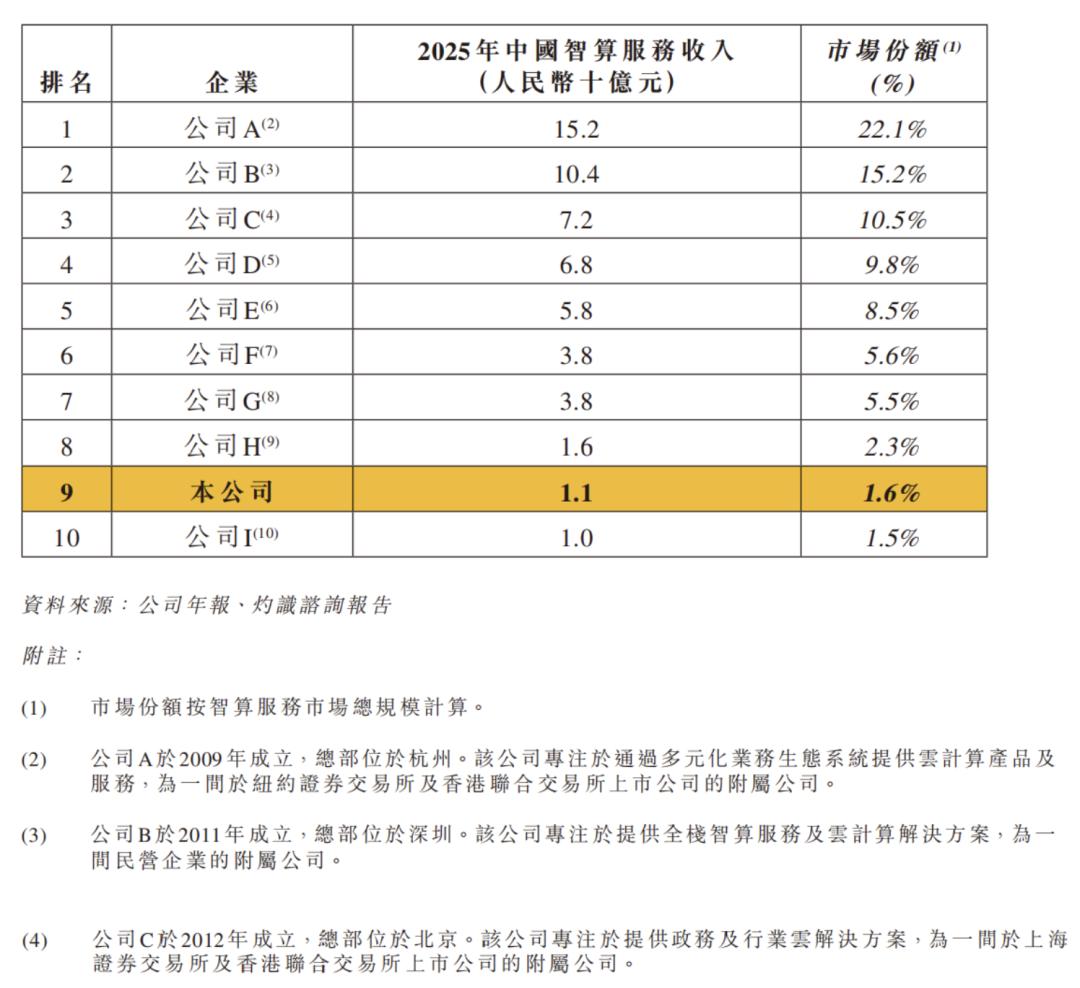
Inferred from information such as the establishment time of the enterprise, the location of its headquarters and the background of its shareholders, the top players include Alibaba Cloud, Huawei Cloud, and Tianyi Cloud, a cloud service provider under the telecommunications operator.
Although this statistic is aimed at the broader intelligent computing service market, not the dedicated Token market, it at least reflects that this is not a market that can be easily divided by new players.
At this stage, large companies hope to turn Token services into a new entry point for cloud business; independent service providers hope to acquire customers through model adaptation and reasoning optimization; traditional computing power enterprises regard Token as a channel, hoping to extend from infrastructure to higher value-added services.
The three types of players have different resource advantages and business models, and face different commercialization prospects.
03. How far are Token factories from making profits?
The more Tokens you sell, the more profitable the enterprise will definitely be?
At least from the disclosed financial data, the answer is still uncertain.
Let's first look at Silicon Flow, which takes Token as its main product. The prospectus shows that in 2025, the company's revenue was 55.33 million yuan, a year-on-year increase of 653.2%, but the gross profit margin dropped from 39.4% in 2024 to -24%. The net loss for the whole year was about 345 million yuan, and the adjusted net loss was about 187 million yuan.
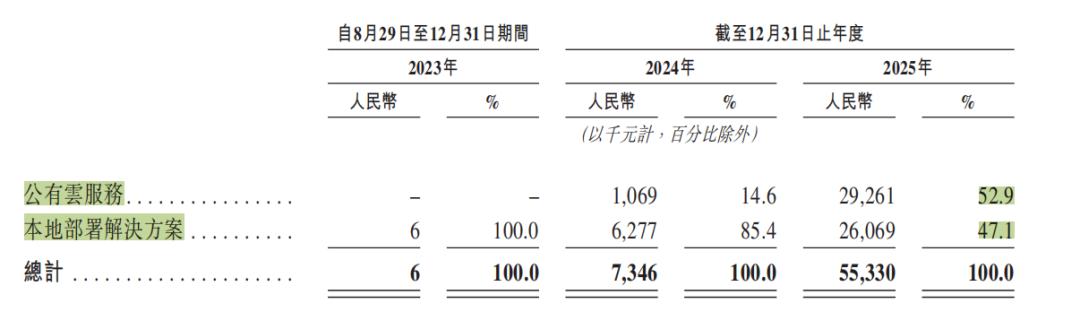
The main drag on profitability is the public cloud business. In 2025, the revenue of this business was 29.261 million yuan, accounting for 52.9% of the total revenue, and the gross profit margin was -119%. Among them, the revenue of serverless Token services billed by Token was about 14.3 million yuan, and the revenue of exclusive instances was about 15 million yuan. In contrast, the gross profit margin of the local deployment business for large enterprises and institutions reached 82.5%. That is to say, the public cloud business of Silicon Flow, which is closest to the "Token factory" model, is exactly the part with the lowest gross profit; while the more traditional project-based business has a significantly higher gross profit margin.
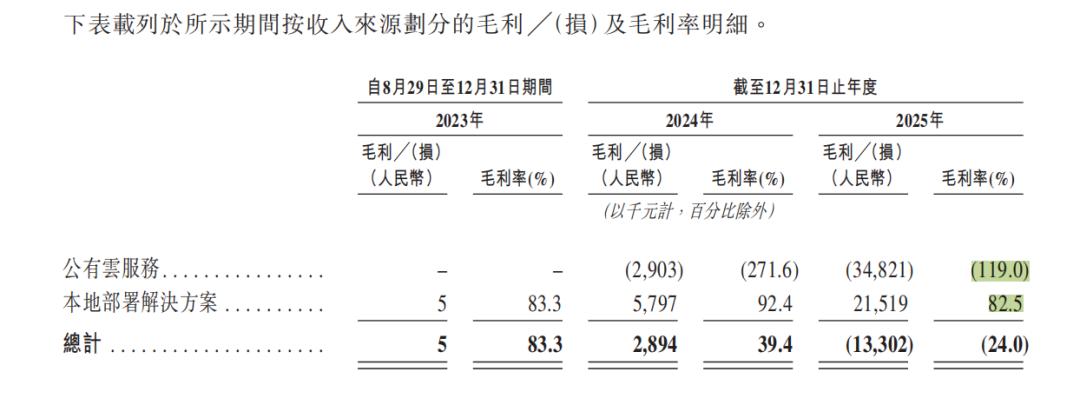
At the same time, with the expansion of the public cloud business, the company's computing power resource costs grew rapidly, accounting for 86.9% of the cost of sales in 2025.
Let's look at Jiuzhang Yunji, which extends from computing power infrastructure. From 2023 to 2025, its total revenue increased from 106 million yuan to 1.098 billion yuan. But when broken down, the revenue is still mainly supported by the intelligent computing infrastructure business.
The prospectus shows that in 2025, more than 90% of Jiuzhang Yunji's revenue came from intelligent computing infrastructure solutions, and the revenue from intelligent computing cloud services only accounted for 7.1%. In the first half of 2026, the revenue shares of the two businesses were 73.8% and 26.1% respectively. Although the proportion of cloud services has increased significantly, helping customers build intelligent computing infrastructure is still its main source of revenue.
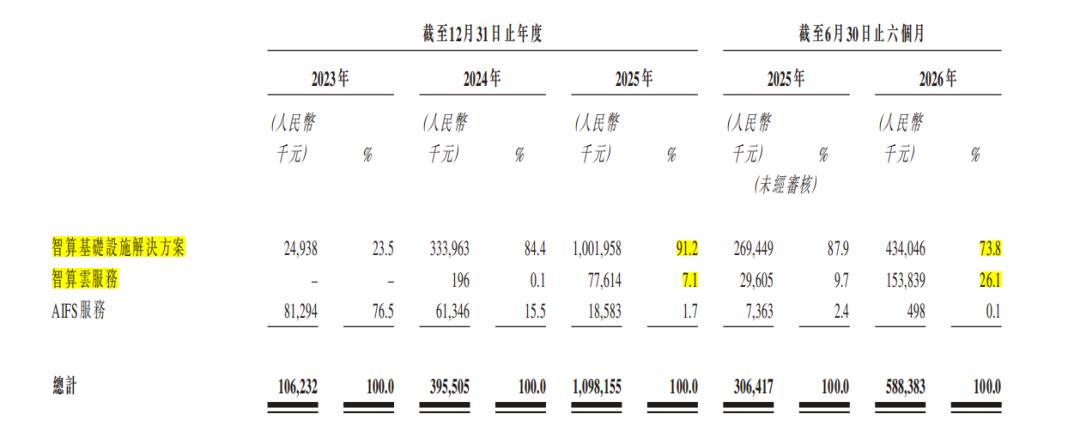
Moreover, intelligent computing cloud services are not exactly the same as Token sales. Jiuzhang Yunji has launched the AlayaToken service billed by Token usage, but the prospectus has not yet separately disclosed the revenue scale of this part of the business.
The commercialization problems faced by the two enterprises are different. Silicon Flow needs to prove that the gross profit margin can turn positive after the scale of model services expands; while Jiuzhang Yunji needs to prove that the Token services extended from intelligent computing infrastructure can form an independent and stable source of revenue.
Even in the view of the above-mentioned investor, some current Token reasoning service providers have not yet formed a clear profit model, and the capital market's judgment on their value is more driven by vision.
Why is this business still not easy to make profits?
On the one hand, real demand is growing, and price competition is also intensifying.
A cloud service channel provider told "Dingjiao One" that in the past six months, its team's Token API sales have nearly doubled, and the growth mainly comes from the expansion of new customers, covering multiple industries such as games, short videos, e-commerce, and