People Who Left ByteDance: 36 Entrepreneurs, Taking Away Both the Methods and the Boundaries
In May 2026, Zhang Yang had a meal with Zhang Yiming in the office area of a business line at ByteDance.
The official account "AI Nao" recorded this meeting in a report in October. The dinner was held in a conference room and lasted for more than two hours. Most of the time, Zhang Yiming was asking questions: why develop AI games, how he came up with the idea, and how to deduce each step. Zhang Yiming had read reports about Zhang Yang's entrepreneurship and took the initiative to ask him out.
Zhang Yang was previously in charge of international expansion at ByteDance, and participated in an Indian version of content community product that achieved tens of millions of daily active users within a few months. After leaving ByteDance, he founded Wanaka to develop AI games, with angel round funding from Jinqiu Fund. Doubao once tried to invite him back, but he declined, stating that he wanted to participate in this era in his own way.
At the dinner table, Zhang Yiming reflected that ByteDance had failed in its past game business due to insufficient patience, as games require a longer waiting period than videos and novels. He gave Zhang Yang two pieces of advice: develop the mobile version as soon as possible, and test interactive video content as soon as possible. Zhang Yang's answer was very straightforward: he cannot outperform ByteDance in the video modality, and ByteDance will definitely enter this field.
The founder of a company and a former employee sat across a conference table. One side was still personally meeting people and delving into details, while the other side went out with the training he received from this company, clearly knowing that he could not avoid it.
Many people like Zhang Yang have emerged in the past three years. After cross-verifying public materials such as company announcements, financing reports and industrial and commercial information, Xiutai counted 36 ByteDance-affiliated entrepreneurs. Among them, 30 have public financing records, and the other 6 have started their own businesses without any public financing records yet.
The ByteDance-affiliated entrepreneurs mentioned in this article refer to people who once worked at ByteDance and then founded or co-founded their own companies after leaving. Founders whose companies were acquired by ByteDance and then worked at ByteDance are also included; people who left ByteDance and then joined other companies are excluded. Among these 36 people, there are researchers from AI Lab and Seed, product managers who managed products with hundreds of millions of users, commercialization operators in charge of monetization, and people who had entrepreneurial experience before joining ByteDance. Sorted by the time of leaving or starting a business, there were 4 people in 2022 and before, 7 in 2023, 4 in 2024, 9 in 2025, and 12 since the beginning of 2026.
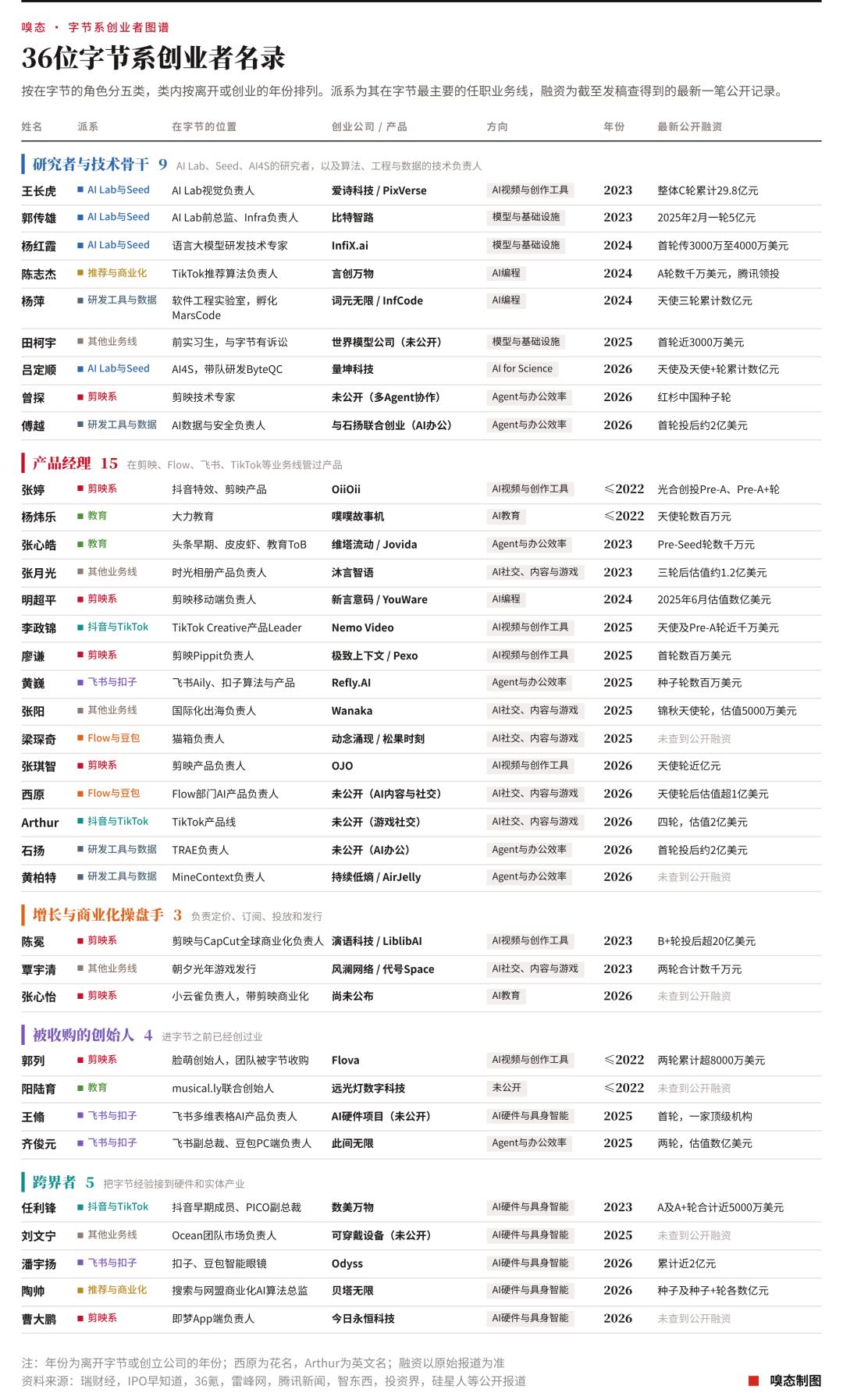
These 36 people are a group whose names, resumes and destinations can be verified one by one. A broader estimate from AI Nao shows that according to public financing statistics, there were about 70 to 80 ByteDance-affiliated entrepreneurs since January 2023, with cumulative financing of about 180 billion RMB. The same report mentioned that a top-tier fund set an assessment for its investment team in 2024, requiring each member to meet at least one core ByteDance employee per month; more than half of the founders of more than a dozen AI projects invested in the first phase of a new fund came from ByteDance.
In 2026, the trend changed. According to AI Nao, an employee at ByteDance level 4-1, roughly equivalent to a director, who left to start a business, used to negotiate for a minimum of 4 million USD in angel round a year ago, but now the valuation has dropped to 2 million USD; investors have begun to check their motivations in turn, to see whether they left voluntarily or encountered difficulties in the company.
ByteDance has developed Toutiao, Douyin, TikTok and Jianying over more than ten years, and is known as the "App Factory". Now, the people who participated in building these products are leaving the factory. Based on the resumes and financing records of these 36 people, this article examines in how many batches they left, what categories they belong to, what methods they took away from the factory, and where they encountered difficulties.
01
Three Batches of Departures
Sorting the 36 people by their departure time, they can be roughly divided into three batches, with a prelude before them. The source of this trend can be traced back to the contraction of ByteDance's education business at the end of 2021.
That contraction made a group of people look for new career positions. According to reports from Star Silicon, Chen Mian was working at the children's thinking product Guagualong at that time, and then transferred to Jianying. Reports from the investment community mentioned that Yang Luyu, co-founder of musical.ly, originally worked at Dali Education, left ByteDance in 2022 and founded Highlight Digital Technology. Zhang Xinhou worked on ToB products for education, and Yang Weile came from Dali Education, both of whom later developed AI products. This contraction did not directly spawn many companies, but pushed a group of people to the crossroads of job transfer and departure in advance.
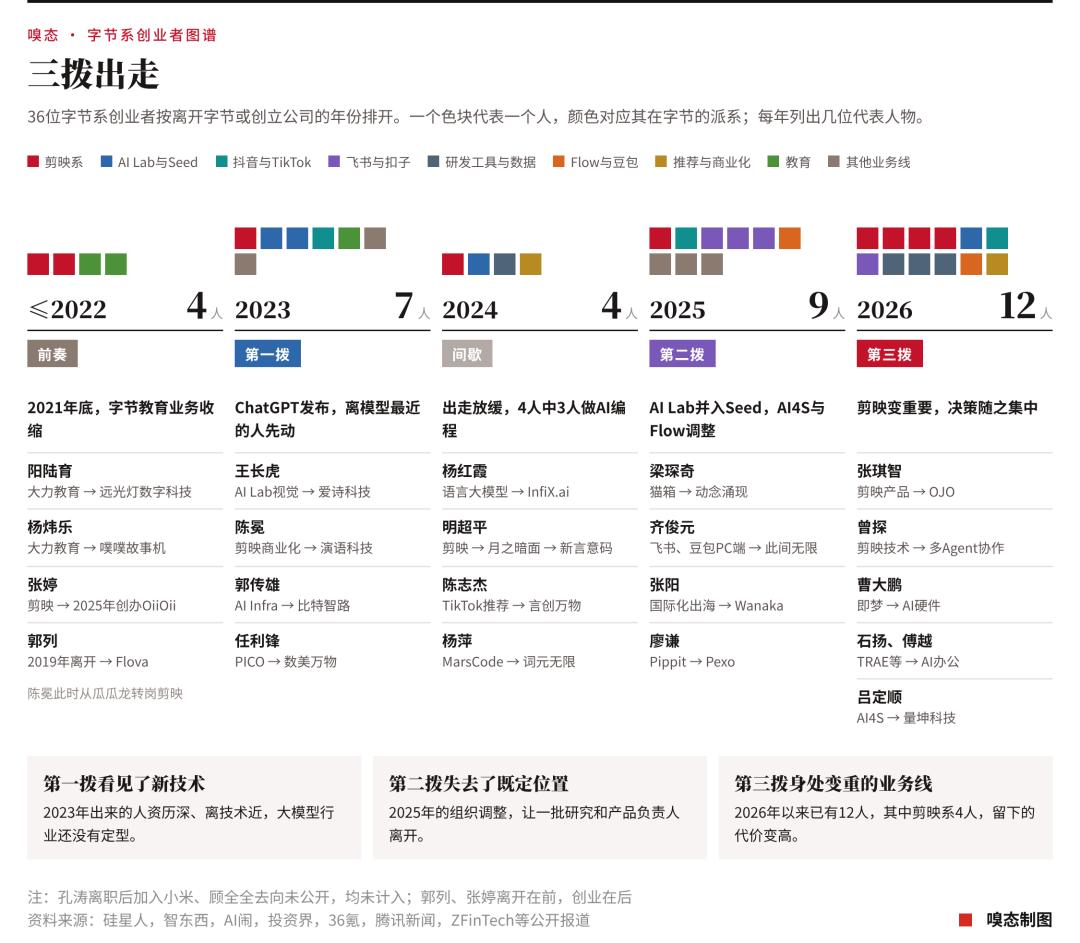
The first real batch of departures took place in 2023. In the months after the release of ChatGPT, a group of people at ByteDance who were closest to the model took action first.
In April, Wang Changhu, head of AI Lab's vision team, registered Aishi Technology to develop video generation. He was a senior research manager at Microsoft Research Asia, and participated in the construction of Douyin and TikTok's vision capabilities from scratch at ByteDance. According to his own recollection, the vast majority of investors at that time believed that video generation could not be implemented within five years. In May, Chen Mian, head of global commercialization for Jianying and CapCut, left the company. In June, Guo Chuanxiong, who led the development of machine learning systems and data center networks at ByteDance, founded Bitwise Road to develop AI networks. Yang Hongxia, former head of the M6 model at Alibaba's DAMO Academy, joined ByteDance to work on large language models in 2023, left in May 2024 and founded InfiX.ai. Ren Lifeng, an early member of Douyin and vice president of PICO, also left to start his business during this period.
These people have deep qualifications and are close to the technology. When they left, the large model industry had not yet taken shape, and no one could clearly tell what the products, company forms and business paradigms at the application level would look like.
The second batch was concentrated in 2025, triggered by organizational adjustments. A June review by Zhidong showed that at the beginning of that year, Wu Yonghui, former vice president of research at Google DeepMind, joined ByteDance, and AI Lab was fully merged into the Seed large model team; the AI4S team was taken over by Yang Zhenyuan, vice president of technology, and was required to output solutions through Volcano Engine, leading a group of research scientists to leave; the AI product department Flow was also adjusted, the Xinghui program was merged into Doubao, and C-end AI products were clearly required to undertake monetization tasks.
In June of that year, Kong Tao, director of robotics research, left the company. He built ByteDance's robotics team from scratch, and saw embodied intelligence being moved to the edge in the redistribution of resources. He did not start a business, and joined Xiaomi in the summer of that year, so he is not included in the 36 people counted in this article. Liang Chenqi, head of Maoxiang, left and founded Dynamic Emergence in Shanghai to develop AI comics. Qi Junyuan, vice president of Feishu products and head of Doubao PC, left in November, and established this Infinite in March the following year to develop GUI Agent. Zhang Yang, who worked on international expansion at both Xiaomi and ByteDance, launched the AI game project Wanaka in May of that year. Lv Dingshun, who came from AI4S, founded Liangkun Technology in January 2026; Gu Quanquan, also from AI4S, was reported to be preparing to start a business with the direction of AI pharmaceutical and protein design, and his destination has not yet been made public, so he is not included for the time being.
The third batch started in 2026, with Jianying as the protagonist.
In February 2024, Zhang Nan stepped down as CEO of Douyin and took charge of Jianying. Jianying had a low status in the group before, with a large number of users, but the commercialization efficiency of its tool products was not as good as that of Douyin and TikTok, which made money from advertising. According to reports from Star Silicon, after Zhang Nan took office, manpower and resources were tilted towards Jianying, people who had fought tough C-end battles with her came one after another, the team traveled between Beijing and Shenzhen, and Shenzhen employees immediately worried that they might be adjusted. At the end of 2024, Zhang Xiaoran, head of Jianying products, and Wang Xuezhi, head of technology, left one after another, and all product lines were directly managed by Zhang Nan.
As the business became more important, decisions became more centralized. Between March and June 2026, Zeng Tan, a technical expert at Jianying, left to develop multi-Agent collaboration and got HSG's seed round; Zhang Qizhi, an early member of FaceMao and head of Jianying products, left to develop the design Agent workbench OJO, and completed an angel round of nearly 100 million yuan in August, invested by Shunwei Capital and Lenovo Capital; Cao Dapeng, head of the Jimeng App, left and developed proactive Agent hardware for the European and American markets in Shenzhen; Zhang Xinyi, head of Small Skylark, also left in May. In June, Z Finance reported that the AI product leader with the alias "Xiyuan" in the Flow department started his business, with a post-money valuation of more than 100 million USD after the angel round.
According to statistics from Star Silicon, at least 10 people with Jianying background founded AI application companies in the past two years, and many Jianying employees have successively joined their former colleagues' teams. The report calls this phenomenon "person-to-person transmission".
The departures are still ongoing. In autumn, Shi Yang, head of TRAE who managed Doubao MarsCode, left and co-founded an AI office business with Fu Yue, former head of AI data and security. According to a ZFinTech report in October, the post-first-round valuation is about 200 million USD.
The starting points of the three batches of people are different. The first batch saw new technologies, the second batch lost their established positions in organizational adjustments, and the third batch was in a business line that suddenly became important, where the cost of staying became higher, and the return of leaving was clearly in sight.
02
Five Types of ByteDance-Affiliated Entrepreneurs
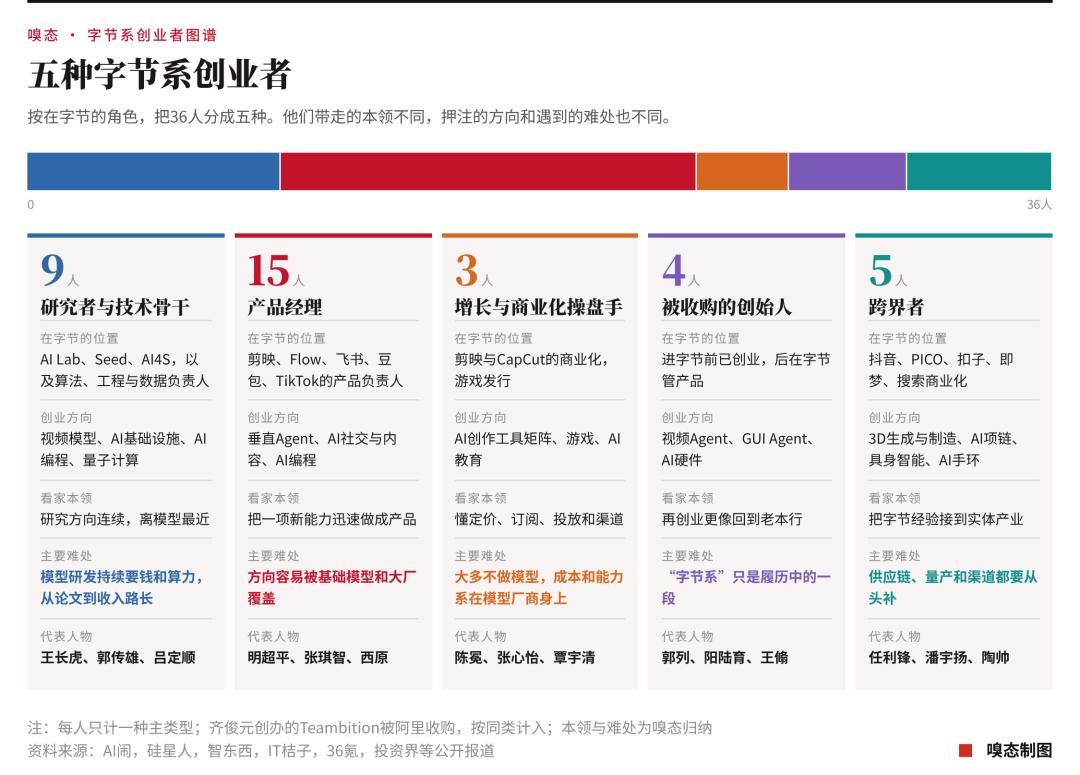
Even though they are all counted as ByteDance-affiliated entrepreneurs, what these 36 people did at ByteDance varies greatly. Divided by their roles at ByteDance, they can be divided into at least five types.
Researchers come from AI Lab, Seed and AI4S, who are closest to the models; product managers managed products in Jianying, Flow, Feishu and Doubao, and are the largest group; growth and commercialization operators understand pricing, subscription and delivery; acquired founders already had entrepreneurial experience before joining ByteDance; cross-border people apply what they learned at ByteDance to hardware and manufacturing.
They had different positions at ByteDance, took away different skills, and their directions of betting, the money they obtained, and the difficulties they encountered when starting a business are also different. AI Nao's report reminds that when looking at a ByteDance-affiliated entrepreneur, you should first see which business line he is in, which stage of the business he is at, and which boss he has followed for a long time.
Researchers: Leaving with Research Directions
Most of this group were already mature researchers before joining ByteDance. Wang Changhu did many years of vision research at Microsoft Research Asia; Yang Hongxia studied for a PhD at Duke University, served as Yahoo's chief data scientist and head of the DAMO Academy M6 model; Guo Chuanxiong was a researcher at Microsoft Research in his early years, and founded the machine learning system, data center network and hardware acceleration departments at ByteDance; Lv Dingshun was one of the first batch of quantum computing PhD students at Tsinghua University's Cross Information Research Institute, and led the development of the quantum chemical computing platform ByteQC at ByteDance. What ByteDance gave them was computing power, data and real product scenarios, and Wang Changhu's vision algorithm was used on Douyin and TikTok.
After leaving, almost all of them continued to move forward along their original research directions. Wang Changhu develops video generation models, Guo Chuanxiong develops AI networks, Gu Quanquan was reported to be preparing for AI pharmaceutical and protein design, and Lv Dingshun develops a scientific computing platform that combines quantum computing and AI. This type of company raises a lot of money, and its valuation logic is closer to that of model companies and hard technology companies. According to Rui Finance, Aishi Technology has raised a total of 2.98 billion yuan in Series C rounds; according to reports from Leifeng.com, Bitwise Road raised 500 million yuan in a single round in February 2025; according to information released by Beijing Economic and Technological Development Zone, Liangkun Technology was established in January 2026, and completed several hundred million yuan in angel round and angel+ round in less than half a year, led by Inno Angel Fund. AI Nao's report believes that the most valuable talents among ByteDance's current talents are in Seed, and the younger researchers who work on the front line are more valuable.
What often pushes them out is organizational adjustment. In 2025, AI Lab was merged into Seed, the AI4S team was required to output solutions through Volcano Engine, and embodied intelligence was moved to the edge in the redistribution of resources. But leaving does not mean starting a business. Kong Tao, who built ByteDance's robotics team, joined Xiaomi after leaving, and became the head of Xiaomi's embodied intelligence and application department in August 2026. ByteDance itself is also taking research directions out for independent financing: the drug discovery team in AI4S was split into Anew Labs, which completed a 290 million USD first round in September 2026, with a post-money valuation of about 1.5 billion USD, and ByteDance retains 56% of the shares. For those who left to start a business, the difficulty lies in the research itself. Model R&D requires continuous investment of money and computing power, and it takes a long way from papers to revenue.
Product Managers: Turning New Capabilities into New Products
This is the largest group. Ming Chaoping worked on Jianying's mobile terminal, Zhang Qizhi was head of Jianying products, Qi Junyuan served as vice president of Feishu products and head of Doubao PC, and Huang Wei worked on intelligent partners and workflows at Feishu and Kouzi. Xiyuan led two AI product lines, Maoxiang and Xinghui, in the Flow department at the same time. A Z Finance report stated that there are only five or six AI-native products with over one million daily active users within ByteDance, and he was responsible for two of them.
They are familiar with horse racing, A/B testing and data-driven iteration, and the companies they run are generally vertical, starting from a newly emerged model capability and a clear scenario. Zhang Qizhi develops the design Agent workbench OJO, Liang Chenqi develops the AI comic platform Pinecone Moment, Qi Junyuan develops GUI Agent, Huang Wei develops the AI workflow Refly.AI, and Ming Chaoping develops YouWare, which allows people who cannot write code to build applications.
Star Silicon's report wrote that when this group sees a new capability, they will immediately judge what product it can be integrated into, and then move towards it immediately. Speed is their strength, but also a hidden danger. Once a direction is covered by basic models or large manufacturers, they will quickly switch to the next