The first Asian country to be ruthlessly fleeced by foreign capital this year
Months ago, South Korean girls shared screenshots of their doubled KOSPI accounts on social media, with the caption "In the AI era, ordinary people can win effortlessly without extra effort";
Months later, the same group of people fell silent. Some posted screenshots of their leveraged accounts being completely cleared on forums, leaving only one line: "I thought this time would be different."
This is the most glaring contrast in South Korea's capital market in 2026.
The KOSPI led the gains among the world's major stock indexes in the first half of the year, but has fallen by 40% since the second half, with its trading volume shrinking by more than 70% from its peak at the end of May.
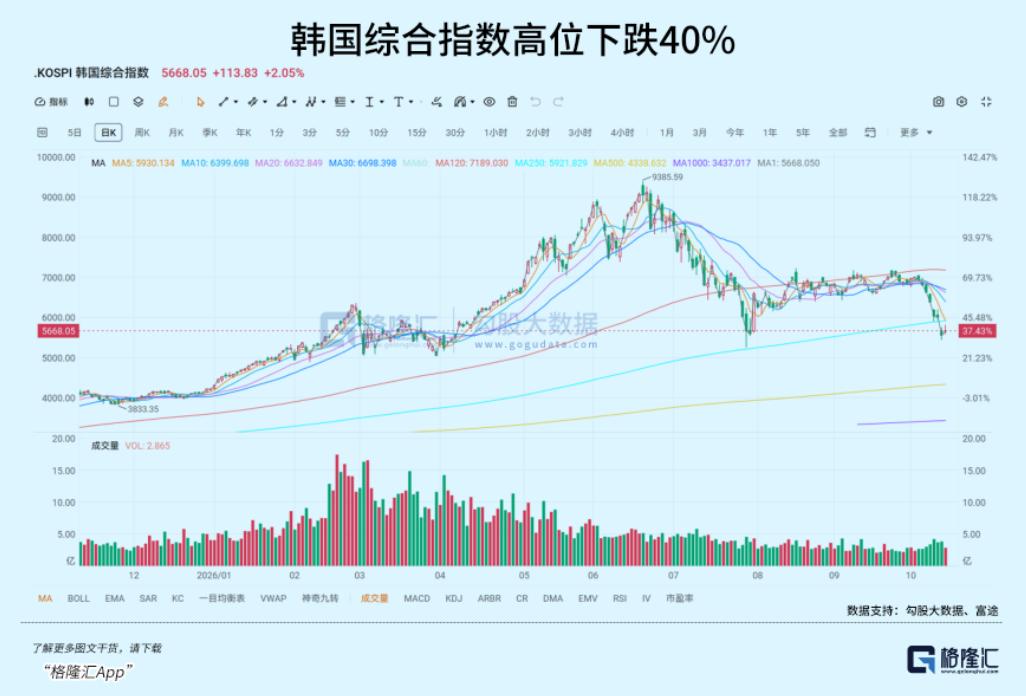
Objectively speaking, South Korea is a country that has truly reaped the super dividends of the industry in this round of global AI technology boom. The revenue and profit growth of Samsung and SK Hynix has brought tangible and huge economic contributions to South Korea.
The South Korea Composite Index has still accumulated an increase of more than 1.3 times since 2025. Although Samsung and SK Hynix have now halved their pullback from high levels, their market capitalizations have still risen by more than 3 times and 6.4 times respectively in the past two years.
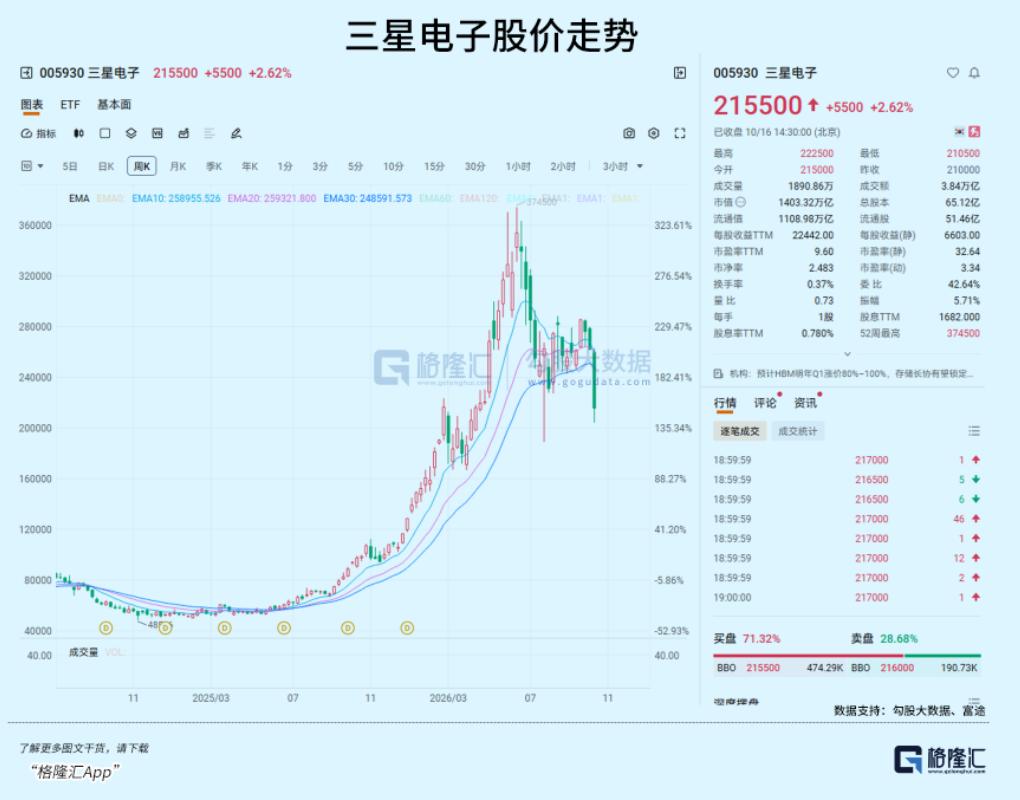
However, the dazzling industrial dividends eventually led to a brutal wealth redistribution in the capital market.
On October 14, at the parliamentary hearing of the National Pension Service of Korea, the fund was severely criticized as "an ATM for foreign investors".
Although this statement is exaggerated, it does reveal that foreign investors have harvested a huge amount of wealth from the South Korean stock market in this epic AI market rally.
01
Blowing up the AI bull market and then pulling the ladder away
The starting point of this round of South Korean stock market rally is very simple.
From 2023 to 2025, the Federal Reserve entered an easing cycle, investment in AI infrastructure exploded, and global funds were searching everywhere for the "cheapest AI entry".
Samsung Electronics and SK Hynix are at the core of the supply chain of memory chips, HBM and AI servers, with their valuations significantly lower than those of US tech giants, so they became the preferred targets for foreign capital.
As a result, investment bank research reports, index inclusion, ETF funds and derivatives leverage jointly promoted the spread of the narrative. The KOSPI index soared all the way from a low level, with its cumulative increase in the first half of the year once exceeding 100%, making it the best-performing major stock index in the world.
In this process, foreign capital played a dual role.
In the early stage, they were the shapers of pricing power: through continuous buying of Samsung and SK Hynix, they rebranded memory chips from traditional cyclical stocks to AI infrastructure stocks;
In the later stage, when valuations were pushed up and expectations were raised to the extreme, they became the first profit-takers to leave the market.
What is more ironic is that Samsung Electronics' operating profit in the third quarter once hit a record high, surging nearly nine times year-on-year, but its stock price fell instead of rising, indicating that the market no longer believes in the simple logic of "good performance equals rising stock price".
Because when expectations are pushed to the extreme, any result that falls short of "even more extreme" will be interpreted as negative news.
But the most important thing is not this, but the lack of take-over orders in the South Korean stock market.
In the first half of the year, retail investors who drove the rise significantly retreated after the sharp plunge in July. The margin balance fell from the peak of 38.6 trillion won in June to about 33 trillion won, and the uninvested deposits in brokerage accounts also dropped from nearly 140 trillion won to about 100 trillion won.
The share repurchase plans of Samsung and SK Hynix that previously supported the market are also nearing completion. The total repurchase of about 55 trillion won by the two companies contributed most of the market buying orders last month.
Samsung Electronics' share repurchase was basically completed in early October, and SK Hynix only has a small amount of remaining work to finish.
When the repurchase exits and foreign capital continues to sell, the market will have an obvious liquidity vacuum.
In fact, the funds did not leave slowly, but pulled the ladder away intensively at a certain node, leaving highly leveraged retail investors and passively holding institutions to bear the decline.
The South Korean stock market, with its huge ups and downs in half a year, has provided a vivid lesson for global investors:
When a market pins the fate of its index on two stocks, one track and a group of external funds, the rise can be dazzling, and the retreat can also be extremely brutal.
What really determines the price is often not just corporate earnings, but who is buying, who is selling, and who can continue to take over the orders.
02
How much does South Korea rely on foreign capital?
The dependence of the South Korean stock market on foreign capital is already very obvious in the position structure.
As of June 2026, foreign investors hold about 37.8% to 38.9% of the total market value of the South Korean stock market, of which US investors account for about 42% of foreign shareholdings.
The foreign shareholding ratio of core tech stocks such as Samsung Electronics and SK Hynix has long exceeded 60%. In early August, it was still about 46.70% and 50.84% respectively, and further dropped to 46.38% and 49.59% in early October.
This means that the pricing power of the most core assets in the South Korean stock market has long been in the hands of foreign investors.
In terms of trading volume, this dependence is amplified to the extreme.
As of October 14, foreign investors have accumulated a net sell-off of about 203.7 trillion won on the main board of the South Korea Composite Index this year, of which Samsung Electronics and SK Hynix alone were net sold for about 176 trillion won, accounting for 86% of the total foreign sell-off; this year, foreign investors withdrew about 131 billion US dollars from the South Korean stock market, the largest among major Asian markets.
The foreign shareholding ratio of Samsung Electronics dropped to 46.38%, the lowest level since 2008; the foreign shareholding ratio of SK Hynix fell below its 10-year average.
The KOSPI index itself is highly concentrated, and the combined weight of Samsung Electronics and SK Hynix exceeds half, which is also an important reason.
This means that once foreign investors concentrate on selling these two stocks, the index will hardly have any buffer.
During the period when KOSPI rose by more than 100% in the first half of the year, foreign investors pushed up the valuations of leading stocks with the AI semiconductor rally; in the second half of the year, the continuous withdrawal of foreign investors became the core driving force for the index to fall from its high point.
Let's talk about liquidity next.
As mentioned earlier, the trading volume of the South Korean stock market has dropped by about 70% from its peak at the end of May. The retail margin balance has dropped from the peak of 38.6 trillion won in June to about 33 trillion won, and the uninvested deposits in brokerage accounts have dropped from nearly 140 trillion won to about 100 trillion won.
The combined share repurchase plan of about 55 trillion won by Samsung Electronics and SK Hynix is nearing completion, and repurchases contributed the vast majority of the about 230 billion US dollars of buy orders in the market last month.
When foreign investors are selling and the repurchases in the South Korean stock market are gradually exiting, it is simply a fantasy to rely on retail investors to support the overall market!
Even if the fundamentals of the South Korean stock market have not changed, even if SK Hynix and Samsung Electronics are still the kings of AI memory chips, even if there is no tightening of monetary policy, after seeing the skyrocketing valuations, funds will instinctively compare other markets and shift to markets with higher cost performance.
03
Take history as a mirror
If we look back further in time, we will find that the operation of foreign capital in South Korea is not unfamiliar.
During the 1997 Asian financial crisis, South Korean chaebols expanded with high debt, and the scale of short-term external debt far exceeded foreign exchange reserves, making the financial system highly dependent on overseas rollover.
When the Federal Reserve entered a tightening cycle and the regional crisis spread, international capital quickly withdrew and shorted the Korean won. The Korean won depreciated sharply, the stock market halved, and South Korea was forced to accept IMF rescue.
Subsequently, the financial market was further opened up, allowing foreign investors to acquire equity in South Korean banks and chaebols at low prices. Newbridge Capital's holding of Korea First Bank is a typical case.
The keyword back then was "fragile national balance sheet"; this time it has become "fragile market structure".
South Korea did not repeat the sovereign default crisis, but KOSPI is highly dependent on Samsung and SK Hynix, the combined weight of the two exceeds half, foreign capital holds pricing power, retail investors participate through leverage and ETFs, and corporate repurchases have become a short-term underpinning tool.
In other words, the South Korean stock market itself has vulnerability, which will be masked in the upward period.
Once global capital changes, South Korea may be the first to have its liquidity drained.
Of course, it is not necessarily correct to over-critically blame foreign capital and denounce them for "killing the donkey after it has done the mill".
After all, foreign capital itself has many objective and hard constraints.
First of all, capital is profit-seeking. Pulling up the price and then selling to take profit is a regular operation that everyone knows.
Secondly, the situation changed drastically in the second half of the year, monetary expectations shifted from easing to tightening, interest rate hikes landed, global bonds were sold off, and risk-free returns continued to rise, leading to the outflow of foreign capital, which is also a normal phenomenon.
These things don't need any conspiracy theories at all, they are written openly on the face of capital.
The real party that should be held accountable is the South Korean government.
Why did it fail to learn lessons even though there were previous lessons?
Then look at all kinds of absurd operations of the South Korean government since the beginning of this year, including excitedly launching leveraged ETFs, and then during the market bubble period, even when there was an obvious correction, it imposed a one-size-fits-all restriction, with clumsy methods and serious consequences.
Of course, this is also the helplessness of some economies. Their domestic funds are limited, and they really need foreign capital to push up asset prices, but when foreign capital is allowed in, they have to give up a certain degree of discourse power, pricing power and interests. The final result is always unsatisfactory, and most of the outcomes are very embarrassing.
Such cases were staged as early as the Latin American crisis in the 1980s and the 1997 Southeast Asian financial crisis.
South Korea is neither the first nor the last.
04
Enlightenment
The story of South Korean girls is so touching because it reminds us that:
The prosperity of the global capital market is never evenly distributed.
Some are responsible for telling the narrative, some are responsible for raising valuations, some are responsible for providing liquidity, and finally some are responsible for bearing the pullback.
The South Korean stock market in 2026 did not prove that the AI narrative failed, nor did it prove that South Korea's AI semiconductor industry failed. It only proved one thing:
When a market pins all its hopes on two stocks, one track and a group of external funds, the excitement comes very fast, but the end is even more brutal.
The most heartbreaking thing is undoubtedly the people who took over the South Korean stocks at the high level. The once hot 2x long SK Hynix ETF in the Hong Kong stock market has a latest quote of 19.22 Hong Kong dollars, which has fallen by 91% from its high of 193.65 Hong Kong dollars at the end of June.
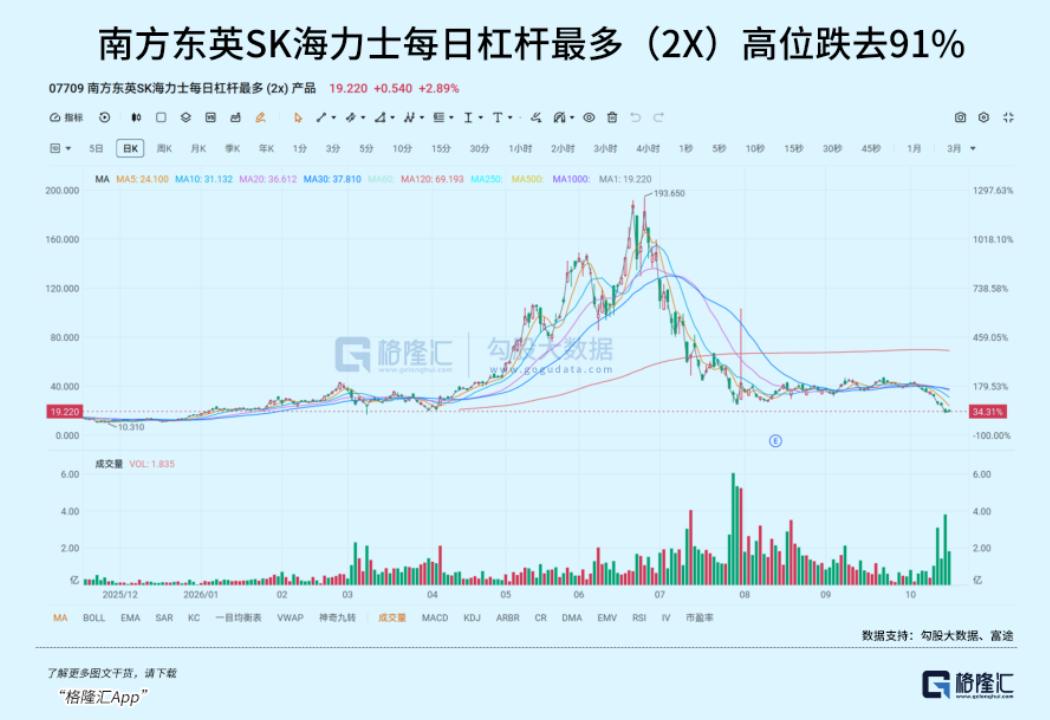
The road to getting back to cost may be very long, and cutting losses may be a helpless move for many investors.
For them, what they really need to remember is not that "foreign capital harvested South Korea", but that any market that lacks diversified take-over orders and relies excessively on external liquidity may leave the people who leave last stranded when the wind direction changes next time.
This article is from the WeChat official account "Gelong", the author is Nanshan Ke, and 36Kr publishes it with authorization.