Beyond Low Prices, AI and Platforms: Reinterpreting the Growth of Walmart U.S.
"We are no longer the Walmart we were ten years ago."
This is the 103rd issue of *Narrowcast Weekly*. The business trend we focus on in this issue is why the "same-store sales" indicator that the retail industry has long valued is no longer sufficient to explain today's Walmart.
If we only look at Walmart's 5.9% revenue growth in the second quarter of fiscal 2027 (ended July 31), this still seems to be a solid financial report belonging to a traditional retail giant: relying on its huge store network and merchandise sales, it continues to maintain growth on a massive revenue base.
But John David Rainey, Walmart's CFO, said in an interview after the earnings release: "We are not the Walmart of a decade ago." — We are no longer the Walmart we were ten years ago.
Walmart has not abandoned the stores and merchandise that supported its rise as a retail giant, but its growth is no longer directly defined solely by these two factors. Breaking down the financial report, global e-commerce sales rose 23%, advertising business grew 38%, U.S. Marketplace sales increased by more than 50%, and in-store fulfillment delivery grew 40% — all growth rates significantly higher than overall revenue.
Merchandise sales remain Walmart's core base, but platform commissions, advertising, memberships and fulfillment services extended from a single transaction are becoming new sources of revenue and profit. Ten years ago, Walmart's growth depended largely on whether it could open more stores, attract more foot traffic, and sell more merchandise; today, it is also answering another question: how to make the already accumulated stores, consumers and supply chains create value across more businesses?
The financial results demonstrate the outcome of this transformation. As for how these growth figures came about, the dialogue Dave Guggina, President and CEO of Walmart U.S., had at the Goldman Sachs Global Consumer and Retail Conference on September 15 provides a more complete explanation.
In summary, stores are connected to e-commerce and fulfillment networks, self-operated business and third-party supply on Marketplace jointly expand merchandise offerings, advertising, memberships and WFS continue to generate revenue around transactions; AI has begun to participate in demand identification, converting a consumer's photo or vague description into a specific shopping solution. Walmart's years of accumulated consumer base, supply chain and store network thus play a role in more links of a single transaction.
The significance of this dialogue also lies in providing an observation window for the current retail and global expansion competition: low-price competition is almost ubiquitous in retail and cross-border e-commerce, but how low prices can be sustained in the long run, how existing consumers, stores and supply chains can create more value, and how enterprises can meet consumer demands that have not yet been clearly expressed, still determine how far growth can go; at the same time, fulfillment capabilities, content, brand relationships and consumer insights accumulated outside platforms are also becoming more important.
Therefore, combining this dialogue with Walmart's latest financial report, we have sorted out several noteworthy changes and their possible implications for retail and global expansion competition.
01
Same-store sales are no longer sufficient to explain today's Walmart
As mentioned earlier, Walmart's fastest-growing segments are concentrated in advertising, memberships, Marketplace and fulfillment services built on top of merchandise transactions. In contrast, U.S. same-store sales only grew 2.6%, below market expectations.
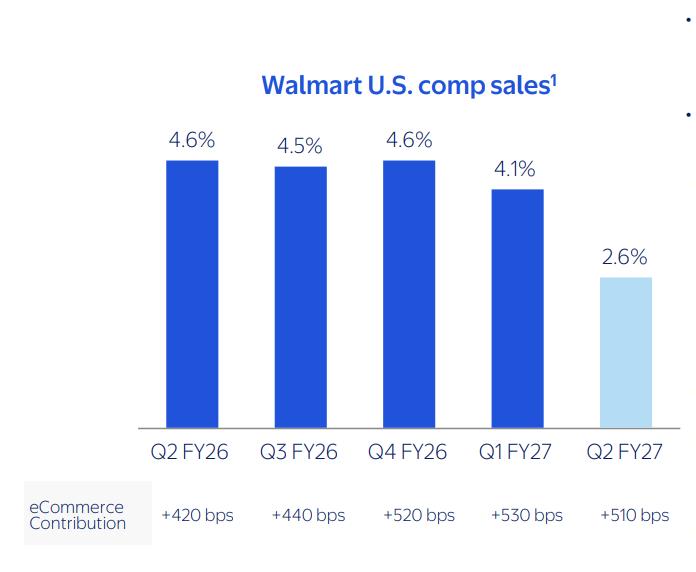
Walmart U.S. same-store sales grew 2.6% in Q2 FY27, and e-commerce contributed 510 basis points to same-store sales growth, making it an important source driving growth. Source: Walmart Q2 FY27 performance presentation materials
If we follow the traditional retail growth logic, these two sets of data are somewhat contradictory. For a retail giant like Walmart, stores are not only the end point of merchandise sales, but also the basic unit of scale expansion. The ability to open more stores, attract more foot traffic, and increase per-store sales directly determines whether revenue can continue to grow, so same-store sales have become the core indicator to measure whether the existing store network is still improving output.
But when stores are connected to e-commerce and fulfillment networks, the value they create is no longer fully reflected in in-store sales. Consumers can place orders online, with nearby stores providing inventory, picking up goods, and then obtaining the products through in-store pickup or delivery. The orders are counted in the e-commerce business, but they still draw on Walmart's years of accumulated store, employee and supply chain capabilities.
As John David Rainey, Walmart's CFO, said in an interview after the earnings release, the explanatory power of the same-store sales indicator for today's Walmart is not as strong as it was ten years ago.
The value created by stores is extending from how many products are sold in the store to how many online demands are received, how many fulfillment tasks are completed, and how many consumption scenarios are covered.
This is more directly reflected in Walmart's fulfillment data. Dave Guggina, President and CEO of Walmart U.S., revealed at the Goldman Sachs Global Retailing Conference that about 80% of e-commerce deliveries go through stores. Currently, about 70% of orders can be delivered the same day or faster; nearly 40% of delivery orders dispatched from stores can be completed within hours or even minutes. The store network that used to cover offline foot traffic has also become an important foundation for Walmart to reduce last-mile delivery costs and improve delivery speed.
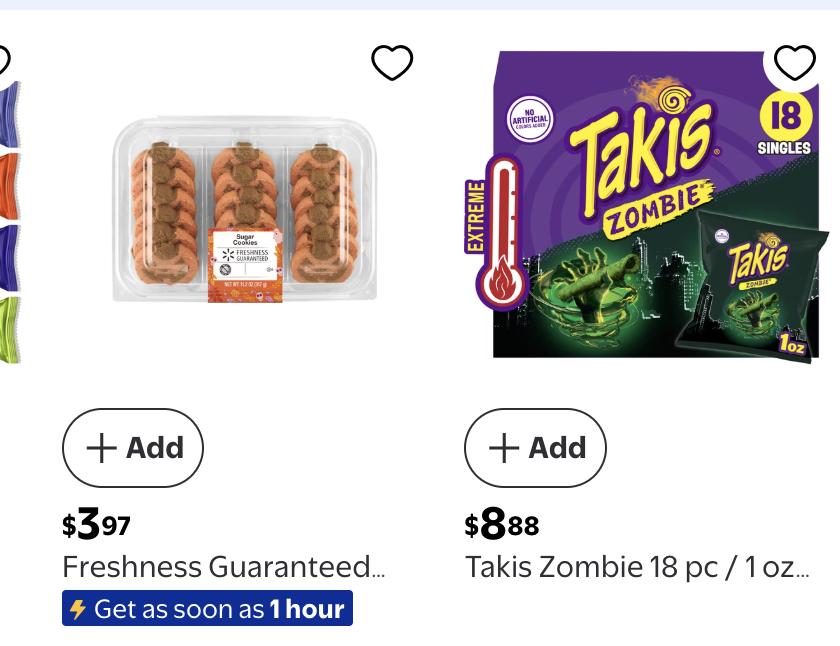
Products stocked and fulfilled by nearby Walmart stores will directly show their delivery time advantage on the product list, as shown in the product on the right. Source: Screenshot of Walmart e-commerce homepage
Changes in supply methods have also expanded Walmart's revenue sources. Walmart's online mall sells two types of products at the same time: one type is purchased by Walmart from brands or suppliers, with Walmart responsible for pricing, inventory and sales, namely 1P self-operation; the other type comes from Marketplace, which can be understood as a third-party sales platform opened by Walmart to external merchants, namely 3P. Third-party sellers upload and manage products on their own, which can not only increase brand and long-tail supply for Walmart, but also allow Walmart to collect commissions from transactions.
Chinese cross-border sellers have also become an important force for Walmart Marketplace to expand its seller base and product offerings. Data released by research institution Marketplace Pulse in June 2025 shows that active sellers on Walmart Marketplace have exceeded 200,000, 34% of which are from China; nearly 60% of new sellers on the platform in the first five months of 2025 alone are from China.
As Marketplace continues to expand third-party supply, Walmart also needs to solve another problem: how to ensure that products that are not placed on store shelves can also obtain a relatively stable delivery experience.
Walmart's official warehousing and distribution service Walmart Fulfillment Services (WFS) undertakes this function. Third-party sellers can send their inventory to Walmart's fulfillment centers in advance, and Walmart will be responsible for warehousing, picking, packing, delivery and returns. Guggina revealed that WFS currently handles about half of Marketplace's transaction volume.
The store network shortens the delivery distance for self-operated and local inventory products, while WFS connects more third-party products to Walmart's fulfillment system, enabling Marketplace to expand its supply while bringing new service revenue to Walmart.
As merchandise offerings expand, advertising demand also increases. The more brands and sellers that enter the platform, the stronger the competition for search rankings and product exposure, and Walmart Connect can convert the traffic and consumer data accumulated by Walmart into advertising revenue.
Vizio, Walmart's smart TV brand, further extends this advertising business from websites, apps and physical stores to family scenarios. When Vizio was acquired in 2024, its SmartCast system already had about 18 million active accounts; Guggina also revealed during this dialogue that sales of Vizio and some Walmart private-label onn devices using its system increased by more than 150% year-on-year.
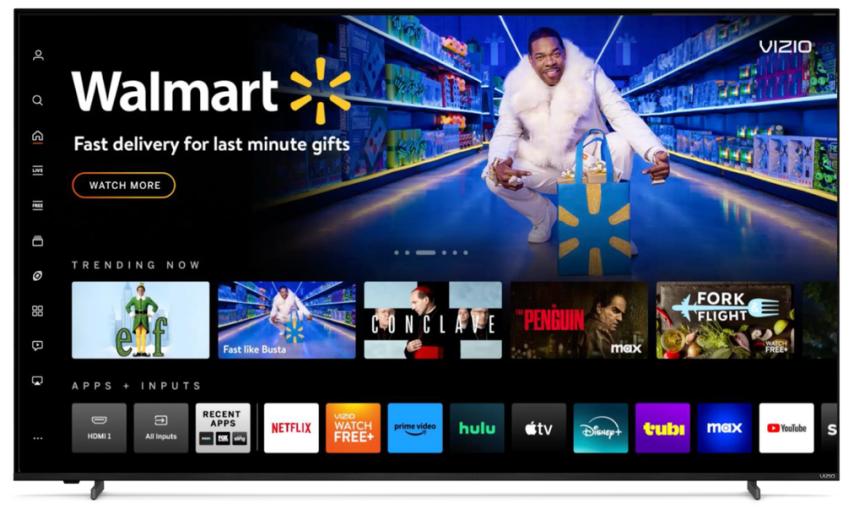
In December 2024, Walmart completed the acquisition of Vizio, a well-known U.S. cost-effective smart TV brand, and connected its TV system to Walmart Connect's advertising network. The picture shows the Walmart advertisement displayed on the Vizio smart TV homepage. Source: Vizio official website
In other words, the value of the TV business no longer only comes from hardware sales. U.S. consumers replace their TVs on average about every seven years, and a device that enters the home can continuously provide content, advertising and shopping touchpoints for a long time.
Guggina even envisions that in the future, the AI shopping assistant Sparky may appear directly on the TV side to help consumers find content and buy products. For Walmart, a TV sale can thus be transformed into a multi-year connection with household users, adding a long-term operable advertising and transaction entry for Walmart Connect.
A mutually reinforcing growth chain is thus formed: stores support offline sales and online fulfillment, the combination of 1P and 3P expands supply, advertising helps merchants obtain orders, WFS undertakes subsequent delivery, and membership rights increase consumption frequency.
Walmart's growth is still based on merchandise transactions, but the same set of stores, consumers and supply chains can already create value repeatedly in different links of a single transaction.
02
Low-price competition targets not a specific income group, but the share of products without premium reasons
There is another quite interesting change in Walmart's financial report this time: high-income households have contributed the most prominent share growth to the U.S. market.
This is not completely consistent with Walmart's long-standing market image. This retail giant started from small towns in the United States, and low prices have become its most distinct label. In the general public's perception, Walmart primarily serves households with limited budgets and more price-sensitive; even if higher-income consumers walk into Walmart, they mostly buy food and daily necessities, and rarely regard it as the main destination for quality consumption.
High-income households have become an important incremental source for Walmart. If this is only explained by the consumption downgrade under the continuous inflation in the United States, it is easy to ignore the more subtle consumption flow behind it.
Guggina's judgment in the dialogue is that consumers' measurement of "value" has gone beyond price itself: in the past, when people mentioned the value of Walmart, the first thing they thought of was low prices; now, more and more consumers come to Walmart, hoping not only to save money, but also to save time.
This judgment redraws the scope of low-price competition. Stronger payment capacity does not mean that consumers no longer pay attention to prices; if low prices, convenience and other services that improve the shopping experience can be provided at the same time, the appeal of saving money can cross income levels.
Walmart's Everyday Low Price strategy has made low prices a daily norm, allowing consumers to form stable price expectations. Consumers do not need to wait for big promotions, nor do they have to compare prices every time they shop.
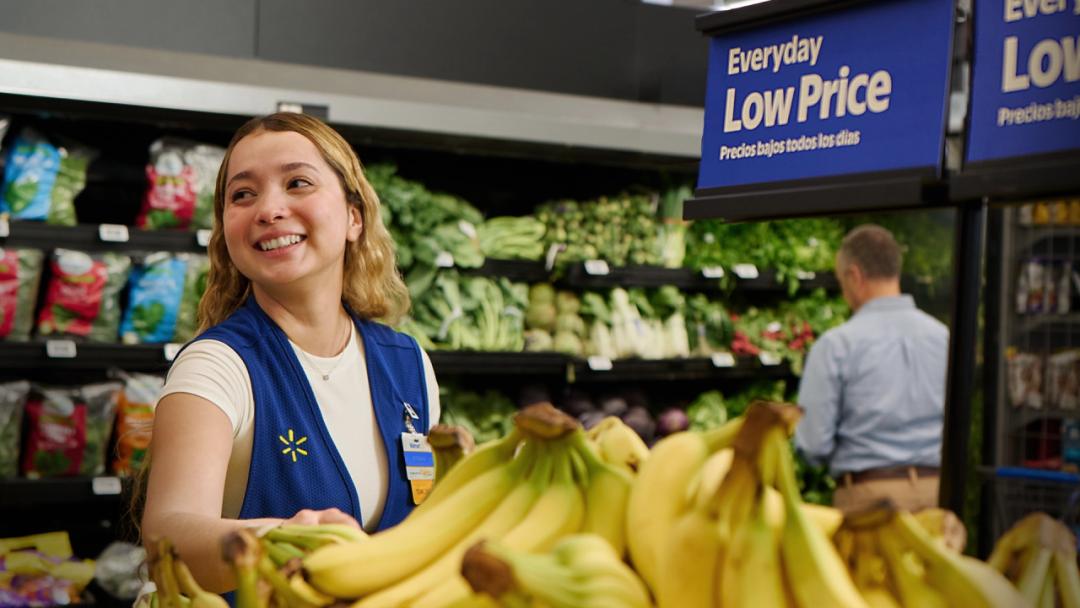
Walmart's EDLP mechanism covers both online and offline channels, keeping the prices of products consumers buy daily competitive and reducing reliance on frequent promotions. The picture shows the EDLP logo inside a Walmart store. Source: Walmart official website
The Everyday Low Cost that supports this promise relies on procurement scale, inventory turnover, automation and fulfillment efficiency to control costs, and then invests the saved resources in prices and shopping experiences. Consumers' price expectations essentially come from a continuously operating low-cost system.
Price trust has allowed Walmart to enter the daily shopping lists of more households, and convenience makes these lists easier to convert into orders. In-store pickup, same-day delivery and multi-hour delivery shorten the time for consumers to obtain products, and ensure that low prices no longer come at the cost of waiting and traveling. When low prices and convenience are both satisfied, Walmart has the opportunity to evolve from an occasionally chosen low-price channel to a more fixed shopping entry.
After entering the shopping basket, the product mix determines how much budget Walmart can ultimately retain. Therefore, private brands not only need to undertake price competition, but also supplement new product choices. Bettergoods, which Walmart launched in the U.S. back in 2024, has a similar role to its private label in the Chinese market, strengthening price competitiveness and expanding product offerings with private brands. It covers global flavors, plant-based products and specific dietary needs, with most products priced below $5, bringing food trends and quality options with certain premiums into the mass price range, allowing consumers to control their expenses while still retaining their requirements for taste, health and freshness.
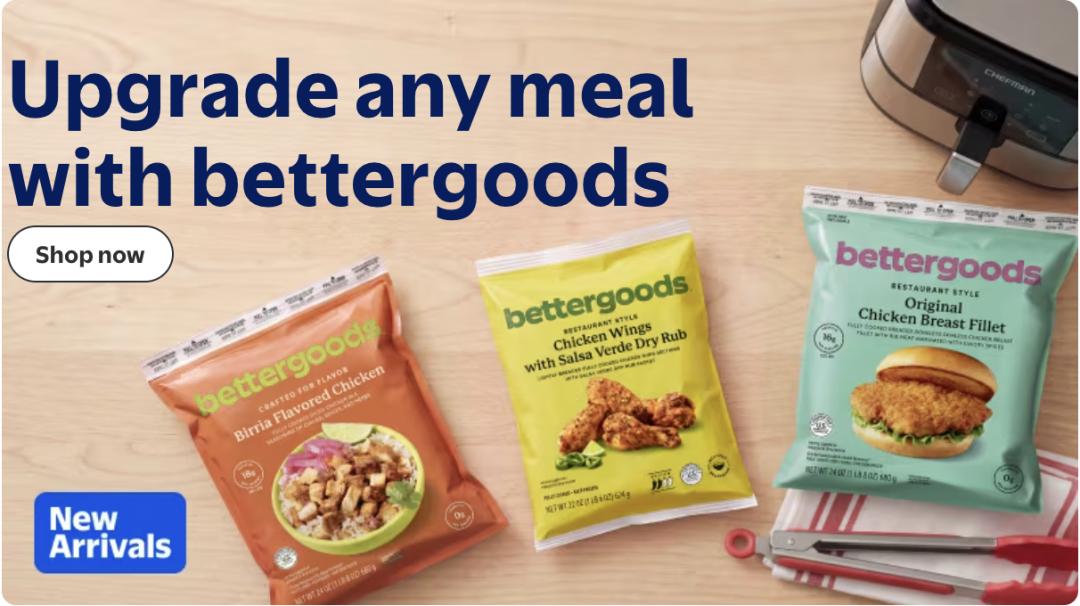
The Bettergoods section on Walmart's e-commerce homepage showcases private-label products. Source: Screenshot of Walmart e-commerce homepage
In terms of the Marketplace business, Guggina took the premium coffee brand Nespresso and beauty brand Medicube as examples to illustrate how Walmart enriches product tiers, attracts new income groups, and expands the categories they buy at Walmart.
Many Nespresso buyers are high-income consumers, and more than 35%, close to 40%, have never bought coffee products at Walmart before; about half of Medicube buyers are new customers in Walmart's beauty category. New brands have driven sales, and also pushed Walmart to capture the coffee and beauty budgets that these consumers originally allocated to other channels.
Thus, low prices bring more consumers into Walmart, and the long-established price trust and consumption experience make them willing to buy more categories, place orders more frequently, and leave more of their budgets here.
03
AI is changing the way demand is formed and products are organized in e-commerce
The application of AI in e-commerce has always been a highly discussed topic. There are more and more related tools, from generating product content, providing intelligent customer service, to recommending products, comparing prices and assisting in order placement. But whether they only improve the efficiency of the original transaction process, or will further change the way consumers discover products, platforms organize supply, and brands compete for orders, still requires more specific cases to judge.
A case Dave Guggina mentioned in this dialogue directly demonstrates how AI intervenes in the process from consumers raising questions to completing purchases: a consumer takes a photo of his poorly maintained lawn and types "I need some help". Walmart's AI assistant Sparky identifies the lawn maintenance demand from the picture, recommends products such as grass seeds and fertilizers, and forms a set of solutions that consumers might not have thought of or searched for one by one.
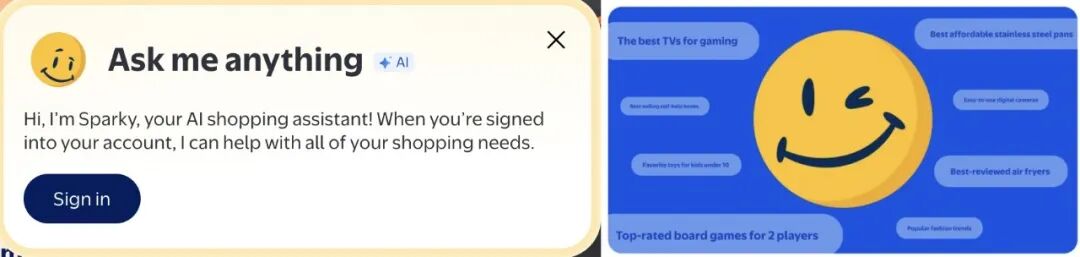
Walmart's AI shopping assistant Sparky provides shopping selection services for consumers. Users can describe their