The 15,999-yuan iPhone Duo is selling like wildfire, with resellers marking up its price by 5,000 yuan. The foldable screen market hasn't been this bustling for ages.
At 8 p.m. on October 16, did you see a flood of posts showing iPhone Duo orders popping up on your WeChat Moments?
If yes, congratulations — you are witnessing a global "consumer carnival" seven years after the birth of foldable smartphones. Even if you are not a participant, you are a witness to this event.
"We haven't seen a phone generate this level of market hype in a very long time," a friend of mine who has been in the mobile phone business in Shenzhen for years told me. "The last phone that caused such a huge market sensation before its official launch was Huawei's Mate XT, the first-generation tri-fold foldable phone."
iPhone Duo is a phenomenal foldable product, a fate that was sealed the day it was unveiled. While foldable phones are no longer a novelty in the current market, Apple's brand influence, the massive market momentum brought by its software and hardware ecosystem, and the product's own premium power are all the core drivers behind the iPhone Duo's frenzy and speculative resale across the country tonight.
To quote my colleague: tonight, everyone wants to be a scalper.
01
How explosive is the iPhone Duo?

Within seconds of the 8 p.m. launch, the device topped Weibo's trending search list, a speed rarely seen in the history of smartphone releases.
As sales went live at 8 p.m., the massive influx of users simultaneously accessing Apple's official website unsurprisingly caused the purchase page to lag and even fail to load for a period of time. Official Apple channels on Douyin and Tmall showed that the first batch of inventory sold out almost immediately.
On social media platforms, topics such as "iPhone Duo goes on sale" and "Did you manage to get one?" quickly drew massive volumes of discussions.
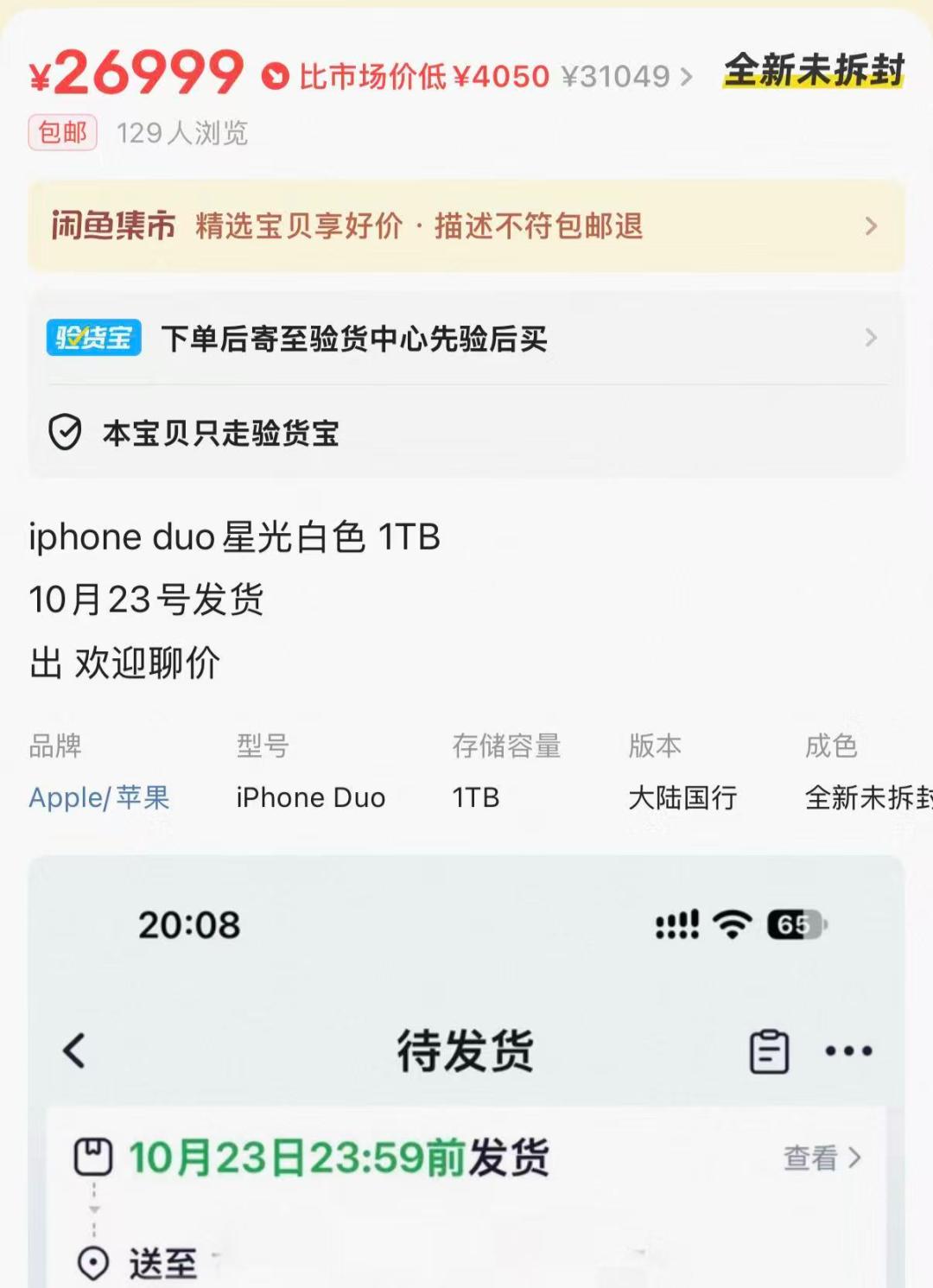
If you open the secondhand trading app commonly referred to as "the seafood market" right now, you will find users who secured the first batch of units reselling them at a markup of 5000 yuan, with notes marked "negotiation welcomed".
This nationwide hype is not limited to the post-launch period.
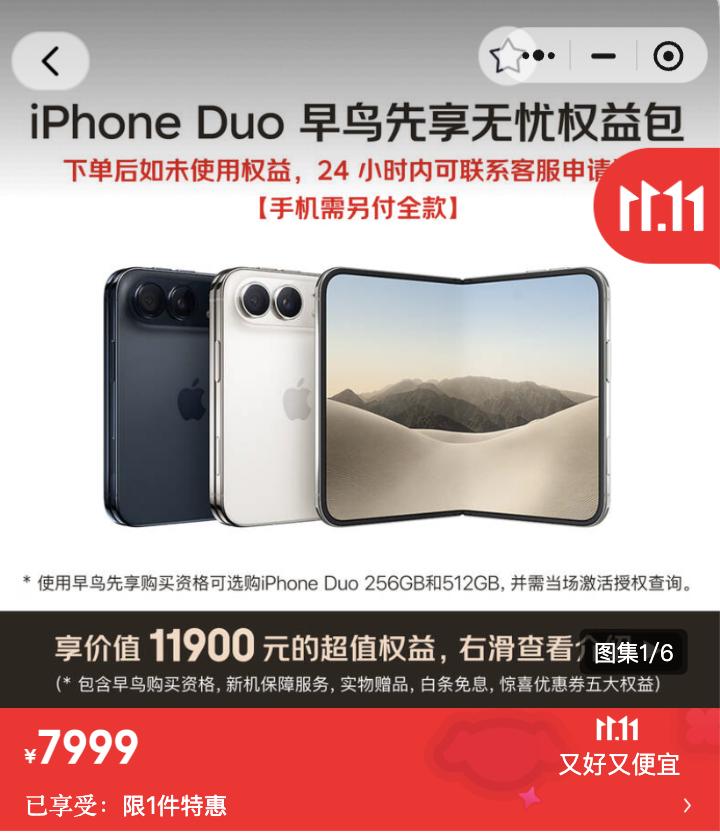
Before the official sale, the number of users who reserved the iPhone Duo on JD's platform had exceeded 2 million, and subsequent media reports put the reservation number at over 3 million. JD even launched a seemingly outrageous "7999-yuan early bird price package" for this phone, which came with a series of perks far exceeding the value of the package itself, with the core benefit being that purchasers could "receive their iPhone Duo much earlier".
Despite widespread confusion from the public, this to some extent shows how high the market expectation for the iPhone Duo was pushed even before its launch.
From the sell-out of the first batch to the price fluctuations on secondhand platforms, the obvious imbalance between supply and demand quickly gave rise to resale premiums. According to reports by CLSA, multiple versions of the iPhone Duo have already been sold at premium prices on the Dewu platform, with transaction prices exceeding the official retail price.
The shipping lead time has become another nationwide competition of sorts.
On WeChat Moments, users who can receive their units on the launch day (October 23) are showing off their orders, while those who have to wait a month and a half for delivery are either regretting their slow checkout speed or complaining about Apple's terrible servers.
It is worth noting that the starting price of the Chinese mainland version of the iPhone Duo is as high as 15,999 yuan, and the top-tier configuration even costs 26,499 yuan. That is absolutely a sky-high price for a smartphone. Consumers are still flocking to buy it despite the high cost, because they recognize the added value carried by this device.
When basic purchase options such as color and storage capacity are no longer the primary factors influencing your decision to buy a new phone, and you instead start focusing on its release date and delivery progress, this carnival makes it clear that the iPhone Duo cannot be measured simply by the standard of an ordinary smartphone.
02
How much effort has Apple put into promoting the iPhone Duo?
Consumers' frenzied rush to buy is on one hand driven by the Duo's inherent scarcity: it is the very first foldable product in the history of iOS. On the other hand, Apple's relentless promotional efforts over the past month have even made users who originally paid no attention to this phone familiar with it to some extent.
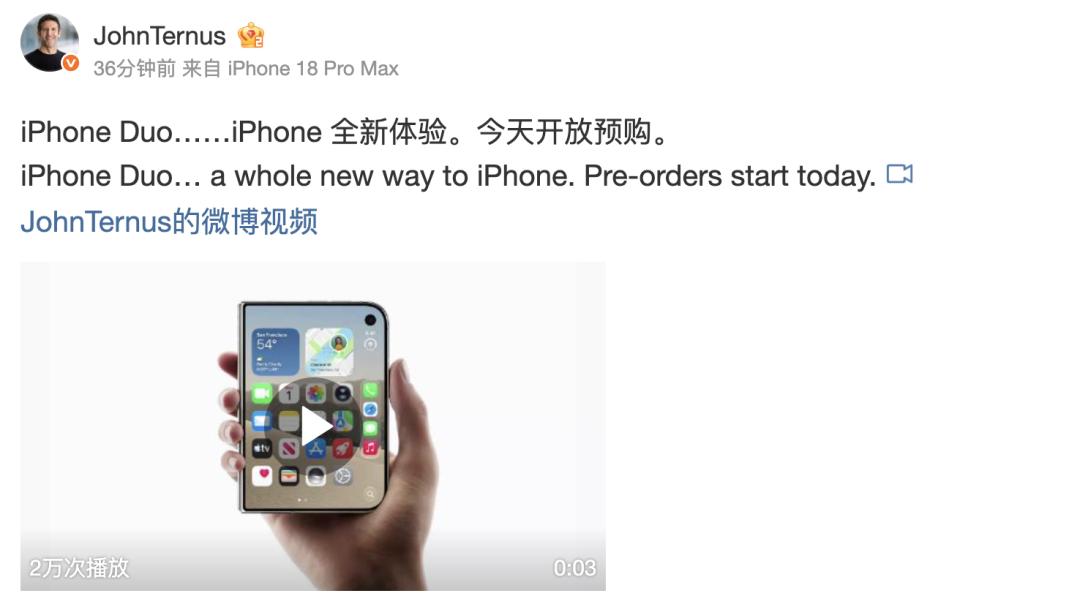
At 8 p.m. on October 16, Apple's new CEO John Ternus posted a Weibo update on schedule, and many users left comments under his post joking about lighting incense to beg for a unit, with such requests aplenty.
Over the past week, Apple's former CEO Tim Cook visited China and attended multiple events. In media interviews, he specifically mentioned that the iPhone Duo is exclusively manufactured in China, and expressed his anticipation for its performance in the Chinese market.
At the same time, Apple's Chief Operating Officer Sabih Khan visited Foxconn's Zhengzhou campus, toured the new product production line and talked about expanding production capacity. The three top executives of Apple made high-profile appearances to endorse the iPhone Duo in the lead-up to its launch, sending a clear signal that Apple's high market expectation for the iPhone Duo is a top-down consensus that will be fully implemented across the company.
The last time Apple put such massive promotional effort behind a product was when the Vision Pro was released. But unlike that device, which was widely seen as a non-essential product that needed extensive public exposure and ecosystem partnerships to drive sales, the iPhone Duo is launched in an extremely mature smartphone market. While it does not have unique groundbreaking hardware innovations, it still receives such dense, high-standard promotion, which clearly shows that Apple is extremely optimistic about the Duo's market prospects.
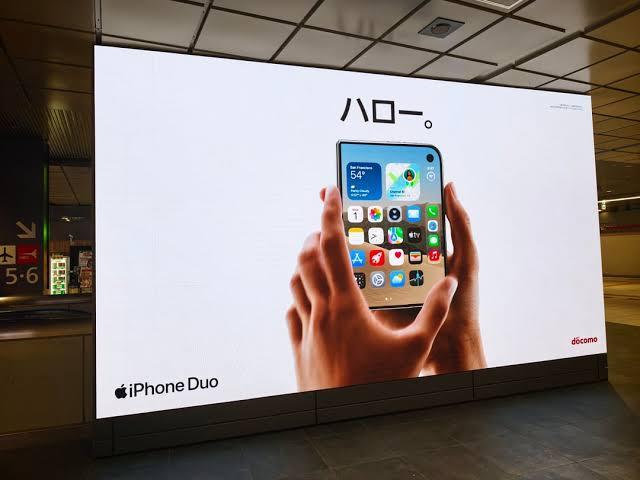
iPhone Duo billboard at a subway station in Japan
The promotional push is not limited to the Chinese mainland, as Apple has also launched extensive campaigns in overseas markets. According to official Apple information, the first batch of iPhone Duo units will be available for pre-order in more than 70 countries and regions, before expanding to 28 additional markets later. Before pre-orders opened, outdoor billboards demonstrating the phone's folding form appeared in New York, and related advertisements were also put up along the Yamanote Line in Tokyo, Japan. Apple centered its promotion on the device's form change: "a regular phone when closed, and a much larger screen when unfolded". Carriers across different regions are also promoting this new product to consumers through physical stores, stations and local distribution channels.
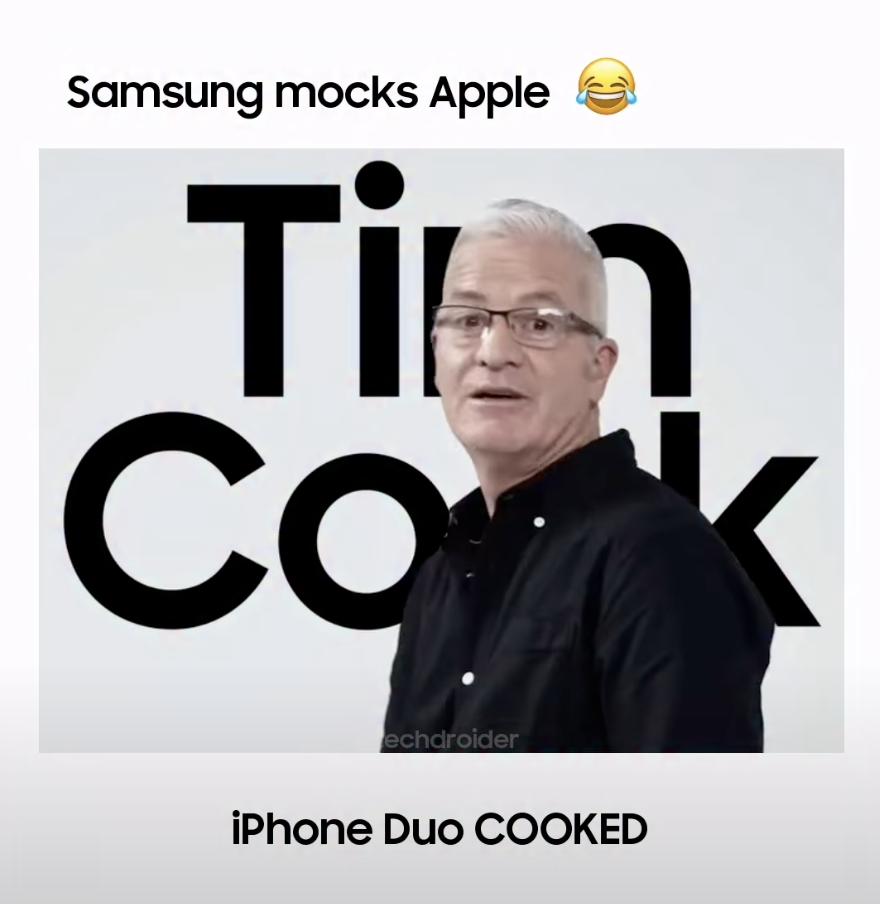
After the iPhone Duo was released, Samsung launched a spoof advertisement featuring a fake Tim Cook
It is also worth noting that the iPhone Duo even received "reverse assistance" from its competitors. Reuters reported that after Apple released the new product, Samsung quickly launched foldable phone advertisements in cities including Seoul, Tokyo and London, with slogans such as "Welcome to the foldable era" as a response. Samsung's playful banter on social media further pushed up the public discussion of "Apple is finally entering the foldable market". In other words, the release of the iPhone Duo has effectively accelerated the foldable phone market into a new round of fierce competition. Apple itself has focused its efforts on product launches, social media, executive interviews and outdoor advertising, while its competitors are also continuously generating discussions around this new phone.
From the CEO's scheduled Weibo post, Tim Cook's visit to China, to the pre-order arrangements covering dozens of countries and the deployment of overseas advertisements, Apple has clearly positioned the iPhone Duo as one of its most important product narratives this year. It is not only Apple's first foldable phone, but also the iconic new product launched after the new CEO took office. The reason why Apple is sparing no effort to promote this phone is not just because it can bring substantial revenue to the company, but also because it can re-bind all the connection points across the industry network, including hardware manufacturing, software ecosystem, market competition, and relationships with global carriers and distributors, injecting a much-needed stimulant into the otherwise stagnant smartphone market.
03
What changes will the iPhone Duo bring?
Beneath the nationwide carnival, the significance of the iPhone Duo — or what most users who actually want to use this device are looking forward to — is the upcoming changes in the foldable software ecosystem.
Counting from the launch of Samsung's first foldable phone in 2019, foldable smartphones have been on the market for seven years, but the software experience has consistently failed to catch up with hardware advancement. The biggest pain point is that when the screen is unfolded, the applications do not necessarily "expand" accordingly. For current Android foldable phones, most apps just stretch the original phone interface to a larger size after the screen is unfolded, some leave large blank areas, and others show inconsistent performance when switching between portrait and landscape modes, split-screen mode, and inner and outer screens.
Although Google has continuously released large-screen adaptation guidelines in recent years, and further required applications to adapt to large-screen devices in Android 17, this software adaptation dilemma can still only be described as "terrible" to this day.
Seven years on, software adaptation for foldable phones remains a topic that the entire industry needs to keep working to resolve.
The problem does not fully lie in Android manufacturers' lack of effort, but is determined by the structure of the ecosystem, which makes adaptation far more difficult. The Android ecosystem has a large number of device brands, with wildly varying screen aspect ratios and interaction methods, meaning developers face a wide range of screen sizes, system versions and hardware forms. The overall shipment volume of foldable phones is also relatively limited, so the investment required to carry out in-depth optimization for each individual device is often not cost-effective.
This contradiction means that developers in the foldable phone market have to constantly weigh the input and return of adaptation work.
The adapted apps that are available on foldable phones today are either developed by software vendors for specific models with funding support from phone manufacturers, or secured through large-scale resource exchange agreements. Without these incentives, almost no developer is willing to take the initiative to adapt their apps for foldable phones in a market of limited scale.
A front-end engineer working at a leading tech company told me that customizing an app for a foldable screen with a special aspect ratio requires at least 5 to 10 people, who cannot be assigned to the task full-time, because the foldable phone market is too small. Their main job is to make their app compatible with the far larger traditional bar phone market. This is manageable for large companies, but small companies or individual developers have almost no incentive to develop customized versions for foldable devices.
But the entry of the iPhone Duo may change developers' calculation of this trade-off. Apple has long controlled the full stack of hardware, operating system, development tools and app distribution channels, and is able to provide unified adaptation specifications, testing environments and review requirements around a relatively standardized device form. More importantly, Apple brings not just a new phone model, but a large base of users willing to pay a premium for high-end devices, as well as product standards that the entire industry will pay close attention to.
If the foldable iPhone becomes a key player in the high-end market, developers will no longer be able to treat "large-screen adaptation" as a niche feature only required by a small number of users. The optimized interface and interaction developed for the iPhone Duo will also raise users' expectations for other foldable phones in turn.
Therefore, the iPhone Duo is far more than just a smartphone. Its real value may lie in becoming a key driving force that pushes the entire foldable software ecosystem one big step forward. Even a niche product like the Vision Pro has gained custom software, custom videos and exclusive music platforms after two years on the market, so a product from Apple's far more mature iOS ecosystem like the iPhone Duo will no doubt achieve even more.
From hardware to software, and the widespread market enthusiasm, honestly, haven't you seen the foldable phone market this lively for a very long time?
This article is from the WeChat Official Account "Tencent Tech", written by WU Bin, edited by XU Qingyang, and republished with authorization from 36Kr.