With bad debt provisions rising by up to 51%, what underlying concerns are haunting major Wall Street banks?
Following strong performance recorded in the first half of the year, the performance of most of the six major Wall Street banks in the third quarter of 2026 remained relatively robust.
Financial data shows that in the third quarter, Goldman Sachs, JPMorgan Chase, Morgan Stanley, Bank of America, Citi, and Wells Fargo recorded revenues of over 18.6 billion USD, 50.1 billion USD, 20.3 billion USD, 30 billion USD, 23.8 billion USD, and 21.8 billion USD respectively, with year-on-year growth rates ranging from 2% to 23%.
In terms of net profit, Bank of America, Goldman Sachs, JPMorgan Chase, Morgan Stanley, Citi, and Wells Fargo recorded net profits of 6.9 billion USD, 5.294 billion USD, 15.305 billion USD, 4.909 billion USD, 5.245 billion USD, and 5.951 billion USD respectively. Except for Bank of America which posted a year-on-year decline, the remaining five banks saw year-on-year growth rates between 6% and 40%.
Net interest income, as the core foundation of performance, remained stable. The net interest income of Goldman Sachs, Morgan Stanley, Citi, JPMorgan Chase, Bank of America, and Wells Fargo reached 3.77 billion USD, 3.25 billion USD, 16.9 billion USD, 27 billion USD, 16.449 billion USD, and 12.517 billion USD respectively. Among the six major banks, with the exception of Goldman Sachs, the other five banks all recorded growth in net interest income, with year-on-year growth rates ranging from 5% to 30%.
At the same time, non-interest income showed a divergent trend: Goldman Sachs recorded 14.909 billion USD, representing a sharp 32% year-on-year increase; JPMorgan Chase and Morgan Stanley recorded 23.136 billion USD and 17.088 billion USD respectively, up 3% and 9% year-on-year; Citi, Bank of America, and Wells Fargo recorded 6.863 billion USD, 13.509 billion USD, and 9.353 billion USD respectively, down 4%, 2%, and 1% year-on-year.
In terms of asset quality, most large banks delivered favorable performance. The non-performing loan ratios disclosed by JPMorgan Chase, Bank of America, Citi, and Wells Fargo ranged from 0.4% to 0.7%, down 2 to 14 basis points year-on-year.
Despite the overall solid performance, the revenue and net profit of all major banks declined quarter-on-quarter. Specifically, the six major banks saw quarter-on-quarter revenue drops between 3% and 12%, and quarter-on-quarter net profit drops between 7% and 28%.
Industry insiders believe that the pressure on market-sensitive businesses is the main reason for the sequential decline in revenue and net profit of the six major Wall Street banks. In the third quarter of 2026, the activity of the capital market cooled down compared with the second quarter.
According to the 2026 monthly market statistics released by Nasdaq Trader, calculated by dividing the number of traded shares in each month by the number of trading days, the average daily trading volume in the second quarter was about 20.21 billion shares, and about 16.93 billion shares in the third quarter, down more than 16% quarter-on-quarter.
At the same time, the US initial public offering (IPO) market in the third quarter of 2026 declined compared with the extremely prosperous second quarter. A report released by PwC on October 8 showed that the number of IPOs in the third quarter fell by more than 46% quarter-on-quarter.
In mid-September, the Federal Reserve announced a 25 basis point rate hike with 12 votes in favor and 0 votes against, raising the target range of the federal funds rate to 3.75%-4.00%, marking the first rate hike in three years.
US September inflation data shows that inflation risks still exist. CME FedWatch data shows that as of the evening of October 15, 2026 Beijing time, the probability of the Fed raising interest rates by 25 basis points in December is 65.7%, a sharp increase from 49.9% a month ago.
Theresa Paiz Fredel, Director of US Financial Institutions Ratings at Fitch Ratings, said that higher interest rates may support net interest income, but will weigh on capital market activities and credit performance. High interest rates may delay mergers and acquisitions and underwriting, put pressure on asset valuations, and increase the debt repayment burden of borrowers. In the long run, weak loan demand and rising credit costs may offset the benefits brought by rising asset yields.
Both Revenue and Net Profit Decline Quarter-on-Quarter
In the third quarter of 2026, the six major Wall Street banks all achieved positive year-on-year revenue growth; except for Bank of America, the remaining five banks all posted year-on-year net profit growth.
Financial data shows that in the third quarter, Goldman Sachs, JPMorgan Chase, Morgan Stanley, Bank of America, Citi, and Wells Fargo recorded revenues of over 18.6 billion USD, 50.1 billion USD, 20.3 billion USD, 30 billion USD, 23.8 billion USD, and 21.8 billion USD respectively, up 23%, 8%, 11%, 3%, 7.9%, and 2% year-on-year.
In terms of net profit, Bank of America, Goldman Sachs, JPMorgan Chase, Morgan Stanley, Citi, and Wells Fargo recorded net profits of 6.9 billion USD, 5.294 billion USD, 15.305 billion USD, 4.909 billion USD, 5.245 billion USD, and 5.951 billion USD respectively. Except for Bank of America which posted a year-on-year decline, Goldman Sachs, JPMorgan Chase, Morgan Stanley, Citi, and Wells Fargo recorded year-on-year growth of 29%, 6%, 6.48%, 40%, and 6% respectively.
Among the six major Wall Street banks, with the exception of Goldman Sachs, the net interest income of the remaining five banks increased significantly year-on-year, providing solid support for the overall revenue growth of each major bank. The net interest income of Morgan Stanley, Citi, JPMorgan Chase, Bank of America, and Wells Fargo reached 3.25 billion USD, 16.9 billion USD, 27 billion USD, 16.449 billion USD, and 12.517 billion USD respectively, up 30%, 14%, 13%, 7.9%, and 5% year-on-year.
According to the financial reports of each bank, the growth of net interest income mainly benefits from the expansion of deposit and loan base.
Financial data shows that in the third quarter of 2026, the credit scale of most of the six major banks continued to expand. Morgan Stanley did not disclose relevant data. The average loan balance of Goldman Sachs, Wells Fargo, Citi, Bank of America, and JPMorgan Chase in the third quarter increased by 23%, 11%, 12%, 6%, and 10% year-on-year respectively.
In the same period, the average deposit balance also increased. Financial data shows that Morgan Stanley and Goldman Sachs did not disclose relevant data. The average deposit balance of Wells Fargo, Bank of America, JPMorgan Chase, and Citi in the third quarter increased by 10%, 1.5%, 8%, and 11% year-on-year respectively.
Theresa Paiz Fredel believes that overall, the trend of net interest income remains positive, but subsequent performance will depend on interest rates, deposit pricing, and loan growth speed.
Many banks expect net interest income to continue to grow. Among them, Bank of America stated in a conference call that supported by factors such as moderate growth in loans and deposits and continuous repricing of fixed-rate assets, net interest income in the fourth quarter is expected to continue to improve and maintain growth in 2027. The bank expects the full-year net interest income growth rate in 2027 to reach 8%.
It is worth noting that the revenue of Goldman Sachs, JPMorgan Chase, Morgan Stanley, Bank of America, Citi, and Wells Fargo decreased by 8%, 12%, 5%, 5%, 3.7%, and 3% quarter-on-quarter respectively; in terms of net profit, Goldman Sachs, JPMorgan Chase, Morgan Stanley, Citi, and Wells Fargo recorded quarter-on-quarter declines of 20%, 28%, 12%, 10%, and 7% respectively; after excluding the impact of huge fines, Bank of America's third-quarter net profit fell by more than 10% quarter-on-quarter.
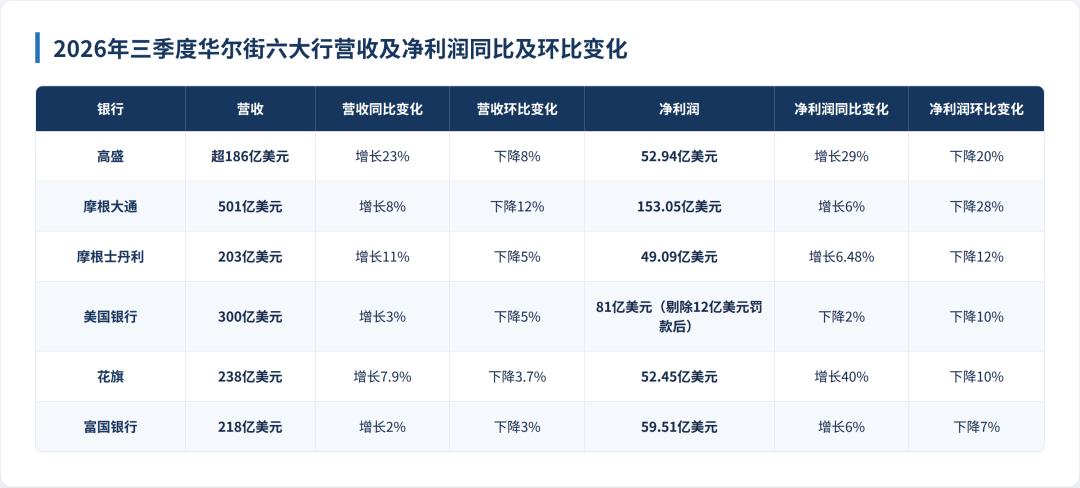
Source: 2026 Q3 financial reports of the six major Wall Street banks; sorted out by Caijing based on financial report content; chart by Gu Xinyu (assisted by AI tools)
Theresa Paiz Fredel said that this is mainly due to pressure on market-sensitive businesses rather than a decline in core business strength: the capital market activities that performed strongly in the second quarter of 2026 slowed down in the third quarter.
Financial data also confirms that capital market-related businesses have weakened. The total revenue of Wells Fargo's corporate and investment banking segment fell by 8% quarter-on-quarter; the net income of JPMorgan Chase's commercial and investment banking segment fell by 9% quarter-on-quarter; the total revenue of Bank of America's global markets segment fell by 26% quarter-on-quarter; the revenue of Citi's markets and investment banking segments fell by 13% and 11% quarter-on-quarter respectively; the net income of Morgan Stanley's institutional securities segment fell by 9% quarter-on-quarter; the net income of Goldman Sachs' global banking and markets segment fell by 13% quarter-on-quarter.
Looking ahead, Fitch expects that the capital market will remain an important but volatile source of profit contribution, but it is difficult to predict whether the profit growth of this segment will continue. Overall, management comments on the 2026 Q3 earnings call indicate that the pipeline of capital market-related businesses remains strong, but the recent execution risk is greater.
In terms of the macro environment, US inflation data in September was higher than market expectations. The US core Consumer Price Index (CPI) for September, released on the evening of October 14 Beijing time, increased by 2.6% year-on-year, higher than the estimated 2.5%; the September Producer Price Index (PPI) released on October 15 rose by 6.3% year-on-year, the largest increase since December 2022, significantly higher than the market expectation of 5.3%.
"Inflation is more persistent than imagined," said Hu Jie, Professor at Shanghai Advanced Institute of Finance, Shanghai Jiao Tong University and former senior economist of the Federal Reserve. He believes that the stalemate of the US-Iraq conflict keeps inflation pressure high. In this context, the possibility of another interest rate hike within 2026 still exists, and even if a rate cut is planned in 2027, it is expected not to start soon. The sustained high interest rate environment is negative for both investment banking and commercial banking businesses.
Bad Debt Provisions Rise by Up to 51%
JPMorgan Chase, Bank of America, Citi, and Wells Fargo disclosed their respective non-performing loan ratios, which were 0.59%, 0.44%, 0.4%, and 0.67% respectively, down 11, 2, 10, and 14 basis points year-on-year.
While the non-performing loan ratios of many large banks declined, the credit loss provisions of most of the six major banks rose. The credit loss provisions of Goldman Sachs, Wells Fargo, and Citi increased by 8.5%, 51.1%, and 6% year-on-year respectively; Morgan Stanley's credit loss provision was zero in the third quarter of 2025, and has continued to increase since then, reaching 148 million USD in the third quarter of 2026. The credit loss provisions of Bank of America and JPMorgan Chase decreased by 2% and 19% year-on-year respectively.
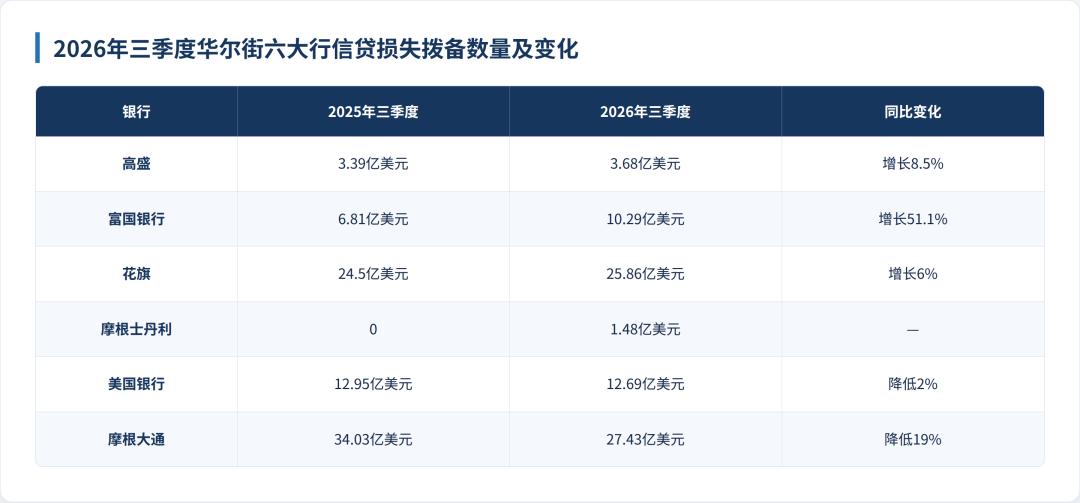
Source: 2026 Q3 financial reports of the six major Wall Street banks; sorted out by Caijing based on financial report content; chart by Gu Xinyu (assisted by AI tools)
Hu Jie believes that the increase in credit loss provisions by many large banks is an adjustment operation under the prudent principle, which does not mean that the operation itself is deteriorating. With the increasing uncertainty of inflation and interest rates in the future, it is reasonable to appropriately increase provisions to take precautions.
Looking ahead, Hu Jie believes that there are still large credit risks in several major areas. Financing related to artificial intelligence (AI) is one of the aspects.
At present, some companies are financing the construction of AI-related infrastructure by selling loans with extremely high yields. According to media reports in early October, Volta, an AI cloud company, is financing a data center complex in Norway by selling debt. A person familiar with the matter said that the loan transaction is being sold at a range of 6.25 to 6.5 percentage points above the benchmark interest rate, and at a discount price of 97 cents to 98 cents per dollar. According to Bloomberg's calculation, at the current benchmark level, this is equivalent to a yield of about 11%, which is one of the highest borrowing costs seen in the leveraged loan market.
Hu Jie said that the financing cost for investing in AI-related infrastructure has risen sharply, and if its profits cannot be realized within a certain period of time, it will face huge risks.
In addition, Hu Jie believes that the high real estate mortgage interest rate is also a hotbed for credit risks.
Against the background of the Federal Reserve's 25 basis point rate hike in September, data from the Mortgage Bankers Association of the United States shows that for the week ended October 9, 2026, the 30-year fixed-rate mortgage rate was 7.5%, more than 100 basis points higher than a year ago.
In this case, borrowers rely more on adjustable-rate mortgages (ARMs) to help reduce monthly payments. The proportion of ARMs reached 10.5%, the highest level since October 2025. Data shows that the interest rate of this type of mortgage has also risen: the average contract rate of 5/1 ARM rose from 6.43% a week ago to 6.54%; its initial interest rate is fixed for 5 years, and then usually adjusted once a year.
Hu Jie said that the US federal benchmark interest rate may remain high for a period of time in the future, and the US real estate market may continue to be under pressure, increasing the burden on existing borrowers, while potential borrowers will choose to wait and see. For banks, all types of mortgage loans face greater default risk.
(Tang Jun, reporter of Caijing, also contributed to this article)
This article is from the WeChat Official Account "Caijing MayFlower" (ID: Caijing-MayFlower), author: Gu Xinyu, editor: Zhang Wei, published with authorization from 36Kr.