WeChat is quietly becoming AI-driven.
In late June, many users opened WeChat and found two green dots in the upper-left corner of the main interface, which looked like a pair of eyes. Tapping into it, they found an AI assistant named "Xiaowei", with the label "Beta" marked at the top of the page. Users do not need to install an additional app, nor do they need to rummage through menus: simply swipe right on WeChat's homepage to call it up.
WeChat has not allocated such a prominent position on its home screen to a new feature for many years. The capital market reacted first. On June 2, the Financial Times disclosed that WeChat was testing an embedded agent prototype, and Tencent's share price rose by 10.46% that day, marking its largest single-day increase in more than three years. What investors are betting on is obviously not just a chat box, but whether WeChat's huge service network can be re-mobilized by AI.
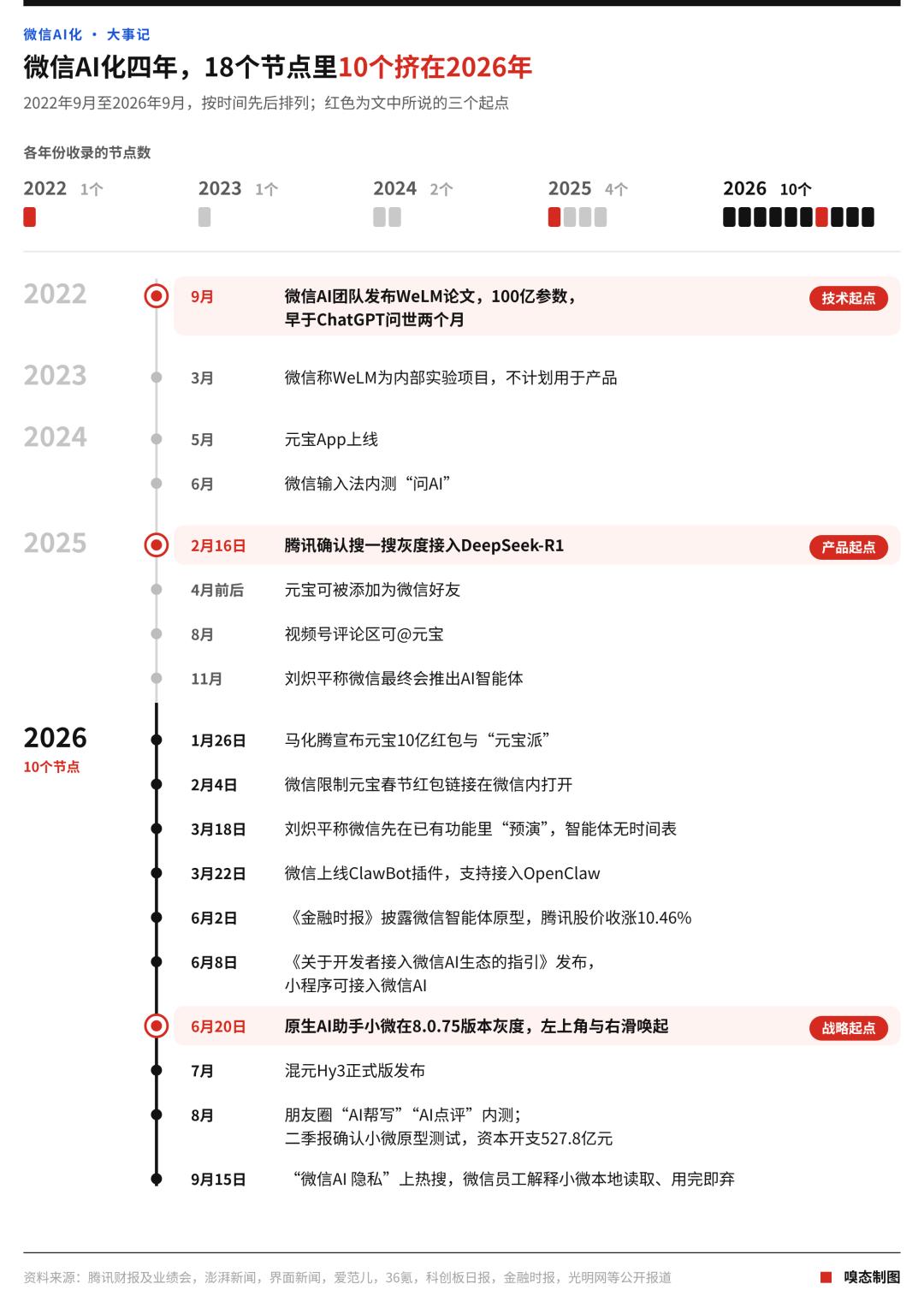
WeChat is no stranger to large language models. In September 2022, the WeChat AI team announced WeLM, two months earlier than the release of ChatGPT. Over the past four years, WeChat first integrated AI into tools such as search and input method, then tried to let Yuanbao appear as a friend, until Xiaowei was granted system-level access. The product form has changed repeatedly, and there has always been a core question behind it: how much authority should WeChat give to AI and what tasks should it perform?
In 2026, the answer gradually became clear. WeChat wants AI to shift from answering questions to executing tasks. Chatbots mainly consume model capabilities, while agents also need to call services, verify identities and process transactions. WeChat's existing mini-programs, payment system and user relationships have thus gained new commercial significance. However, the greater the authority, the more difficult it is to avoid problems related to privacy, misoperation and platform responsibility.
01
What identity should AI take to settle in WeChat
WeChat initially developed AI as a single-purpose tool.
In September 2022, the WeChat AI team published a paper introducing WeLM, a Chinese pre-trained model with 10 billion parameters. The team reported that it could compete with models with much larger parameter scales in some tasks. When ifanr tested it in March 2023, WeChat still emphasized that it was only an internal experiment with no formal productization plan. With research capabilities already in place, WeChat did not rush to push the model to all users.
Subsequently, AI gradually appeared in WeChat's specific businesses. WeChat Input Method can call AI to generate responses, WeChat Reading provides the "Ask Book" function, and the official account backend supports AI-generated images; in February 2025, the "Search" function was connected to DeepSeek-R1 in grayscale release. WeChat compiled a list of AI tools in May that year, with a considerable number of functions, but most of them required users to find the corresponding scenarios first.
Such a design reduced product risks, but also limited the role of AI. It can improve search or reading experience, but cannot cross different functions to complete a task on behalf of users.
In 2025, Tencent tried a form closer to social products. Around April, some users could add Yuanbao as a WeChat friend, send it articles and documents to ask it to read and summarize. In August, the comment section of Channels supported @Yuanbao; during the 2026 Spring Festival, the "Yuanbao Group" function tried to pull WeChat and QQ friends into AI group chats. Tencent hopes to convert existing social relationships into AI usage habits.
But Yuanbao is still an external service in WeChat. It can receive content actively sent by users, but cannot directly schedule WeChat Pay and a large number of mini-programs. On February 4, 2026, WeChat restricted the direct opening of links to Yuanbao's Spring Festival red envelope activities within WeChat on the grounds of inducing sharing. WeChat's public relations director said that "user experience comes first, and all are treated equally".
This conflict shows that even the group's internal AI products must abide by WeChat's platform rules. In March, Yuanbao's independent app had 57.35 million monthly active users, less than one-fifth of Doubao. Investing traffic can bring downloads, but may not bring long-term usage.
Xiaowei received different treatment. It appears directly on the home screen, can send messages, modify some settings and call mini-programs according to instructions. By mid-August, 16 positions including official accounts, Moments, chat images and Scan can evoke Xiaowei. WeChat began to let AI undertake system operations instead of just accepting questions. The difference lies in permissions: Yuanbao is responsible for conversations, while Xiaowei tries to complete tasks in WeChat on behalf of users.
The model selection also serves this goal. According to Martin Lau's introduction at the August performance meeting, Xiaowei mainly adopts the WeChat team's WeLM, taking a different path from Hunyuan which the group invests heavily in, and pays more attention to privacy protection, WeChat operation coverage and cost control. For an assistant facing 1.4 billion monthly active users, even if each call only adds a small amount of cost, it will form a considerable expenditure after scaling up. What WeChat needs is a model that can stably execute tasks and whose costs can be sustainably borne.
WeChat also retains limited openness to external agents. The ClawBot plugin launched on March 22 allows users to access self-deployed OpenClaw to WeChat one-on-one chats, and related products adapt quickly, but cannot obtain system permissions such as group chats and mini-programs accordingly. WeChat thus draws a line: third parties can communicate with users through WeChat, but cross-business scheduling and transaction entrances are still controlled by WeChat itself.
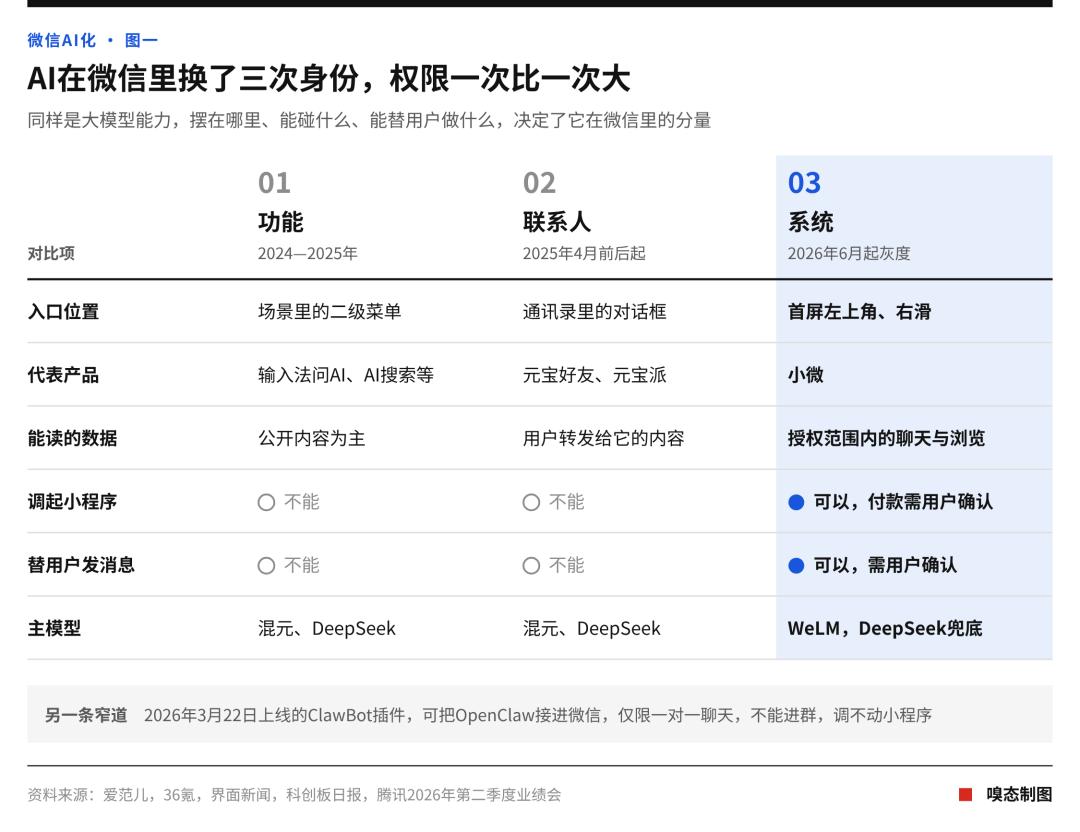
From the function behind the button, to the contact in the address book, to Xiaowei on the home screen, AI has moved forward little by little in WeChat, accessing more data and more adjustable services. When moving to the forefront position, WeChat adopted its own model.
02
From public to private
WeChat's slow progress in AI is often attributed to Allen Zhang's product restraint, and the more specific problem is data authorization.
To complete complex tasks, the agent must understand the context when users put forward requirements; WeChat stores a large amount of private chats and acquaintance relationships, but users have not authorized any AI to read them at will. Every time a product adds a new capability, it has to re-answer where the data comes from, to what extent it is used, and who takes responsibility.
The order in which WeChat opens data thus shows a clear rule: let AI process public articles first, then materials actively sent by users, and finally try to read chat content and assist Moments expression under user authorization.
As the authority gradually expands, the risks also increase.
The starting point is public content. When Search was connected to DeepSeek in February 2025, Tencent specifically stated that AI search only uses public information on official accounts and the Internet, and does not touch users' personal information. Official accounts have published more than 444 million articles in total in 2024, which is the most uncontroversial material in WeChat's hands.
After Yuanbao entered WeChat, the scope expanded to the content that users actively sent. Users forward articles, files and chat records to it, then it can see them, and the authorization is hidden in the action of "forwarding".
When Xiaowei was launched in 2026, it took a big step forward. It will recommend questions based on users' follows, browsing and interactions on official accounts and Channels; in chats, when users actively tap "Ask Xiaowei", it will read the latest chat records from the local mobile phone to make a summary. Tencent's statement is that the original records will not be saved or used to train the model, and what Xiaowei can see will not exceed what the user himself can see.
In August, AI touched Moments. The internal test "AI Writing Assistant" will read users' pictures and drafts to generate copies in several styles; "AI Comment Assistant" helps users reply to friends' comments. At this point, AI is not only touching data, but also how a person speaks in front of acquaintances.
The deeper you go, the greater the cost. On September 15, a blogger posted that Xiaowei could read deleted chat records and could not be turned off, and the topic "WeChat AI Privacy" quickly became a hot search. WeChat employees explained item by item on the same day: it cannot see deleted Moments, chats are read locally and discarded immediately after use. When Xiaowei was first released in grayscale, Tencent customer service also confirmed that it is a built-in system function and cannot be turned off for the time being.
This also explains why Martin Lau ranked privacy first among the problems of WeChat agents in March, and said such a sentence in August: Xiaowei's prototype can technically run complex agent processes, but it is deliberately set to require user intervention and step-by-step confirmation for now. How fast WeChat AI can go is only half determined by the model, and the other half depends on how much authorization users are willing to give, and how fast they give in this process.
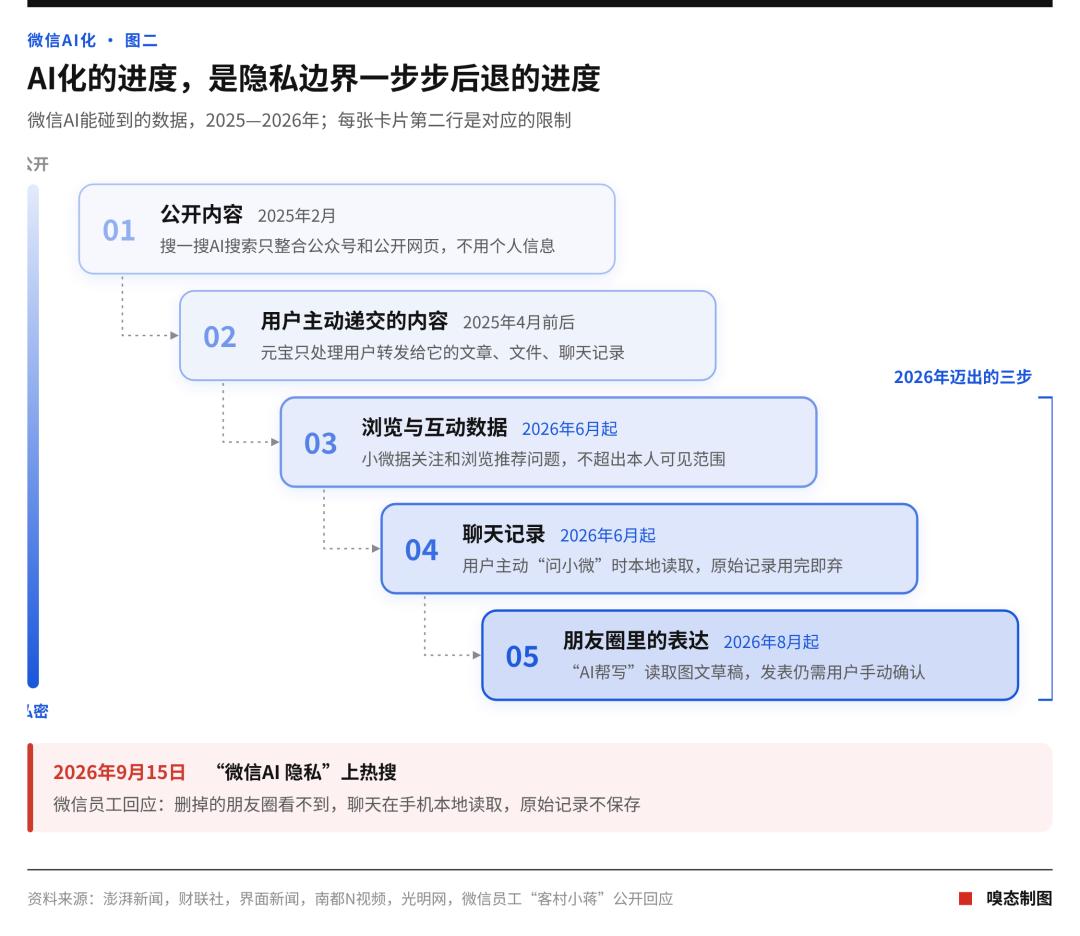
Among these steps, three of them were taken only in 2026. The guardrails added in each step all convey the same thing: what AI sees will not exceed what users are willing to give, and WeChat will always stand on the user's side.
03
No chance of winning in chatting, but the real advantage lies in handling tasks
2025 was the year of chatbots. This business competes on the intelligence level of models, the intensity of promotion, and users' willingness to install a new app. Tencent did not take the lead in any of these aspects, and the company internally admitted that it was the latest to enter the AI game.
After Yuanbao was connected to DeepSeek, it once topped the top of the application list, and Tencent then increased its promotion efforts. According to DataEye statistics, from January to October 2025, the amount of Yuanbao's promotional materials ranked first among domestic AI applications, but its monthly active scale still lagged behind Doubao. Advertisements can attract users to try, but cannot guarantee that users will keep opening the app.
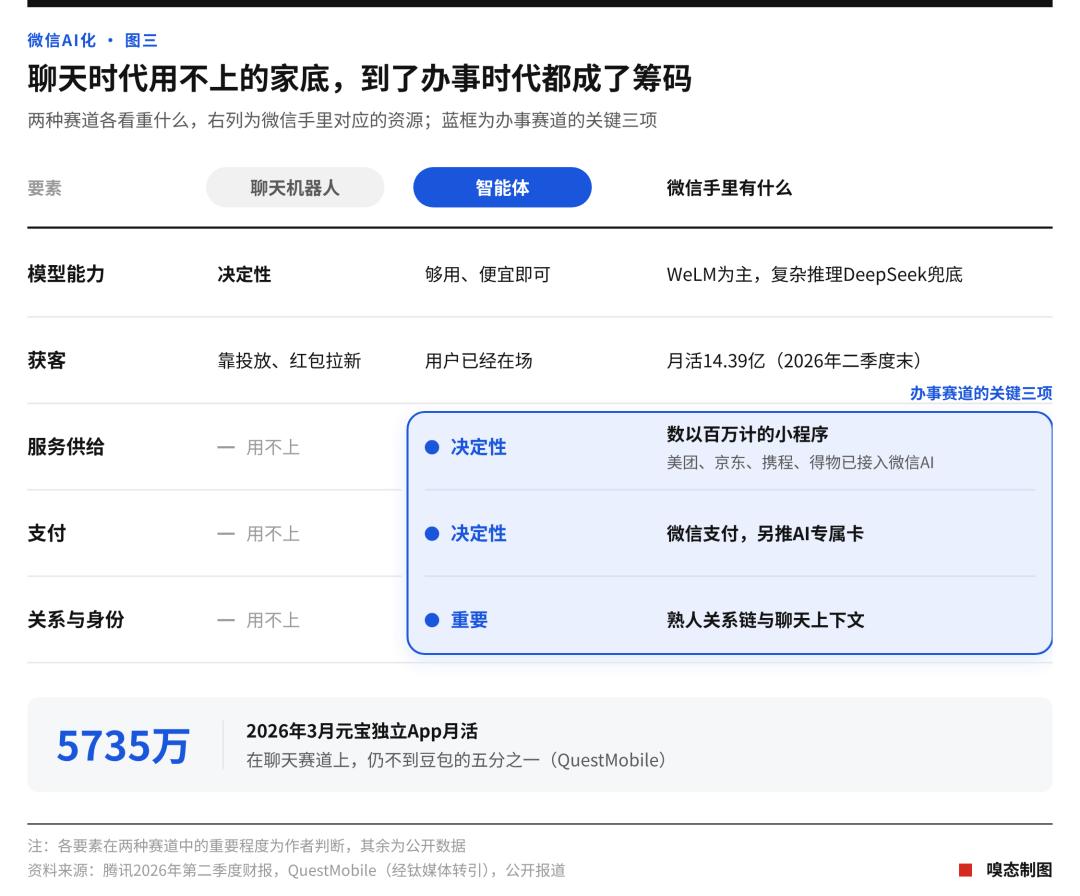
The assets accumulated by WeChat are almost useless in this business. 1.4 billion users, millions of mini-programs, WeChat Pay and acquaintance relationships are all decorations for a chat box that only answers questions. Anyone can make a chatbot, and the quality of the product has little to do with WeChat. The most simple reason why WeChat did not enter the market late is right here.
WeChat's advantages are difficult to realize in this kind of competition. Users who have WeChat friends and use WeChat Pay will not think that Yuanbao's answers are more accurate because of that. The competition of chat products mainly lies in model quality, interactive experience and usage habits. WeChat's service network can only be transformed into an advantage when AI needs to actually execute tasks.
In 2026, agent tools such as OpenClaw attracted attention, and the focus of competition for AI products began to extend to the task execution level. After users give the target, the agent calls tools, advances the process, and submits the result after completion. Pony Ma valued the asynchronous experience of combining agents with instant messaging at the March performance meeting: after users send instructions, they can handle other things first, and the results will be delivered in the form of messages. WeChat already has user habits that support this interaction.
Competitors are also connecting AI to transaction links. Doubao supports AI shopping and is connected with Douyin E-commerce; Qianwen is connected to Taobao, opens third-party agents, and attracts catering merchants to participate. Alibaba and ByteDance first call their mature e-commerce businesses. The difference of WeChat is that it connects a large number of third-party mini-programs. Whether it can organize these scattered services into a callable network will determine the actual value of Xiaowei.
Tencent has experienced a similar choice in the short video business: the independent Weishi failed to establish expected advantages, while Channels embedded in WeChat has developed.
There is also a difference between independent applications and native functions for Yuanbao and Xiaowei, but it cannot be simply asserted that the Yuanbao route has failed. A more accurate judgment is that Tencent leaves the growth exploration of model applications to Yuanbao, while letting WeChat use its original service and transaction capabilities to develop native agents.
Services, payment and relationships are not used by chatbots, but are indispensable for agents. What Yuanbao and WeChat differ in is exactly these elements.
WeChat's AI transformation can be defined as a "service entrance reorganization": users shift from finding mini-programs by themselves to putting forward demands to agents; the platform further participates in selection, calling and transaction execution from displaying service lists. The key that determines commercial interests thus extends from who owns the entrance to who formulates the calling rules of agents.
04
The distribution right of a single sentence
The first thing Xiaowei changed is the path for real WeChat users to find a service.
In the past, to order a cup of coffee in WeChat, you had to search, scan the code, click the link shared by a friend, or find the mini-program in "Recently Used"; now you only need to say a sentence.
When the path gets shorter, one thing becomes very important — which mini-program is assigned to handle this sentence, and who has the final say. WeChat used to be like a shopping mall full of shops, and now it has to pick shops for customers.
This distribution right is connected to several of Tencent's revenue streams, the most direct of which is advertising. In the second quarter of 2026, Tencent's marketing service revenue was 43.565 billion yuan, a year-on-year increase of 22%, the fastest growing among the three major sectors. The financial report attributed the success to AI recommendation models, upgraded delivery tools and closed-loop delivery in the WeChat ecosystem.
At the performance meeting, some analysts worried that users placing orders with a single sentence would squeeze out the originally high-margin ad exposure. Martin Lau responded that these risks will not appear, he compared QQ and WeChat: WeChat, which prioritized mobile experience, amplified the overall value of QQ by more than ten times. According to the current path, it is more likely that advertising will change its form, and what merchants will compete for will gradually change from users' attention to the agent's recommendation.
On the transaction and payment side, WeChat keeps a tight grip. When Xiaowei orders food for users, the transaction is still completed in the mini-programs of Meituan and Luckin Coffee, and the money still goes through WeChat Pay. The AI exclusive card is specially prepared for agent payment. Orders, memberships and user relationships all remain on the merchant side, and WeChat does not take them for itself. Xiaowei stops at the payment page, half for security, and half to leave room for the ecosystem.
What Xiaowei first changed is the process of users finding merchants. In the past, ordering coffee in WeChat required searching, scanning codes or opening mini-programs; now users can directly state their needs, and AI selects services and fills in orders. After the operation steps are reduced, new commercial problems arise: the same demand can be met by multiple merchants, what does