Bosses no longer hand over their money to VCs.

Family offices are emerging as a rising new force in China's primary market.
Author: Tao Huidong
Editor: Wang Qingwu
You may have noticed that the term "family office" has appeared more and more frequently in financing announcements this year.
In February, Qianxun Intelligence completed nearly 2 billion yuan in financing, and "Minghui Investment (the family office of Zhu Xingming, Chairman of Inovance Technology)" was explicitly listed in the investor list.
In May, Zenbot announced the completion of a nearly 100 million yuan angel round, co-led by the family offices of leading precision manufacturing enterprises including Eson Precision, KEDALI, and Zhaomin Technology.
In July, Wujie Intelligent Navigation secured nearly 100 million yuan in angel round financing, and "Xtep Family Office" appeared in the official announcement.
In September, Digurobot announced the completion of a 400 million US dollar Series C financing, mentioning that "the old shareholder Joyoung Family Office continued to increase its investment".
The above are only publicly available family office investment events, and there are far more unexposed cases under the surface. Since family offices generally do not need to raise funds and come with industrial endorsement on the investment side, most of them are very low-key and unwilling to do public PR.
More family offices are on the way. An investor told me that the boss of a leading third-generation semiconductor enterprise is also setting up a family office, and is currently looking for office space and recruiting staff in Suzhou. Headhunters also said that family offices have very intensive recruitment plans, hiring for positions from investment research to back-office roles.
Family offices are emerging as a rising new force in China's primary market.
Family offices start to "evaluate deals in person"
The family offices mentioned here specifically refer to family-office-style VC.
The concept of family office is not new in China, but over the past decade, the work done by single family offices in China has mainly focused on wealth management: allocating funds obtained from share reduction and dividends, purchasing wealth management products, public offering special accounts, secondary private equity funds, as well as allocating part of funds to real estate and overseas insurance policies, focusing on value preservation and inheritance. In the primary market, most of them choose to act as LPs of VC funds — they are capital providers, not deal evaluators. Well-known examples include Blue Pool Capital of Joe Tsai from Alibaba, Cool River Venture of Zhang Yiming from ByteDance, Sunrise Capital of Zhang Yong and Shu Ping from Haidilao, and Lollapalooza Capital of Wang Huiwen from Meituan. Their founders come from the internet and consumer sectors, most of them are registered in Hong Kong, China and Singapore, and their capital is not mainly invested in the primary market.
The new batch of family offices that have emerged now is different. Their capital only flows out for investment without new fundraising, they invest in equity of unlisted companies, and their investment scope extends from Series B and Series C all the way down to angel round and Pre-A round. To make their investment more professional, they also poach talents from professional VC firms to build a complete team covering pre-investment and post-investment management.
Such institutions can be properly defined as family-office-style VC — entrepreneurs conduct venture capital investment in the form of family offices.
It is not a traditional family office. The core of traditional family offices is asset allocation, which means entrusting capital to professional managers; while the core of family-office-style VC is equity investment, which means making investment judgments on their own.
It is not CVC either. The capital of CVC belongs to listed companies, which needs to be approved by the board of directors, disclosed publicly, and responsible for strategic synergy, so their investment targets are basically limited to their main business scope. However, the capital of family offices belongs to the family, they can invest in quantum computing and controlled fusion that have nothing to do with their main business, or even invest in potential competitors of their own main business, and do not need to explain the losses to minority shareholders.
It is also different from the scenario where "former entrepreneurs start their career as GP". The latter is a second venture to become an asset manager, whose core action is fundraising and managing other people's money; family-office-style VC generally does not raise funds, so there is no 7-year duration limit, nor DPI statements that need to be shown to external investors.
In short: family-office-style VC uses their own capital, their own industrial cognition, and their own recruited team to make early-stage equity investment. This was actually quite rare in the past.
Why do they choose to invest in person?
The rise of family-office-style VC in the past two years cannot be viewed in isolation. It happens exactly after the drastic change of RMB fund capital contribution structure: the primary market is not short of money, but more and more capital comes from state-owned entities, and the capital itself is increasingly endowed with clear policy, regional and industrial attributes.
The problem is not that state-owned capital cannot invest in good projects, but that one sum of capital often needs to achieve multiple goals at the same time. Especially for local government funds and state-owned LPs, in addition to evaluating the projects themselves, GPs often need to take into account return investment, local settlement, investment attraction, industrial chain complementation, compliance audit and exit arrangements. For GPs, investment is increasingly becoming a multi-objective optimization problem; for entrepreneurs, taking a sum of capital often means accepting multiple demands behind the capital at the same time.
If a GP takes too much state-owned capital, it has to deal with two sets of logics at the same time: one is investment logic, the other is investment attraction logic. Entrepreneurs only want to follow the investment logic, so starting their own VC business is somewhat a "forced" choice.
From the perspective of startups, family-office-style VC is a rare high-quality shareholder.
The first advantage is fast decision-making. Family-office-style VC has a short decision-making chain, and there are very few levels to go through from the first meeting to the final investment decision.
Secondly, family-office-style VC is also one of the few high-quality market-oriented long-term capital, with no duration limit, no investors urging for DPI, no clear exit cycle restrictions, and not as many restrictions as CVC, which is more suitable for investing in cutting-edge projects. The so-called "long-term capital" here is first a capital structure, not just a slogan.
The biggest attraction of this type of capital lies in the fact that behind it are usually industrial leaders and the entrepreneurs themselves, who can provide direct support in supply chain, customer resources, pilot production scenarios, management experience and overseas channels.
This also explains why the presence of family-office-style VC has suddenly become stronger in the past two years. Traditional market-oriented GPs have to raise funds on the one hand, and meet the increasingly complex demands of LPs on the other; entrepreneurs also need to balance among capital, industry, local settlement and exit arrangements. Family offices reunite capital owners, industrial cognition and investment teams at the same table, with a shorter principal-agent chain and more concentrated investment objectives.
Therefore, it can also be said that family-office-style VC has led a "Renaissance" in the primary market. This does not mean that the investment method returns to the past, but that the core issues of the primary market have become simple again: whether the entrepreneur is competent, whether the technology and product are valuable, whether the industry is large enough, and whether the company is worth accompanying for many years. In recent years, there have been more and more interference variables in the primary market, and both GPs and entrepreneurs have felt at a loss. Family-office-style VC has brought a solution that returns to the essence: using professional methods to do relatively pure things.
Of course, family-office-style VC also has some motivations beyond financial returns. For these entrepreneurs, making investments is also to find new possibilities for their main business, but the purpose is not as direct as that of CVC.
From the data point of view, the players in the primary market are indeed being cleared out. In the first half of 2026, the number of institutions that made investments in China decreased by 8% year-on-year. Filing information also shows that only 20 new private equity managers were added in the first half of the year, while as many as 364 were deregistered. At least part of these disappeared market shares flows to non-funded family-office-style VC. This is not necessarily a bad thing, and can even be called a recalibration of the primary market.
What do they invest in?
As mentioned earlier, it is very difficult to systematically identify all family-office-style VC, because they almost never take the initiative to expose themselves. I used AI to batch check the shareholder registers of startups that completed financing this year in several popular tracks, and found the following five very active family-office-style VCs this year:
Minghui Yuanzhi, the family office of Inovance Technology;
Liling Venture Capital, the family office of Luxshare Precision;
Changyingxin Investment, the family office of Eson Precision;
Wanfeng Investment, the family office of Xtep;
Qunxin Investment, the family office of Lens Technology;
Inovance Technology: Minghui Yuanzhi Investment (Shenzhen)
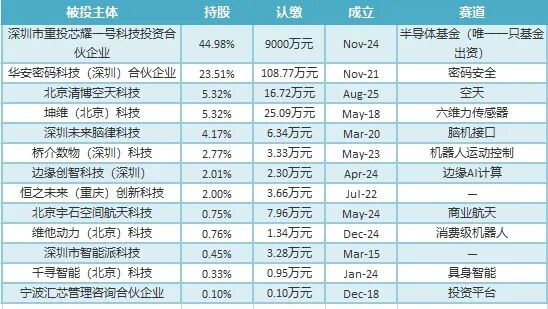
Zhu Xingming, Chairman of Inovance Technology, holds 1% of the shares and serves as the supervisor, while Pan Li holds 99% of the shares and serves as the executive director and general manager. The company was established in May 2022, with a total of 14 outbound investments.
Inovance Technology: Minghui Yuanzhi Investment (Shenzhen)
13 of Minghui Yuanzhi's 14 investments are direct investments, and almost all its capital is invested in the robot industry chain (force sensor, motion control, ontology, core control system) and AI computing; the subscribed amount per investment is mostly between tens of thousands to hundreds of thousands of yuan, which is a typical "gradual investment along with different financing rounds". The only fund it invested in was taking a LP position in Chongtou Xinyao No.1 with 90 million yuan in November 2024, accounting for 44.98% of the fund's share. In addition,
It also interacts with Inovance Technology's CVC platform — the lead investor of Kunwei Technology's Series A2 round is Inovance Capital.
Luxshare Precision: Liling System
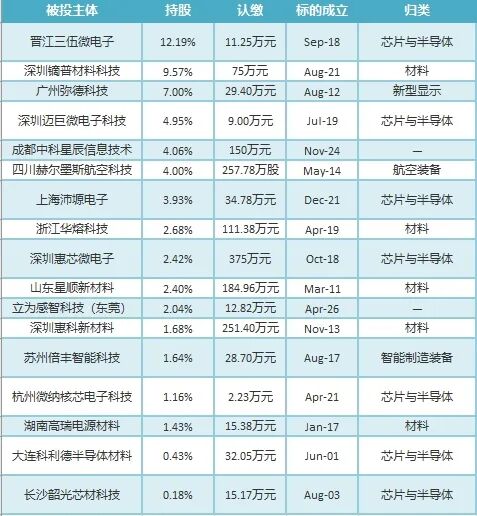
The investment entities of Liling System are relatively diverse. First, Liling Venture Capital Co., Ltd. was established in Jiangsu in 2021, and submitted a private equity fund manager registration application in 2023, but later abandoned the registration and carried out a small number of investments with its own capital. In January 2024, Yi Lei, the second generation of the family, newly established Shenzhen Liling Private Equity Fund Management Co., Ltd., which completed the private equity fund manager registration on July 19, 2025. This GP has since become the main investment entity of the Liling System.
Although it adopts the fund-based investment method, Liling's fundraising method is very different from that of ordinary VCs. There are no roadshows, no FOF, no state-owned capital, and no government guidance funds. It only raises funds in a small circle of manufacturing entrepreneurs. The actual controllers of another manufacturing listed company KuaiKe Intelligent, Qi Guoqiang and Jin Chun couple, are important fund contributors.
Luxshare Precision: Liling System
Seventy percent of the Liling System fund's investments are focused on chips and materials, which exactly form an upstream and downstream relationship with Luxshare Precision's main consumer electronics business. It does not chase the latest hot spots, and prefers to bet on "old companies" that have been polished on production lines for many years, and will repeatedly increase positions in the targets they value.
Eson Precision: Shenzhen Changyingxin Investment
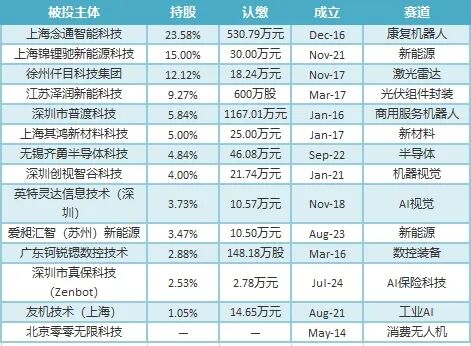
Established in July 2014. It has made 17 outbound investments, and has never acted as an LP of any institution. Its legal representative is Chen Qixing, the chairman of Eson Precision himself.
Eson Precision: Shenzhen Changyingxin Investment
17 investments in 11 years are evenly distributed in four tracks: robot, semiconductor, new energy materials, and machine vision, with the shareholding ratio generally between 3% and 20%, and the investment pace has accelerated significantly after October 2025.
Xtep: Jinjiang Wanfeng Investment
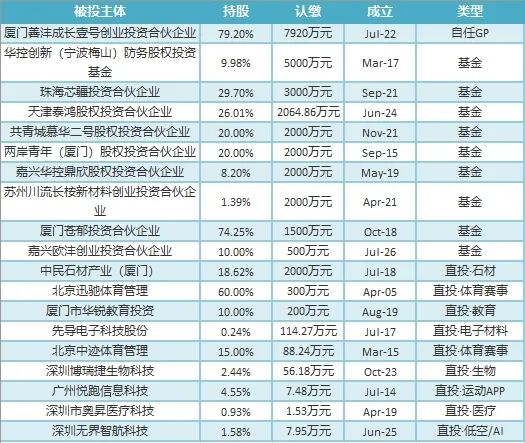
Ding Mingzhong, the founder of Xtep, holds 70% of the shares. It was established in Jinjiang, Fujian in August 2014. It has as many as 40 outbound investments, the most among the five institutions.
Xtep: Jinjiang Wanfeng Investment
It is the one with the most capital contribution to funds among the five, and there are another 20 fund and GP type capital contributions not listed in the table. The 11 direct investments are also widely distributed, covering building materials, sports events, education, medical care, and biology, which is very close to the investment style of a comprehensive FOF. This is more like a family investment platform that is transforming from LP to GP, rather than a typical family-office-style VC.
Lens Technology: Changsha Qunxin Investment
Zhou Qunfei, Chairman of Lens Technology, holds 98% of the shares. It was established in 2011, the earliest one among the five institutions.
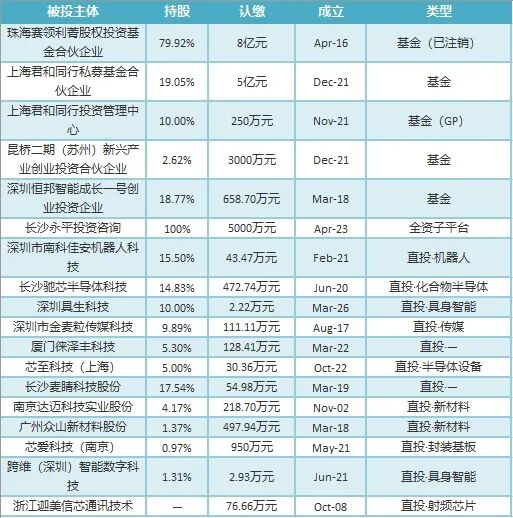
Lens Technology: Changsha Qunxin Investment
Qunxin Investment has 19 outbound investments, 5 of which are fund capital contributions, but all of them occurred before December 2021. No new LP capital contributions have been added since then, and it has fully shifted to direct investment. Its heaviest positions are in semiconductors (Chixin, Xinzhi, Xin'ai, Jiamei Xinxin) and robots (Nanke Jia'an, Kuawei, Jusheng).
Generally speaking, the investment preference of family-office-style VC is obviously affected by the entrepreneur's own experience