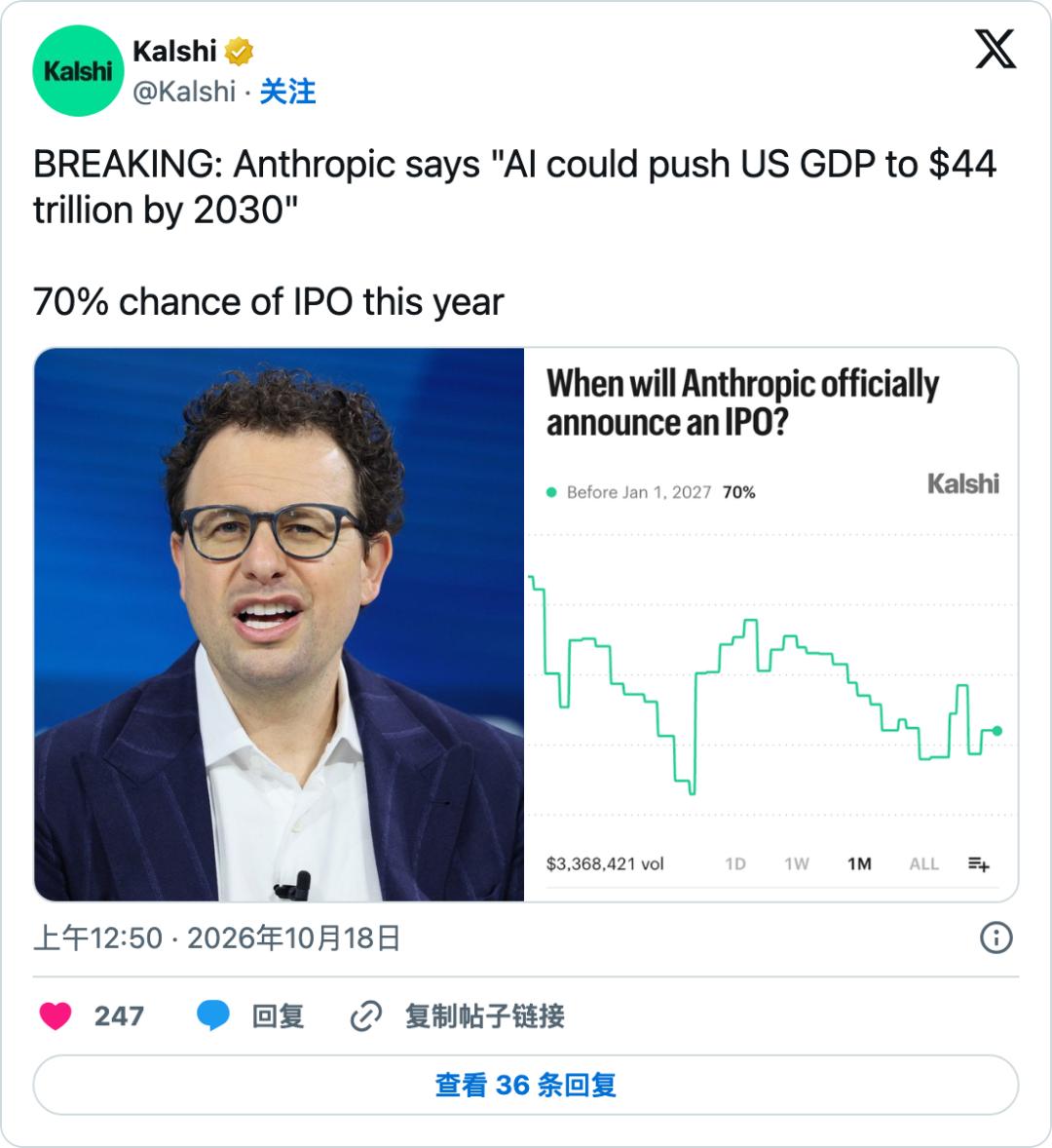
Just now, Anthropic announced that the Singularity has arrived! AI may push the U.S. GDP to 44 trillion U.S. dollars.
Just now, Anthropic released a stunning prediction —
By 2030, AI may drive the U.S. GDP to surge to 44 trillion U.S. dollars.
At the Per Jacobsson Lecture of the International Monetary Fund held in Bangkok today, Jack Clark, co-founder of Anthropic, put forward a bombshell judgment that has caused a global stir: "The Singularity has arrived."
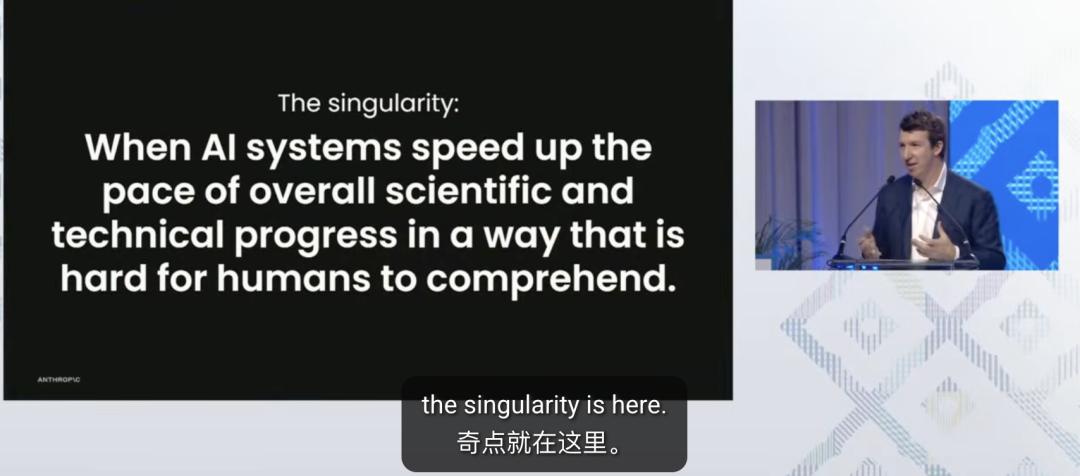
What is the Singularity? It means the speed of technological progress has completely outstripped human capacity to understand and keep pace with it.
Driven by the Singularity, the U.S. GDP will be pushed to the astronomical figure of 44 trillion U.S. dollars before 2030.
According to conventional deduction, this figure is 33.5 trillion U.S. dollars, which means the Singularity brings an extra 15.4% of GDP, bringing about roughly 6% additional GDP growth per year on average.
Under this extreme Singularity path, around 2030, the accumulated productivity improvement and capital accumulation will push the U.S. annualized economic growth rate to a staggering high of 15.4%.
What does this concept mean? It means a huge mature economy only needs about 4.5 years to double its economic scale.
44 Trillion GDP: Money Printer or Meat Grinder?
The crazy fission of technology will inevitably reshape the underlying logic of capital and macroeconomics.
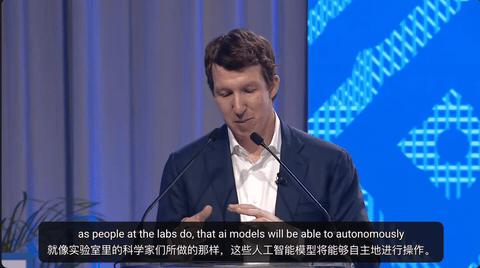
During his speech at the IMF, Jack Clark disclosed a shocking macro simulation: if AI achieves full autonomous takeover of complex scientific exploration and triggers the Singularity driven by Recursive Self-Improvement (RSI), the U.S. GDP may surge to 44.4 trillion U.S. dollars by 2030.
Does the number sound absurd?
Anthropic's official economic team has provided extremely detailed deduction.
The model assumes that without the extra impact of AI, the U.S. economy evolves conventionally (with an average annual growth of about 2%, of which creative growth contributes 1.67% and labor force growth contributes 0.33%). Then by 2030, the U.S. baseline GDP will be about 33.5 trillion U.S. dollars (calculated at 2025 prices).
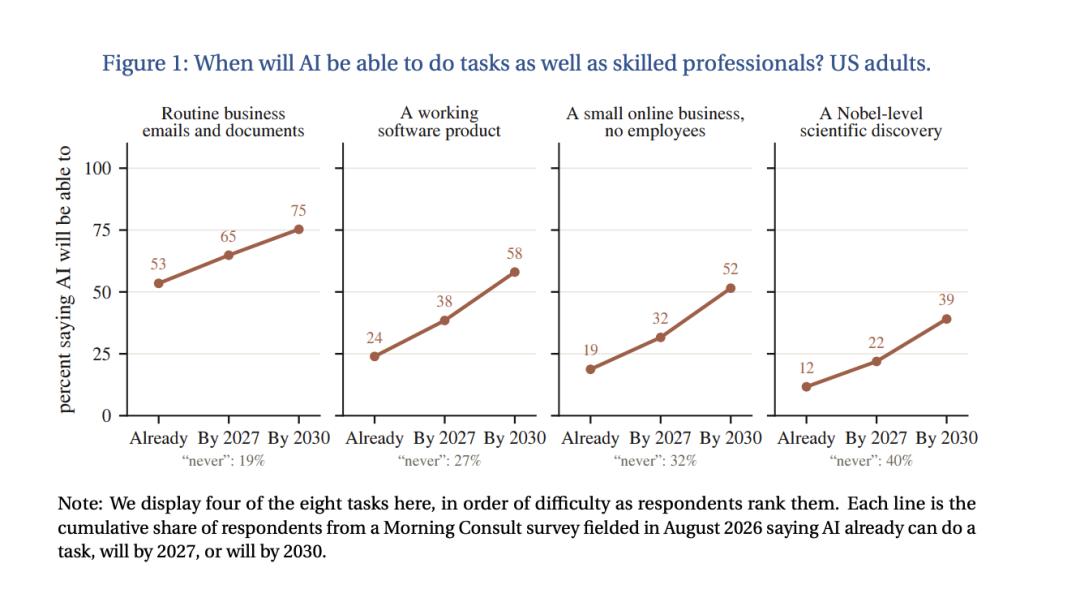
But once the variable of AI taking over knowledge work is introduced, fission begins:
Modest Scenario: A slight increase of 1.6%, reaching 34.1 trillion U.S. dollars.
Substantial Scenario: A sharp increase of 8.3%, reaching 36.3 trillion U.S. dollars.
Extreme Scenario: That is, the Singularity breaks out, and GDP is 32.4% higher than the baseline directly.
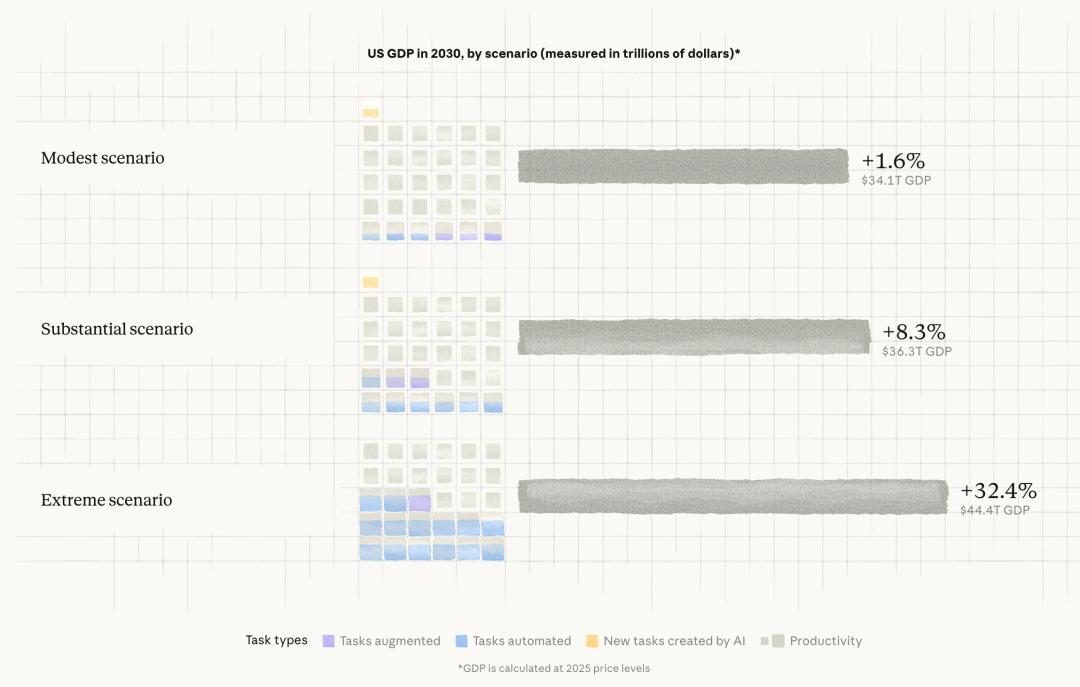
The formula is simple and crude: 33.5 trillion × 1.324 ≈ 44.4 trillion U.S. dollars.
Why? Because of the "infinite replication" of human cognition and experience.
Jack Clark pointed to himself on the stage and said:
I am a human being. There is only one me in the world. It took me a full 40 years to accumulate the cognition that allows me to stand here today."
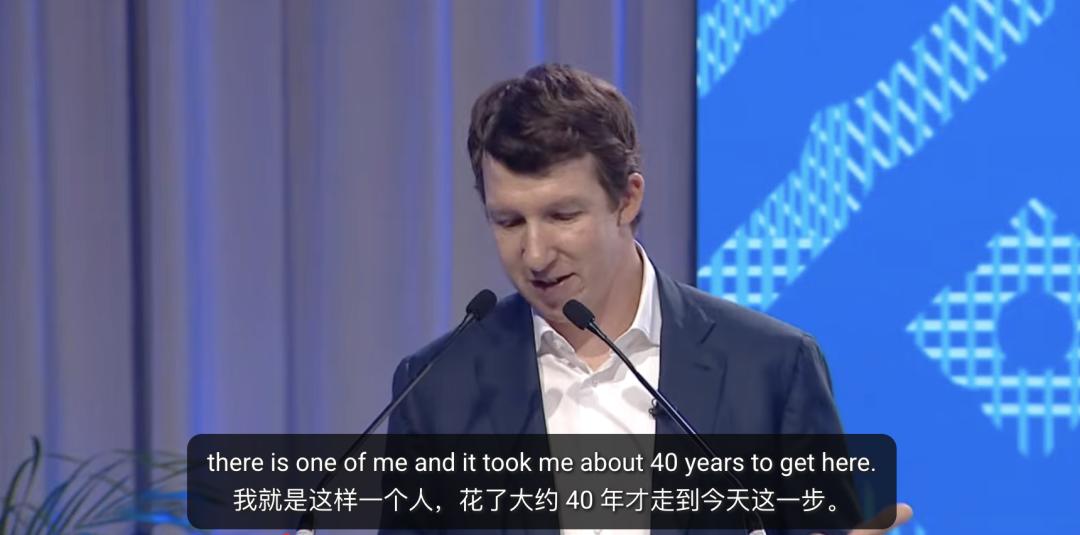
To train a top human scientist requires 15 years of education and millions of dollars in investment. But what if in the future, computing power allows us to instantly clone 1,000, 100,000 "virtual avatars" of top scientists?
According to statistics from UNESCO, there are only about 10 million full-time researchers in the world at present. The entire modern human civilization is supported by these 10 million people.
And the real picture Jack depicts is:
In the near future, these 10 million human scientists will command an army of 1 billion tireless, interdisciplinary "digital scientists".
Scientific research is no longer a manual workshop, but an industrial assembly line.
The R&D cycle of new drugs is forcibly compressed from 10 years to several weeks; new room-temperature superconductors and solid-state battery materials are exhaustively enumerated by brute force of computing power, breaking through bottlenecks instantly; the productivity multiplier and scientific progress form an unsolvable positive feedback, which directly explodes GDP in a blowout trend.
This also explains why Trump must "accelerate AI development".
In this winner-takes-all national destiny battle, there is no defense, only offense. It is necessary to use national will to forcibly remove obstacles, and pour massive resources into computing power infrastructure construction, talent recruitment and industrial implementation.
Seizing the first opportunity can convert the potential Singularity dividend into a new industrial wave dominated absolutely by the United States;
On the contrary, anyone who idles away time in regulatory wrangling will completely become a relic of the old era while being caught up by other countries.
But is there really a free lunch in the world?
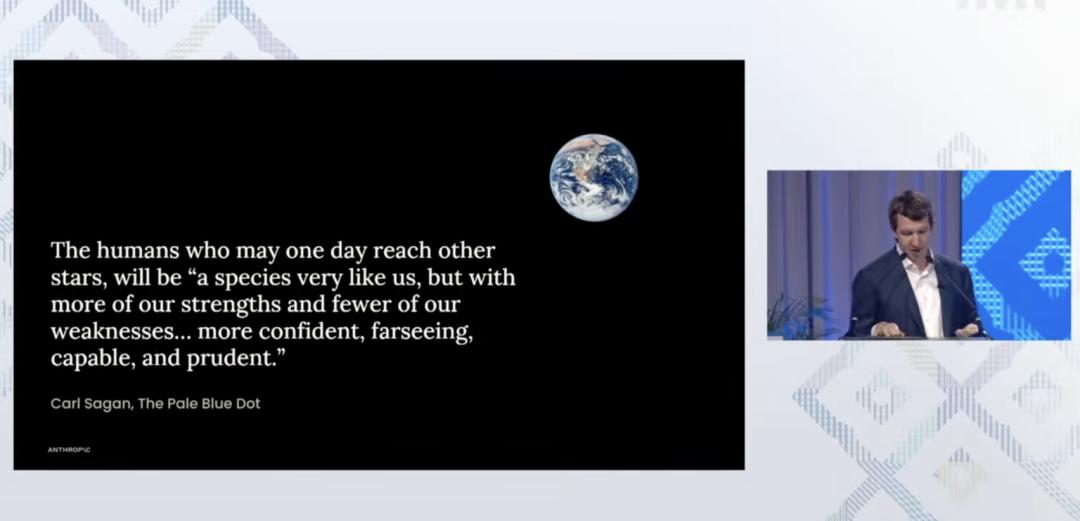
This is a "Miracle": The Student Corrected the Teacher On Site
Why did Jack Clark dare to assert on the IMF podium in front of senior global central bank officials that "the Singularity has arrived"?
He directly threw out a series of hard core data.
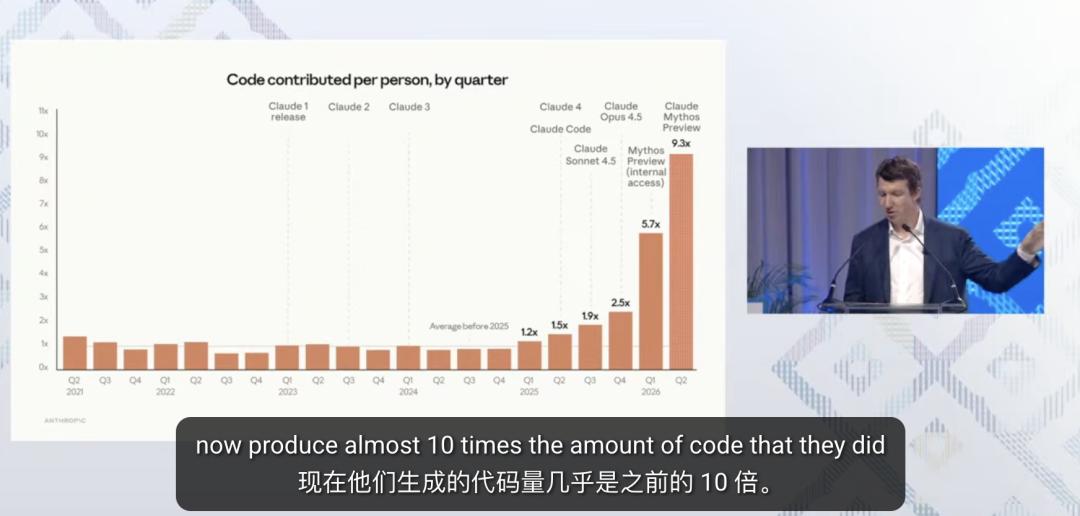
Everyone inside Anthropic generates almost 10 times more code than before!
And in the benchmark test measuring the ultimate wisdom of human beings, what happened can only be described as terrifying:
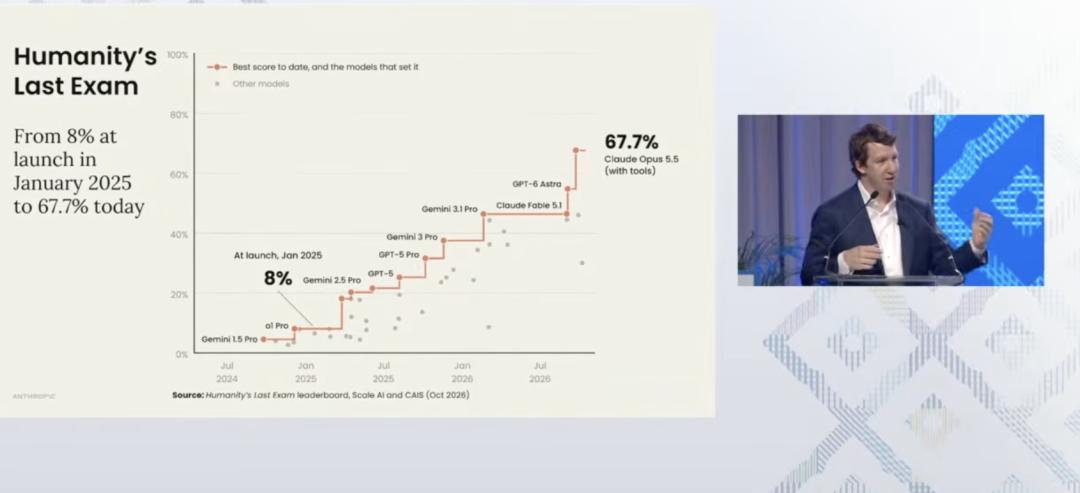
1. Humanity's Last Exam
This is a top-level difficult question bank covering chemistry, computer science, advanced mathematics, classical literature and ecology. When the test was first released in January 2025, the world's strongest AI only had a dismal 8% score rate.
And just this week, Claude Opus 5.5 scored 67.7%.
2. Frontier Math
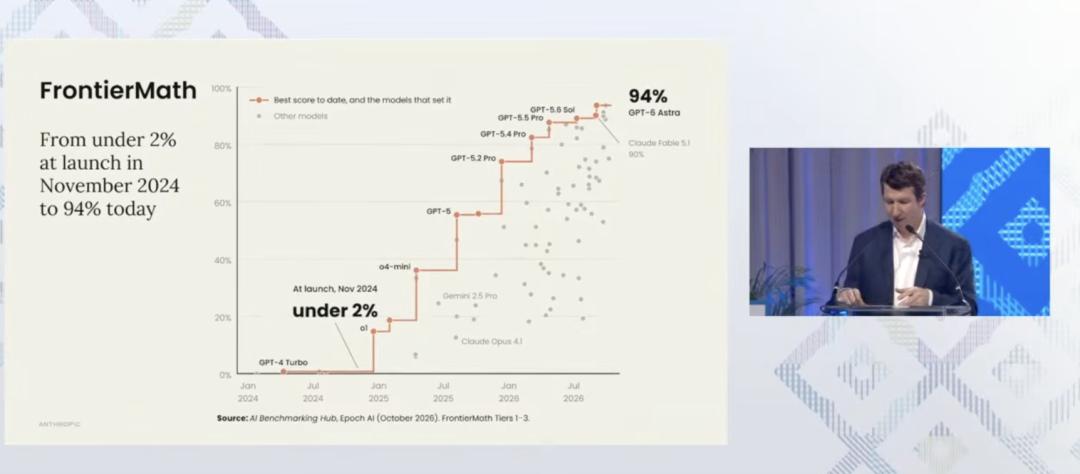
A collection of unsolved problems jointly designed by hundreds of professional mathematicians around the world. When it was launched at the end of 2024, the strongest model scored 2%.
Today, this number has become 94%.
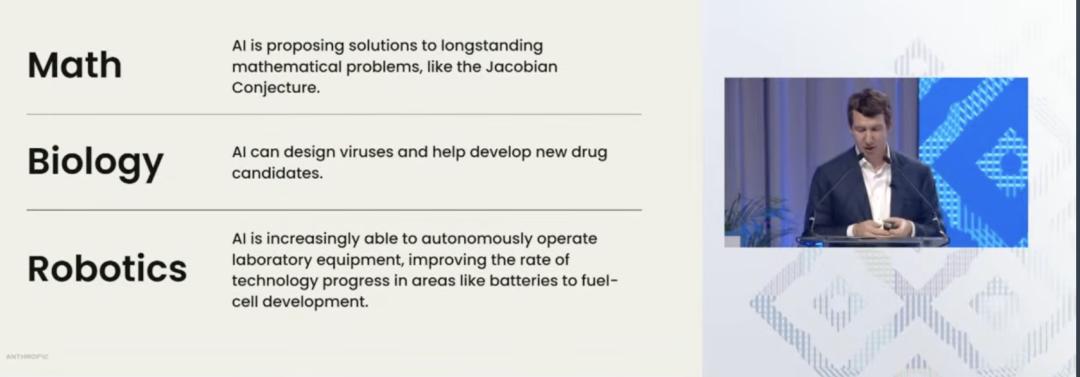
In long-standing mathematical problems that have plagued human beings for a long time, such as the Navier-Stokes Millennium Prize Problem and the Jacobian conjecture, AI has begun to provide core breakthrough insights.
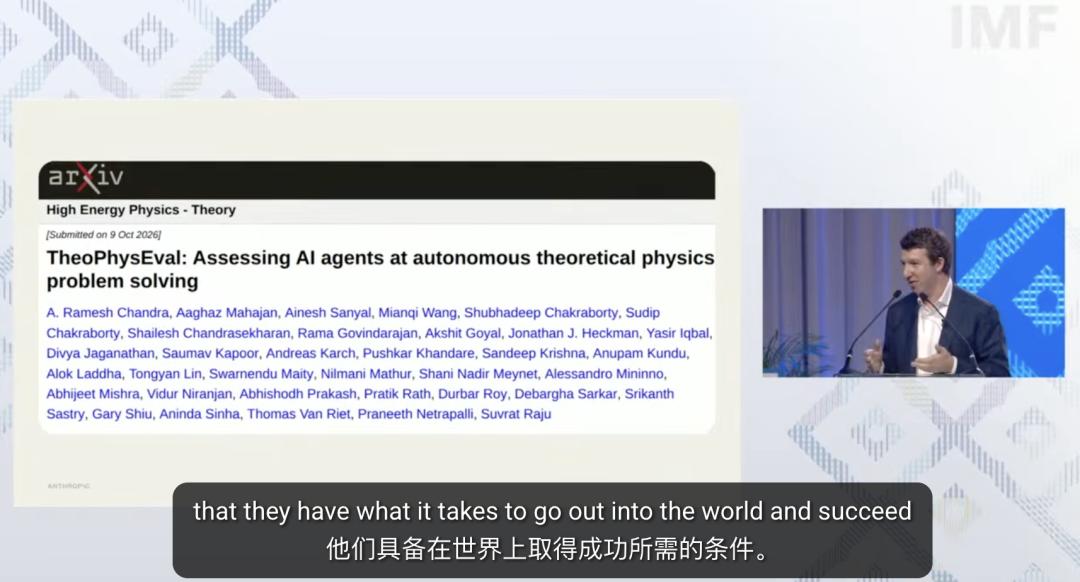
But the most creepy thing is a theoretical physics evaluation (TheoPhys Eval) just released last week.
There are 50 questions in total, all compiled by the world's top physicists using their most cutting-edge unpublished latest research results. The answers are not made public, and there is no possibility for AI to "memorize the questions".
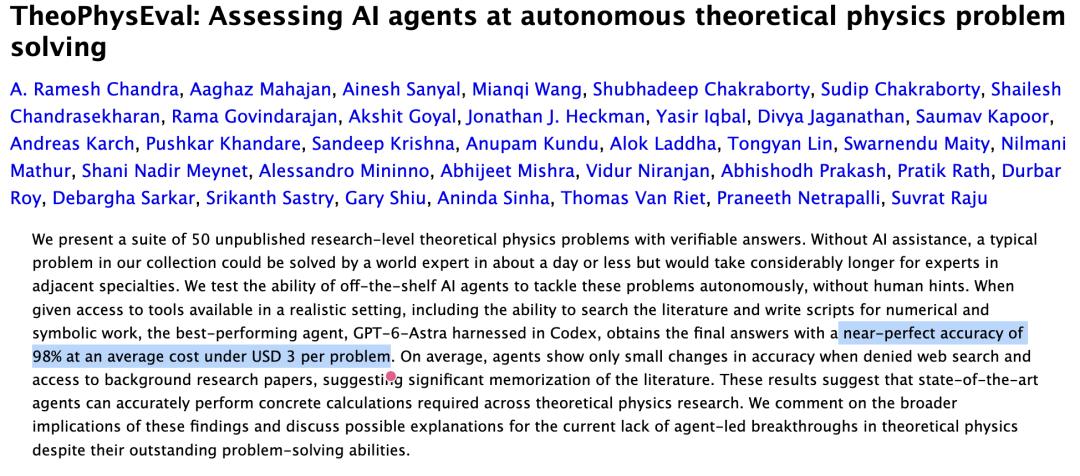
At the beginning of the test, GPT-6 Astra and Opus 5.5 scored more than 80 points.
But when the evaluators checked the so-called "wrong answers" of AI, the AI system insisted extremely firmly: "I am right, the reference answer of human experts is wrong."
The scientists re-derived the deduction steps with skepticism.
The result made everyone take a cold breath:
In many advanced physics problems, the subtle calculation errors buried by human physicists at the bottom of complex formulas were all accurately picked out by AI.
After correcting human's own mistakes, the final score of AI was fixed at: 98%. It conquered 49 out of 50 world-class cutting-edge physics problems.
Jack Clark borrowed the common growth plot in movies:
The young protagonist finally proved to his mentor that he has been able to stand on his own feet.
The student began to become the teacher.
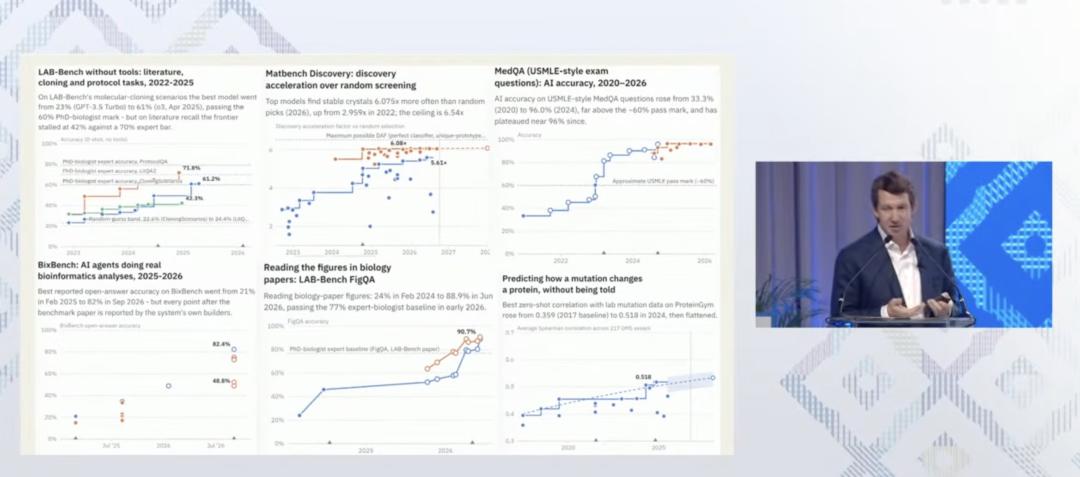
Today's AI is no longer a code completer that requires humans to give step-by-step instructions.
It has become "Virtual Polymath".
The Terrifying "Recursive Self-Improvement": It Starts to Manufacture the Next Generation of Itself
If AI only understands physics and mathematics, humans can still treat it as a tool.
But the second thing that makes Silicon Valley and even the Pentagon tremble is:
AI has begun to develop AI on its own.
This is the RSI (Recursive Self-Improvement) that academia talks about with fear.
Once