Anthropic, the leading AI giant, has laid bare the cruellest truth of the entire AI industry.
Several months ago, Anthropic even benchmarked itself against SpaceX, touting a mythical $2 trillion valuation. But as the roadshow draws near, not only have the quotes on the old share trading platform fallen below $1.7 trillion early on, many institutional buyers have even stated privately: If the final listing price is not cut below $1.5 trillion, no one is willing to step in to take over the high-position shares at all.
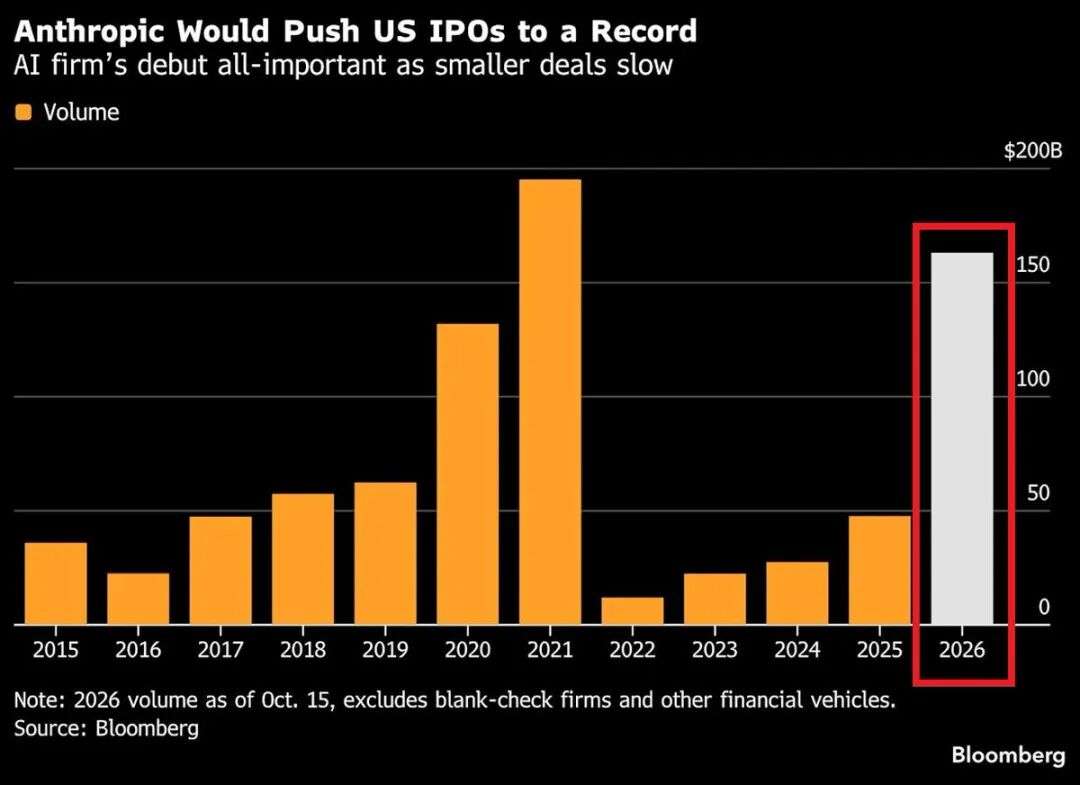
Oddly enough, Anthropic has just presented an impressive set of results: $16.8 billion in revenue for the third quarter alone, its first adjusted profit on record, and positive free cash flow.
Why did this impeccable report card only get a cold shoulder from the capital market? Beneath the glossy figures, the market has detected the scent of financial statement window dressing:
This article is extremely in-depth. It is by no means a fast-food content that only gives you a 3-minute overview or draws hasty conclusions after listing a few news headlines. This is the commercial and financial truth I have broken down layer by layer after reviewing the details of the prospectus and financial statements over this period of time.
Today we mainly discuss three issues:
First, why is a profitable AI company seeing its valuation cut instead of rising?
Second, the "profit impossible trinity" of the AI industry: model companies, computing power giants, and enterprise customers all want to grab more benefits. But the total profit is fixed, who earns the most? Who might be squeezed out of profits entirely?
Third, what tricks are Amazon and Google playing in their financial statements to cover for Anthropic at all costs?
By the end of this article, you will know whether you should participate in this $2 trillion IPO, and why the AI stocks in your portfolio will be affected across the board by Anthropic's move.
What supports a $2 trillion valuation?
Let's talk about valuation right now.
First of all, we are not judging whether Anthropic is a good company. What we want to judge is whether the $2 trillion IPO pricing has sufficient fundamental support.
We can first look at its valuation trajectory:
In February this year, it completed Series G financing with a valuation of $380 billion;
In May, for Series H financing, its valuation jumped directly to $965 billion;
In less than four months, the valuation reached about 2.5 times the previous level;
Now the expected IPO valuation is directly raised to $2 trillion, more than double that of the Series H round.
The company's valuation logic is: it expects to generate annual revenue of $190 billion to $200 billion by 2028.
Dividing the $2 trillion valuation by $200 billion in revenue corresponds to a forward price-to-sales ratio of about 10x. For a tech giant maintaining ultra-high growth, a 10x forward price-to-sales ratio is actually reasonable.
But for this calculation to hold, there is only one core premise: the ultra-high growth must continue.
The problem lies exactly here.
Look at the latest quarterly data:
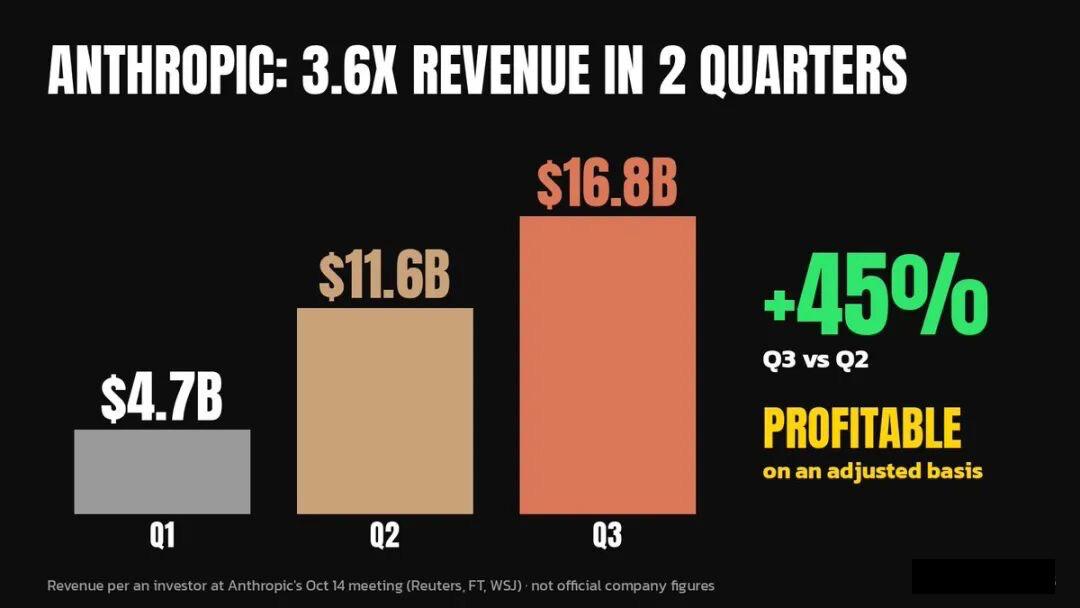
Total revenue in 2025 was $4.59 billion;
Revenue in Q1 2026 hit $4.7 billion, matching the full-year revenue of the previous year in just one quarter;
Revenue in Q2 reached $11.6 billion, with a quarter-on-quarter growth rate of 147%;
Revenue in Q3 was $16.8 billion, with quarter-on-quarter growth slowing to 45%.
Objectively speaking, a 45% quarter-on-quarter growth rate for a single quarter is not bad. But in the pricing logic of the capital market, high valuations depend on acceleration of growth.
With the growth rate dropping from 147% to 45%, it has slowed down by two-thirds within one quarter. When the company is targeting a $2 trillion valuation, the first thing the market will notice is this downward slope.
One more critical detail:
The $16.8 billion revenue in Q3 annualizes to roughly $67.2 billion. Back at the end of July this year, the management had already communicated an annualized revenue figure of $65 billion to the public, and the two figures differ by only 3%.
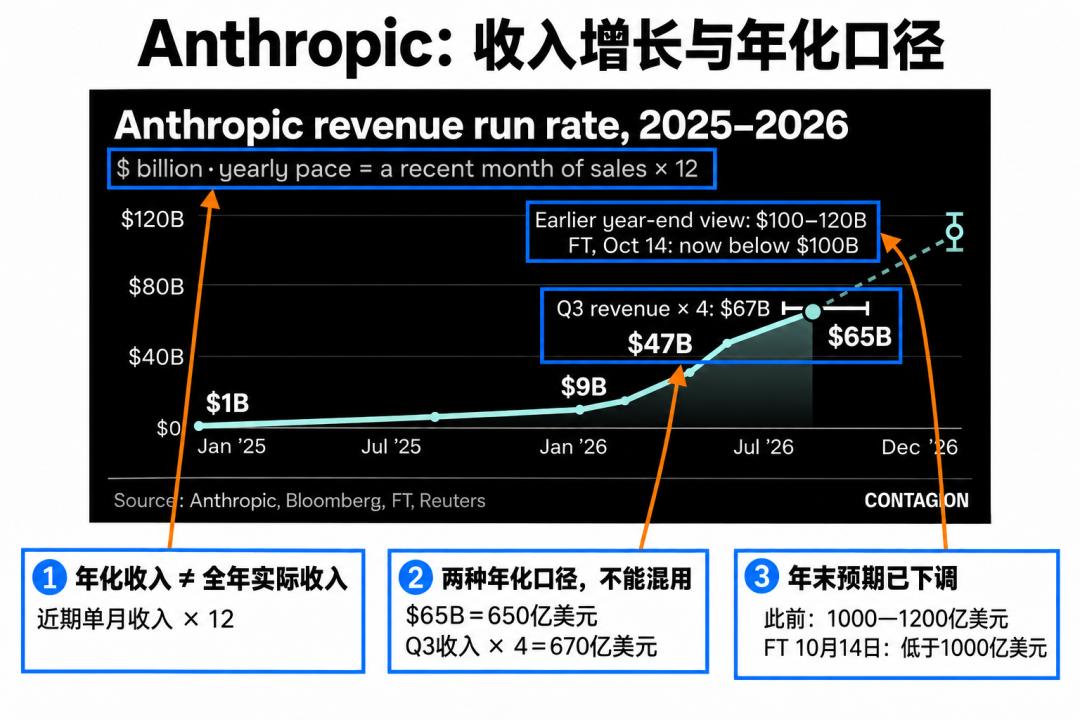
What does this mean? Either there was barely any growth between July and September, or the previous $65 billion figure had its own share of padding. Either way, the $100 billion annualized revenue the market originally expected is almost impossible to achieve in the short term.
The scale of revenue depends first on the statistical caliber
In addition to slowing growth, the deeper problem is that the financial reporting calibers of various AI unicorns are actually not transparent.
The commonly mentioned ARR (Annual Recurring Revenue) is essentially calculated by multiplying the current monthly revenue by 12, with the preset assumption that customers will continue to renew their contracts. In practice, however, different companies have very different recognition methods.
For example, Anthropic sells its models through Amazon AWS and Google Cloud using the "gross method" for accounting; while OpenAI uses the "net method", which deducts the share paid to distribution channels first, and only records the remaining part as revenue.
With similar businesses, simply due to different accounting recognition methods, the reported revenue can have a gap of 30% to 40%.
Earlier, different versions of the annualized revenue figure for OpenAI came out, which directly triggered fluctuations in the secondary market. Now the market generally takes a more cautious look at this kind of self-reported operational data.
Behind high gross margins, there is still long-term R&D investment
The revenue caliber has padding, and the consideration of profit is even more realistic.
Anthropic publicly stated that its adjusted operating profit margin in Q3 exceeded 11%, and adjusted gross margin reached 85%.
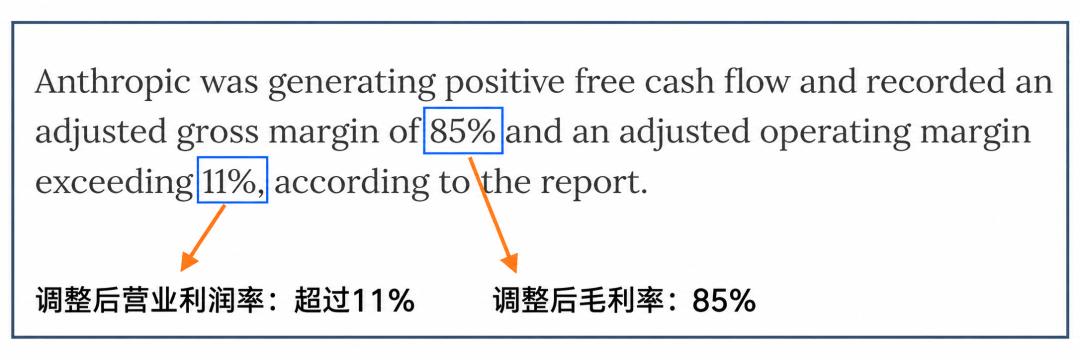
But this 85% gross margin does not deduct the training cost of new models. In the AI track, pre-training and continuous iteration of large models are not one-off capital expenditures, but R&D costs that must be invested in for a long time.
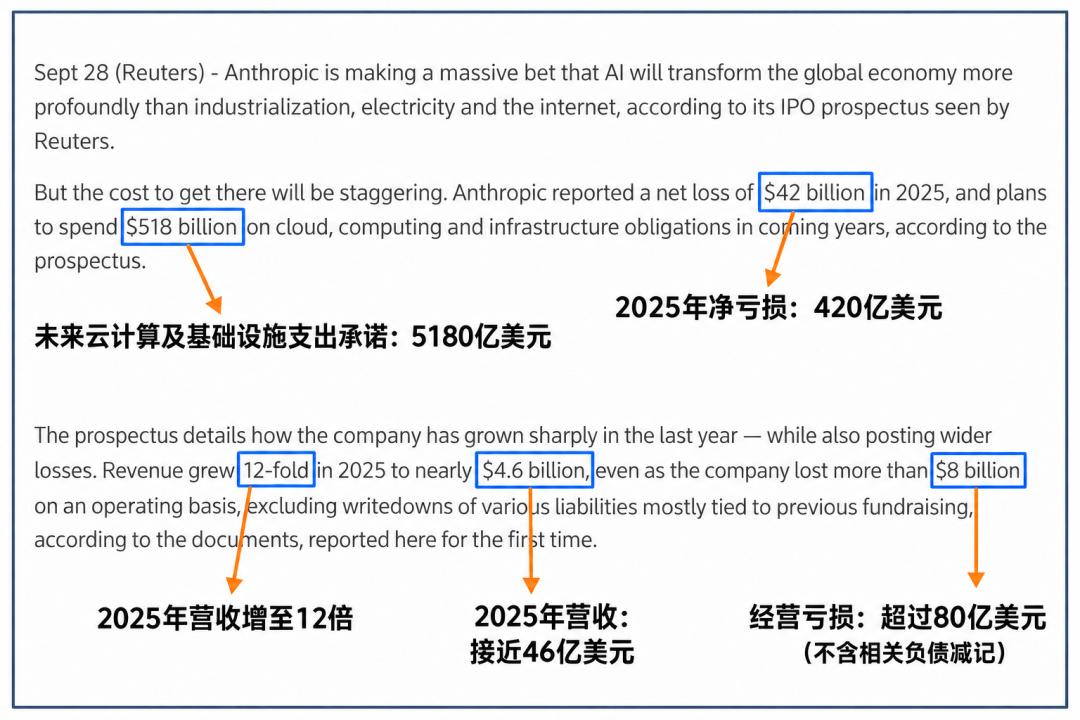
According to the strict GAAP (Generally Accepted Accounting Principles), its operating loss in 2025 was $8.06 billion, and its net loss was about $42 billion.
Even after excluding $34 billion in non-cash book expenses, the company still faces considerable loss pressure at the operational level.
Finally, there is a structural risk that is most easily overlooked: its deep binding with computing power giants.
Amazon and Google are nominally its shareholders and distribution channels, but in essence, they are underlying computing power suppliers, and may also be potential competitors in the ecological niche.
Over the next ten years, Anthropic has committed to cloud and computing power purchases of at least $518 billion from its major partners, about 80% of which are irrevocable.
This creates a mismatch in finance:
Expenditures are rigid and must be paid when contracts expire; while revenue is flexible, as customers pay based on usage and have no obligation to renew their contracts.
In the period of rapid industry expansion, this model can quickly capture market share; but once the downstream commercial monetization pace slows down, this rigid expenditure commitment will bring continuous pressure to cash flow.
So back to the original question, why did the market start re-evaluating the $2 trillion target?
To support this valuation, the conditions are very harsh: either the company can present solid positive GAAP profits in the official prospectus, or its quarter-on-quarter growth rate in Q4 can rebound against the trend to over 50%.
If neither of these two points can be fulfilled, a more realistic outcome is that the valuation will be revised down from $2 trillion to between $1.4 trillion and $1.7 trillion, which is equivalent to a 30% to 15% discount on previous expectations.
This pricing range can not only leave a premium space of about 50% for the institutional investors that entered in the Series H round, making it easier for the underwriting group to get the deal approved, but also meet the benefit expectations of strategic shareholders.
In the final analysis, the business judgment can be summed up in one sentence:
Whether Anthropic is a good company with promising technology is completely different from whether $2 trillion is a reasonable pricing.
No matter how good the asset is, if you buy it at an excessively high price, it is a high-risk transaction at the investment level.
The "profit impossible trinity" of AI
But if you shift your focus from Anthropic alone to the entire AI industry chain, you will find a more counterintuitive phenomenon:
In the past three years, Wall Street has priced almost every key link in the industry chain as a "super winner".
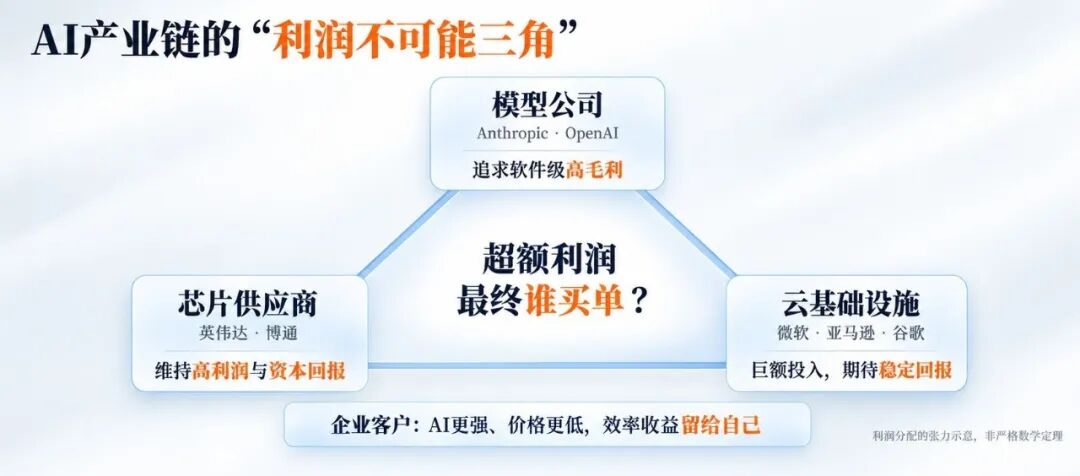
Model companies such as Anthropic and OpenAI hope to enjoy a gross margin of over 80% like traditional software giants to support a trillion-dollar valuation.
Chip suppliers such as NVIDIA and Broadcom rely on technical barriers and scarce computing power to maintain extremely high profit margins and capital returns.
Cloud infrastructure giants such as Microsoft, Amazon, and Google spend hundreds of billions of dollars every year building data centers, expecting to recover stable rents by leasing computing power in the long run.
But what about the enterprise customers who actually use AI?
They also have their own plans: they hope AI will become smarter and cheaper, so that the benefits brought by improved productivity can truly stay in their own income statements.
Sounds like everyone can win. But here comes the question: who will pay for this excess profit in the end?
This is the "profit impossible trinity" of the AI industry chain.
Model companies want software-level high profit margins, the computing power supply chain wants continuous high returns, and end customers want low prices and high benefits. The same amount of economic value cannot be divided infinitely among all parties.
Creating the same $100 of value can lead to completely different profits
Why? Let's do a simple calculation.
Assuming that a certain AI service helps an enterprise create $100 of economic value. After deducting $40 in necessary costs such as model R&D, computing power depreciation, and infrastructure, the remaining $60 is the economic gain that all parties in the industry chain can distribute.
But who will get the $60 in the end depends on who has the pricing power.
Scenario 1: Computing power suppliers hold the dominant position
If advanced GPUs and power are in continuous shortage, NVIDIA and cloud vendors will have stronger bargaining power.
Assuming customers spend $65 on services, of which $50 flows to the upstream. After deducting costs:
The upstream earns $20;
Customers keep $35 in gains;
The model company in the middle only gets $5.
Scenario 2: Model companies hold the dominant position
This is also the long-term business model that Anthropic most wants the market to believe in as it pursues a $2 trillion valuation.
If Claude always takes the lead in reasoning, programming and Agent tasks, is deeply embedded in enterprise workflows, and can also reduce computing power procurement costs, profits will tilt towards the model company.
Customers are willing to pay $70, and computing power procurement costs drop to $35. After deducting other costs:
The model company earns $25;
The upstream only gets $5;
Customers keep $30 in gains.
Scenario 3: Homogenized models trigger industry price wars
With open-source models and competitors catching up continuously, enterprises find that using any model for many tasks makes little difference, so why pay a higher price?
In the end, customers are only willing to pay $40. Even if the model company reduces computing power costs to $33, after deducting R&D and operating costs:
The model company still loses $3;
The upstream can only earn $3;
Customers keep $60 in gains.
Of course, these are only three hypothetical scenarios, not real financial data.
But it illustrates one point:
The $100 of value created by AI does not decrease, but the profit distribution within the industry chain can be vastly different.
Why could all parties get along peacefully in the past three years?
Because AI demand exploded, the entire pie expanded rapidly, and growth temporarily covered up these conflicts of interest. But now, a warning risk is that the shortage of upstream computing power and downstream model price competition may occur at the same time.
On one hand, high-end computing power remains expensive, and on the other hand, model API prices keep falling. Squeezed in the middle, model companies may see their profit margins compressed from both sides.
This leads to another key trend — intelligent deflation.
Simply put, AI capabilities are getting stronger, but the unit price of intelligent services is getting cheaper.
If the API price drops by 50%, the billing usage must double to maintain the original revenue;
If the price drops by 70%, the usage needs to grow to more than 3.3 times the original level.
With technological progress, some tasks can be completed with fewer Tokens, while complex Agents may consume more Tokens.
Therefore, the increasing number of tasks processed by AI in the future does not mean that the revenue and profit of model companies can grow synchronously.