The grandson of the world's richest man has been running his business for 30 years, and now his company is on the verge of bankruptcy.
A single photo sells for hundreds of US dollars.
Author | Li Bingzhi Editor | Wu Ren
Source | thecapital
"You can turn to Getty Images for photos."
When I took a multimedia course in graduate school, my professor once recommended this website to us. Two seconds later, he added: "It's just a bit pricey." How pricey is it? Even with a subscription plan, the average cost per photo still reaches hundreds of US dollars.
This very week, this giant dubbed the "world's most expensive image library" announced its plan to restructure debts under Chapter 11 of the U.S. Bankruptcy Code, and complete the privatization process before the end of the year.
In 2022, Getty Images relisted via a SPAC merger, with the disclosed implied enterprise value of the transaction reaching around 4.8 billion US dollars. On August 15 of that year, its stock price hit a closing high of 33.93 US dollars. Based on the share count at the time, its market value once neared 11 billion US dollars. But as of October 15 this year, its share price had plummeted to 0.014 US dollars, leaving a market value of only about 5.89 million US dollars, down roughly 99.96% from its all-time highest close.
Its financial status is equally grim. By the end of June this year, Getty Images had total debts of around 2.1 billion US dollars, with only 51.6 million US dollars in cash on its books. Paradoxically, back in 2025, the company posted 981 million US dollars in revenue, hitting a record high in its 30-year history.
Now, the Getty Family, together with the investment arm under U.S. industrial giant Koch Group, has stepped in again, pledging to provide up to 533 million US dollars in equity investment support to try to rescue this time-honored industry giant.
How did a company that has made profits from selling image copyrights for more than 30 years end up in such a situation?
From the richest oil tycoon to the image empire
Mark Getty, co-founder of Getty Images, comes from the illustrious oil-rich Getty family in the United States.
His grandfather J. Paul Getty was once the richest man in the world. In 1957, Fortune magazine named him the richest man in the United States; in 1966, he was listed by Guinness World Records as the wealthiest private individual on the planet.
This tycoon who made his fortune in the oil industry was extremely wealthy, but also famously stingy.
In 1973, 16-year-old John Paul Getty III, grandson of the senior Getty, was kidnapped in Rome. The kidnappers initially demanded a ransom of 17 million US dollars.
According to multiple media reports, the senior Getty refused to pay at first, worrying that once he gave in, his other grandchildren would also become targets of kidnapping. It was not until the kidnappers cut off one of the grandson's ears and mailed it to a newspaper outlet, after rounds of negotiations, that the ransom was finally reduced to 2.89 million US dollars. The senior Getty paid 2.2 million US dollars, and the remaining roughly 690,000 US dollars was treated as a loan to his son, on which he would charge 4% annual interest.
This old story was later adapted into the movie *All the Money in the World*. And the kidnapped Getty III was exactly the elder brother of Mark Getty.
Different from the oil business run by his grandfather, Mark set his sights on the image industry. In 1995, he co-founded Getty Communications, the predecessor of Getty Images, in London with Jonathan Klein. Just one year later, the company went public on NASDAQ in July 1996.
At that time, the internet was on the rise, and the traditional image industry also ushered in new opportunities.
In the past, when news agencies and advertising companies wanted to find a suitable photo, they usually had to contact photographers or image agencies, check catalogs, negotiate for authorization, and then wait for delivery. Image resources were scattered, and the transaction process was extremely cumbersome.
What Mark and Klein valued was to gather images scattered across different regions online, so that clients could search, purchase authorization and download images online.
What followed was a non-stop acquisition spree.
In 1997, Getty Communications announced a merger with U.S. digital image library PhotoDisc, and officially completed the transaction in 1998, forming Getty Images. In 2006, the company acquired the budget image library iStockphoto for about 50 million US dollars, and continued to acquire photography agencies and historical image resources afterwards.
By the end of June 2026, the Getty Images Group owned roughly 625 million image assets and 39 million video assets, with subsidiaries including the budget image library iStock and the free stock image platform Unsplash.
From the Olympic Games, the World Cup to major news events, Getty Images has accumulated a huge number of on-site photographic works, and also collected historical images spanning over a hundred years.
These resources form its business model: clients pay fees to find the images they need and obtain legal use authorization. The more irreplaceable exclusive content is, the stronger its bargaining power usually is.
However, the charging model of Getty Images has also sparked controversies.
Some public domain historical photos that can be downloaded for free from the Library of Congress in the United States have also appeared in the paid image library of Getty Images. In response, Getty Images explained that the fees the company charges are for services such as image search and distribution, which do not mean that the company owns the copyright of these photos.
With its huge image library resources and client network, Getty Images became an acquisition target in the eyes of private equity firms.
In 2008, Hellman & Friedman acquired Getty Images for about 2.4 billion US dollars and took it private; in 2012, The Carlyle Group led a consortium to complete the acquisition for roughly 3.3 billion US dollars. Both rounds of transactions involved leveraged financing, that is, borrowing money to pay part of the acquisition consideration, and then repaying the debt with the operating cash flow of the enterprise. Since then, Getty Images has never completely got rid of the high debt problem.
In 2018, the Getty family regained control of the company. In the same year, Koch Equity Development under the Koch Group announced that it would invest 500 million US dollars in preferred shares in Getty Images, becoming one of its key investors.
In July 2022, Getty Images relisted on the New York Stock Exchange via a SPAC merger. In the early stage of listing, the share price of Getty Images once surged above 30 US dollars.
This round of price rise had obvious speculative features. Due to a large number of redemptions by original SPAC shareholders, the actual number of tradable shares of Getty Images in the early stage of listing was only about 500,000, so the share price was very easy to be pushed up by short-term trading. As the share price fell back, the stock price of Getty Images kept sliding.
At the end of September 2026, as the share price of Getty Images was too low, the New York Stock Exchange initiated delisting procedures against it, and its shares were later transferred to over-the-counter market for trading.
Where did the problem lie?
2.1 billion US dollars in debt, a lawsuit, and a failed acquisition
The core business of Getty Images did not collapse all of a sudden.
According to its financial report released in March this year, the company's revenue in 2025 reached 981.3 million US dollars, up 4.5% year on year, hitting a new high in its 30-year history. But while it posted a net profit of 39.5 million US dollars in 2024, it recorded a net loss of 206.2 million US dollars in 2025.
First, it is the long-standing heavy debt burden on the company.
According to the documents the company submitted to the U.S. Securities and Exchange Commission, in October 2025, Getty Images swapped about 294.7 million US dollars of old debts with an annual interest rate of 9.75% for new debts maturing in 2028 with an annual interest rate of 14%.
By the end of June this year, the company's total debt stood at around 2.1 billion US dollars, while its cash on the books was only 51.6 million US dollars. In July, although the company redeemed about 628 million US dollars of acquisition-related bonds, the pressure from remaining debts remained significant. In the second quarter of 2026, the company recorded a net loss of 85.8 million US dollars, with a net cash outflow of 108.7 million US dollars from operating activities, compared with a net cash inflow of 6.5 million US dollars in the same period last year.
One major cash expenditure came from a lawsuit.
Getty Images is indeed in copyright lawsuits with AI companies, but what made it pay out hundreds of millions of US dollars in a lump sum this year was a dispute left over from its 2022 listing.
At that time, the share price of Getty Images surged sharply after listing. Investors holding the company's warrants, including Alta and CRCM, hoped to buy shares at the agreed price, but Getty Images refused on the grounds that relevant registration procedures had not been completed.
By the time Getty Images allowed investors to exercise this right, its share price had plummeted significantly. The investors believed they had suffered losses as a result, and took the company to court.
Getty Images lost the lawsuit. The court finally ruled that the investors had met the exercise conditions at that time, and Getty Images' refusal to allow them to exercise the rights constituted a breach of contract.
According to the company's first quarter 2026 financial report, on April 23 this year, it paid 110.9 million US dollars in judgment compensation and related interest, and even used its bank credit line for this purpose.
Another incident that cost Getty Images a large amount of money was an uncompleted merger and acquisition deal.
In January 2025, Getty Images announced a merger with its long-time rival Shutterstock. According to the announcement from both parties, the enterprise value of the combined company was estimated to be around 3.7 billion US dollars.
The two companies hoped to cut costs by integrating image resources and client networks, but ran into obstacles from the UK regulator.
The UK Competition and Markets Authority (CMA) worried that the merger would weaken competition in the local editorial image market, and required Shutterstock to sell its image businesses related to news, sports and entertainment. Coincidentally, this was exactly a business segment that Getty Images attached great importance to.
Getty Images ultimately did not accept this condition, and the two sides officially terminated the transaction on July 7 this year.
To push forward this merger, Getty Images once issued 628.4 million US dollars of secured bonds with an annual interest rate of 10.5%. After the deal fell through, the bonds were redeemed through escrow funds, but the expenses that had already been incurred could not be recovered.
Craig Peters, CEO of Getty Images, said in August that the company had spent more than 100 million US dollars in professional service fees and financing costs for this failed transaction.
The money was spent, but the deal never closed.
The subsequent developments unfolded quickly.
In August, Getty Images withdrew its full-year financial guidance and hired Guggenheim Securities to find financing and debt restructuring solutions; at the end of September, the NYSE initiated delisting procedures; on October 12, the company officially announced its restructuring plan.
However, the bankruptcy here does not mean the company will shut down and liquidate.
Getty Images plans to carry out a "pre-packaged restructuring" under Chapter 11 of the U.S. Bankruptcy Code, which means reaching a preliminary agreement with major creditors in advance before entering the court procedure, striving to complete debt adjustment as soon as possible while maintaining normal operations.
According to the official announcement on October 12, creditors holding 83.5% of the unsecured bonds agreed to support the cancellation of 270 million US dollars of outstanding bonds, while relevant secured creditors agreed to reduce the interest burden and extend the debt repayment period.
Affiliated institutions of the Getty family and Koch Equity Development have pledged to provide up to 533 million US dollars in new equity investment, and the Koch side will also provide up to 143 million US dollars in financing support during the restructuring period.
According to the plan, Getty Images will complete the restructuring before the end of the year, when all its shares will be held by affiliated institutions of the Getty family and Koch, and existing common shareholders are not expected to retain their original equity interests. The company said the normal business of employees, photographers, clients and suppliers will not be affected.
Even if the immediate financial problems are solved, the company still faces a longer-term challenge: AI is changing the image copyright business.
With AI coming, who is still willing to pay hundreds of dollars for a photo?
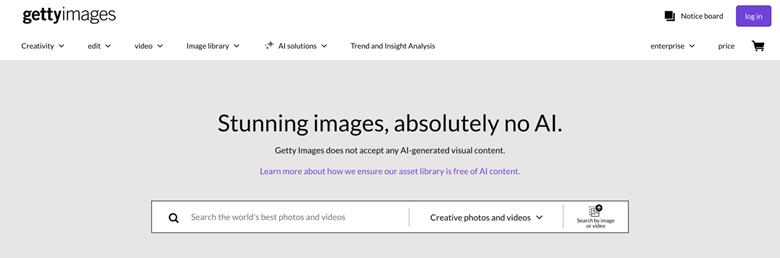
When you open the official website of Getty Images, you can see a striking slogan:
"Stunning images, absolutely no AI."
A company that made its fortune selling photos now highlights its selling point of "no AI-generated content".
The impact of AI on the traditional image library business is already easy to understand. Especially for ordinary commercial illustration materials, a large number of materials that originally required paid purchase now have cheaper alternatives to replace them.
The financial reports of Getty Images also reflect this pressure. According to its 2026 Q2 financial report, the company's revenue from creative content reached 127.4 million US dollars, down 2.6% year on year; the number of active annual subscription clients over the past 12 months dropped from 321,000 in the same period last year to 240,000, a decline of 25.2%.
Of course, the reduction in clients is not entirely caused by AI. The company's management also mentioned that factors including iStock's discontinuation of the free trial program and the drop in search traffic have also affected business performance.
Facing AI, Getty Images has not stood idle.
In January 2023, it sued generative AI company Stability AI in the UK, accusing the latter of using its images without authorization to train the Stable Diffusion model. Some AI-generated images even carry the watermarks of Getty Images or iStock.
According to Reuters, in November 2025, the High Court of Justice of the UK delivered a ruling. As it was difficult to prove that the relevant model was trained using its images in the UK, Getty Images withdrew its core copyright claim targeting the training behavior, and another copyright claim was not supported by the court. However, the court ruled that the appearance of iStock watermarks in some AI-generated images constituted trademark infringement. At present, relevant litigations between the two parties in the United States are still ongoing.
The core of the dispute lies in: what kind of authorization do AI companies need to obtain when using copyrighted images to train their models, and how should they pay the copyright owners?
Interestingly, Getty Images is doing its own AI business while filing lawsuits.
Back in