NVIDIA has invested in a chip competitor.
Over the past two years, the keywords of the AI industry have been almost entirely dominated by computing power: GPU, HBM, advanced packaging, and supernodes. But as the industry moves forward, more and more people are realizing that computing power is not an isolated island. No matter how powerful the chips are, if they cannot be interconnected, they are nothing more than expensive isolated silos.
As large models evolve from hundreds of billions of parameters to trillions of parameters, and training clusters scale from thousands of cards to tens of thousands or even hundreds of thousands of cards, network interconnection technology is shifting from a supporting back-end facility to a core variable that determines how fast an AI cluster can run and how large it can scale.
At this very juncture, a seemingly contradictory investment has drawn industry attention: Recently, a company called Upscale AI released a full-stack AI network platform named Token Fabric, which is designed to allow AI chips from different vendors to run simultaneously in a data center.
This in itself is not particularly unusual. What is surprising is that NVIDIA is prominently listed among its investors. A company that ties its accelerator cards together for sale through a full set of proprietary interconnection technologies has paid to support a business that helps customers mix and match chips from other vendors.
Why Did NVIDIA Invest in a Company That Seems to Undermine Its Own Interests?
As is widely known, almost everyone in the industry takes it for granted that NVIDIA monopolizes AI clusters with its closed NVLink + full-stack binding strategy, and never allows a multi-chip mixed-use ecosystem. However, Token Fabric is compatible with AI accelerators from different vendors including NVIDIA, AMD, Intel, and domestic Chinese AI chip makers, and NVIDIA is its core strategic investor and technology supplier.
If you look at this statement from the opposite perspective, the entire strategic logic seems to become clear at a glance: NVIDIA is well aware that the trend of multi-vendor heterogeneous computing power is unstoppable. Instead of futilely preventing customers from using chips from other vendors, it is better to ensure that it still occupies an indispensable node of the entire system when this trend lands.
Upscale AI's Token Fabric does not sell an "anti-NVIDIA" solution, but taps into the incremental market brought by heterogeneous computing power outside the NVIDIA ecosystem.
From this perspective, this may not be a compromise or internal competition for NVIDIA, but a dimensionality-raising strategic layout. A few years ago, NVIDIA acquired Mellanox for $7 billion, which bought it absolute dominance in private interconnection. Now, by investing in Upscale AI and empowering the open interconnection platform Token Fabric, NVIDIA is proactively embracing the inevitable industry trend of multi-chip mixed use, abandoning the shallow binding of single-card private links, locking in the ultimate entry of the data center cluster egress network, and achieving a new form of monopoly.
From the Acquisition of Mellanox to the Investment in Upscale: The Iteration of NVIDIA's Interconnection Hegemony
Acquiring Mellanox to Build a Core Barrier for the Integration of Computing and Networking
On March 11, 2019, NVIDIA announced the acquisition of Mellanox for $6.9 billion in cash, which was the most expensive transaction in NVIDIA's history. At that time, Intel, Microsoft, and Xilinx all participated in the bidding for Mellanox, and NVIDIA finally won the deal. In April 2020, after passing antitrust reviews in many countries around the world, the transaction was officially completed for $7 billion.
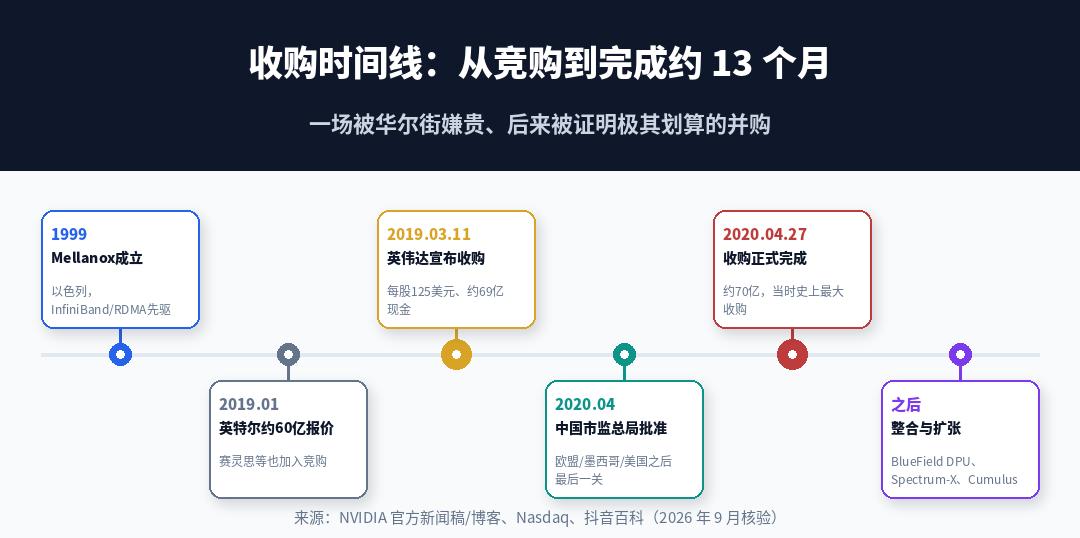
The landscape before the acquisition was very clear: NVIDIA's GPUs were rising rapidly in the AI training market, but high-speed interconnection across racks and clusters relied on third-party vendors. NVLink could only achieve high-speed connections between tightly coupled GPUs within a single rack. Once scaled out to large-scale data center clusters, the communication bottleneck was determined by external network vendors.
Mellanox held leading positions in InfiniBand, ConnectX smart network cards, BlueField DPUs, and Spectrum Ethernet switching chips, and occupied a leading position in the global supercomputing and HPC fields. More than half of the world's TOP500 supercomputers use combined solutions from the two companies. Taking InfiniBand as an example, Mellanox's InfiniBand high-speed interconnection technology holds more than 70% of the market share, with customers including Google, Amazon, and Microsoft.
Through this acquisition, NVIDIA opened up the full private link covering NVLink (on-board scale-up) + InfiniBand/Spectrum (cluster scale-out). Jensen Huang said at the time: "By integrating Mellanox's technologies, the new NVIDIA will have end-to-end technologies from AI computing to networking, as well as full-stack products from processors to software."
The essence of this stage is a fully closed binding system: customers must purchase a full set of NVIDIA GPUs and network equipment for their clusters, which delivers extreme performance but zero compatibility, leaving customers with no alternative options and extremely low bargaining power.
This model brought huge early dividends during the outbreak of large models, but its bottlenecks gradually emerged. With the continuous development of domestic AI chips, the continuous breakthroughs of AMD and Intel, the outbreak of cloud vendors' self-developed chips, and the shortage of production capacity and delivery cycles caused by the explosion of AI computing power demand, single-vendor capacity shortages and unstable delivery cycles have led to a rapid increase in customer demand for heterogeneous computing power clusters. Multi-chip mixed deployment has gradually become a rigid demand for cloud vendors, and the full-stack binding model of a closed ecosystem is increasingly unable to meet the demands of industry customers.
Token Fabric Opens a New Paradigm for Interconnection
Against this trend, NVIDIA's strategic thinking is undergoing a fundamental upgrade. It no longer tries to prevent competitors from entering the market, but shifts to controlling the underlying circulation channels for heterogeneous computing power.
The logic of acquiring Mellanox is exclusive monopoly through self-operation and full profit capture. The logic of investing in Upscale AI is to let all participants join the market while it controls the channels and captures the incremental market, that is, to recognize the inevitability of multi-chip mixed use in the industry, abandon the shallow exclusive lock on the scale-up tightly coupled link, and instead compete for the discourse power of the scale-out backbone network for the outward expansion of heterogeneous clusters.
NVIDIA's moat has been upgraded from GPU hardware + private interconnection protocols to standard network infrastructure for AI data centers. No matter which vendor's AI chips customers access, the backbone networks across racks and data centers still have the opportunity to run on NVIDIA's Spectrum-X foundation.
It is worth noting that NVIDIA also launched NVLink Fusion in May 2025, opening NVLink IP licensing to third parties for the first time, allowing non-NVIDIA CPUs, ASICs or accelerators to be deeply integrated with NVIDIA GPUs.
This series of moves and layouts by NVIDIA shows that its operations are not isolated investment behaviors, but a systematic strategic shift.
What Exactly Is the Token Fabric Layered Architecture?
To understand the Upscale AI platform, we first need to distinguish two completely different layers of networks in AI clusters, commonly known as scale-up and scale-out in the industry.
Scale-up (intra-rack tightly coupled layer): Connects a group of accelerators closely into a unified computing entity. Its bandwidth and latency directly determine the training efficiency of large models, and low-latency, high-determinism direct memory access between chips is required.
Scale-out (cross-cluster loosely coupled layer): Reconnects multiple scale-up completed computing pods to achieve ultra-large-scale expansion across racks and computer rooms, determining the upper limit of cluster scaling.
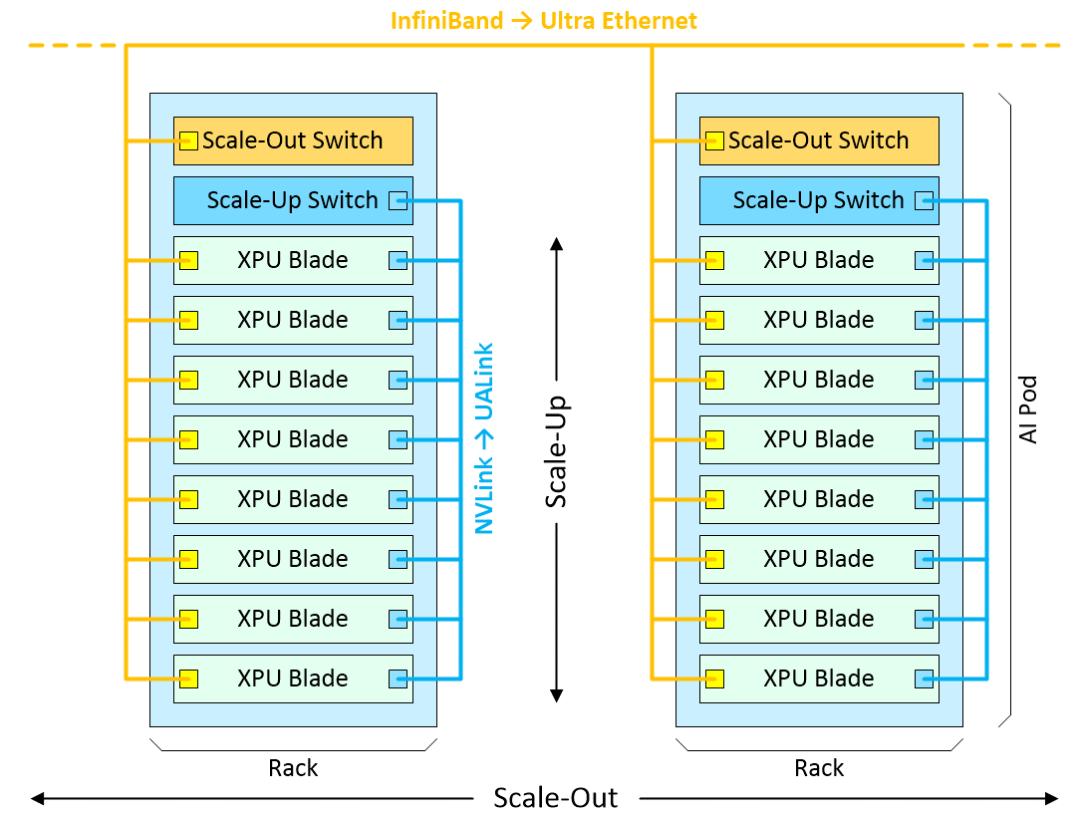
In traditional solutions, the two layers of networks are usually delivered as a package by the same vendor. If a customer wants to change the accelerator vendor, it often means that the entire network architecture, switches, and network cards need to be completely rebuilt, resulting in extremely high engineering transformation costs.
Upscale AI's idea is to divide and conquer.
The scale-up intra-rack layer of Token Fabric uses Upscale's self-developed SkyFabriX switching chip, supports two open interconnection standards, UALink and ESUN, and allows GPUs, various custom accelerators, and third-party network cards to access, forming an open entry.
The scale-out cross-cluster outward expansion backbone layer is directly built based on NVIDIA's Spectrum-X Ethernet technology. Spectrum-X is an Ethernet platform designed by NVIDIA specifically for AI workloads, covering 400G/800G/1.6T high-speed ports. Compared with traditional commercial Ethernet, it delivers 1.6 times higher AI network performance, integrates Spectrum switching chips and SuperNIC, has built-in congestion control and collective communication optimization capabilities for large model communications, supports RoCE expansion and adaptive routing, and adapts to ultra-large-scale AI cluster expansion.
At the software level, Token Fabric is equipped with the SkyOS network operating system and the SkyCMD operation and maintenance system, which are responsible for identifying full-network bottlenecks, warning of component health status, and scheduling cluster traffic. The entire set of components is packaged as Token Fabric. What customers get is no longer scattered switching hardware, but a two-layer interconnected, software-hardware integrated heterogeneous computing power network.
This is the core contradiction of the entire solution: the access layer is open, and heterogeneous chips such as GPUs and custom accelerators can be freely accessed; the technical foundation of the outward expansion egress backbone is in the hands of NVIDIA. Opening the entry while locking the exit is the key to understanding the entire business model, and also the starting point of subsequent industrial disputes.
A Win-Win Situation for Upscale and NVIDIA?
At the standard level, Token Fabric supports both UALink and ESUN technical routes at the same time.
UALink (Ultra Accelerator Link) is an accelerator interconnection specification promoted by an industry open alliance. Its members include AMD, Intel, Google, Meta, Microsoft, AWS, Alibaba and other companies. By mid-2026, the number of alliance members has exceeded 115, and its original intention is to hedge against private closed interconnection solutions such as NVLink. UALink is natively oriented to in-rack tightly coupled AI clusters, supports direct video memory access between accelerators, and achieves lossless low-latency transmission at the hardware level. ESUN is an extension of Ethernet in the scale-up scenario.
Upscale AI's compatibility with both standards at the same time may indicate that it is not sure which route will succeed, so it does not bet on the victory or defeat of a single technical route. At present, the open interconnection standards have not yet been finalized. Dual-track layout can maximize the coverage of access requirements for different customers and different chips.
NVIDIA's role in it is quite subtle. On the one hand, the very existence of the UALink alliance is a direct challenge to NVIDIA's private NVLink ecosystem. On the other hand, NVIDIA is deeply bound to the open Ethernet system through Spectrum-X, leveraging industry open standards to dilute the impact of the UALink alliance on its private ecosystem. In response to this, NVIDIA has invested 2 billion US dollars to take a stake in Marvell, turning potential competitors into partners, and further strengthening its discourse power in the open Ethernet ecosystem.
It is understood that the product delivery schedule of the Upscale AI solution has been announced to the public: the first phase of Token Fabric will be released in the fourth quarter of 2026, prioritizing the solution of cross-data center and multi-pod computing interconnection; the complete platform will be implemented in phases in 2027. This progress is faster than many industry analysts expected, which means that the verification cycle in real production environments will be greatly shortened.
Whether this solution is a truly neutral open infrastructure or a lock-in in another form, there is a relatively clear verification standard in the industry: if the scale-out layer of Token Fabric in the future can be compatible with high-speed Ethernet solutions from other vendors besides Spectrum-X, then it is a truly neutral heterogeneous network platform; if after the complete platform is launched in 2027, cross-cluster scale-out still can only rely on Spectrum-X, then it only solves the problem that cards from different vendors can be mixed, but does not realize multi-vendor options for the cluster backbone network, and the network ecosystem is still monopolized by NVIDIA.
The current openness of Token Fabric only opens up the access right of computing power, not the circulation right of clusters, which means that NVIDIA still firmly controls the external export of heterogeneous computing power.
Who Needs Token Fabric?
Upscale AI has a clear positioning for its target customers: large public cloud service providers, and emerging computing power cloud vendors. These two types of customers are facing the same practical dilemma: the growth rate of AI computing power demand far exceeds expectations, and the production capacity and delivery cycle of a single chip supplier cannot meet business expansion, and long-term single-source procurement will also weaken procurement bargaining power.
For traditional large cloud vendors, the core demand for heterogeneous computing power is to disperse supply chain risks, carry out multi-vendor parallel procurement, and ensure the schedule of computing power expansion. The pressure on new computing power cloud vendors is even more acute: they undertake a large number of short-cycle, large-volume computing power leasing businesses, and the delivery time is directly written into commercial contracts, but the supply of goods depends on the spot market and allocated quotas.
In this business scenario, whether it is possible to quickly gather hundreds of accelerator cards of different brands within two months is more important than a few percentage points of improvement in single-card performance. If you can use cards from multiple suppliers at the same time, you will have an extra way out in project scheduling. The value of heterogeneous interconnection is essentially to disperse supply risks and ensure delivery certainty.
However, the fact that hardware can be mixed and deployed does not mean that clusters can work together efficiently. Between procurement willingness and engineering implementation, there are three hard industry barriers.
Differences in memory architecture: The video memory organization and memory access models of various AI accelerators are completely different. Simple physical line interconnection cannot achieve unified memory scheduling.
Fragmented software stacks: Model parallel strategies, collective communication libraries, and compilation toolchains are independent ecosystems of each vendor. Replacing chips often requires rewriting a large number of scheduling logic.
Differences in communication semantics: Many vendors have done private communication optimization inside the hardware. Once mixed networking across vendors is carried out, these hardware acceleration features will fail, the communication link will degenerate to the general path, and the performance will drop significantly.
In response to this, Upscale AI stated that the Token Fabric network platform can eliminate some of the underlying hardware interconnection barriers, but a large amount of work on the software stack, model adaptation, and scheduling layer still needs to be completed by customers themselves. It can open up network paths, but will not erase the huge gap between chip architectures and software ecosystems.
This statement is not a marketing promise, but an industrial reality — it clearly leaves the most difficult part to customers. The core value of Token Fabric is to solve the rigid demand for interconnection at the physical layer and network layer, lower the threshold for building heterogeneous clusters, but cannot completely solve the adaptation problems caused by differences in software stacks and architectures, and the industry still needs long-term ecological running-in.
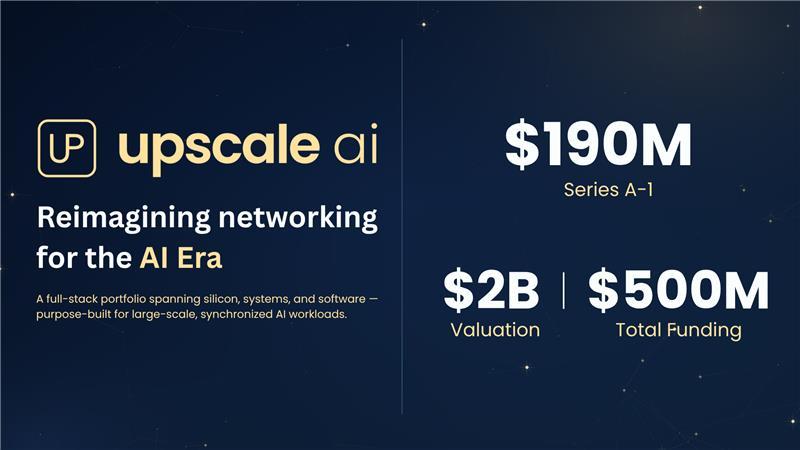
In June 2026, Upscale AI completed a $190 million additional financing, led by Premji Invest, with participation from NVIDIA, Temasek, and Salesforce, bringing its total financing to $500 million and a company valuation of $2 billion.
Barun Kar, CEO of Upscale AI, said in an interview that Token Fabric is expected to achieve tens of millions of dollars in revenue in 2027, and is expected to grow to hundreds of millions of dollars in the long term. For a start-up company that is still in the product implementation stage, this revenue expectation is relatively modest.
This strategic investment, together with the $7 billion acquisition of Mellanox back then, represents two completely different capital strategies.
The acquisition of Mellanox is a heavy-asset merger and acquisition, which directly buys the entire team, IP, and products, takes over the high-speed interconnection business in an all-round way, and builds a closed self-owned ecosystem. In contrast, investing in Upscale is a light-asset strategic positioning, which does not require large-scale R&D and manufacturing investment, and uses the innovative solutions of start-ups to lay out the heterogeneous computing power track in advance.
NVIDIA's underlying