Sam's Club, Freshippo and other retailers have been churning out a steady stream of hit products, and they have begun to gain the dominant say in product innovation.
On October 11, Walmart's new-generation store at KK ONE in Futian, Shenzhen opened to the public. Customers queued up to enter, and the store was extremely popular. This is Walmart's third new store format launched within a month.
The store focuses on its private brand Great Value Fresh, and launched the "Seasonal Delicacy × Osmanthus Season" series in autumn, which is another seasonal new product launch following matcha, durian-mango, and grape flavors. The gastrodia elata stewed pigeon flavored potato chips and the boletus luridus beef flavored potato chips on the shelves are flavors defined by the retail channel itself...
At the same time, the Nanjing Autumn Sugar Fair was held, but we heard many participating distributors feedback that there are almost no exciting product innovations.
"This time I went to the Autumn Sugar Fair, I didn't sign any new product. In previous years, I could at least bring some products back to the meeting to discuss whether it is worth promoting."
On one hand, the channel's own products are sought after by queuing consumers; on the other hand, the manufacturers' new product promotion events are bleak.
Such a contrast sends an extremely important signal to the market that the dominant player in mainstream innovation of FMCG products has changed.
Products developed by retail channels are driving the popularity of various categories
This judgment can be clearly seen from the real cases that have happened in the past two years with a few simple examples.
The first example is Sam's Club's dried apple. Apple, as the most common and ordinary fruit, is dried into the simplest dried apple, but it has become a bestseller at Sam's Club.
There is no complicated reason, just that the product has an attractive appearance and high quality, which meets consumers' more extreme pursuit of a "clean ingredient list".
After driving the popularity of the dried apple category, it even triggered imitation across the whole market. Yonghui, Metro, 7Fresh, Bestore, Liuliumei... retailers and manufacturers are all launching dried apple products.
The effect is directly reflected in the data: according to the data from Magic Mirror Insight, in 2025, the total online sales of the preserved apple category reached 317 million yuan, a year-on-year increase of 162.51%.
The second example is Hema's HPP red-flesh apple juice. Due to the inherent characteristics of red-flesh apples, namely "fibrous flesh and high acidity", it is difficult for consumers to truly love them. However, by applying HPP technology and blending with Fuji apples, the juice presents a unique flavor that other apple juices cannot match.
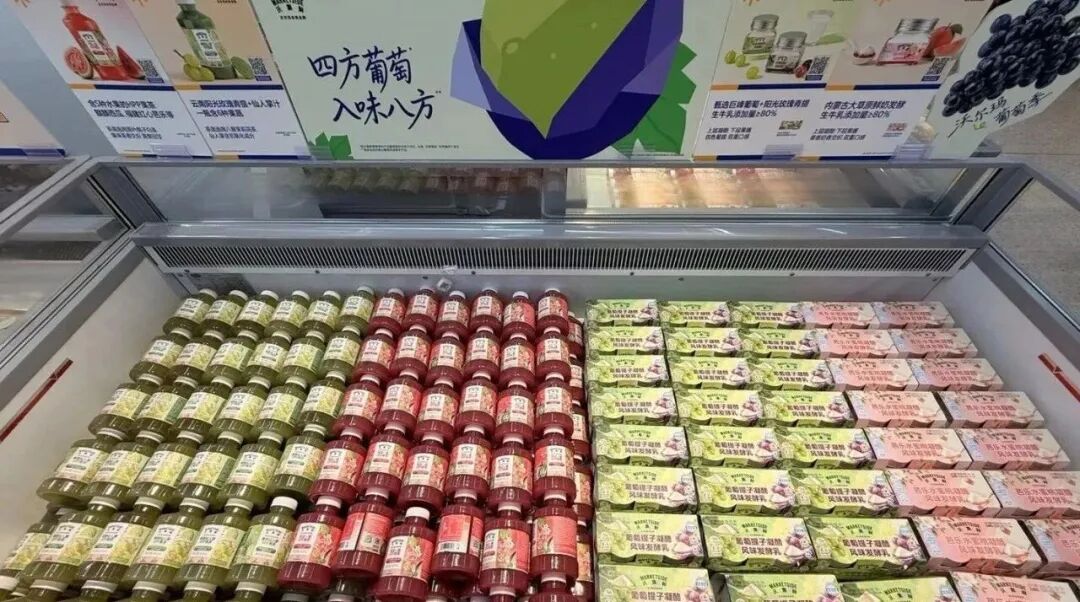
Through the use of new technology, it perfectly meets consumers' preference for sweet and sour palatable juice, thus driving continuous repurchase.
After the HPP red-flesh apple juice became popular, it promoted the popularity of HPP technology, and further drove the prosperity of the juice category, which led to a series of other hit juices in the market later.
The above two products are just examples, not isolated cases, but relatively typical representatives: It is no longer factories and brands that define products, but the link closest to consumers.
Retail channels are grasping the discourse power of market product innovation, which is an inevitable result of the development of FMCG industry to a certain stage.
Why did the innovation right transfer from brand owners to retail channels?
Why did this happen? If we look back three years ago, the context is very clear, which can be summarized into three events.
The first event is that retail channels have completely reconstructed the circulation efficiency.
In the past, FMCG products had to go through brand manufacturers, first-level agents, second-level agents, and then to terminals to reach consumers, with layers of price increase and layers of turnover.
However, in the past three years, bulk snack stores have directly adopted large-scale centralized procurement between channels and manufacturers; member supermarkets (even discount supermarkets) skip brands and find factories to do ODM by themselves; instant retail either requires manufacturers to operate directly or seek centralized cooperation with service providers... to reduce intermediate links and cut the cost of turnover waste.
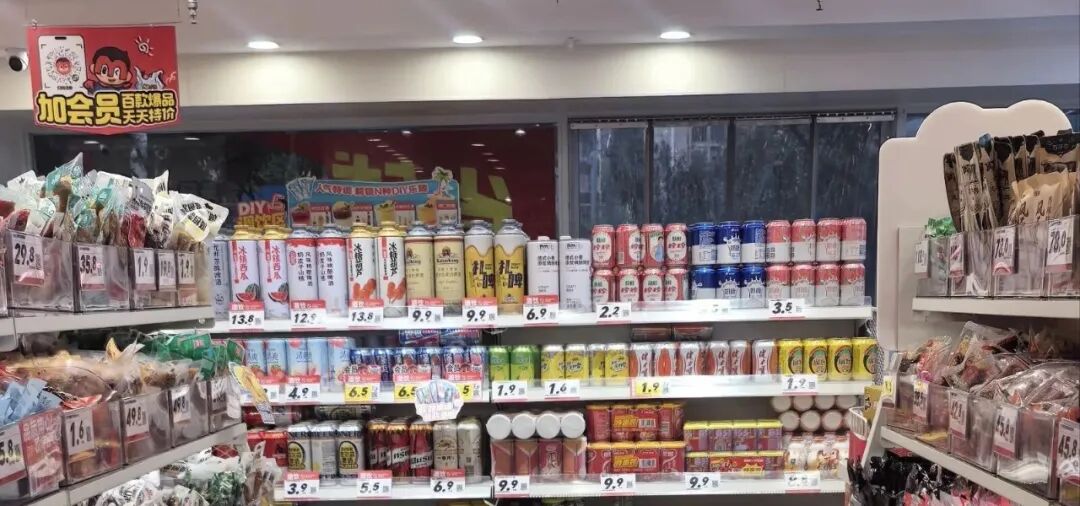
Of course, the game process between manufacturers and channels is complicated, but the result is that "new retail" such as snack stores, discount stores, member supermarkets and even instant retail are growing rapidly against the trend in the current economic cycle, attracting a large number of consumers from traditional retail channels.
The effect is also very ideal. The efficiency reconstruction has lowered the average gross profit margin of products.
Under such a trend, manufacturers actually have no choice. In order to maintain their brand's dominance at the terminal, they can only be forced to cut prices to maintain sales.
The second event is that after the gross profit margin is compressed, brand companies begin to lose their vitality in product innovation.
Innovation costs money, requires trial and error, and takes time, which is based on a premise: there is enough gross profit margin to support the trial-and-error cost, and a long enough product life cycle to recover the R&D investment.
When the gross profit margin is compressed to a sufficiently low level, and new products have to be taken off shelves if they do not generate sales within three to five months after being launched, the most rational choice for brand companies is no longer to stick to strategic determination and bet on an innovation that will take effect three years later, but to invest resources in channels and promotion expenses that can immediately bring sales under the pressure of sales.
On one hand, there is no money and patience to do innovation; on the other hand, a large amount of production capacity is idle. Some manufacturers frankly communicated with us that considering equipment depreciation and loan interest, a new factory generally needs a gross profit margin of more than 15% to operate normally, but in the past two years, even with a gross profit margin of less than 10%, some factories are willing to take orders from retailers.
This is only because if the capacity utilization rate does not reach the critical point, the loss of maintaining factory operation will be greater. This dilemma has a direct and significant negative impact on manufacturers' innovation.
The third event is that retail channels, relying on the improvement of operational efficiency, attach importance to private brands and take over the discourse power of product innovation!
Retail channels have something that brand companies cannot obtain: millions of transaction data every day, repurchase records of members, instant feedback of in-store taste tests, and the most direct one - consumers' three-second choice when standing in front of the shelf.
In the past, retail channels only told suppliers what goods to purchase, but now they begin to use such data to tell factories what products to produce.
Hema's buyer system combined with data-driven operation, Sam's Club's reverse customization based on member demands, and Walmart's seasonal development system for production scheduling according to solar terms are essentially the same thing: taking consumers' demands as the starting point to put forward product definitions to the upstream.
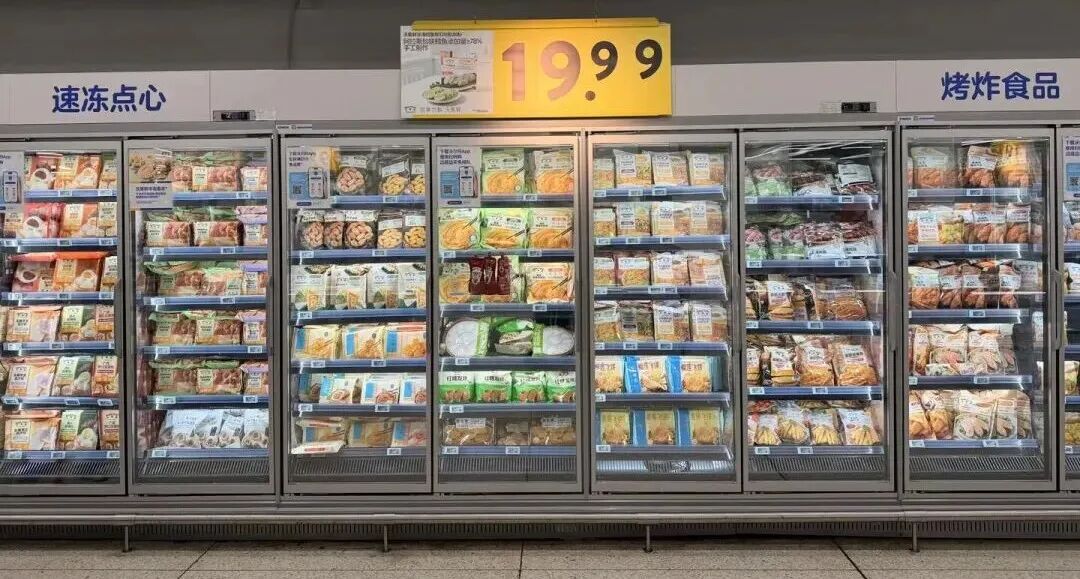
Moreover, a large number of practices have proved that this set of methods is more efficient. Without the historical burden of brand premium and the path dependence of the dealer network, the cycle from proposing a new product to putting it on the shelf is much shorter than that of brand companies; if the product sells well, the order will be increased, if not, it will be taken off the shelf, and the trial-and-error cost is borne by the channel itself.
Thus, the division of labor has been rewritten: in the past decades, enterprises were responsible for R&D and branding, while retailers only provided shelves to deliver products to consumers; now retailers design products by themselves, manufacturers are reduced to earning processing fees, and the role of brand companies as "product innovator" is being replaced.
In other words, it is the rise of private brands, which is also the development result after channels take the dominant power of product innovation.
There is nothing new under the sun. This is not a special case in the Chinese market, but an inevitable mature stage that the FMCG market will experience after developing to a certain level.
In 2025, private label sales accounted for 38.8% of the 17 major markets in Europe, with Germany, the United Kingdom and France totaling more than 40%, and Switzerland even exceeding 52%.
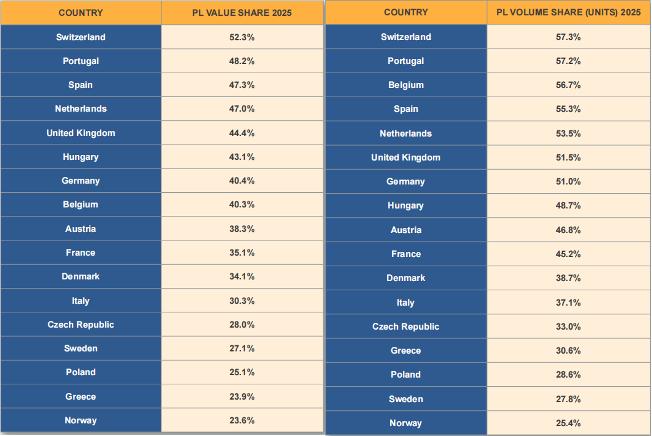
The market share of private label sales volume and quantity in 17 European countries in 2025, excerpted from PLMA's "2026 European Private Label Status Report"
Therefore, the desertedness of the Autumn Sugar Fair is not a problem of a single exhibition, nor a problem of consumer willingness. It is a signal: when the channel completes the efficiency reconstruction, it will naturally use the products defined by itself to answer what consumers really want.
Final Notes
For brand owners and distributors, accepting this reality is more important than complaining about channels.
The most important thing at present is to accept the reality, understand the development trend and rules, and find a way out.
There are three paths: make products with differentiation that channels cannot replicate, so that consumers have no choice but you; or put down your pride, become an ODM supplier of channels, and use production capacity and R&D to undertake certain orders; or avoid head-on competition, and target niche crowds and scenarios that channels cannot take into account.
The Sugar & Wine Fair will continue to be held year after year, but its role as a "new product launch site" is probably gone forever.
This article is from the WeChat official account "New Distribution", author: Zhang Zhenyu, published with authorization from 36Kr.