Are overseas short drama apps getting no returns at all even after burning huge amounts of money?
When the news of the merger between DramaBox and GoodShort broke out, the vast majority of people in the overseas short drama industry breathed a sigh of relief.
Both of the two platforms rank among the top 5 in overseas revenue lists. In the past, they bid for the same batches of ad slots, driving up each other's customer acquisition costs. After the merger, at least this part of the cost can be saved.
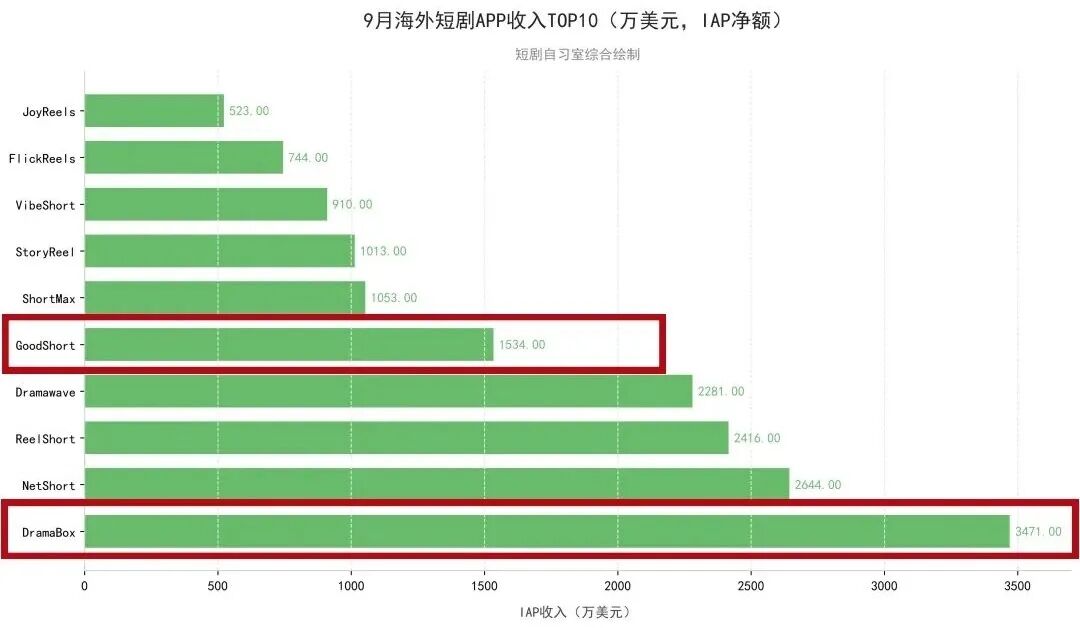
However, Chen Ruiqing, Chairman of Dianzhong Technology, holds a different view.
After the merger, he serves as Chairman, while Hu Zexin, founder of GoodShort and former CTO of Dianzhong, takes the position of CEO. He said in an interview with GrowData: "Even if I don't compete with him, I still have to compete with others, there is no difference at all."In his opinion, the investment after the merger will only increase.
These remarks are frank enough. Even after the top-grossing platform merges the 5th-ranked player, it still dares not cut back on marketing spending.
In the past three years, the short drama overseas business has been pretty straightforward.
They adapt online novels into vertical-screen dramas, purchase massive traffic on Meta and TikTok to drive users to their apps, and set up paywalls at the most cliffhanging points of the plots.
In the past, the growth trajectory between ad spending and revenue was at least a straight line. ReelShort achieved this exactly, boosting its revenue from less than 100 million USD to 785 million USD within two years.
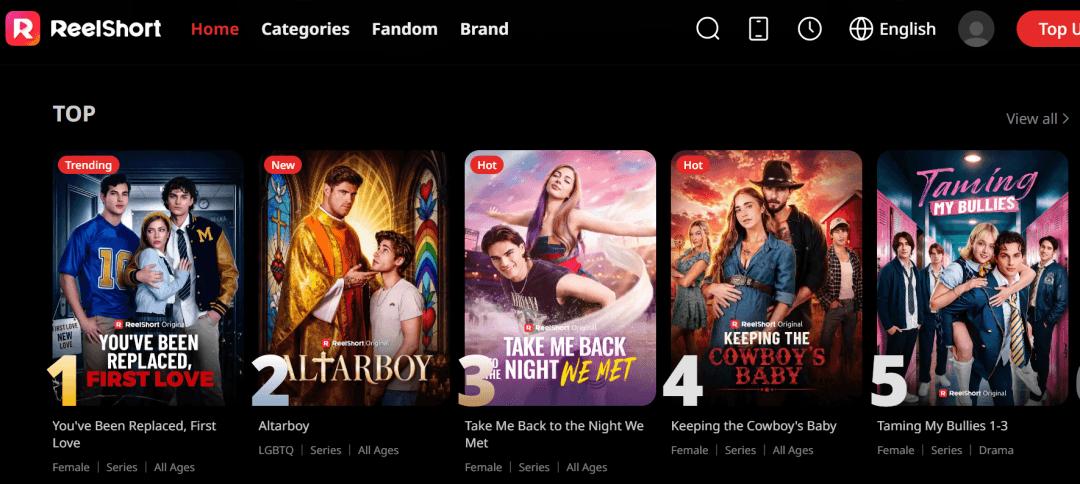
As more and more people see this growth path, more and more companies are flocking into this track.
Statistics show that by this year, there are nearly 300 overseas short drama apps, and apart from the top 5 players, the rest are all competing for the same group of users.
But when ad spending can no longer bring corresponding revenue growth, and the narrative's boost to stock prices has exceeded the threshold, all parties obviously have to start looking for their own way out.
01、More and more investment can no longer bring more revenue
The most obvious change is that user growth is no longer synchronized with revenue growth.
Data from Sensor Tower shows that in the first quarter of this year, the total download volume of global short drama apps increased by 140%, while in-app purchase revenue only increased by 20%.
This shows that massive ad spending can still bring in users, but cannot generate much revenue.
For users of ReelShort and DramaBox, only about 2% of them are still active 30 days after installation.
After watching several free episodes, most users leave as soon as the paywall pops up.
This is actually a well-known issue. The pricing design of many short drama apps going overseas looks like a one-off deal most of the time.
The annual pass of ReelShort is priced at 199.99 USD, which is only slightly cheaper than the standard plan of Netflix in some markets. A vertical-screen drama with episodes of 1-2 minutes each and rough production is priced close to the subscription fee of long video platforms. It can trigger impulsive consumption, but it is very difficult to get users to renew subscriptions in the long run.
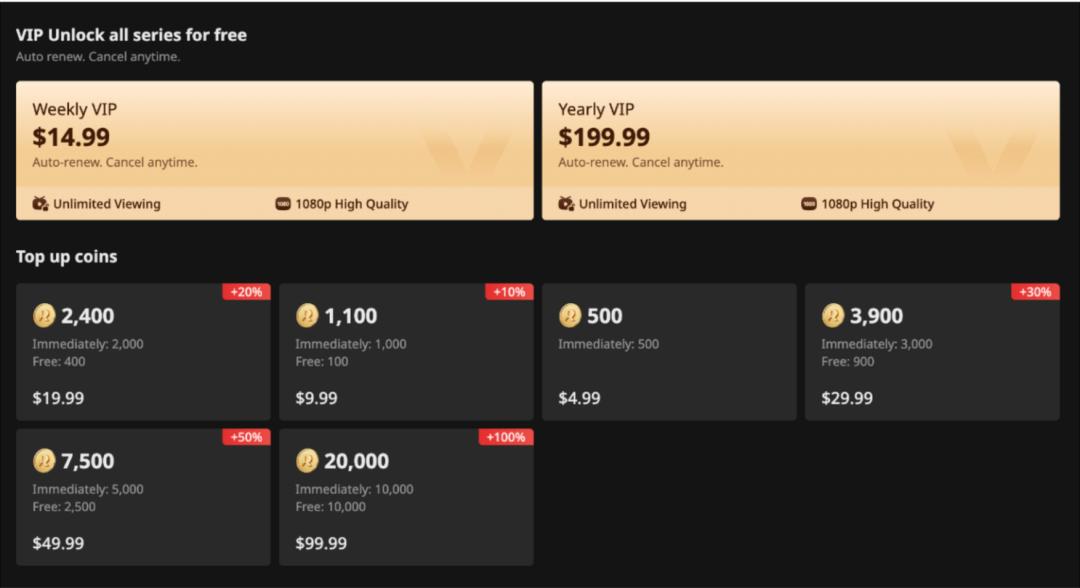
ReelShort's In-App Purchase (IAP)
What's more troublesome is that users barely have any loyalty to the platforms themselves. Audiences follow a specific drama, and they leave once they finish watching it.
The interfaces, payment rhythm and themes of different apps are almost the same. From dominant CEO, revenge, werewolf to the current AI-generated dramas, users can hardly tell the difference after switching platforms.
Every time a platform launches a new drama, it has to spend money again to acquire users for it.
What ad spending buys is only the viewing duration of a single drama.
AI has brought down the production cost, but it obviously cannot reduce the user acquisition cost on traffic channels.
Every company can produce more dramas and edit more ad materials in a single day, but the total number of ad slots is limited. The more materials there are, the fiercer the bidding competition will be. Most of the saved production cost ends up flowing into the accounts of Meta, Google and TikTok.
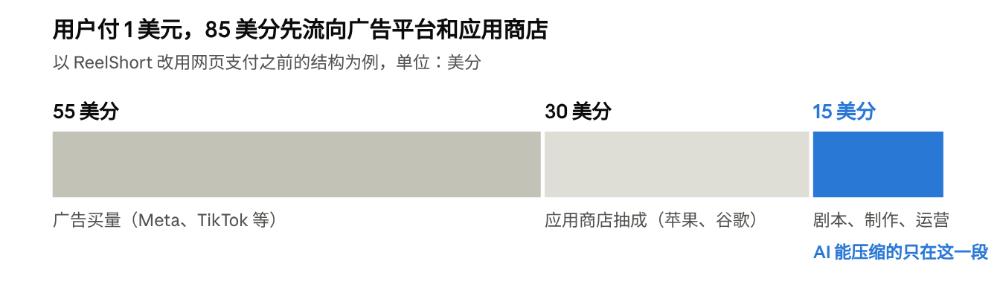
Source: DataEye
As the user acquisition cost in the US keeps rising, companies start shifting their budgets to India, Indonesia and Brazil. Users in these markets are cheaper and the download volume grows fast, but far fewer of them are willing to pay. The download figures on the ranking lists look good, but the actual revenue on the books does not increase accordingly.
Kunlun Wanwei's AI short drama revenue increased by 1.6 times in the first half of this year, but its promotion cost grew even faster, and the company still recorded a loss after non-recurring gains and losses were deducted.
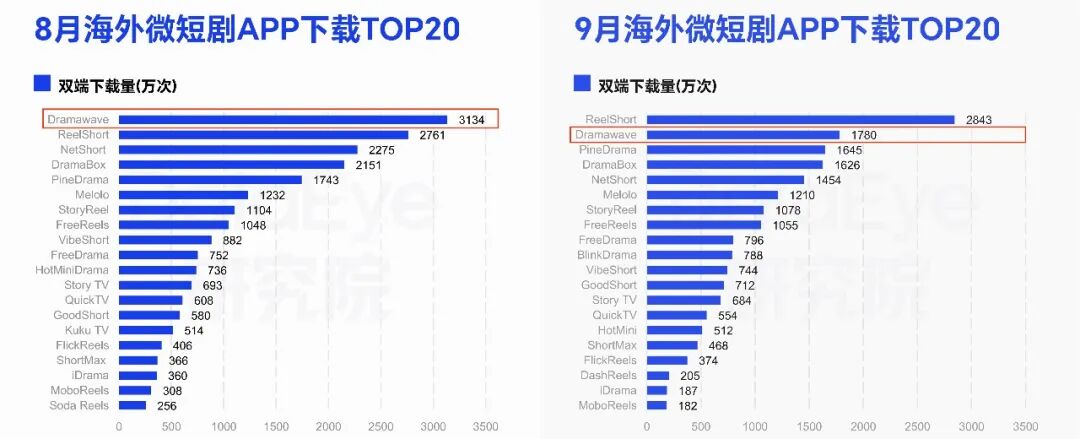
A set of data from September can well illustrate this situation.
DramaWave's download volume decreased by more than 40% that month, but its revenue only dropped by 6.56%. It cut nearly half of its ad spending, while its total revenue barely changed, indicating that those lost users were never willing to pay much in the first place.
Source: DataEye
The marginal return of burning money has dropped to such a low level, and continuing to spend is mostly to maintain the position on the ranking list.
No one dares to be the first to stop.
Domestic short drama businesses went through the exact same path several years ago.
Ad spending ate up most of the revenue from top-ups. Platforms and production teams worked hard for a whole year, but most of their profits went to the traffic platforms.
It was the free model of RedVideo that rewrote the rules in the end, and now this biggest variable has also appeared in the overseas market.
02、Top players huddle together for fear that ByteDance will enter the track
Some companies have started to stop and calculate their accounts.
Chinese Online spent heavily on overseas ad spending last year, its sales expenses doubled, and it recorded a full-year loss.
In the first half of this year, it cut down its sales expenses, achieved profitability in the second quarter, and its overseas platform FlareFlow also turned from huge loss to profit.
Mapleleaf Interactive, the company behind ReelShort, also turned a profit in the first quarter.
But the profit gained by cutting spending is very thin, and the net profit margin of top platforms is only around 3%. The cost is also obvious: the revenue of Chinese Online in the second quarter dropped by 17% year on year.
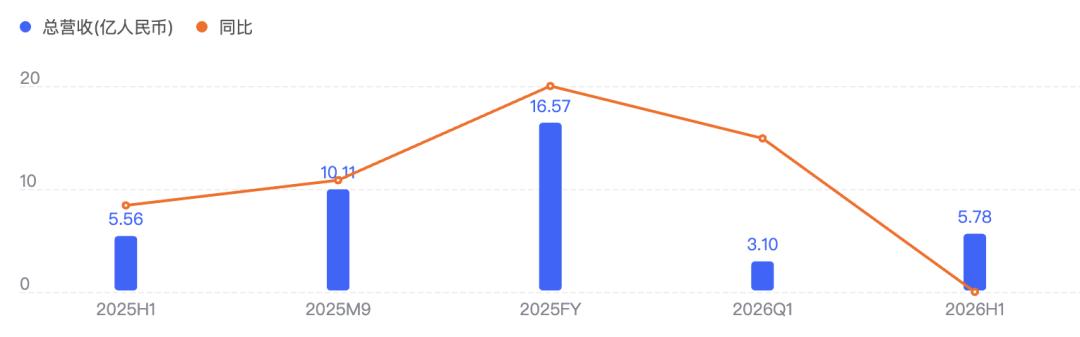
Total revenue trend of Chinese Online
Less ad spending means less growth, which is an unavoidable dilemma for paid short drama platforms.
That's probably why Chen Ruiqing said he dared not cut investment.
From this perspective, the merger of DramaBox and GoodShort is a defensive move. Neither of the two plans to stop, so they can only expand the scale, share content, IP and AI tools, and use a larger scale to resist the same ad spending pressure.
In the past two years, every time a Hollywood company signs a cooperation agreement with a short drama platform, there will be a wave of reports and narratives in China claiming that "Hollywood is betting heavily on Chinese short dramas".
It is also common to see industry insiders state in public that Hollywood and Silicon Valley are entering the track, and short dramas will usher in new capital and a larger stage.
Looking back over the whole year, such remarks are either exaggerated or completely unsubstantiated.
Disney gave DramaBox an undisclosed amount of investment through its accelerator program, launched vertical-screen information feed in Disney+, and tried to shoot a vertical-screen drama with more than ten episodes.
Peacock bought more than a dozen dramas from ReelShort and put them on the mobile end as a test.
The vertical-screen function of Netflix only cuts clips from its own existing dramas.
Google announced that it would develop dozens of short drama projects, but never disclosed the budget.
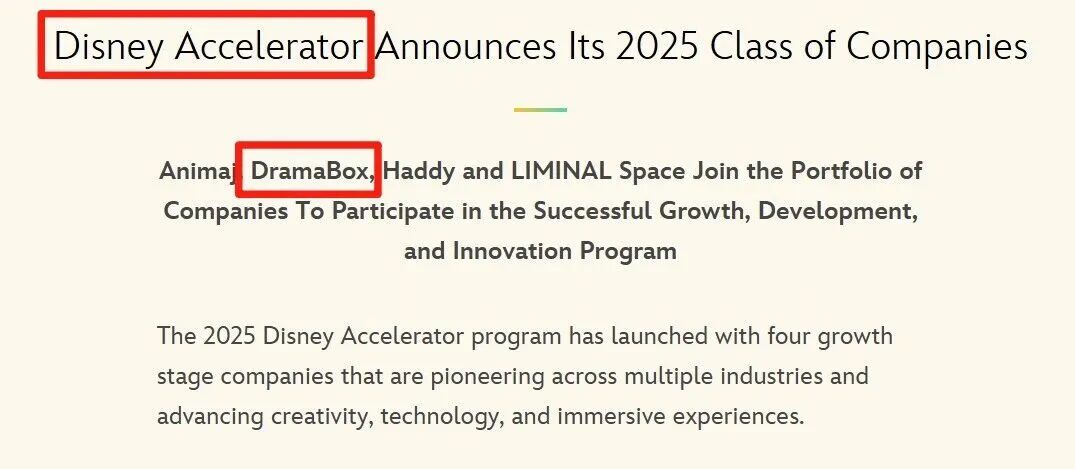
Source: Disney Accelerator official website
At present, the only player that is seen to have made real substantial investment is probably Fox.
It took a stake in the short drama platform Holywater and promised to produce more than 200 vertical-screen dramas within two years, but the amount of the equity investment was also not disclosed.
The common point of these moves is to buy an observation seat at a very small cost. Vertical-screen content can divert traffic to long videos and test the preferences of young audiences, but no giant is willing to bet heavily on short dramas themselves for now.
At present, for American streaming media giants or film and television companies, the threat brought by short dramas is obviously not as obvious as that brought by short videos before. What's more, even the growth of TikTok itself has hit a ceiling.
It can be said that at the moment, the only company that is really investing heavily in short drama overseas business is ByteDance.
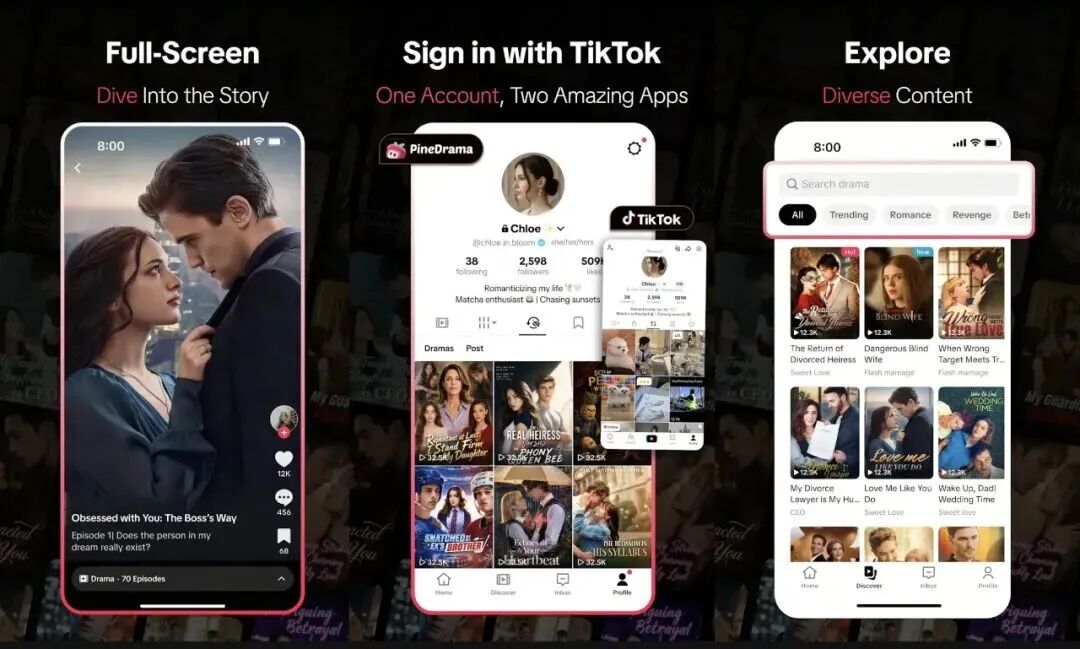
In January this year, TikTok officially launched the independent short drama app PineDrama. The industry generally regards it as the overseas version of "RedVideo": TikTok is responsible for distribution, PineDrama is responsible for viewing, all dramas are free, and users can unlock episodes by watching ads.
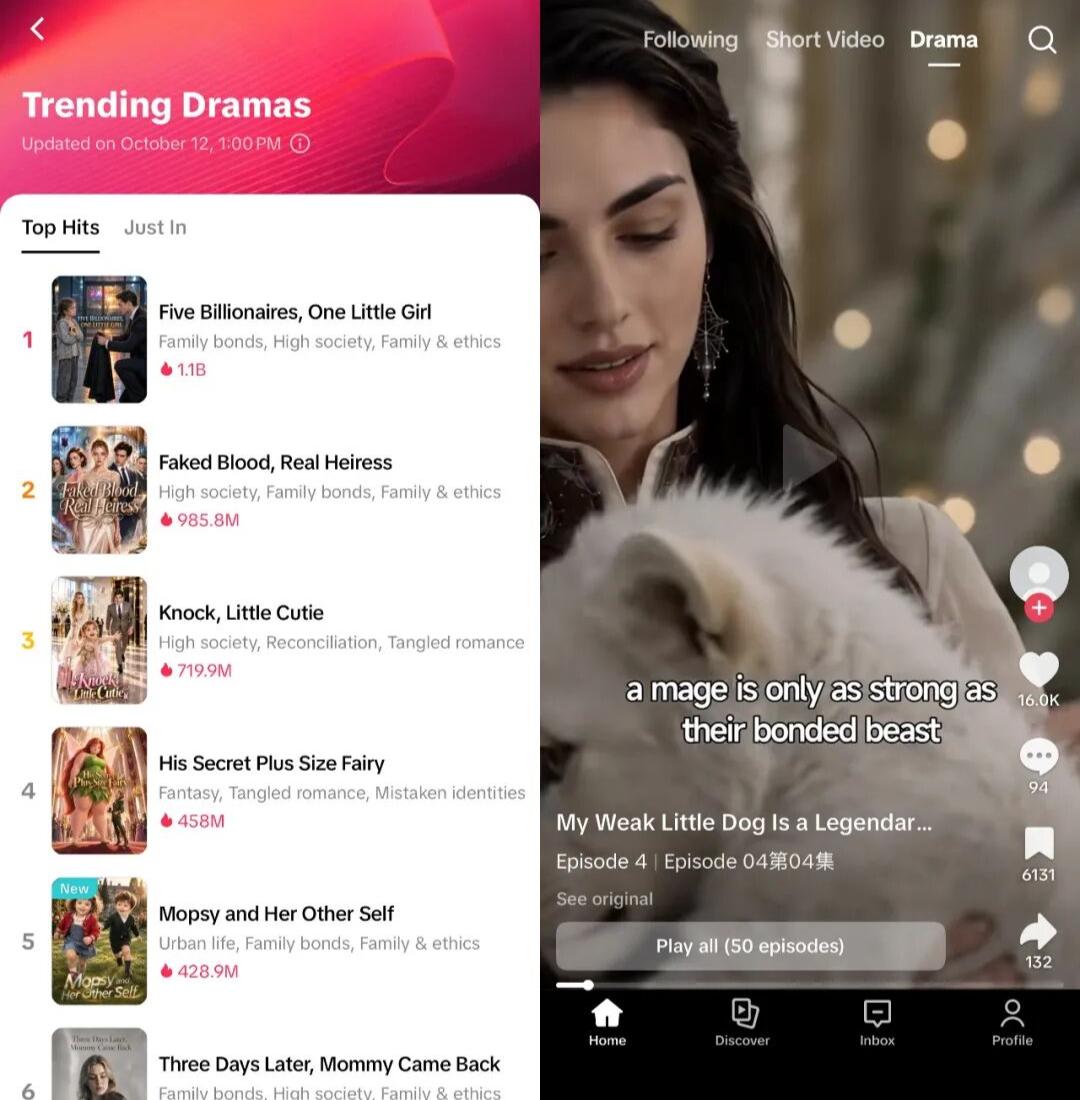
Screenshot of PineDrama
Nine months after its launch, according to the latest statistical data, PineDrama's download volume has exceeded 100 million, with about 7 million daily active users, and it has surpassed ReelShort in Brazil.
This may be the real competition that all domestic short drama platforms going overseas have to face. RedVideo has proved this in China: after the free model is popularized, users will hardly be willing to pay for short dramas any more, and paid platforms have to tear down their paywalls and turn to the advertising model.
ByteDance's advantage lies in cost in the first place.
For DramaBox and ReelShort, they have to pay to ad platforms including TikTok every time they acquire a new user. PineDrama's traffic comes from its own platform, so it doesn't need to spend extra money on that.
For ByteDance, whether PineDrama makes a profit in the short term is not that important. It is first and foremost an extension of TikTok, which can keep users who are scrolling short videos staying in its own ecosystem for a longer time. Paid platforms do not have such leeway, every penny of their ad spending has to be recovered within a few months.
However, it is still too early to draw a conclusion on whether ByteDance can replicate the success of RedVideo overseas.
RedVideo has 168 million daily active users in China, and users spend an average of two hours on it every day. In the US, users of ReelShort only spend more than half an hour on the app every day. Part of the gap comes from the product and model, and the other part probably comes from the market itself.
The reason why short dramas can spread rapidly in China is that they are free and low-threshold, filling the fragmented time of a large number of users. Free short dramas win first at the price, and then retain users with massive content.
When it goes overseas, the advantage of being free still exists, but the advantage of content is no longer that obvious.
Compared with Chinese content consumers, audiences in the US, Europe, Japan, South Korea and even Southeast Asia have far more choices, and the content quality they get for the same amount of money is also higher.
Users can watch Netflix and HBO by paying a dozen dollars a month, and free YouTube and TikTok also provide abundant content, not to mention a large amount of sports content to consume. In such a market, it is