80% Awaiting Exit: What Has Become of the 1163 Market-Oriented FOFs?
In the past two years, a clear trend in the primary market is the "direct investment orientation": many LPs have begun to emphasize their direct investment capabilities, and government investment funds are also increasing the proportion of direct investment. This poses a very practical problem for funds of funds (FoFs), especially market-oriented FoFs: if LPs are more willing to make direct investments on their own, can FoFs still raise money? How are they investing and exiting on their own?
With these questions, we compiled a set of data: as of September 20, 2026, there are 1163 market-oriented FoFs recorded in CVSource by ChinaVenture Jiachuan. Through data analysis of this batch of funds, we have observed three noteworthy conclusions.
The first conclusion is that the "long-term capital attribute" of FoFs is continuously strengthening. The agreed duration of market-oriented FoFs is mainly 8 to 10 years, accounting for about 57% of the disclosed samples; by the year of establishment, the central duration of newly established funds in the past two years has risen significantly compared with before, and the distribution is more concentrated.
The second conclusion is about "phased operation": 80% of market-oriented FoFs have entered the exit or extension stage.
The third conclusion is "market-oriented fundraising as the mainstay". Non-market-oriented funds such as state-owned platforms, government agencies and guidance funds account for only about 13.8% in total, which mainly play the role of guidance and credit enhancement; the real main force is market-oriented capital, of which corporate investors and VC/PE investment institutions together account for about 64% of all contributors.
Putting these three points together, the conclusion is very clear: Most FoFs are long-term capital, but the vast majority of them have now reached the stage of needing to exit or extend; whether FoF managers can continue to operate and launch new funds depends crucially on their market-oriented fundraising capabilities.
01. Duration distribution: Extending, but not across the board
Essentially, market-oriented FoFs act as a transfer station connecting long-term capital and the primary market, and are naturally endowed with the attribute of long-term capital. However, looking at FoFs established at different times, their long-term capital attribute is still continuously strengthening.
We divided the 56 funds with disclosed agreed duration among the 1163 market-oriented FoFs into three groups by establishment time: 24 funds established in 2019 and before, 25 funds established from 2020 to 2024, and 7 funds established since 2025. Comparing these three batches of funds, three characteristics can be found.
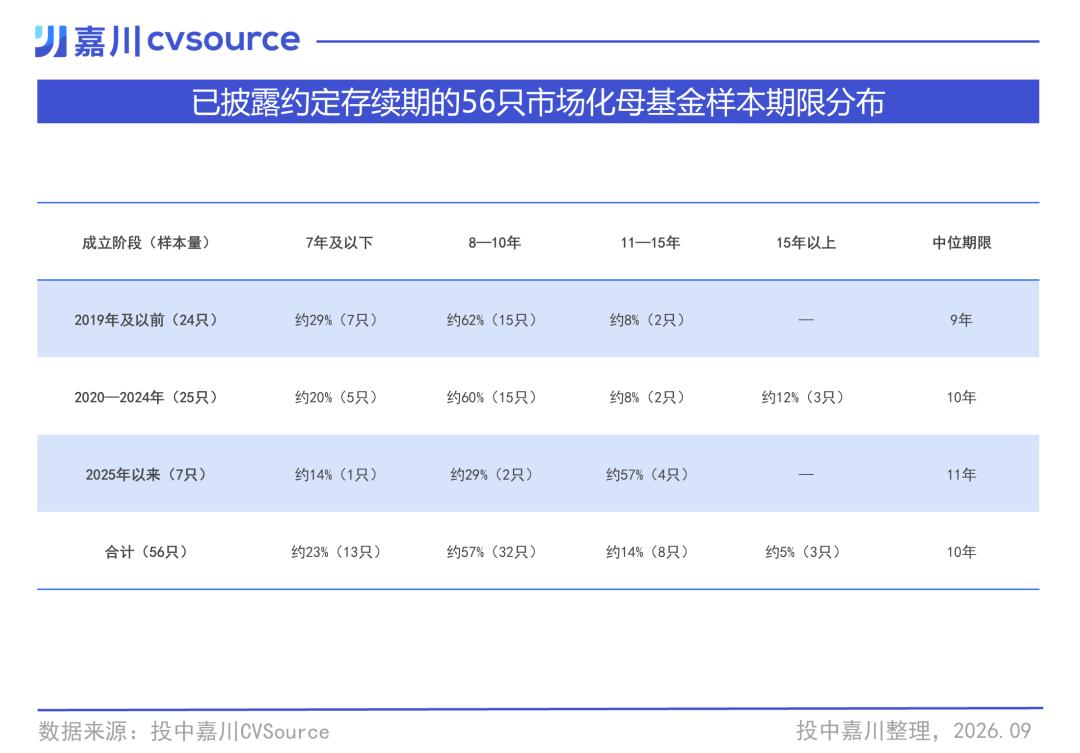
First, the number of short-duration funds is shrinking. The proportion of funds with a duration of 7 years or less dropped from about 29% in 2019 and before to about 20% in 2020-2024, and then to about 14% since 2025, making short-duration funds increasingly rare.
Second, the central duration of funds is moving upward. The median agreed duration has risen from 9 years to 10 years, and then to 11 years. The central duration of newly established funds in the past two years has increased by about two years compared with the previous level.
Third, the duration of newly established funds since 2025 is mainly concentrated in 7 to 15 years, with a significant reduction in short-duration funds, and ultra-long duration funds are only individual cases. The overall duration distribution is more concentrated than in the past.
When it comes to specific funds, the characteristics are more intuitive.
Among the samples with disclosed duration, the shortest one is only 5 years. For example, Guangdong Xuelaite Dayu Industrial M&A Fund established in 2016 has an agreed duration of 5 years (3+2 mode). This type of short-duration fund was relatively concentrated between 2014 and 2017, and has become fewer and fewer since then.
At the other end, there are also examples of funds with a duration of 20 years: CPIC Big Health Industry Private Equity Investment Fund (Shanghai) established in 2021 has an agreed duration of 20 years, led by capital from the Pacific Insurance system.
Behind the duration figures is the internal "phased" arrangement of the funds. For funds with disclosed phased plans, the investment period is usually 3 to 5 years, and the exit period is usually 4 to 5 years. Common combinations are "4+4", "4+5" or "5+5"; most funds have an extension period after the end of the exit period, generally 1 to 2 times, 1 to 2 years each time.
For FoFs, their actual life cycle will be transmitted one level further down. Whether the sub-funds can exit smoothly directly determines whether the FoF can exit and liquidate as scheduled.
02. Operation stage: 80% have reached the exit or extension threshold
Which stage have the 1163 funds reached now? This question cannot be generalized, because only 56 funds in the sample have disclosed their duration, and the remaining 1107 have not. Therefore, we use two calibers to measure.
First, look only at the 56 funds with disclosed duration. As of September 2026, about 30.4% are still in the investment period, about 41.1% have entered the exit period, about 25.0% are in the extension period, and 2 others have been deregistered or entered liquidation. However, this batch of samples has a high proportion of newly established funds in recent years, and the proportion of funds in the investment period is significantly higher than that of the whole market. Therefore, looking at this sample alone will overestimate the proportion of funds that are "still in the early stage".
For the 1107 funds with undisclosed duration, we estimate by referring to the median duration of funds with disclosed duration in the same year. The result shows that about 18.9% are in the investment period, about 47.2% are in the exit period, and about 33.9% are in the extension period. The sum of funds in the exit period and extension period exceeds 80%.
The large difference between the two data chains is related to the sample composition: most of the funds with disclosed duration are newly established in recent years, so the proportion of funds in the investment period is naturally high; the whole sample is dominated by existing old funds, and the characteristics of exit and extension are more prominent.
Another important background is that the median operating period of all sample funds is about 9 years, of which funds established before 2020 account for about 65%, and most of them are close to or even exceed the agreed duration.
At present, more than 80% of the funds have entered the exit or extension period, which means that they have generally reached the window when returns need to be realized; and the proportion of the extension period reaching about 33.9% also reflects to a certain extent that the exit pace of some funds is slower than expected and extension is needed.
03. Fundraising performance: Industrial capital and VC/PE are the absolute main force
Finally, let's look at where the capital comes from, that is, the fundraising end. We counted more than 4,000 contributor entries in total (different contributors of the same fund are counted separately, and the same contributor investing in multiple funds is also counted separately, including GPs), and found that non-market-oriented capital accounts for about 13.8%, including state-owned platforms, government agencies and guidance funds, and the remaining market-oriented capital accounts for about 86.2% in total.
Among all contributor entries, corporate investors account for 33.4%, and VC/PE investment institutions account for 30.2%. The two together account for 63.6%, accounting for about 74% of the market-oriented capital, and are the absolute main force; among them, the contributions from industrial capital and listed companies are mostly related to the synergy of their own industrial chains.
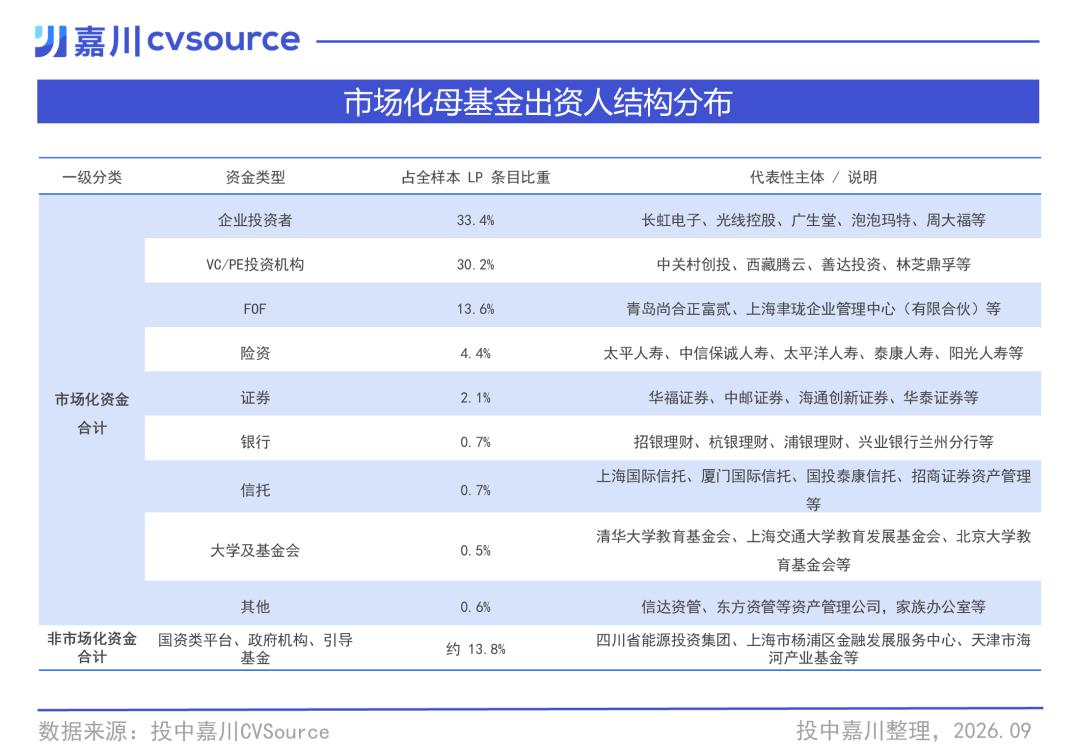
Behind these figures are specific contribution behaviors. A typical example of corporate investors is Changhong Group: Sichuan Changhong Electric Co., Ltd., together with many of its listed and subsidiaries — Changhong Huayi, Changhong Meiling, Changhong Air Conditioner, Guangdong Changhong Electronics, Changhong Sanjie New Energy, Changhong Green Environmental Protection, Changhong Jiahua Digital, Changhong New Energy, etc. — jointly contributed with Shenwan Hongyuan to establish "Changhong Group Sichuan Shenwan Hongyuan Strategic Emerging Industry FoF". An industrial group leading a group of listed platforms to jointly set up a FoF is a direct reflection of "industrial capital contributing and deploying around its own industrial chain".
On the side of VC/PE investment institutions, fund GPs account for the majority. Among the remaining types, FoFs account for 13.6%, insurance capital accounts for 4.4%, securities firms account for 2.1%, trust and bank wealth management each account for 0.7%, and university foundations account for 0.5%.
Based on this sample, market-oriented capital is still the main force, but about 80% of the funds have entered the exit or extension period; the real test for FoF managers has shifted from fundraising to exit.
This article is from the WeChat official account "ChinaVenture Jiachuan", author: Jiachuan Editorial Department, published with authorization from 36Kr.