The number of fresh snack stores recorded a net increase of 131 in September: Jiduquan and Puxialongjiu are speeding up their expansion, while Jinlimen makes steady progress in both financing and new store opening.
In September, the expansion pace of fresh snack brands accelerated once again.
Data from Yilan Business shows that in September, the emerging fresh snack brands under monitoring added 135 new stores, closed or suspended 4 stores, with a net increase of 131. Compared with the net increase of 51 in August, the net increase scale in September rose by about 156.9%.
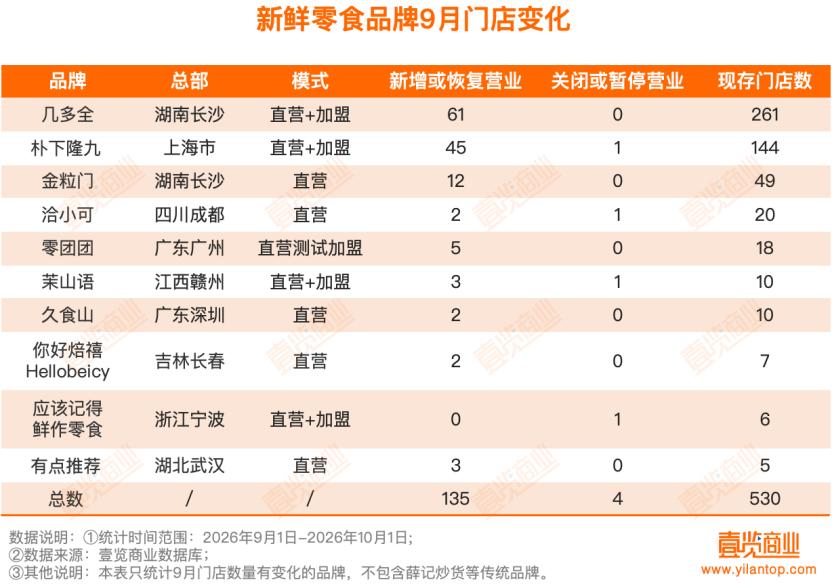
Among them, Jiduquan and Puxialongjiu added or resumed 61 and 45 stores respectively, contributing 78.5% of the total new stores of the month, remaining the main force driving the expansion. Jinlimen added 12 new stores, and brands such as Lingtuantuan and Youdian Tuijian also continued to expand their store networks.
At the same time, traditional snack enterprises are also speeding up the trial of new store formats. Xueji Chaohuo and Liangpin Puzi launched fresh snack stores in September, while Lishanghuang and Liuliumei respectively pushed forward their first store project and central factory project recently. With more participants joining in, the competition in the fresh snack sector is extending from the number of stores to product development, production and distribution, and terminal operation.
Jiduquan: Expanding and upgrading simultaneously, blue-label stores land one after another
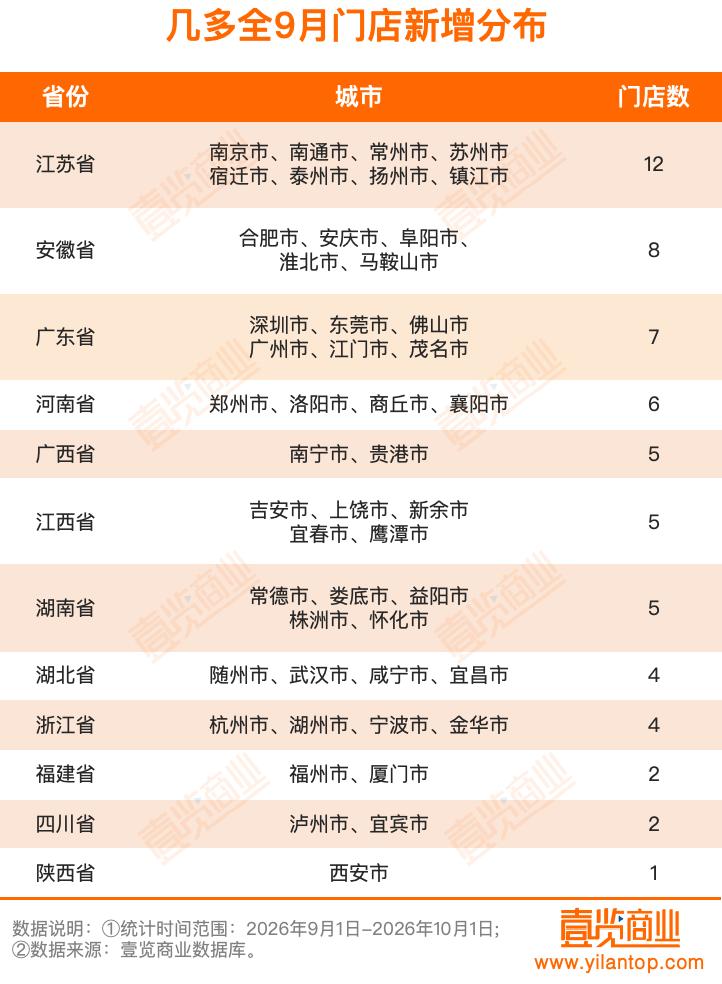
Jiduquan remained the most aggressive brand in terms of expansion in September. As of October 1, Jiduquan had a total of 261 stores. In terms of the distribution of new stores, Jiangsu still ranked first with 12 new stores, with 8 cities including Nanjing, Nantong and Changzhou promoting expansion simultaneously. Compared with August, the expansion coverage of Jiduquan expanded significantly in September. The proportion of new stores in Jiangsu dropped from 40% to 20%, while Anhui, Guangdong, Henan and other provinces saw simultaneous growth. The number of provinces where new stores were opened increased from 9 to 12. More than ten cities including Wuhan, Xianning, Yichang, Yingtan and Yangzhou were new cities that the brand entered for the first time.
In addition to regional expansion, Jiduquan began to strengthen its brand positioning through different store formats.
On September 12, Jiduquan's first national blue-label store opened in Wuxi IKEA Shopping Center. The store covers an area of nearly 400 square meters, focusing on the concept of "clean formula" with nearly 200 SKUs. According to the brand, the Wuxi blue-label store achieved a turnover of over 3 million yuan in the first two days of opening. The freshly made milk tea was limited to 4 bottles per person due to insufficient production capacity, but it was still sold out quickly. On September 24, the Huaihua BBK store opened, becoming the first blue-label store in prefecture-level cities in Hunan Province.
It is worth noting that all current expansion of Jiduquan is centered around its manufacturing bases. Data from Yilan Business shows that Jiduquan has set up 4 major manufacturing bases in Liuyang of Hunan, Chongqing, Foshan of Guangdong and Nanjing of Jiangsu, with 100% of core products independently developed and produced. The base in Xinxiang of Henan also started construction in August, and is expected to be put into operation by the end of the year. It can be predicted that with the completion of the Xinxiang base, Jiduquan's stores will expand into North China.
Apart from store expansion, brand-level upgrading is also advancing simultaneously. On September 26, Jiduquan officially signed the actor Lin Yi as its first brand spokesperson, making it the first brand in the fresh snack track to use a spokesperson. It also released the new proposition "Jiduquan, Tastier and More Reliable" and the new positioning of "R&D and manufacturing-oriented retail brand".
As of the end of September, Jiduquan's national stores have covered 14 provinces and more than 80 cities. The franchise application channel has not resumed throughout September since it was suspended on July 10.
Puxialongjiu: Net increase of 45 stores in a single month, landing at Hongqiao Airport
Puxialongjiu also saw obvious expansion. In September, it added 45 new stores, closed 1 store, with a net increase of 44, reaching 144 stores by the end of the month. The number of new stores was 2.25 times that of 20 new stores in August.
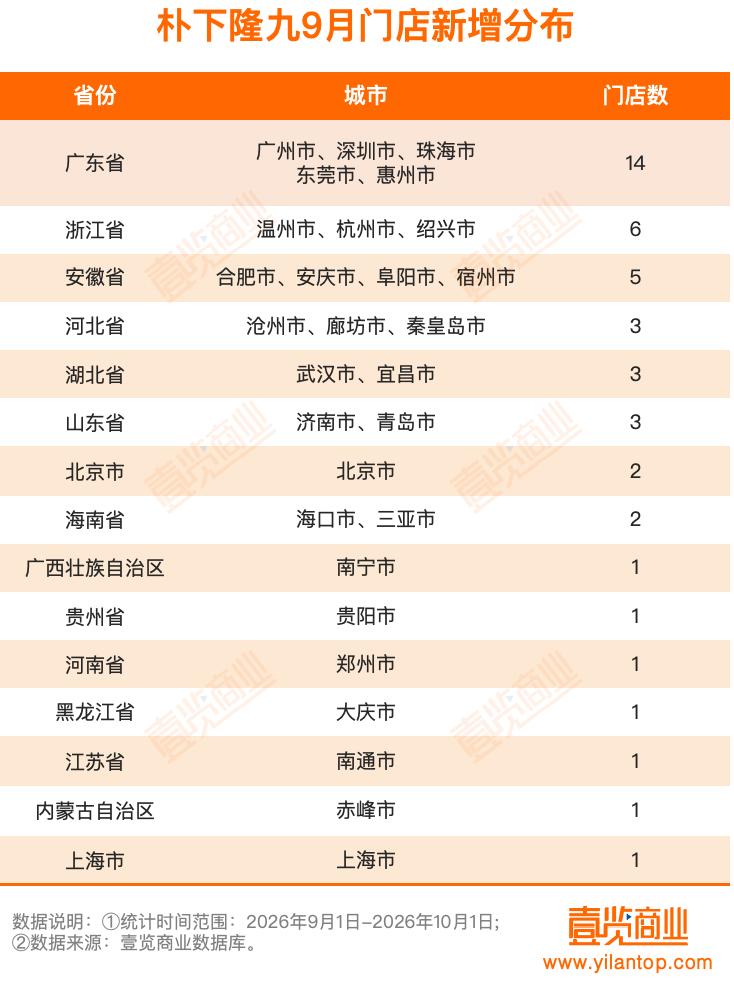
Guangdong became the market with the largest number of new stores of Puxialongjiu that month. 5 cities including Guangzhou, Shenzhen, Zhuhai, Dongguan and Huizhou contributed 14 new stores in total, accounting for 31.1% of the total new stores of the month. Zhejiang and Anhui added 6 and 5 new stores respectively, while Hebei, Hubei and Shandong added 3 new stores each.
Overall, the new stores of Puxialongjiu in September were distributed in 15 provincial-level administrative regions, further expanding from 10 in August. While the increment in Guangdong increased significantly, the brand continued to densify its layout in original markets such as Zhejiang and Anhui, showing the feature of parallel cross-regional expansion and deep cultivation of existing markets.
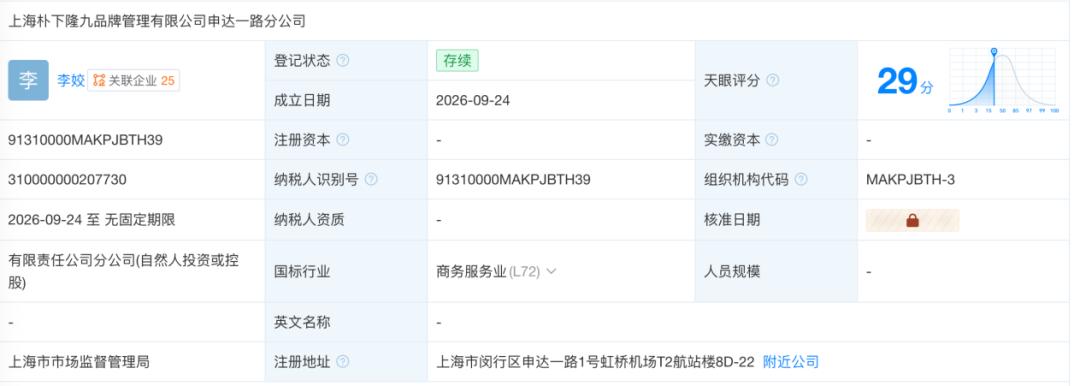
Transportation hubs are also channels that the brand is promoting. Following the opening of the store at Changchun Longjia International Airport in August, industrial and commercial information shows that Shanghai Puxialongjiu Brand Management Co., Ltd. Shenda 1st Road Branch was established on September 24, with its registered address located at Terminal T2 of Shanghai Hongqiao Airport.
Jinlimen: Capital actions take the lead, regional first stores land one after another
Jinlimen added 12 new stores in September, reaching 49 stores by the end of the month. Compared with Jiduquan and Puxialongjiu, its store scale is relatively small, but its recent regional expansion and capital actions are relatively intensive.
On September 17, Jinlimen's first store in Zhejiang opened in Hangzhou Xiaoshan MixC; subsequently, the store at Hangzhou Xixi Impression City and stores in Changzhou, Taizhou and other locations were opened one after another. At the end of September, the brand entered Foshan, Zhuhai and Guangzhou, further expanding its coverage in the Guangdong market before the National Day holiday.
Most of these new stores are located in shopping malls, continuing Jinlimen's expansion mode of distributing stores around commercial projects. As the brand steps out of its original market, its competition has gradually shifted from regional operation to simultaneous operation in multiple cities.
At the capital level, in September, Guangdong Kuaike E-commerce Co., Ltd., the operating entity of KK Group, and Wu Yuening, the founder of KK Group, entered the shareholder list of Jinlimen's operating entity, holding 5% of the shares respectively, totaling 10%. Information disclosed in October shows that BUER CAPITAL STAR PTE. LTD., an affiliated entity of Buer Capital, has also taken shares, holding 3.5% of the shares.
As of press time, Jinlimen's first store in Shanghai has opened at Shanghai MixC on October 15. This means that it will compete with Jiduquan and Puxialongjiu in Shanghai.
Emerging brands: Partial expansion coexists with store adjustment
While head brands are speeding up store opening, small and medium-sized brands still focus on partial expansion.
In September, Lingtuantuan added 5 new stores, an increase from 1 new store in August, reaching 18 stores by the end of the month; Youdian Tuijian added 3 new stores, reaching 5 stores by the end of the month; Moshanyu added 3 new stores, closed or suspended 1 store, with a net increase of 2, reaching 10 stores by the end of the month.
Qiaoxiaoke added 2 new stores, closed or suspended 1 store, with a net increase of 1, reaching 20 stores by the end of the month. Jiushishan and Nihao Beixi added 2 new stores each, reaching 10 stores and 7 stores respectively by the end of the month.
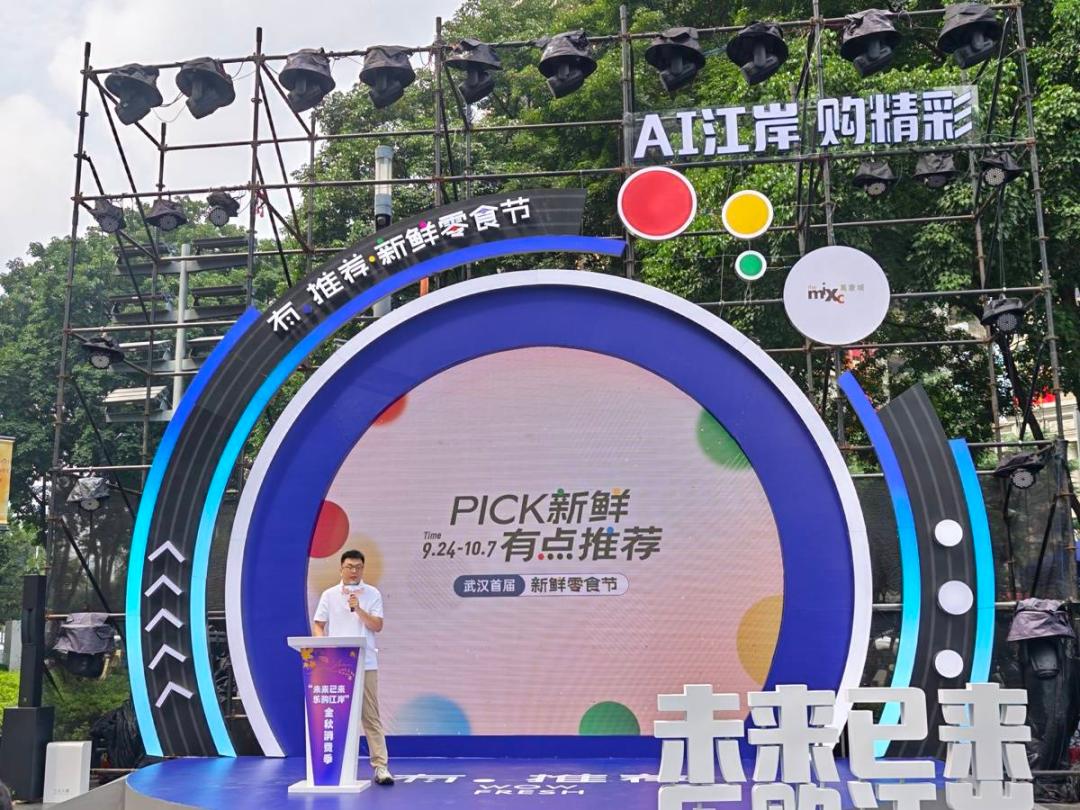
In addition to opening new stores, some brands are also trying to raise consumer awareness through activities. On September 24, Youdian Tuijian participated in and held the Fresh Snack Festival at Wuhan MixC, cooperating with multiple food brands to showcase fresh snack products and consumption scenarios in a centralized manner.
Under the circumstance that the store model has not been fully verified, stabilizing existing stores is more important than blindly opening new stores. Especially against the backdrop that head brands are accelerating to seize high-quality locations and supply chain costs are rising, regional small brands without scale effect are the first to face pressure.
New entrants: Roasted nut giants and listed snack companies enter the market intensively
The number of participants in the fresh snack sector continues to increase.
On September 12, Liangpin Puzi's fresh and healthy food 7.0 store opened in Hanyang, Wuhan, with freshly made cold chain SKUs accounting for 45%, and the product supply extending to freshly baked and freshly made products, cold chain marinated products, and short-shelf-life daily distribution products. The company stated in an investor communication that this store format is still in the pilot polishing stage, and it will continue to track consumer feedback and operation performance to carefully determine the subsequent store expansion pace.
On September 19, Xueji Chaohuo's brand new store format made its debut at Beijing Chaoyang Hopson One. Based on the original products such as nuts and dried fruits, the new store added products such as freshly baked dried fruits, same-day freshly made baked goods and freshly blended yogurt shakes. Its category selection still revolves around its original advantages, trying to expand consumption scenarios by adding freshly made links and short-shelf-life products.
Entering October, Lishanghuang's first fresh snack store opened at Guangzhou Huacheng Hui Plaza; on October 8, Liuliumei signed the "Liuliumei X Aikaishi Central Factory" project, and the new brand "Aikaishi" made its public debut for the first time, planning to lay out categories including baked goods, tea drinks, cooked food, light meals and dairy products, exploring the business model combining central factories and terminal stores.
Different enterprises have different focuses on their entry methods: roasted nut brands add freshly made and short-shelf-life categories around their existing products, comprehensive snack enterprises upgrade their store structure, and manufacturing enterprises extend from central factories to retail terminals. These new players all have existing business and supply chain foundations, entering the market in a tentative posture, expanding stores prudently rather than carrying out full transformation. The incremental value they bring mainly lies in channel and supply chain resources, which is not enough to change the competition pattern of original head brands in the short term.
The short-shelf-life attribute of fresh snacks makes store opening closely connected with supply chain construction. The wider the store coverage, the more fine-grained cooperation is required in production organization, replenishment frequency and inventory management. In the next stage, brands not only need to compete for high-quality locations, but also need to make their supply chain and operation capabilities keep up with the expansion pace, converting the attention at opening into daily consumption.
This article is from the WeChat official account "Yilan Business" (ID: yilanshangye), written by Zhang Yongkun and Lei Jun, published with authorization from 36Kr.