In 2014, Zhang Yiming paid a visit to the headquarters of Tesla.
Recently, an old photo taken in 2014 has been circulating in the tech circle and the WeChat Moments of entrepreneurs.
The background of the photo is Tesla's iconic red logo. Elon Musk is wearing a dark polo shirt with both hands in his pockets, looking a little tired; next to him, Zhang Yiming is wearing a slightly oversized white shirt, with a visitor badge hanging on his chest, standing stiffly with a gentle smile.
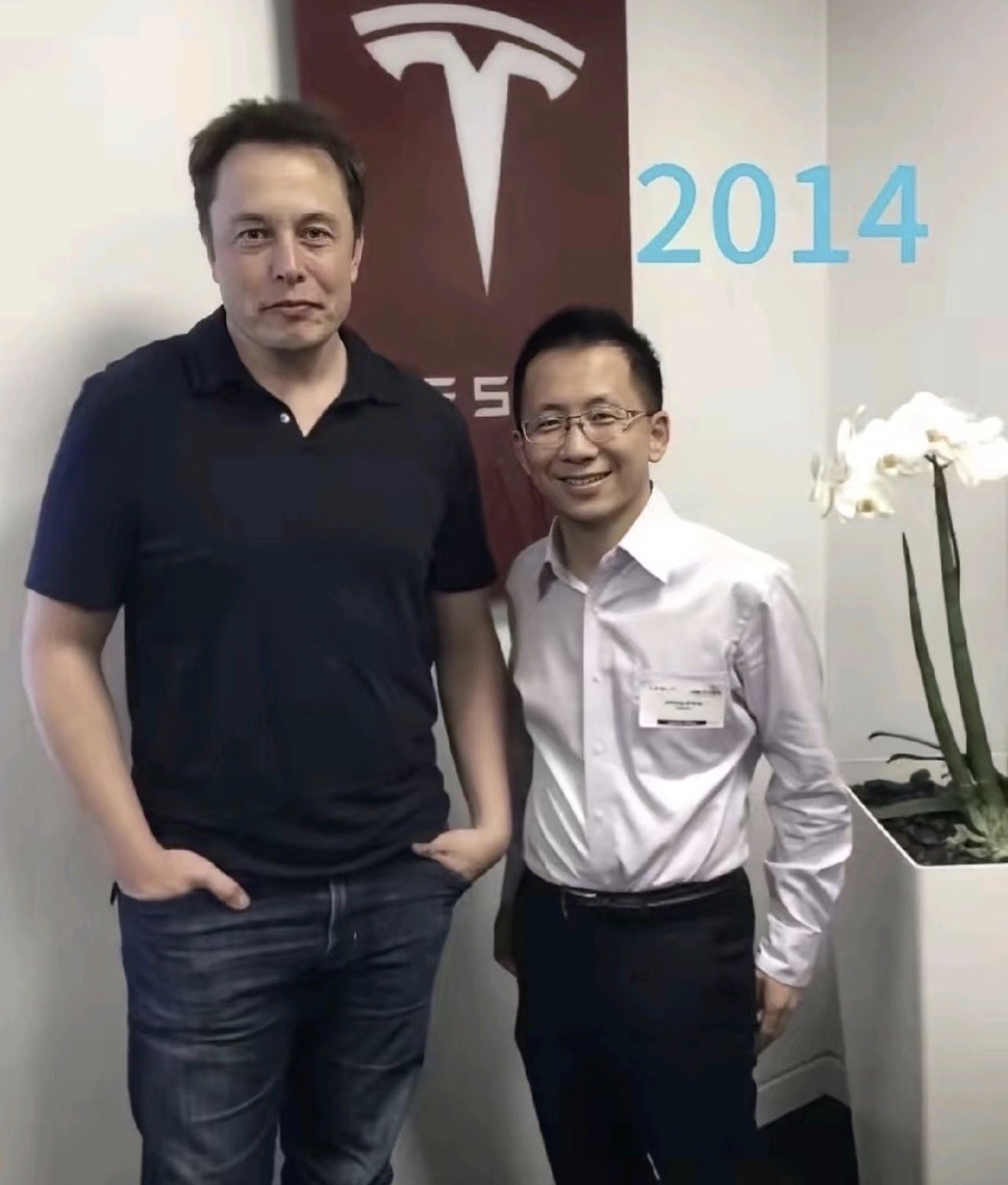
That year, Zhang Yiming was 31 years old, having just founded ByteDance not long before. Toutiao had been launched for less than two years, and was still regarded as a low-grade "content porter" by traditional media and web portals. That year, Musk was 43 years old, and Tesla had just proved that electric vehicles could become mainstream, but the delivery of Model S was still a precarious process, with the shadow of production hell and broken capital chain threatening to swallow the company at any time.
At that point in time, Zhang Yiming went to the United States for exchange and study, and made a special trip to visit Tesla's headquarters. This was less of a "meeting of giants" than a brief encounter between two entrepreneurs trudging through the mud on their respective long marches.
More than a decade later, when people look at this photo again, they tend to fall into a kind of ex post romanticism, exclaiming that "everything was destined long ago". But the truth is, no one could have predicted the script of the future at that time. Zhang Yiming might not have been sure whether the recommendation algorithm could resist the strangulation of giants, and Musk might have been anxious about the payroll for the next month. Stripping away the wealth and aura that were later endowed, these were just two ordinary entrepreneurs with dreams, hurrying on their way silently.
No one stands under the spotlight from the very beginning
People are used to viewing business history as a series of dazzling moments — going public, disrupting industries, reaching the top of the rich list. But this is only the tip of the iceberg above the water. Beneath the surface lies a long, boring, even self-doubting decade.
In 2014, Musk did not hold the password to clear the game of the future. At that time, Tesla's situation was far from safe: the production hell of Model S once pushed the company to the brink of bankruptcy, and short-selling institutions on Wall Street were eyeing it covetously. What Musk did was to desperately tackle battery costs, supply chains, and every physical limit in countless seemingly desperate days and nights. Similarly, Zhang Yiming did not change the world by a single spark of genius. In the early days of Toutiao, he was accused of running a "news client without editors", ran into repeated obstacles in financing, and was even questioned by investors: "What will you do if Tencent also develops a recommendation algorithm?" He pulled ByteDance out of the valley of death step by step, through countless adjustments to the recommendation algorithm and countless crises of being besieged by industry giants.
All world-changing ideas seem trivial at the very beginning. When Amazon was first founded, Jeff Bezos packed books in his garage and delivered them by himself; in the early days of Tencent, Ma Huateng almost sold QQ due to the excessively high server cost. Business history has repeatedly proved that the starting point of great undertakings is often not the highlight moment under the spotlight, but those dark nights that are ignored, even ridiculed and questioned by others.
It takes ten years to nurture a tree into full growth: great success never comes overnight. A truly great company often needs to go through several cycles to grow into a towering tree. In the first year, it may only be a tiny idea; in the third year, it struggles on the line of life and death, looking for the product-market fit; in the fifth year, it faces the growing pains of growth bottlenecks and organizational expansion; it is not until the seventh or tenth year that it can possibly build an unshakable moat.
Over the past decade or so, ByteDance has expanded from graphic distribution to short videos, using algorithms to reconstruct the path of global information flow. It took Zhang Yiming ten years to turn the abstract concept of "algorithmic recommendation" into an information infrastructure that billions of people around the world cannot live without every day. During this period, ByteDance experienced the failure of products like Duoshan and Feiliao, and also faced the extremely complex regulatory environment encountered by TikTok overseas. Every challenge is an ultimate test of the organization's vitality.
Tesla, on the other hand, has gone from the verge of bankruptcy to the global leader in new energy vehicles, and has sent rockets into space. It took Musk ten years to survive the "production hell" of Model 3, and get through the most desperate moment in 2018 — when Tesla was only a few weeks away from bankruptcy. He slept on the floor of the factory, personally supervised the production line, and finally completely reversed the war situation with the launch of the Shanghai Gigafactory.
These two completely different companies answered the proposition of time in the same way: no disruption happens overnight, and the real moat is built with countless boring days and nights and countless trials and errors. The public often overestimates the changes that can happen in one year, but underestimates the power of ten years. One year can make a hit product, but only ten years can build a great company.
Entrepreneurship is a long journey, and the real threshold lies in the trough period
If we regard entrepreneurship as a journey, many people mistakenly think it is a sprint that tests the explosive power at the starting line. But in fact, it is an extremely long marathon, or even a wilderness survival with no clear end point.
In this long journey called entrepreneurship, all short-term trends will pass, and all dividends obtained by luck will ebb. People often only see the glory of the survivors, but ignore the cruel truth behind the survivor bias: the vast majority of fallen entrepreneurs once had the same or even better starting points, but they failed to survive a long winter.
Those who can finally change the world have gone through a dark time before they are truly seen by the world. They were not born standing under the spotlight; they just gritted their teeth and kept moving forward with their heads down when others chose to give up or turn around. In the trough period, enterprises need to face not only the depletion of capital, but also the collapse of team confidence, the deterioration of the external environment, and the erosion of self-doubt. Those who can survive in the trough period, and continuously iterate the organization and polish products, deserve the subsequent outbreak.
The Answer Given by Time
Looking back at this 2014 photo, its value does not lie in recording the subsequent peaks of these two figures of the era, but in reminding us: on that "eve of legend" that has been deified by countless later generations, they were just ordinary entrepreneurs.
A dozen years ago, they were still young and inexperienced. The two passed each other in the corridor of Tesla's headquarters. Zhang Yiming might be thinking about how to use algorithms to retain users, and Musk might be anxious about how to ramp up production capacity. At that time, they could not predict what kind of waves their companies would set off around the world in the future.
Today, one company has changed the way information spreads globally through algorithms and content; the other has redefined multiple industries with electric vehicles and rockets. The answer given by time is not "they were born great", but "they stuck to doing one right thing for ten years".
The real legend often starts with inconspicuous struggles, and emerges step by step through years of unknown hard work. The power to change the world is hidden in this long persistence of being willing to be ordinary. There is no greatness achieved in one go, only a long march that goes on day after day.
This article is from the WeChat official account "Tech Business", written by Tech Business, and authorized for release by 36Kr.