New Oriental Cultural Tourism is pre-positioning around the "10 Years of Backpacking" IP.
1
New Oriental has recently set its sights on a youth hostel.
Tianyancha data shows that Chengdu Backpack Planet Hotel Management Co., Ltd. (hereinafter referred to as "Backpack Ten Years") has recently undergone industrial and commercial registration changes.
New Oriental (Zhuhai) Cultural Tourism Investment Co., Ltd. holds a 30.5% stake, becoming the second largest shareholder of the company.
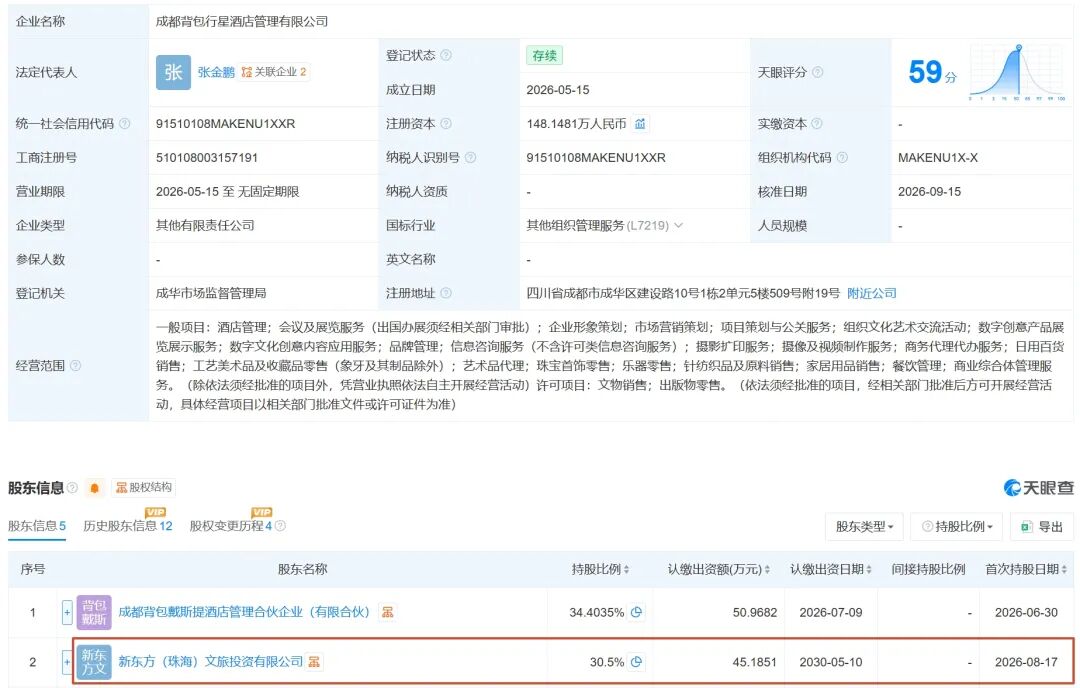
The total financing amount reaches tens of millions of yuan. The two sides will carry out in-depth cooperation on cultural tourism products, and jointly explore new scenarios and new experiences targeted at young consumer groups.
As a leading brand in the youth hostel industry, Zhang Xiaopeng (Zhang Jinpeng), the founder of Backpack Ten Years, is one of the earliest professional backpackers in China. The brand name originates from his travel literature work *Backpack for Ten Years*.
The book was published in 2010, with an initial print run of 15,000 copies, and was reprinted 5 times within 50 days.
With the output of Xiaopeng's blog posts, Backpack Ten Years has accumulated a group of loyal readers.
In modern terms, before opening youth hostels, Xiaopeng had already built up the IP of "Backpack Ten Years" with a very precise customer group.
When the first store in Lijiang opened in 2014, a large number of tourists came here attracted by its reputation.
However, running a youth hostel well cannot rely solely on passenger flow, the product itself also needs to meet customer expectations.
Each bed in the first Lijiang store is equipped with a reading lamp and two USB ports. Do not underestimate this configuration. In the Lijiang youth hostel market in 2014, guests in most hostels even had to compete for power sockets.
Subsequent stores were successively equipped with independent curtains, lockers and other facilities, and the bedding products adopted the same standard as those used in star hotels.
If traditional youth hostels sell "a cheap bed", Backpack Ten Years sells a "social space".
According to relevant statistics, the public area of Backpack Ten Years accounts for 25% to 30% of the total space, exceeding the 10% of traditional economy hotels and 15% of traditional youth hostels.
It has a full range of facilities including lobby, bar, reading area, movie viewing area, kitchen and rooftop, and organizes activities such as hiking, Werewolf game, hot pot parties and movie nights every day.
Many guests do not just come for a one-night stay, but "come back for a visit". Some people met their partners here, some changed from guests to employees, and then became store managers.
It is precisely these spaces and activities that support the premium of Backpack Ten Years.
The price of a bed per night in Backpack Ten Years ranges from 121 yuan to 245 yuan, about 30% higher than that of traditional youth hostels. Many young people are willing to pay for the vibrant public area atmosphere.
2
However, as a leading chain brand, Backpack Ten Years has only opened more than a dozen stores so far, all of which are directly operated.
The slow store expansion is not only related to the brand's planning, but also related to the inherent characteristics of youth hostels.
The appeal of a good youth hostel lies in the atmosphere created by "people" and "space", while chain operation requires replicable processes and standards. There is a natural tension between the two.
The competition of youth hostels is extending from "cheap beds" to "what wonderful experiences can happen when you stay here".
Rent, site selection, hygiene, safety, service and booking process are only the bottom line of standardization, and the unique local charm can raise the upper limit of operation.
The local charm of youth hostels highly depends on the store manager's familiarity with the local area. The store manager also needs to be "good at having fun", capable of organizing activities, livening up the atmosphere, and making guests get along like friends.
It is hard to find a qualified store manager, and it is equally hard to find the group of backpackers that emerged in the millennium era.
A more critical change lies in the customer group. Some youth hostels gradually have long-term tenants, including exam-preparing students and interns in transition. They usually go out early and come back late, and the youth hostel is only a place for them to sleep.
Some Gen Z young people pay more attention to privacy and personal boundaries. By paying a little more, they have a large number of economy hotel options.
Substitutes at similar or even lower prices are everywhere, including bath centers, Internet cafes, 24-hour restaurants and capsule hotels.
Affected by multiple factors, a large number of traditional YHA-certified youth hostels have exited the market.
Around 2017, there were nearly 300 YHA-certified youth hostels, but only 109 remained by 2025.
The YHA system is essentially a loose alliance of "certified franchising + global member network". It cannot solve the profitability problem of individual stores, nor can it provide sufficient operational support to cope with rising rents and the loss of customers.
This also illustrates the difficulty of youth hostel chain operation from another perspective.
The difficulty in operating chain youth hostels is not a problem unique to China.
The top six youth hostel brands in the world only account for about 5% of the total market share combined. Even in Europe, the world's largest youth hostel market (accounting for 39% of the global share), the brand concentration is far lower than that of the hotel industry.
Selina was founded in Latin America in 2015. With the model of "youth hostel + co-working + community", it opened 102 stores with 30,000 beds in 22 countries around the world. Its market value once exceeded 1.2 billion euros when it went public in 2022.
In July 2024, due to its inability to repay the $50 million loan interest, it formally filed for bankruptcy. Its brand value dropped by more than 99%, and it was acquired by Singapore's Collective Hospitality and later operated under the new brand Socialtel.
Since operating youth hostels is so difficult, why does New Oriental still choose to invest in this field?
3
To understand this investment, we must first figure out what New Oriental Cultural Tourism is lacking at present.
In July 2023, Beijing New Oriental Cultural Tourism Co., Ltd. was established, marking the official launch of the group's cultural tourism project.
It officially announced its cultural tourism business "targeting middle-aged and elderly people", and launched travel routes for middle-aged and elderly groups such as "Dongpo Traceability Tour".
However, the silver-haired market is not as easy to operate as expected.
Only half a year after its establishment, the business scope of the brand was quietly adjusted from "targeting middle-aged and elderly people" to "serving all age groups including middle-aged and elderly people, teenagers and parent-child families".
The special mention of teenagers and parent-child groups is not an impromptu decision.
New Oriental started its business in the education field, and its original group of students and parents naturally fit the consumption scenarios related to study tours.
As early as 2005, New Oriental had already launched businesses including international study tours, camp education and domestic study tours.
In the third quarter of fiscal year 2025 (from February 1 to April 30, 2025), K12 and college student study tours contributed more than 50% of the cultural tourism revenue.
In addition to the "elderly and children" groups, other tourism products of New Oriental Cultural Tourism focus on high-end boutique positioning.
For example, the polar tour is directly led by Yu Minhong, with famous teachers accompanying the trip. The price ranges from 100,000 yuan to 220,000 yuan, far exceeding the 60,000 to 100,000 yuan of similar products on the market.
The premium of these products highly depends on the appeal of the founder, but Yu Minhong's time and energy are limited, which determines that this model cannot be scaled up for replication.
From a financial perspective, the performance of New Oriental Cultural Tourism is not optimistic.
In fiscal year 2025, the revenue of the company's cultural tourism business was about 1.2 billion yuan, with a loss of about 100 million yuan.
In fiscal year 2026, which was originally expected to achieve profitability, the revenue of the cultural tourism business was not mentioned separately at all.
Putting these business lines together, the current situation of New Oriental Cultural Tourism is very clear.
Its current advantages only lie in study tours and parent-child travel, the silver-haired market has not been fully validated, and high-end products are difficult to scale up.
The customer group of Backpack Ten Years can exactly fill its gap in young users.
4
The cooperation between the two sides seems very appropriate, but it remains to be seen whether it can achieve success. After all, New Oriental's past investment records are there, and its investment vision and post-investment management capabilities are worrying.
Yu Minhong publicly stated at the 2023 Yabuli Forum: "New Oriental has lost a lot of money due to its own decision-making mistakes."
He personally admitted that he missed Luckin Coffee: at that time, only 10 million US dollars was needed to obtain a large proportion of equity, but the New Oriental investment research team and the board of directors rejected the deal on the grounds that "it has little to do with education".
For investments related to cultural tourism, New Oriental's investment layout is very extensive.
In September 2023, New Oriental joined hands with Shenqi Capital to lead a 200 million yuan investment in Huangbaoche Travel, which was New Oriental's first investment in the cultural tourism sector. The two sides reached a strategic cooperation in passenger flow diversion and supply chain.
In February 2024, Beijing Dongfang Zhuoyong Investment Management Co., Ltd., a subsidiary of New Oriental, contributed 370 million yuan to become a shareholder of Zhangjiakou Chongli Taiwu Enterprise Management Co., Ltd., holding 35% of the shares, and Yu Minhong took the position of director.
In December of the same year, New Oriental fully acquired Taimei International Travel Agency through its subsidiary Wokaide Company, obtaining the travel agency operation qualification.
In March 2025, New Oriental made a strategic investment of about 200 million yuan in the boutique hotel group Songtsam, holding about 12.4% of the shares, and Yu Minhong personally served as a director.
Recently, New Oriental Cultural Tourism has started a "wide net casting" investment strategy.
In addition to the aforementioned Backpack Ten Years, it has invested in tourism trains, digital cultural tourism, and digital experience products for middle-aged and elderly people.
According to Tianyancha data, it became a new shareholder of Beijing Dangdang Dangdang Technology and Culture Development Co., Ltd. in June 2026. The company owns the first cross-border comfortable tourist train in China, the "Dangdang Kunming" train.
In August of the same year, it invested in Shenzhen Yiqi Time Technology Co., Ltd. Yiqi Time mainly targets adults and middle-aged and elderly users, providing clear, friendly and easy-to-use digital experiences around cognitive training, puzzle interaction, health management and personal reference.
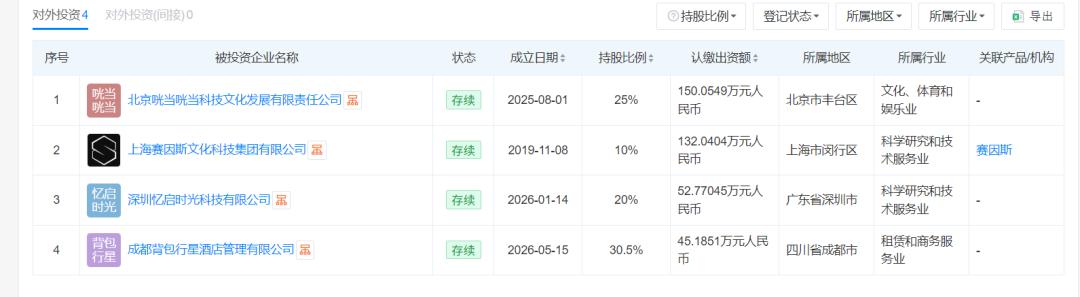
In September, it became a new shareholder of Shanghai Sience Culture Technology Group Co., Ltd. This company is a comprehensive service provider of digital cultural tourism creativity, and the dynamic ride projects including "Soarin' Around the World" in Shanghai Disneyland, the "Minions" area in Universal Studios Beijing, and the dynamic ride facilities in Shanghai Legoland are all developed by it.
However, the problem is that there is no quantifiable synergy between these investments at present.
Although Huangbaoche Travel has a strategic cooperation with New Oriental, Yu Minhong also said that "it will either go public independently in the future, or be merged into New Oriental Cultural Tourism for a combined listing", and no obvious business linkage has been formed yet.
In theory, industrial chain investment can achieve the effect of 1+1>2, but there is no evidence of this effect at present.
Yu Minhong has strong operational capabilities. From New Oriental to East Buy, he has been able to build new businesses from scratch. But operational capability and investment capability are two different things. The fact that New Oriental can run its own business well does not mean that it can turn the capital it invests into good businesses.
No matter it is laying bait or casting a wide net, New Oriental has made enough investment moves in the cultural tourism field, but what it lacks is a truly successful project that can bring expected returns.
This article is from the WeChat official account "Wenlv" (ID: wenlvpai), written by Wu Yanrui, authorized to be released by 36Kr.