As new and old retail forms go head to head, small robot-operated stores grab the lion's share of the Golden Week business of traditional convenience stores.
During the 2026 National Day holiday, the number of domestic tourist trips across China hit a new record high. Data shows that during the seven-day holiday, there were 826 million domestic tourist trips nationwide, with total domestic tourism spending reaching 738.375 billion yuan, up 6.3% and 4.3% respectively year-on-year compared to 2025.
Against the backdrop of robust growth, embodied intelligence and robotics enterprises are accelerating their entry into more consumer scenarios. Robot convenience stores have emerged at Jiaxing Nanhu Tiandi, Hefei Leijie, Zhuhai Hengqin Chimelong Spaceship Park, Yuanmingyuan, the Summer Palace, Dunhuang Mingsha Mountain and other locations, where robots sell snacks and hand out drinks, attracting numerous tourists to take the initiative to experience the services.
Compared with the novelty brought by robot convenience stores, traditional convenience stores are facing survival challenges as their convenience advantages fade out. A 2026 first-half baseline survey by the China Chain Store & Franchise Association (CCFA) shows that 71.7% of convenience store enterprises have seen a drop in customer flow, 50% have recorded a year-on-year decline in sales, and 60% have shrunk net profits.
These two contrasting scenes together form a thought-provoking picture of the 2026 retail industry. This is not a problem of robots seizing business from "7-Eleven-style" stores, but a question of what exactly convenience stores of the future should sell?
Robots "on duty", convenience stores "retreating"
This National Day holiday, if you visit the Summer Palace, Yuanmingyuan, Dunhuang Mingsha Mountain, Hangzhou West Lake, Xiamen Gulangyu Island, Jingdezhen Taoxichuan, you may spot a "Galaxy Capsule" in a corner. Inside the transparent capsule, a wheeled dual-arm robot is making coffee, delivering drinks, or steadily handing a cultural and creative product to tourists.
This is the Galbot G1 humanoid robot from Galaxy Universal. It can independently complete the whole process of greeting guests, order taking and payment, grabbing and delivering goods without manual remote control. Since it settled in the FamilyMart convenience store at Dinghao Store, Zhongguancun, Beijing in March 2026, the "Galaxy Capsule" robot convenience stores have covered about 50 cities across China with around 200 locations, providing 7×24-hour retail services for drinks, cultural and creative products, and snacks.
The performance of CrossVerse Intelligence is equally intuitive. This National Day holiday, CrossVerse Intelligence, together with local operators, has operated more than 30 robot commercial service stations in cultural tourism scenic spots, theme parks, commercial complexes and other places, providing freshly made and retail services such as ice cream, popcorn, coffee and beverages.
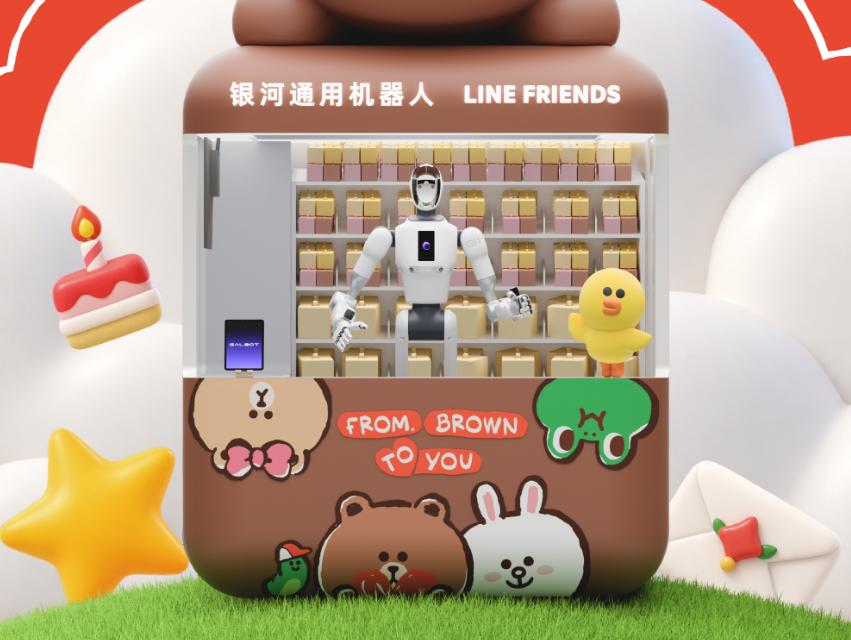
Galaxy Capsule co-branded with LINE FRIENDS
Data shows that the robot commercial service stations received a total of over 110,000 passenger visits during the National Day holiday, with a single robot serving more than 500 orders per day on average, and the benchmark store recorded a total revenue of 150,000 yuan during the holiday. Up to now, its humanoid robot commercial applications have achieved a total of 25,000 hours of barrier-free operation.
What does 150,000 yuan mean? According to data from LeadLeo Research Institute, the average daily revenue per store in China's convenience store industry dropped to 4453 yuan in 2025, so the total revenue for the seven National Day days is only a little over 30,000 yuan, while the revenue of a single robot store in the scenic spot is nearly 5 times that of a traditional convenience store.
The "Shaomai Go" robot convenience store under SenseTime is also crowded with customers. During this year's May Day holiday, the Baoshan Binjiang store of Shaomai Go has achieved the data of "as fast as 15 seconds per order, 400 orders per day on average". During the National Day holiday, the transaction volume of "Shaomai Go" stores in Shanghai was nearly twice that of weekdays, and the store with the largest increase saw a month-on-month rise of more than 25 times.
In Hefei Leijie, a robot quietly went on duty in a small shop of more than ten square meters. The robot "Xiaomai" wearing an orange tennis cap is busy among the shelves. Tourists scan the code to place an order, and in less than 20 seconds, a bottle of iced cola is steadily delivered to the pickup port. This robot "shop assistant" developed by Hefei Zero Power Robot Co., Ltd. has an average daily order volume of about 100 orders per store during the National Day holiday, with a turnover of about 1500 yuan.
In Jingdezhen Taoxichuan, a tourist shouted to the Galbot G1 "I want to buy a bottle of water", the robot turned to the shelf, picked up the water, turned back and handed it over, the whole process took less than a minute. A five or six-year-old boy next to him stared intently, holding his mother's hand and refusing to leave. Then his mother took out her mobile phone to scan the code to pay and said: "Buying a bottle of water is just an excuse, he just wants to watch the robot."
This scenario is being repeated in major scenic spots across the country. Today, small robot stores are as popular as internet-famous check-in spots.
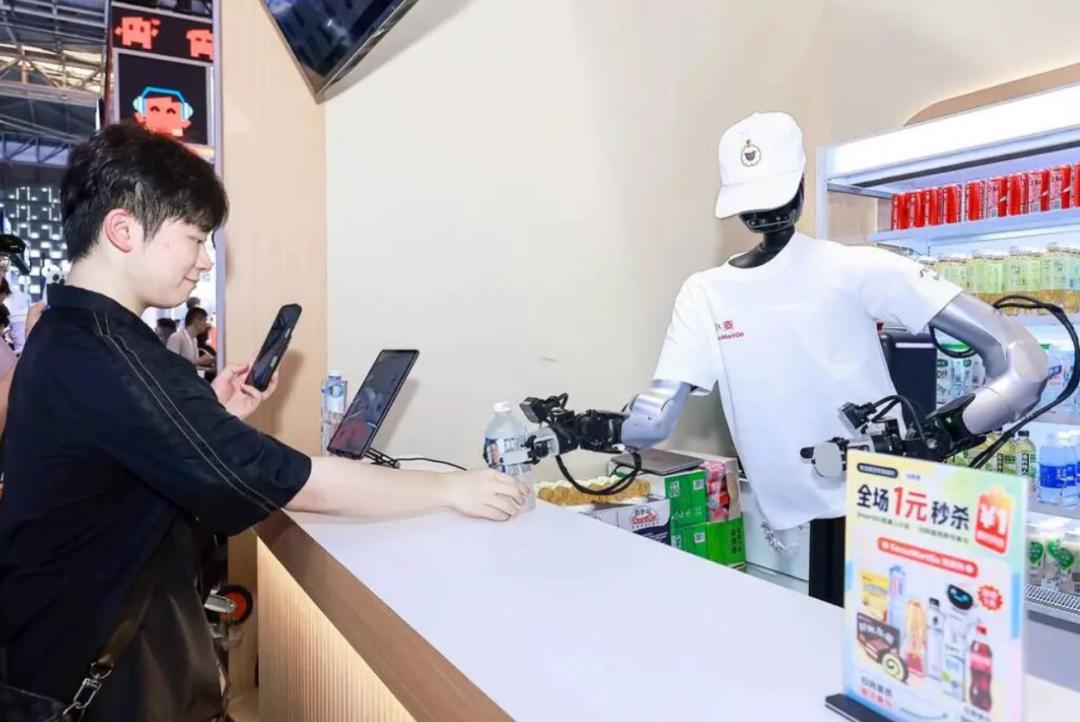
Image source: SenseTime
On one side is the booming small robot stores, on the other side is the retreat of traditional convenience stores.
A 2026 first-half baseline survey by the China Chain Store & Franchise Association (CCFA) shows that 71.7% of convenience store enterprises have seen a drop in customer flow, 50% have recorded a year-on-year decline in sales, and 60% have shrunk net profits. The average daily revenue per store in the industry dropped to 4453 yuan, down 3.9% year-on-year; the number of customers per store dropped by 8.7% year-on-year.
"The stronghold of convenience stores is being breached from the inside. It's not that consumers don't spend money anymore, but that they don't come into the stores." commented an industry observer.
The difficulties of convenience stores are multiple. Bulk snack stores have pushed the price of beverages below the purchase price of convenience stores, and instant retail platforms have intercepted the impulse consumption of "buy one thing conveniently" with front warehouses and free delivery fees.
The deeper reason that affects consumers' willingness to enter the store is what exactly convenience stores sell. In the past, geographical convenience was a major advantage, but when takeaway can be delivered to your home in 30 minutes and the price of snack discount stores is lower than the purchase price, the meaning of "convenience" has changed.
What small robot stores sell in scenic spots is precisely not convenience.
In the past, the shortage of night shift manpower in the convenience store industry was a common pain point, which robots can just make up for. In scenarios with drastic passenger flow fluctuations such as scenic spots, the flexibility of on-demand deployment is efficiency in itself.
The demarcation between new species and old species: Why scenic spots?
From the perspective of industry path, small robot stores and traditional convenience stores are moving towards two different paths.
The "Capsule" of Galaxy Universal covers about 50 cities and around 200 locations, mainly concentrated in scenic spots, commercial districts and transportation hubs. More than 30 stations of CrossVerse Intelligence are distributed in cultural tourism scenic spots, theme parks and commercial complexes. SenseTime's Shaomai Go started from office buildings and industrial parks, and gradually extended to scenic spots.
Why do these robot convenience stores all choose scenic spots with concentrated traffic, non-daily consumption scenarios and higher experience value than convenience value?
First of all, scenic spots are naturally suitable for interaction. At present, the process of a robot taking a bottle of drink in a scenic spot is not absolutely convenient, but in the scenic spot scenario, tourists are originally wandering and playing, and time is not a scarce resource, so novelty will naturally attract tourists.
Secondly, the manpower pain points of scenic spots are exactly the strengths of robots: there is a manpower shortage in peak seasons and manpower waste in off-seasons. Robots do not need shift scheduling, rest or training. In scenarios with drastic passenger flow fluctuations such as scenic spots, their efficiency is far higher than that of traditional convenience stores.
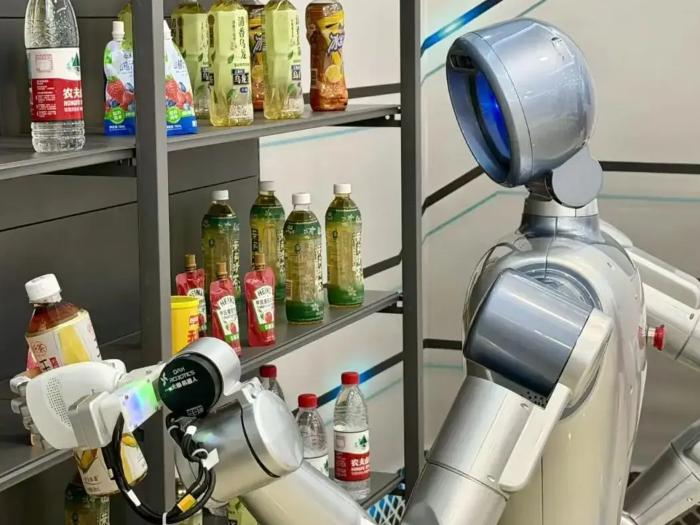
More and more robotics enterprises are focusing on convenience stores, pharmaceutical retail and cultural tourism scenarios
The essence of the difficulties of convenience stores is the stall after the redefinition of convenience. After crossing the extensive store opening growth stage, the digitalization process of convenience stores has also diverged: instant retail has achieved sustainable growth, but unattended operation has not yet achieved large-scale replicability.
The core competitiveness of convenience stores cannot be separated from "speed". Consumers enter the store, pick up goods and check out, pursuing efficiency throughout the whole process. It takes 1 to 3 minutes for a robot to get a bottle of drink, which is a regression of efficiency in the convenience store scenario, but an experience bonus in the scenic spot scenario. The same technology, placed in different scenarios, has completely different value judgments.
The demarcation between new species and old species does not lie in the competition between robots and humans, but in selling goods or selling experiences.
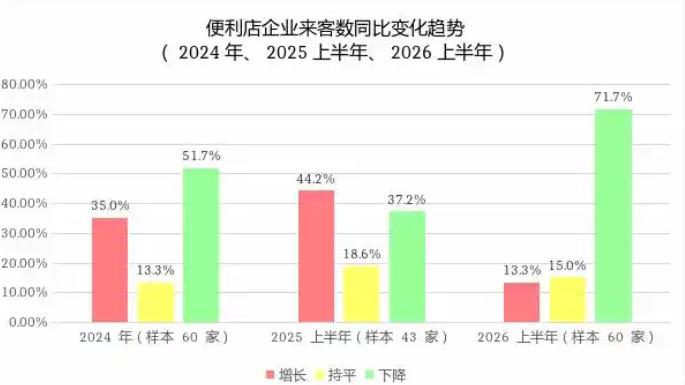
Image source: Zhengdian Consumption
Galaxy Universal has actually tried to enter the daily operation system of convenience stores. In April 2026, Galbot G1 officially settled in the FamilyMart Dinghao Store in Zhongguancun, Beijing, which can independently complete the picking and delivery of sausages, cold drinks and cooked food, and can also make coffee independently. This shows that robot retail and traditional convenience stores are not antagonistic, but may move towards integration.
But the premise of integration is that convenience stores must first figure out what exactly they are selling. Peng Jianzhen, President of CCFA, once pointed out that product strength is the real watershed for enterprise development in the next stage. The old logic of geographical convenience is no longer enough to support the continued growth and expansion of convenience stores.
More importantly, the commercial implementation of embodied intelligence has already started from scenic spots.
Industrial scenarios have extremely high requirements for rhythm, stability, safety and yield, and many projects are still in the verification stage. Family scenarios are more complex, and it is difficult to achieve large-scale implementation in the short term. In contrast, retail and cultural tourism are relatively friendly "newbie villages".
However, the 150,000-yuan single-store revenue is very eye-catching in the scenic spot during the National Day holiday, but whether these small robot stores can survive in the 300 days outside the Spring Festival, May Day and National Day holidays is the real test. Traditional convenience stores have taken decades to turn convenience into a sustainable business. What small robot stores need to prove is not only that robots can sell goods, but also that people will keep buying goods from robots.
This article is from the WeChat official account "Zinc Scale" (ID: znkedu), written by Zinc Scale, published with authorization from 36Kr.