Protein has become the new "Hope Project" for dairy enterprises.
In the global food and beverage market, "high protein" is becoming a universal consumer consensus.
Overseas, protein drinks have become a daily trend, and the sales growth rate of related products such as protein shakes, protein bars and protein powder has approached 200% within two years.
This boom has also swept across China, becoming a breakthrough for dairy enterprises to seek new growth.
Data from Ma Shangying Intelligence Station shows that in the second quarter of 2026, dairy product sales in the traditional offline retail market decreased by 8.48% year-on-year. Against the backdrop of a sluggish market environment, none of the leading dairy enterprises are having an easy time.
Yili's net profit attributable to shareholders in the first half of the year fell by 20.02% year-on-year, while Bright Dairy's revenue in the first half of the year dropped by 4.81% year-on-year. Mengniu has maintained growth, but its growth source has shifted from traditional ambient milk to three major businesses: fresh milk, milk powder and cheese.
Under pressure, dairy enterprises, riding the global rising protein economy wave, have launched a full-industry-chain "protein arms race", trying to pack more protein into product containers in various forms.
In the basic liquid milk market, the protein index is being pushed to the extreme. After the parameter war in dairy products, "protein water" in the beverage market has also become a new trend. At the same time, enterprises are extending their business to the downstream of the industrial chain, supplying high-protein customized raw materials for freshly made tea and coffee brands, trying to open up new incremental space in the B-end market.
However, the fact that the protein business is expected to become a growth driver for dairy enterprises does not mean that it is easy to operate.
Against the backdrop of the protein parameter competition in the liquid milk sector, costs are continuously rising. End-user awareness of protein water remains vague, and the profit margin of B-end OEM is uncertain. How this protein economy can be reflected in the growth data of dairy enterprises still awaits market verification.
The Business Race for 0.1 Grams of Protein
Liquid milk is the first battlefield where the high-protein competition among dairy enterprises emerged.
The competition kicked off in 2020. At that time, the protein content of domestic low-temperature milk was generally concentrated at 3.4-3.6 grams per 100 milliliters, and Yoplait launched 4.0+ milk containing 4.1 grams of protein per 100 milliliters. In 2023, this figure rose to 5.0 grams.
Nowadays, among the common brands in supermarkets, Mengniu's Daily Fresh has 4.0g of protein per 100ml of fresh milk, Yili's Jindian high-protein ultra-filtered milk reaches 4.4 grams, and Bright Youbei has launched 5.0 Ultra Fresh Milk.
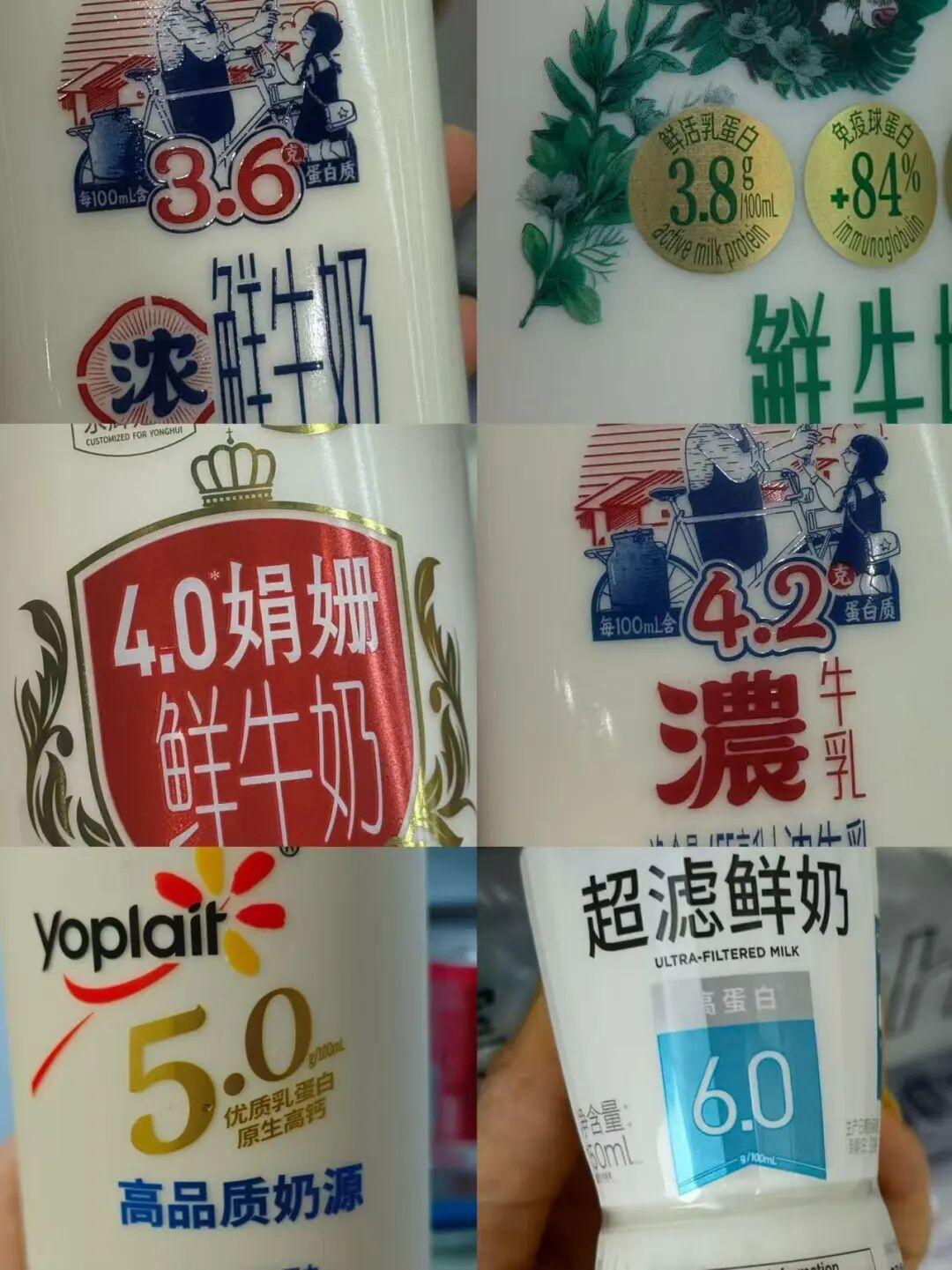
This competition has also extended from low-temperature fresh milk to the ambient milk market. In June this year, Mengniu launched M-PLUS Daily Protein Milk, which contains 15 grams of native milk protein per 250ml bottle, equivalent to 6 grams per 100 milliliters.
As a result, the protein competition in the liquid milk market has gradually risen from the conventional level of about 3 grams to 4 grams, 5 grams and even 6 grams. Protein content has evolved from a single product parameter to an important competitive point for dairy enterprises to win consumers and build product differentiation.
However, enterprises go to great lengths to raise the protein content marked on the packaging of the most basic white milk or low-temperature milk from 4.0g to 4.1g. How many consumers are willing to pay for this extra 0.1g, and is this business a profit or a loss?
From the 3.0 era to the 4.0 or even 5.0 era, this leap in parameters relies on the membrane filtration technology of dairy enterprises, such as ultrafiltration (UF). Dairy cow breeds, feeding management and the milk source itself will affect the protein content of raw milk, but to significantly increase the protein content of ordinary milk, industrial processing technology is essential.
The core logic of ultrafiltration technology is to filter out water and lactose in raw milk, so as to concentrate protein. That is to say, the higher the parameter, the more raw milk is lost, and the higher the processing cost.
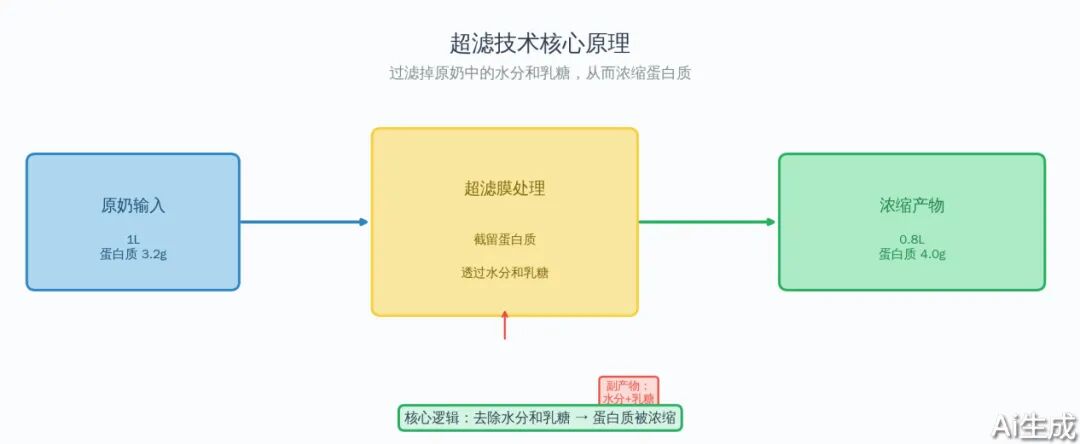
The specific cost increase depends on the process route, protein recovery rate, equipment efficiency and the utilization of by-product streams.
For example, Bright Youbei 5.0 adopts a combined process of nanofiltration concentration and ceramic microfiltration membrane sterilization; Mengniu M-PLUS adopts multi-stage membrane separation technology and realizes zero lactose through enzymatic hydrolysis process.
That different enterprises choose different technical paths itself shows that high-protein products are not as simple as just adding an extra filtration process. Enterprises need to strike a balance between nutritional density, taste and production efficiency, and also need product premium to maintain profits.
However, the market's acceptance of such premiums is decreasing. In particular, as more and more brands focus on promoting protein content, differentiation no longer exists, and consumers' choice criterion has returned to picking the cheapest product under the same protein content value.
According to the data of "Ma Shangying Intelligence Station", the overall sales of dairy products in the second quarter of this year decreased by 8.48% year-on-year. Although the sales of low-temperature pure milk increased, there was an obvious compromise in price. From the third quarter of 2024 to the second quarter of 2026, the average price of low-temperature pure milk per 100 milliliters dropped from 1.63 yuan to 1.59 yuan.
For low-temperature fresh milk that originally sold for 6-10 yuan per bottle on average, the promotional price of products from some mainstream dairy enterprises has dropped to 4-5 yuan, and some small and medium-sized brands sell their products at even lower prices.
In addition to the unsatisfactory sales prices, the ever-increasing protein values also bring other cost problems. For example, while raw milk is concentrated for protein, minerals are also concentrated synchronously, which will lead to a bitter taste and slightly salty milky fishy smell in high-protein milk.
To cover up the taste defects brought by the process, enterprises need to add nanofiltration technology for selective desalination. This not only increases the cost, but also reduces the health attributes of milk.
Despite all these problems, no enterprise dares to stop, and Mengniu's M-PLUS Daily Protein Milk is a typical example. It raises the protein content per bottle to 15 grams, takes nutritional supplementation before and after exercise as the main consumption scenario, and tries to push high-protein milk further from basic nutritional supplements to the precision nutrition market. Meanwhile, the unit price of one bottle has reached 12.9 yuan.
At the mid-term performance meeting in August 2026, Mengniu President Gao Fei said that he hopes M-PLUS will become another blockbuster product after Telunsu. But he also emphasized that the enterprise is not in a hurry to pursue sales, but hopes to build the brand well first and provide suitable products to suitable people and scenarios.
The so-called "not in a hurry to pursue sales" shows that enterprises are clearly aware that such new products take time to build consumer awareness. How long exactly it will take remains unknown.
The Wavering "Protein Water"
When increasing the protein content of liquid milk requires more and more careful calculation of input and return, dairy enterprises choose to take an alternative path, no longer wrapping protein in the form of milk, but directly taking it as the core component to develop protein water that is closer to ordinary beverages.
Since the end of 2025, enterprises such as Freshippo, Mengniu and Yili have successively launched related products, and protein water has gradually entered the public view.
However, the large number of participants does not mean that the new category has formed clear consumer awareness. Especially for consumers, for this new form of product that emerged out of nowhere, what is it actually selling, the protein itself, or "daily nutritional supplementation"? I am afraid that even the enterprises themselves have not figured out this problem.
Take the two giants Mengniu and Yili as examples. This year, Mengniu launched protein water with 10 grams of isolated whey protein per 250ml bottle, with a pre-sale price of 9.9 yuan. Its promotion focus also includes added BCAA and collagen peptides, focusing on professional recovery after exercise.
In May of the same year, Yili launched Puritime transparent protein water, which contains 9 grams of isolated whey protein per 300ml bottle. Different from Mengniu, it emphasizes the addition of electrolytes and lemon juice, trying to expand the scenario to the public's daily hydration.
Apart from dairy enterprises, there are all kinds of other players in this track.
Enterprises of all kinds such as Freshippo, Baixiang, and JD 7FRESH have also joined the market one after another. Some emphasize the whey protein content, some focus on exercise recovery, some highlight electrolytes and daily hydration, and others turn to beauty nutrition. The wavering positioning makes protein water face resistance in both end markets.
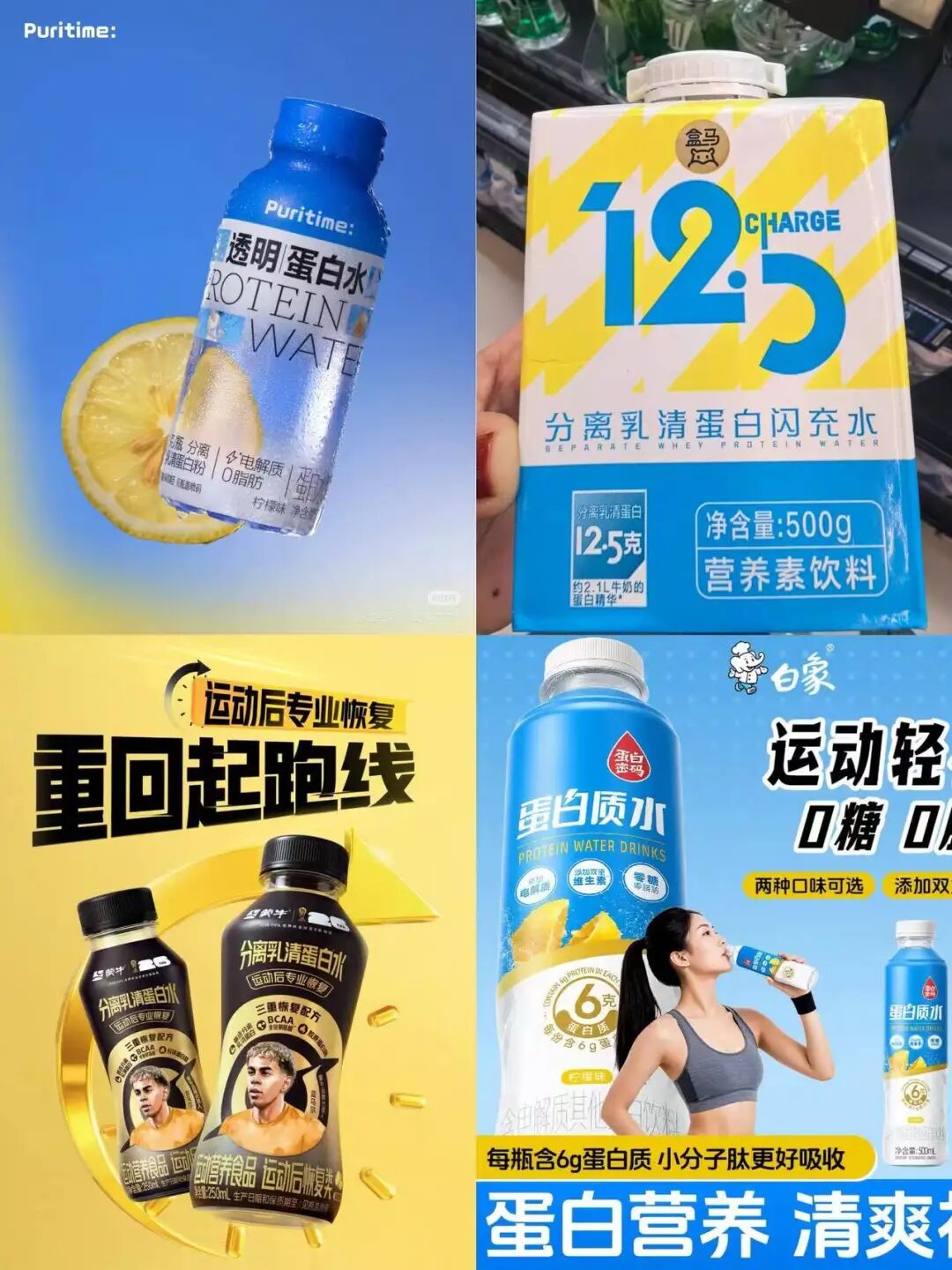
If positioned as professional protein supplementation, protein water needs to compete with large cans of protein powder and high-protein milk. But the advantage of protein water lies in convenience rather than cost, because its raw material, isolated whey protein, is extremely expensive itself.
Driven by the high-protein diet trend and the demand of GLP-1 weight-loss drug users, the selling prices of global concentrated whey protein WPC80 and isolated whey protein WPI90 both increased by more than 100% this year. In the short term, as the whey protein production capacity is difficult to expand rapidly, the price is unlikely to fall back. The selling price of protein water is destined not to be low.
Even for fitness people who have specific needs for protein supplementation, such a price gap is quite large.
Take Mengniu's product as an example, it costs 9.9 yuan to get 10 grams of protein; as a reference, buying a box of ordinary pure milk priced at 2.3 yuan (containing about 8 grams of protein), the cost of getting 10 grams of protein is only about 2.88 yuan. Relying solely on convenience is probably difficult to support such a huge price difference for a long time.
If positioned as daily nutritional supplementation, protein water needs to compete with electrolyte water and functional drinks. Many products keep adding ingredients to cater to the mass market, making the core memory point of the products unclear.
In terms of taste, whey protein naturally has astringency, powdery texture and slight bitterness after being dissolved in water. To maintain the refreshing experience of transparent water drinks, enterprises need to pay more costs to make the taste reach the basic level of other soft drinks.
In terms of implementation standards, protein water is still in a "chaotic period" at present.
There is no independent classification of "protein water" at the national level, and products on the market can only find their respective categories according to their actual formulas: Mengniu's product is marked as a sports nutrition food, FamilyMart Jishang belongs to flavored beverage, and Freshippo's product is marked as a nutrient beverage. Products under the same name have vastly different actual thresholds.
All called "protein water", some products use high-cost isolated whey protein, while some products from enterprises such as Baixiang and JD 7FRESH add collagen peptides. The nutritional value of the two is vastly different, but both can be used as raw materials for "protein water".
This complexity at the raw material level is also reflected in the recent new industry regulations.
The National Food Safety Standard for Milk Protein released in August 2026 has drawn a red line for industrial milk protein for the first time, requiring that the dry basis content of isolated milk protein must be ≥90.0g/100g, and vague naming is strictly prohibited.
Although the new national standard has standardized the quality indicators and naming of some upstream raw materials, its scope of application cannot cover the entire protein water industry. For protein water, different raw material routes correspond to intricate implementation standards.
Before the product classification, nutritional source and compliance standards are completely clarified, if enterprises cannot clearly explain to consumers what protein is contained in a bottle of water and why it is sold at a high price, this new category will hardly move from short-term trial purchase to long-term stable repurchase.
Industrial Opportunities Beyond the Shelves
The competition for high-protein milk has moved from the shelves to coffee machines and tea preparation counters.
Starbucks previously launched the "High Protein Pro" series of coffee added with whey protein. Industry sources say its raw material supplier behind the series is Mengniu. Suppliers usually do not appear in the front end of freshly made beverage brands, but this cooperation quickly entered industry discussions.
No matter whether this exposure is the result of brand communication or industrial chain communication, it has made Mengniu's another capability visible: Mengniu can not only sell high-protein dairy products, but also provide customized raw materials and application solutions for downstream brands.
Subsequently, Luckin Coffee also launched a high-protein yogurt drink, but the supplier was not made public.
The protein competition has thus extended from the product shelves on the consumer side to the B-end supply chain of freshly made beverages.
For coffee and new tea brands, "high protein" is another product label following zero sugar under the healthy consumption trend. For dairy enterprises, freshly made beverages provide new distribution channels, which can help them digest the expanding product lines of milk protein, whey and other products.
Brands get new selling points, and dairy enterprises get new orders, and both get what they need. But this business is not as simple as adding one more SKU on the shelf.
In June 2026, Mengniu released its milk raw material brand MnmpX, providing food industry customers with products such as milk protein and whey, as well as customized application services.
For downstream brands such as Starbucks and Luckin, high protein is still more like a product under test at present. In the early stage of the launch of High Protein Latte Pro, Starbucks once launched a same-price activity in designated stores on Mondays, allowing consumers to try the high-protein version at the price of ordinary latte. If the market feedback is not good, the brand can remove the product from shelves, and the trial and error cost is relatively limited.
But for upstream dairy enterprises, the situation is not so simple. Dairy enterprises need to invest in raw material R&D, formula testing, production line transformation and quality verification in advance, and also ensure stable delivery of products in different batches. A short-term new product launch may mean a heavier supply chain investment.
Industrial milk protein itself has a high customization threshold. According to the new national standard, the dry basis protein content of concentrated milk protein must reach more than 40.0g/100g, and that of isolated milk protein must reach more than 90.0g/100g. The deep processing links of dairy enterprises such as ultrafiltration, concentration and drying need to have the ability to stably produce qualified products.
Meeting the standards is only the first step. Dairy enterprises also need to solve the practical problems after high-protein raw materials enter freshly made beverages: high-concentration protein liquid needs to maintain stable foaming when heated by coffee machine steam; when mixed with acidic fruit juice or high-temperature tea, flocculation and stratification must not occur; at the same time, the natural slight astringency of whey protein needs to be reduced through formula and process.
These requirements push the competition of dairy enterprises from protein content to application capability. Whoever can stably solve the problems of taste, solubility, foamability and delivery will have the opportunity to get longer-term B-end orders.
But whether the