Wash speaks highly of AI, will the Federal Reserve refrain from raising interest rates in October?
This is the first time Walsh has systematically elaborated on his policy stance at a multilateral occasion since he took the helm of the Federal Reserve in May.
On local time October 16, during the 2026 Annual Meetings of the International Monetary Fund (IMF) and the World Bank held in Bangkok, Thailand, Federal Reserve Chair Kevin Walsh held a fireside chat with IMF Managing Director Kristalina Georgieva, covering topics including AI, monetary policy and the global economy.
AI is the most profound economic transformation in a lifetime
Walsh's positioning of AI is extraordinarily rare in its high regard.
He emphasized that AI is the most far-reaching economic transformation he has witnessed in his lifetime.
In his view, AI will first impact the demand side, then unlock productivity dividends on the supply side, and ultimately make the economy more productive and create more wealth.
At present, capital expenditure on data centers, chips and power infrastructure is competing for resources and driving up prices; but in the medium term, AI will bring a positive supply shock.
However, he also warned that "the road to this goal will be very bumpy", and the impact on employment in the next 12 to 18 months remains uncertain.
"I want everyone to feel my optimism, but this optimism carries a serious mission."
To this end, he announced that the Productivity and Employment Task Force established in June will hold its first on-site hearing in the San Francisco Bay Area on November 16.
This is one of five external expert task forces he set up, all of which are expected to submit policy recommendations to the Federal Reserve around the end of the year.
Wei Liang Chang, a macro strategist at DBS Bank, pointed out that Walsh's reaffirmation that AI will boost productivity in the medium term helps ease inflation expectations and reduce market concerns about successive interest rate hikes by the Federal Reserve, which "will reassure the market".
It is worth noting that recently, affected by concerns that the AI capital expenditure boom may cool down, the Philadelphia Semiconductor Index of US stocks has fallen for the seventh consecutive trading day.
Jonas Goltermann, chief markets economist at Capital Economics, warned that more and more signs of the end of the cycle are emerging in US stocks, and a more sustained pullback may occur in the next year or so, accompanied by a decline in US Treasury yields.
He believes that this stock-bond combination exactly matches the market performance that may appear when the AI boom begins to reverse.
Manish Singh, chief investment officer of Crossbridge Capital, further said that although AI demand and long-term opportunities are real, it does not mean that every enterprise building infrastructure can bring satisfactory returns to investors.
"AI may represent the future, but debt repayment is the present."
The interest rate meetings in October and December will be data-dependent
Since the Federal Reserve implemented its first interest rate hike since 2023 in September, the market has been closely watching Walsh's statements on monetary policy.
Meghan Swiber, a US interest rate strategist at Bank of America, said before Walsh's speech that investors are closely watching whether he will "green light" further interest rate hikes by the Federal Reserve.
The answer is: No.
Walsh is unwilling to disclose in advance the possible actions to be taken at the remaining meetings this year.
He emphasized that the Fed's policy conclusions "should not have a preset stance", and it is not appropriate to send signals in advance about what actions may be taken at the remaining meetings this year at the current stage.
When talking about the September interest rate hike decision, Walsh said that the Federal Reserve "clearly demonstrated its determination to achieve price stability" and reduced the degree of monetary easing.
Regarding the next policy path, he said that the trend of the global economy is "generally in line with" the Fed's expectations. There are two remaining interest rate decision meetings in October and December this year, and policymakers will be able to more clearly assess economic output, employment and inflation at that time before determining the monetary policy path.
The timing of this statement is quite sensitive.
On the eve of the speech, the US September CPI and PPI data were released one after another, both exceeding expectations: CPI rose by 3.7% year-on-year, core CPI rose to 2.6% year-on-year, higher than expected for the second consecutive month; PPI soared by 6.3% year-on-year, the largest monthly increase since March 2022.
Despite rising inflation, most Fed watchers still expect the central bank to keep interest rates unchanged this month, postponing the next rate hike to December.
According to the CME "FedWatch Tool", the probability that the Federal Reserve will keep interest rates unchanged in October is 85.1%, and the probability of a cumulative 25 basis point rate hike is 14.9%; the probability of keeping interest rates unchanged in December is 10.8%, and the probability of a cumulative 25 basis point rate hike is 76.1%.
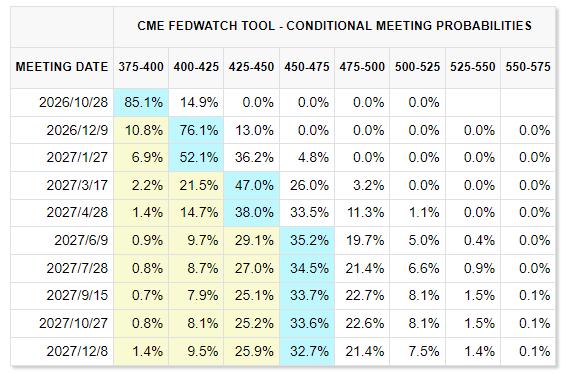
At present, many voting members of the Federal Reserve tend to wait until the December interest rate meeting to take action.
Several senior officials including Federal Reserve Vice Chair Philip Jefferson, Governor Christopher Waller, and New York Fed President John Williams have previously sent signals that there is no urgent need to take further action after the September rate hike.
Guy LeBas, chief fixed income strategist at Janney Montgomery Scott, believes that although the price increase of many categories is indeed at a high level, there is no substantial evidence that inflation is accelerating.
Analysts remind that against the background of rapid economic changes, do not overreact to a single data point. Waiting until December to consider raising interest rates will allow the Federal Reserve to have more time to assess the potential trend of prices.
The global economy is in a stage of structural growth
In addition to AI and monetary policy, Walsh also talked about the global economy.
He believes that the global economy is currently in a stage of structural growth, experiencing a round of investment boom that is "not limited to the AI field".
"The economies in almost all regions of the world have shown resilience, which I could not have anticipated five or six months ago."
Walsh attributed this round of investment prosperity to a favorable policy environment, and believes that it is the single most important factor driving the improvement of the global economic development trend.
However, he also admitted frankly that he "may be too sensitive to the shadow left by the global financial crisis".
Since US President Trump launched a war against Iran in February, global energy prices have skyrocketed, triggering Tehran's retaliatory actions against US Gulf allies, plunging the Middle East into crisis.
The rise in oil and gas costs, superimposed on the AI investment boom, has pushed up inflation in many economies including the United States, forcing central banks around the world to raise interest rates.
Walsh pointed out that sustained inflation is a common challenge faced by central banks around the world. At present, most regions of the world are synchronously tightening monetary policy, and "no one can free ride".
It is worth noting that just a few days ago, the IMF released the Global Financial Stability Report, stating bluntly that the global economy is "tilted to the downside in terms of risks".
Chief Economist Silvana Tenreyro warned that the global economy has shown resilience, but this resilience is approaching its limit.
This article is from the WeChat official account "Gelonghui Finance Hotspot" (ID: glh_finance), author: Sun Over the Mountain, published with authorization from 36Kr.