Are Robot CEOs Collectively Losing Sleep?
Editor's Note: The trillion-dollar embodied intelligence track is undergoing a fierce game between real value and inflated valuation. This is the 05th issue of *Rushing Robots*, which faces the real dilemma of the contradiction between financing and profitability of robotics companies.
Over the past year, endless financing news has hidden the anxiety of embodied intelligence entrepreneurs behind the scenes.
However, entering October 2026, the bustling financing market has begun to show some changes: the financing popularity of embodied intelligence has shown signs of cooling down.
According to data from IT Juzi, as of October 15, 19 financing deals have been completed in the embodied intelligence industry, with a total amount of 4.934 billion yuan. In contrast, from July to September, there were more than 70 financing deals per month, and in August, the number reached 91 with a total amount of 31.323 billion yuan. Although October has not passed halfway, compared with the previous months, the financing popularity has declined.
An industry insider pointed out that most of the currently disclosed financing news are transactions that were finalized several months ago. "The real changes in the market often take some time to be reflected in the data."
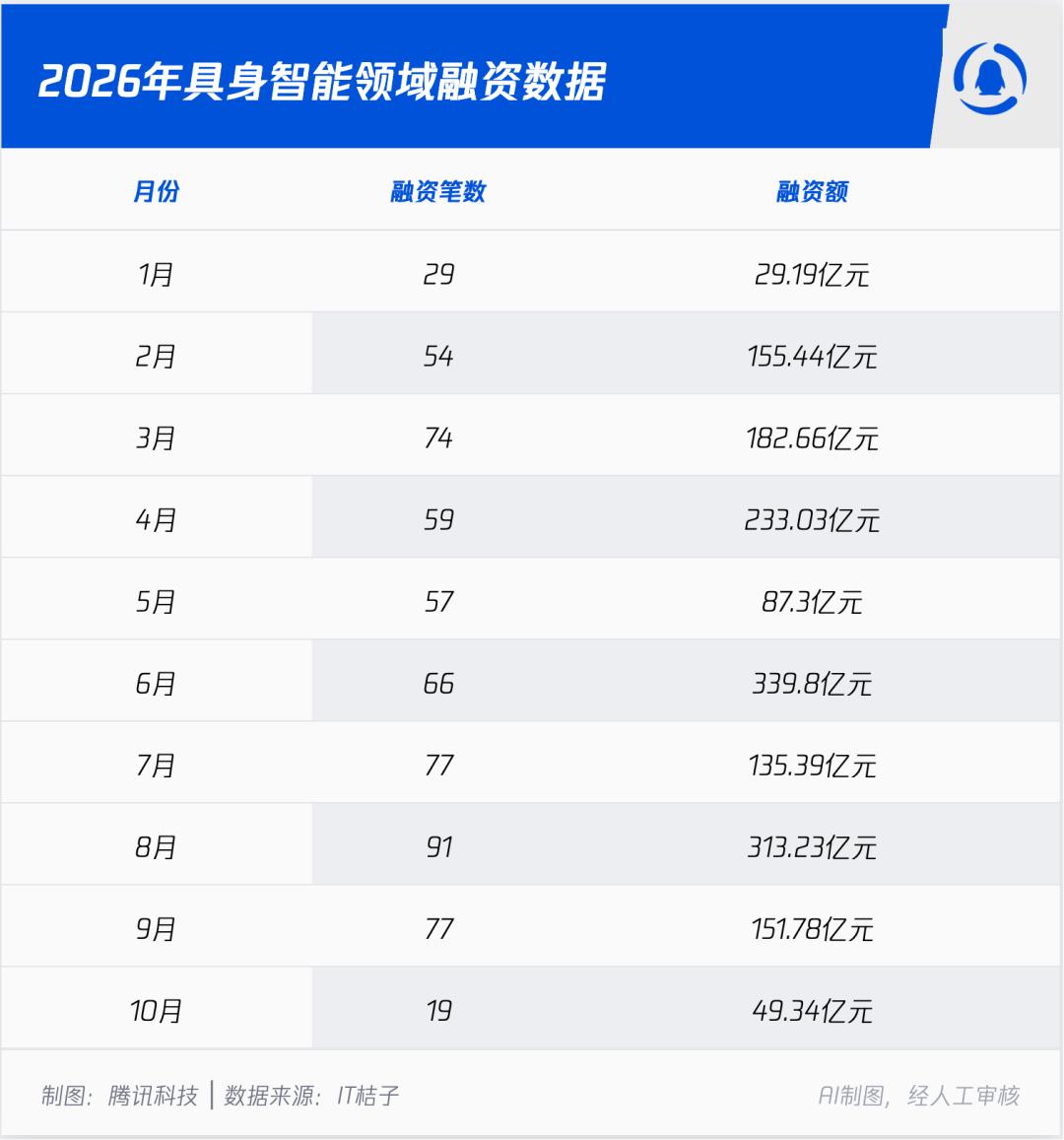
At the same time, the anxiety of some embodied intelligence founders has also begun to surface.
"The news from two FAs both says that the listing is suspended, our founder didn't sleep all night yesterday." An employee in the embodied intelligence industry revealed to Tencent Tech, "The current market situation is unclear." What is unclear is not only the trend of the capital market, but also the time of technological breakthroughs, the speed of commercial implementation, and how long the entire industry will have to wait.
"This is a track with a cycle of 10 or 20 years. For many people, maybe their whole youth has passed, and they still can't wait for the day when the industry is truly mature." Hong Shaotun, an investor in the embodied intelligence field, told Tencent Tech.
But entrepreneurs are still trying various methods to find orders, explore scenarios, adjust directions, and try to gain more certainty for themselves in the long industrial cycle.
Behind the glamorous financing stories, some robotics practitioners are experiencing unknown anxiety.
"A group of people rushing forward despite despair"
Hong Shaotun told me that this track is full of "a group of people rushing forward despite despair".
Because they don't know exactly how long it will take to achieve the final goal. "For example, Li Feifei, a representative figure standing at the forefront, also believes that the time cycle for AGI to develop into embodied intelligence may be 10 years, or even 20 years." For many entrepreneurs, maybe their whole youth has passed, and they still can't wait for the day when general-purpose robots are truly realized.
Not only the founders, but also the front-line employees are in the same situation, "they actually don't have a clear sense of purpose."
At a robotics industry event, I once talked with a robotics algorithm engineer about VLA and world models. These popular technologies that are repeatedly discussed in the industry are not so mysterious in his eyes. "VLA is essentially a few lines of code. After building the model architecture, input physical data, and then adjust continuously according to the output results." He described his daily work as constantly adjusting various parameters, "it's not that mysterious."
As for whether there will be a better technical solution in the future, he can't explain clearly. Similar confusion also exists in other robotics companies. "Even my +1 and +2 leaders can't reach an agreement on whether to build an embodied model or take the route of hardware-software integration." A product manager in the robotics industry told me, "The management hasn't figured it out, so we at the grassroots level have no idea what to do."
Although no one has figured it out yet, product iteration still needs to continue, and the iteration speed of large models hardly gives robotics companies much chance to catch their breath. "There will be various large and small product iterations every quarter, every month, or even every few weeks."
This is a bit like a marathon with no end in sight. No one knows how long they have to run, but the people around them are constantly accelerating, so they dare not stop.
This contradiction is a special product of the current development stage of embodied intelligence. "Every industry has its own development curve. At present, embodied intelligence is still in the bubble period of the first stage." Hong Shaotun explained.
At this stage, the technical routes have not converged, and products and business models have not been fully verified. For a start-up company, how to prove its technical strength to the outside world has become a practical problem.
From the perspective of hardware, there are still differences in technical routes. Hong Shaotun gave an example, "Tesla adopts a scheme that combines linear and rotary actuators, while domestic enterprises mainly use rotary joint drives. Even in China, enterprises such as Unitree and DeepMotion that emphasize motion performance have differences in the selection of core components such as reducers compared with enterprises oriented to industrial operation scenarios. The problem is that there is no clear answer to what scenarios robots will work in and what kind of hardware they need in the future. Product competition is already very fierce, but the technical routes are still being explored, which also makes it difficult for investors to judge which direction the money should be bet on."
From the perspective of models, there is also no convergence. Last year VLA was very popular, this year it's the turn of the world model, what will it be next year? In addition to these two routes, different directions such as brain-inspired models are also emerging. But model R&D is more money-burning than hardware, and continuous investment is required in computing power, data collection and training.
Therefore, how to do it and which direction to take are things that need to be explored in a short time, which is also one of the sources of their collective anxiety. The deeper anxiety is the capital anxiety behind the slowing down of the influx of hot money in the market.
Money, money, or money
At the end of the day, embodied intelligence is still an industry with huge investment and limited returns.
For most start-up companies, the most realistic choice at the moment is to raise as much money as possible to let themselves survive for more years.
This also explains why when the FA spread the news that the IPO is suspended, some founders will be so anxious that they can't sleep all night. Once the expectation of listing exit is affected, the investment willingness of the primary market may decline accordingly. "In fact, market-oriented VCs have basically stopped investing in the embodied intelligence track." A practitioner said.
In this context, whoever can reserve enough funds in advance will have the opportunity to get a longer period of technical exploration. For new companies that have not yet established obvious advantages, the survival pressure will be even greater.
But embodied intelligence is very money-burning.
Hong Shaotun summarized that funds mainly flow to four directions: talents, computing power, data, as well as production lines and supply chains.
The first three items have been the main investment in the industry for a long time. This year, as robotics companies pay more and more attention to commercial implementation, production lines and supply chains have become a new cost. Taking factories as an example, at this stage, robots mainly try to enter semi-structured scenarios where fixed production lines and dynamic operation environments coexist. It is difficult to directly replace the entire production line, and they can only start from one or two processes. But even small-batch delivery requires building production lines, purchasing parts, and coordinating suppliers, which all mean new capital investment.
While burning money, the channels for making money are narrow. At present, there are two main sources: financing and commercial revenue.
First look at financing. As the investment enthusiasm in the primary market cools down, the financing difficulty of robotics companies is also increasing, and the uncertainty of listing prospects is particularly concerned.
Recently, the market has spread the news that Agibot Innovation has replaced the short-term IPO plan with a new round of financing. According to relevant sources, Agibot is pushing a new round of financing of about 1 billion to 1.5 billion yuan, with a valuation of about 50 billion yuan, and the financing is nearing completion. However, whether this means that it cannot complete the Hong Kong stock IPO within this year remains to be confirmed.
For the VCs behind it, if the listing time of the enterprise is delayed, they may need to find other ways to exit. Compared with waiting for IPO, it is also an option to exit in advance through the transfer of old shares while the valuation of the enterprise is still rising.
A VC in the hard technology field told Tencent Tech that when the valuation of the enterprise continues to rise, it is often a good time to transfer old shares. "Only during the valuation rising period can you have the opportunity to sell old shares, otherwise you can't sell them." Once the valuation stops rising, the liquidity of equity may drop rapidly. "If the valuation does not rise, it is equivalent to losing liquidity, with a price but no market."
This also explains an interesting phenomenon in the embodied intelligence track: many of the public-facing figures in front of the stage of robotics companies are not necessarily the founders themselves, but those star talents with their own technical aura. "This is conducive to bringing aura to the enterprise, so as to quickly increase the valuation." The investor explained.
For example, Peng Zhihui, who was once called "Huawei Genius Youth", is a representative figure of Agibot, but not the founder of the company; Wang He from Galaxy Universal is also the technical face of the company, but his position is CTO; Huang Qingqiu with Huawei background is also the CTO of Moqi Technology, not the founder.
These technical stars are pushed to the front of the stage, with practical considerations behind them. At the stage when technology and business models are not yet mature, a sufficiently impressive technical resume is often easier for capital and the outside world to build confidence than products that have yet to be verified.
"But at this stage, it is difficult to impress investors by competing for teams and models." Hong Shaotun believes that the current stage has reached the stage of competing for orders and deliveries, which derives another revenue route for embodied intelligence enterprises — orders.
However, at this stage, the commercial revenue of robots is also limited. The above-mentioned VC said that the early orders in the industry mainly come from government-related procurement and "grouping" orders between industrial chain enterprises. Although it can bring a certain amount of income, the overall scale is still difficult to cover the high R&D and operation costs. In July this year, Zhou Zhifeng, managing partner of Qiming Venture Partners, once told Tencent Tech that the embodied intelligence market will soon enter the stage of "Show me the money", and investors will pay more attention to whether robots can truly land and be converted into sales revenue and profit margins.
So, if embodied intelligence enterprises are facing the current situation of cooling financing and few orders, how can they break the situation?
Tap revenue scenarios, each showing their own magic powers
"Some enterprises with capital reserves can first make the model to the extreme and hold on for a while." The above-mentioned embodied intelligence practitioner said, but for more enterprises, they still need to combine their own advantages to find profitable scenarios as soon as possible.
Judging from the actions of leading embodied intelligence enterprises this year, there are more and more ways to make money. In addition to selling robots directly, businesses such as leasing, software subscription, and data services have all been tried.
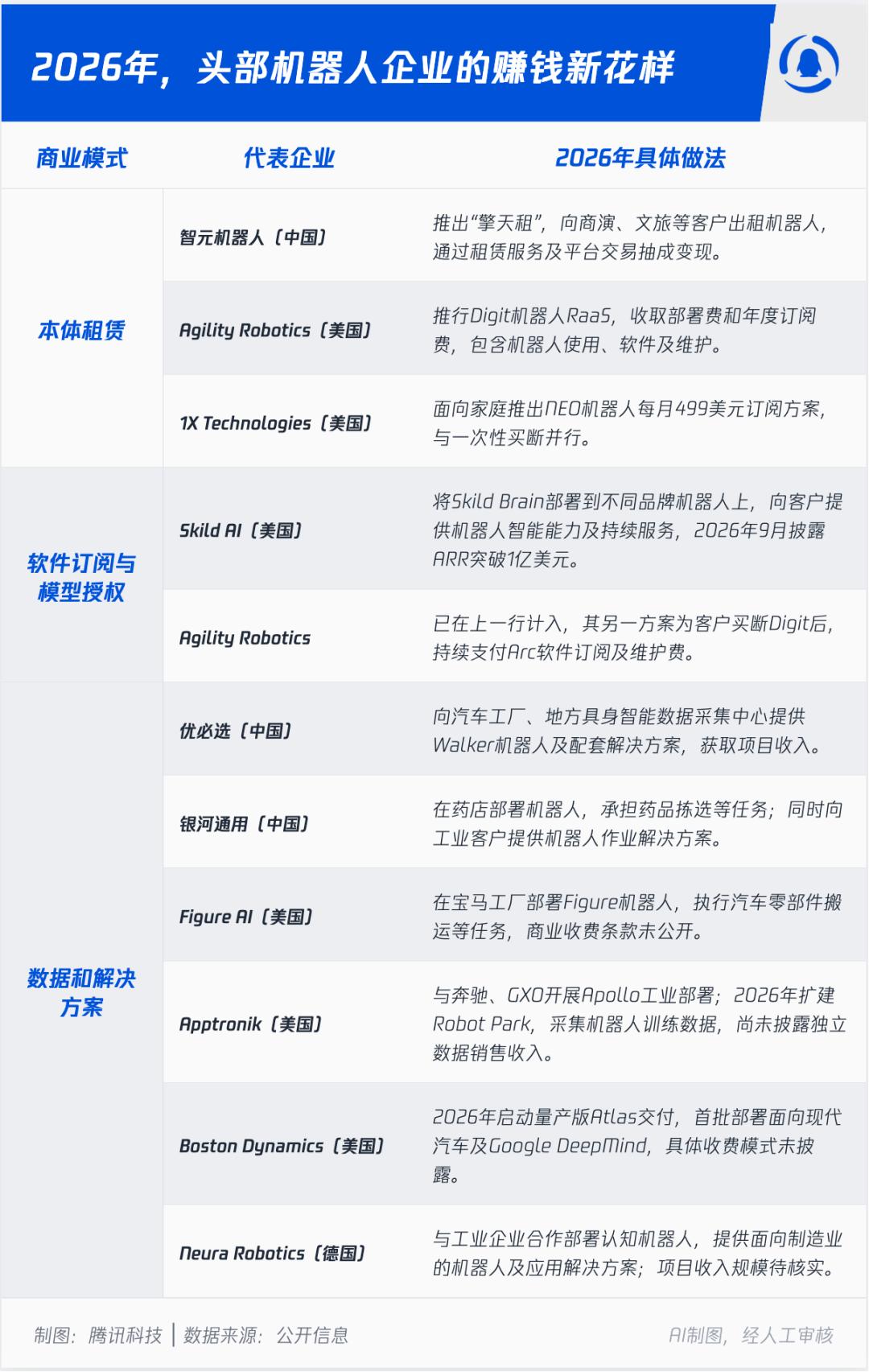
The first type is leasing, which turns one-time transactions into long-term charges.
In 2026, Agibot began to increase its efforts in the robot leasing business. Its holding platform "Qingtian Zu" leases robots to customers such as shopping malls, scenic spots, and corporate annual meetings. Robots don't have to work in factories; dancing, performing, and welcoming guests can also generate income. The platform tries to make money by taking a cut from orders.
Overseas enterprises are also trying similar businesses, but they are more inclined to long-term use. The American humanoid robot company Agility Robotics launched the RaaS (Robot as a Service) model. Customers do not need to buy the Digit robot directly, but pay deployment fees and annual subscription fees to obtain robot usage, software and maintenance services.
The home robot company 1X launched a $499 monthly subscription plan for NEO, parallel to the $20,000 one-time purchase price.
These models have one thing in common: customers do not have to bear the high purchase cost at one time, and robotics enterprises also have the opportunity to obtain continuous income. But leasing does not mean that it is easier to make profits. Equipment depreciation, maintenance, labor and operation costs will eventually be borne by the enterprise.
The second type is service and software subscription, so that robots can continue to charge after being sold.
This year, Agility Robotics disclosed two sets of charging plans for the Digit robot. In addition to the leasing model mentioned earlier, customers can also buy the robot directly, and then pay the Arc management software subscription fee and maintenance fee on an annual basis. According to the company's calculation, one Digit can bring a cumulative revenue of about $400,000 within five years.
Going a step further is to directly sell the "brain" of the robot. In September this year, the American embodied intelligence model company Skild AI announced that its annual recurring revenue (ARR) exceeded $100 million, with more than 60 paying customers. Different from relying on the sales of a certain robot, Skild AI deploys the general robot model Skild Brain to robots of different forms, and obtains revenue by providing model capabilities and related services.
For such enterprises, they do not necessarily have to manufacture the robot body themselves, and models and software can also become a separate business.
The third type is selling data and solutions.
This year, Agibot spun off its data business and established Mifeng Technology. In September, Mifeng launched "Mifeng Pai", allowing ordinary people to wear devices to collect daily operation data, and then process the data and provide it to robotics companies.
Ubtech provides Walker robots and supporting solutions to automobile factories and embodied intelligence data collection centers. In 2025, its full-size embodied intelligence humanoid robot products and services generated a revenue of about 821 million yuan, but the company as a whole is still not profitable.
However, it is still unknown how far these new money-making methods are from supporting a robotics company to survive for a long time.
Before robots really learn to make money, founders will probably have to lose sleep for a while longer.
This article is from the WeChat Official Account "Tencent Tech", written by Zhou Xiaoyan, and published with authorization from 36Kr.