Who is bankrolling the world model sector? In addition to GL Ventures and HSG, this robotics company has surprisingly also taken a seat at the main table.
How exaggerated is the current financing pace in the world model track?
In 2026, for a newly established world model startup, the median time from official announcement of its establishment to obtaining the first tranche of financing is only two months. This is not an isolated case, but the median level of 39 sample companies.
Then, you may also wonder: Who on earth is making high-frequency investments in world model projects and competing for the home field of the first financing round?
The initial round is the moment with the lowest valuation, highest risk, and the greatest test of investors' judgment. Who puts in the money at this moment will profoundly affect the financing resources and valuation anchor of this company.
We took 79 world model companies established and financed between 2024 and 2026 in the IT Juzi database as valid samples (the selection of companies founded after 2024 is based on the sample distribution, we have excluded samples of large technology enterprises, vehicle manufacturers, robotic embodied hardware companies, AI video and image generation platforms, to better retain the group of startups whose core main business is world models), penetrated the list of their initial round investors, and interpreted this core question: Where does the money come from? Who exactly holds the first ticket on this track?
TOP 10 "Seize the Lead" Institutions: GL Ventures Takes the Lead, Followed by HSG and Inno
Ranked by the number of companies that participated in the initial round of financing, among the top dozen institutions, GL Ventures, HSG and Inno Fund take the lead, occupying the top three positions on the list. The most surprising thing is that the industrial player Agibot Robot broke into the top five of the list and took a seat at the main table. Those leading VC institutions that understand and invest in AI unexpectedly failed to outperform a unicorn enterprise making robots.
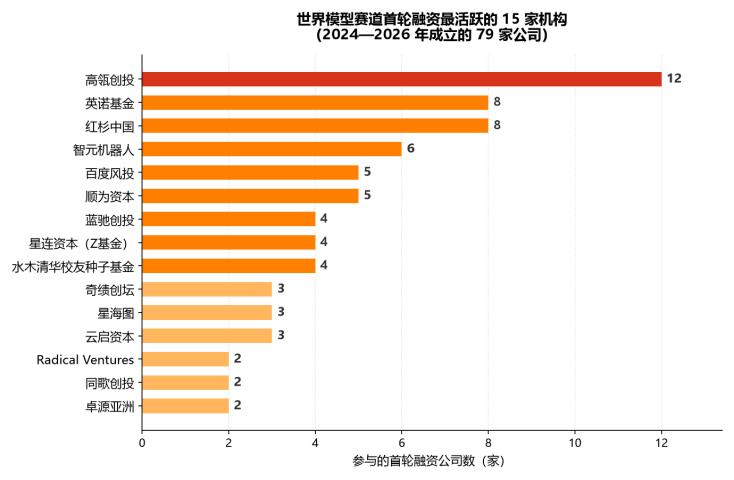
Figure note: Data source: IT Juzi MCP, with 79 companies as samples
If we match the top ten investors one by one with their investment years and the projects they invested in, we will get the following results:
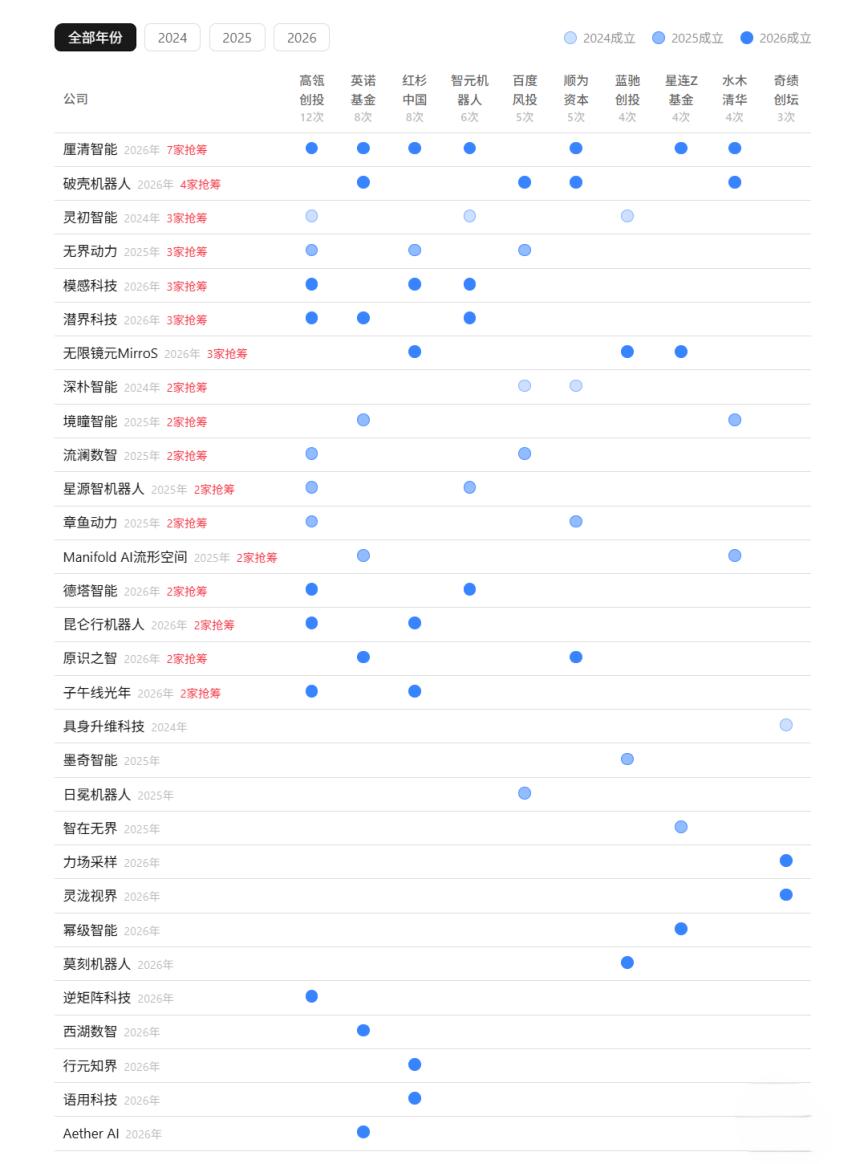
Combined with the situation of invested enterprises and institutions' investments, several situations are worth pondering.
First, the investment portfolios of these institutions are highly overlapping, instead of placing scattered bets respectively.
According to statistics from IT Juzi, the top ten institutions have made a total of 59 investments, covering 30 world model startups, 17 of which have been invested by more than two institutions, with an overlap rate of 57%; 7 enterprises have been jointly backed by more than three capital parties. In particular, Clarify Intelligence is the best "stake-grabbing king" in the whole field — 7 TOP10 institutions all appear in its initial round investor list.
Second, GL Ventures and HSG launched a "close combat" in 2026.
GL Ventures leads the whole list of institutions with 12 investments, but the rhythm shows a trend of increasing year by year: 1 company in 2024, 4 companies in 2025, and 7 companies in 2026. HSG, on the other hand, came from behind, making only 1 investment in Wujie Power in 2025, and reaching 7 companies in one go in 2026, tying with GL Ventures.
Moreover, these two leading institutions have heavily invested in the same batch of companies in the same year. For example, 4 companies including Clarify Intelligence, Meridian Lightyear, Kunlunxing Robot, and Modsense Technology appear on the lists of both institutions, indicating that their judgments on "who are the leading projects" are highly overlapping, which in fact raises the investment threshold for leading projects.
Third, leading institutions reached a consensus on the world model track in 2026 and entered the market in groups.
Among the TOP10 institutions, GL Ventures is the only institution that has invested continuously from 2024 to 2026. The rest of the institutions entered the market in 2025, such as Inno Fund and Starlink Capital, and more of them began to make concentrated investments in world models only in 2026, following the initial rounds of projects in groups, indicating that capital has truly formed a consistent bullish expectation for this track this year.
Four Signals: Where Does the Money Come From and What Is the Pattern of Investors
From a larger perspective, the following layers of signals revealed in the initial round investors of 79 world model companies are worthy of attention.
■Signal 1: Two-thirds of the "tickets" are in the hands of leading VCs.
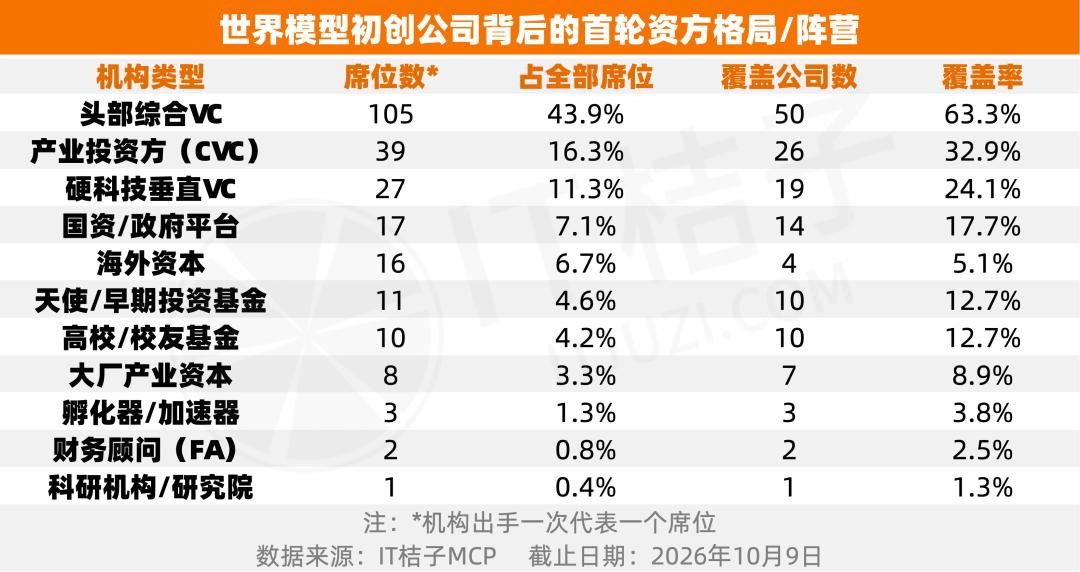
Among the 79 startups, the initial round financing of 50 of them involved leading comprehensive VC institutions, with an initial round coverage rate of 63.3%, which means that nearly two-thirds of the "first tickets" in the world model track are dominated by leading VC capital, with industrial investors, vertical VCs focusing on hard technology and state-owned capital as supplements.
In addition, university-affiliated funds have covered the initial rounds of 10 world model companies, including Shuiwu Tsinghua Alumni Seed Fund invested in 4 companies such as Manifold Space, Peking University Yanyuan Venture Capital participated in the investment of 2 companies including Inverse Matrix Technology and Wisdom Without Boundary, Fudan Science and Innovation participated in the investment of Linglong Vision, and Westlake University invested in and incubated Westlake Digital Intelligence.
■Signal 2: Robot companies investing in "world models" are building their own ecosystems.
Industrial investors (non-CVCs of comprehensive giants such as BAT) appear in the initial round lists of 26 world model companies.
Among them, Agibot Robot is the most aggressive industrial capital in this round, participating in the investment of 6 world model startups, including Lingchu Intelligent invested in 2024, Xingyuanzhi Robot invested in 2025, and Clarify Intelligence, Data Intelligent, Modsense Technology and Potential Boundary Technology invested in 2026.
Star Seamap participated in the investment of 3 companies such as Liulan Digital Intelligence, Horizon Robotics and Lingchu Intelligent each invested in 2 world model enterprises, while UBTECH Robotics, Star Era, Li Auto etc. made sporadic investments. The industrial capital basically covers the leading enterprises in half of the robot industry chain.
Although most of these robot companies are still startups that may need to rely on financing to maintain their own operations, they are still actively deploying upstream world model technologies, trying to build their own ecological barriers; world model enterprises output "embodied brain", perception and decision-making capabilities, which are exactly the capabilities that embodied intelligent companies urgently need. Moreover, the technical route has not yet converged, so multi-line deployment and direct equity participation in the seed round to bind partners is a feasible strategy.
When industrial capital has appeared in this wave of initial round financing, it means that the alliance between "technology providers" and "scenario providers" has been advanced to the first day of the company's establishment.
■Signal 3: Leading institutions choose to keep betting, while more institutions are just "participating for the sake of participation".
IT Juzi data shows that only 38 institutions have appeared more than twice in the initial rounds of the world model track, and the remaining 120 institutions in the whole sample have only made one investment.
Leading institutions place repeated bets while long-tail institutions make symbolic attempts, which may also be a typical form of the track transitioning from "no man's land" to "consensus period"; currently the market is not short of money, what is lacking is certainty after repeated verification by institutions.
■Signal 4: The track is still accelerating its layout.
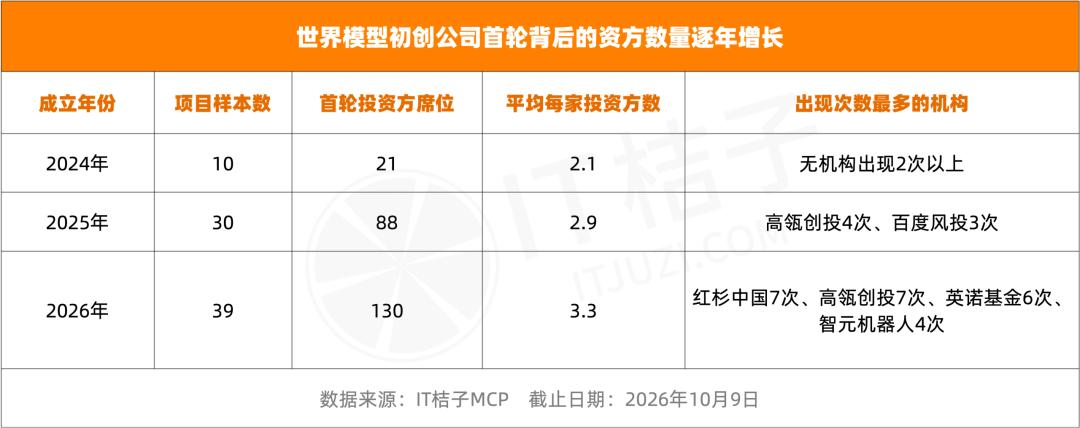
According to IT Juzi data, the average number of investors introduced in the initial round of each world model enterprise increased from 2.1 in 2024 to 2.9 in 2025 and 3.3 in 2026.
At the same time, no institution made two repeated investments in this track in 2024, some institutions began to place multiple bets in 2025, and in 2026, GL Ventures, HSG, Inno Fund, Agibot Robot and other institutions collectively made high-frequency investments.
This acceleration curve shows that the hotter the track is, the higher the "shared table density" of a single round of financing, and the shorter the time window for institutions to grab stakes. Moreover, the higher the amount of money required for initial round financing, the stronger the institution's demand to spread risks, and the more likely multiple institutions will jointly invest.
Finally, the landscape of capital forces in the world model track has gradually emerged. For startups, the choice of the initial round investor list is never random — choosing which institution means choosing which valuation anchor.
This article is from the WeChat Official Account "IT Juzi" (ID: itjuzi521), written by Wu Meimei, published with authorization from 36Kr.