Global smartphone shipments plummeted by 22% in the third quarter, marking the largest drop on record.
The storage chip crisis continues to hit the global smartphone market.
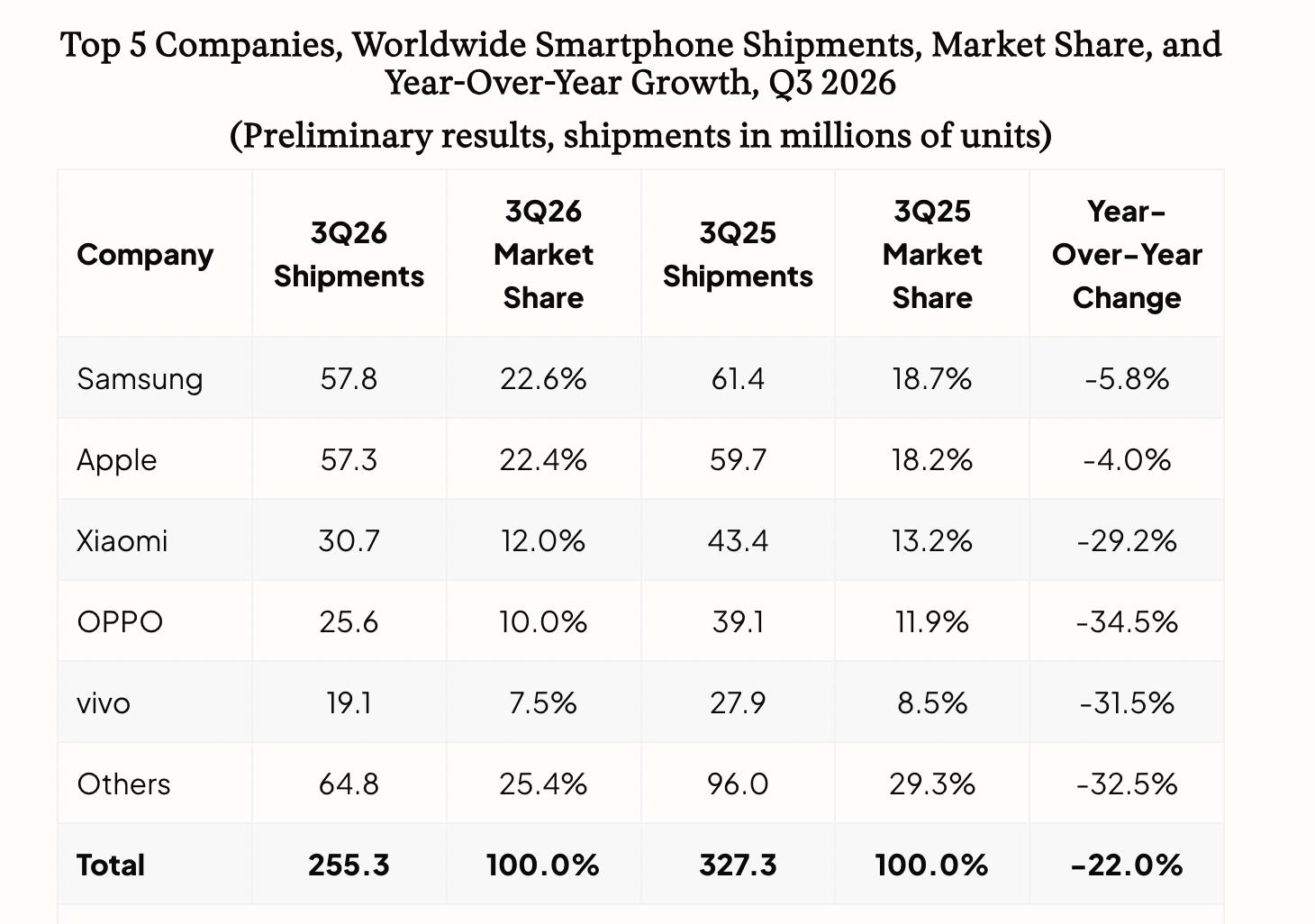
On local time October 15, International Data Corporation (IDC) released preliminary data from its *Global Quarterly Mobile Phone Tracker*, stating that global smartphone shipments in the third quarter of 2026 dropped to 255.3 million units, a 22.0% year-on-year contraction, marking the largest year-on-year quarterly decline on record.
IDC researchers stated that all indicators show the market has not yet hit the bottom. The cost of storage chips has risen by about 350% compared to last year and is still climbing, putting huge pressure on manufacturers' profit margins and shipment volumes. Although the rise in storage chip prices has started to slow down — the quarter-on-quarter growth rate in the third quarter fell to a lower double-digit percentage, compared to about 50% to 100% in previous quarters — the costs of other key components remain high, further exacerbating the industry's difficulties.
As upstream prices are passed on to retail terminals, many consumers choose to extend the service life of their existing devices, leading to a significant drop in mobile phone sales. IDC data shows that in the third quarter of this year, among global smartphone shipments, the top five brands all recorded year-on-year declines in shipments, with OPPO and vivo both posting year-on-year drops of more than 30%.
In terms of market share, in the third quarter of this year, Samsung, Apple, Xiaomi, OPPO and vivo ranked the top five in global smartphone shipments. Among them, the market shares of Samsung and Apple continued to grow compared to last year, reaching 22.6% and 22.4% respectively; the shares of Xiaomi, OPPO and vivo stood at 12%, 10% and 7.5% respectively, with a slight year-on-year decline.
Source: IDC official website
IDC expects market growth to remain constrained until 2027, and the recovery will be delayed at least until 2028. The report states that a growing number of original equipment manufacturers are realizing that the industry's cost structure is facing a permanent structural shift.
IDC researchers said that despite weak sales, some suppliers have raised their production plans ahead of the expected tightening of component supplies next year. If demand remains weak, this could lead to increased inventory in 2027, bringing further downside risks.
In the third quarter of this year, smartphone shipments in the Chinese market also recorded a sharp decline.
Recently, statistics on smartphones in Chinese Mainland for the third quarter of 2026 released by data institution Omdia show that the total domestic smartphone shipments in this quarter reached 59.3 million units, down 12% year-on-year, hitting the lowest shipment level for the same period since 2013. The market pattern has shown obvious differentiation, and only Huawei and Apple among the top five brands have achieved positive growth.
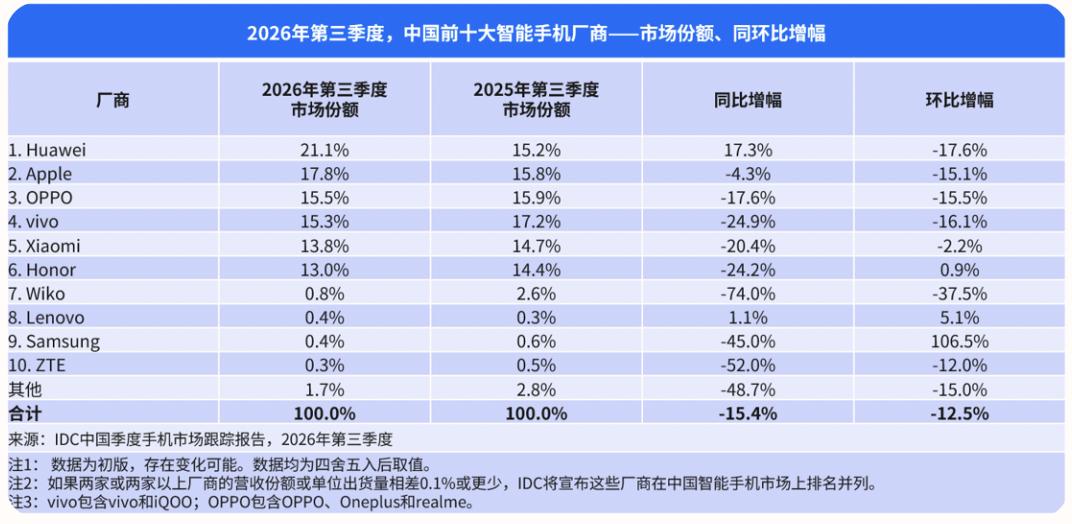
The report on China's smartphone shipment data released by IDC shows that in the third quarter, the domestic smartphone market shipment volume was about 57.9 million units, down 15.4% year-on-year. Huawei is the only brand among leading manufacturers that has achieved double-digit year-on-year growth.
Source: IDC China official website
IDC stated that compared with the year-on-year decline of about 4% in the first half of the year, the decline rate of the overall Chinese market in the second half of the year has further accelerated. The terminal price increase and product configuration adjustment triggered by the sharp rise in the cost of storage and other components have begun to significantly curb consumer demand, among which Android manufacturers and long-tail brands are under particularly prominent pressure.
In IDC's view, the Chinese market in the third quarter presented the typical feature of "falling volume and rising price". The continuous transmission of upstream cost pressure to terminals has led to a general increase in the pricing of new products, while manufacturers have to adjust their product configuration portfolios to balance costs. Consumers still need time to adapt to rising prices, and the phone replacement cycle has been further extended, which directly drags down the overall shipment performance. This trend indicates that cost pressure has become a key variable affecting the current trend of China's smartphone market.
According to the institution's forecast, the cost of storage and other materials will remain at a high level in the next few quarters, and the price of mobile phone products will continue to show a growing trend. Most consumers still need time to accept and adapt to the price rise, and the phone replacement cycle is likely to be further extended. Therefore, even with a large number of new products of all price ranges released intensively, the performance of China's smartphone market in the fourth quarter of 2026 is expected to remain under pressure. Even for most of 2027, cost pressure will still exist, and the market is expected to continue to show a clear downward trend.
Omdia predicts that for the whole year of 2026, smartphone shipments in Chinese Mainland will decline by about 7% year-on-year. The institution stated that under the general environment of high storage costs, manufacturers need to balance R&D investment, hardware costs and terminal pricing. Only by converting AI capabilities into implementable high-frequency practical scenarios can they truly leverage the replacement demand in the stock market.
This article is from "Jiemian News", written by Hou Ruining, published with authorization from 36Kr.