CoreWeave has a more than 60% probability of default, Jensen Huang is stepping in to calm the situation: financing costs are falling, and NVIDIA does not need to provide a backstop.
At a time when CoreWeave's default risk has surged to an all-time high and the credit market implies that the five-year cumulative default probability exceeds 60%, Jensen Huang, CEO of NVIDIA, stepped in to "defuse the situation", stating that CoreWeave's financial strength is continuously improving and its financing cost is declining, so there is no need for NVIDIA to provide a financial backstop for it.
On Thursday, October 15, Eastern US Time, the spread of CoreWeave's 5-year credit default swap (CDS), an indicator reflecting the cost of corporate debt default protection, once rose 74.5 basis points to 1194.5 basis points, hitting an intraday all-time high. Meanwhile, the yields on some of the company's bonds rose to above 15% to 16%, reflecting a sharp surge in investors' concerns about its debt repayment capacity.
Jensen Huang said in a media interview during an event in Sweden the same day: "CoreWeave is getting stronger by the day." He noted that he holds an optimistic attitude towards the company, pointing out that the company's "cost of capital is actually falling". Regarding the market-focused question of whether NVIDIA needs to provide financial backstop for CoreWeave, Jensen Huang made it clear that he does not think this is necessary.
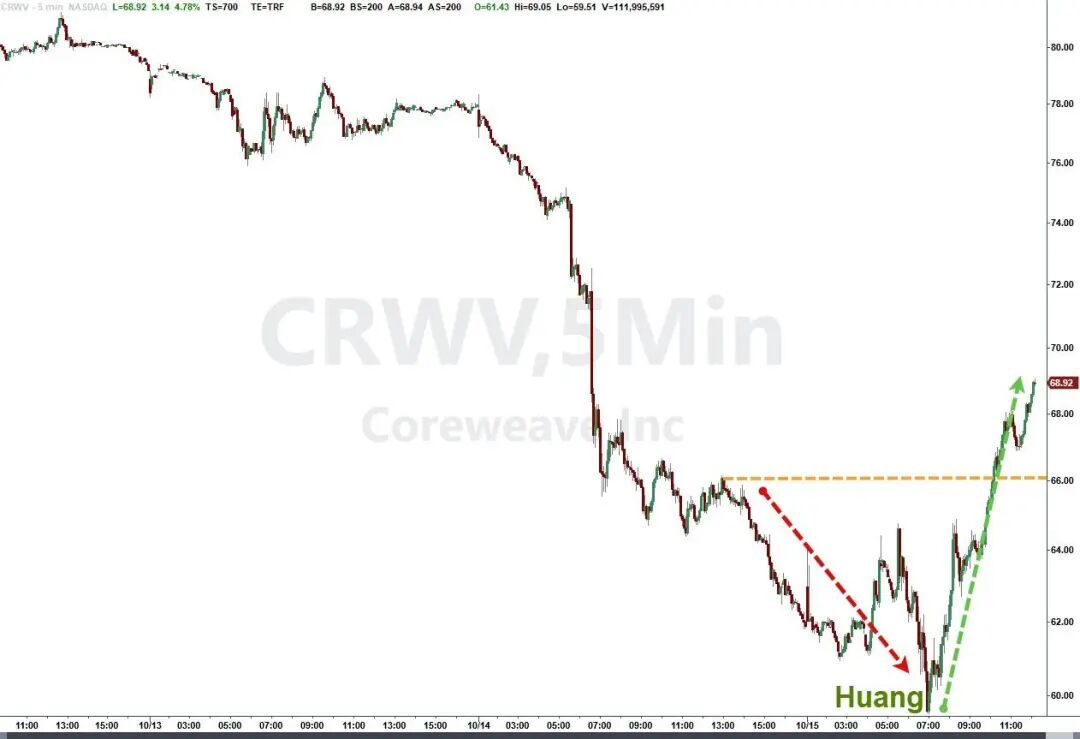
On Thursday, CoreWeave (CRWV) opened 6.6% sharply lower, and its decline once widened to 9.5% in early trading. After Jensen Huang's speech, the decline narrowed rapidly, turned positive and kept rising in midday trading, with the intraday gain once slightly exceeding 6% in late trading, rebounding about 17% from the daily low refreshed in early trading. By the close, the stock price rose more than 5.9%, reversing three consecutive days of decline, and the cumulative decline for the week narrowed to around 15%.
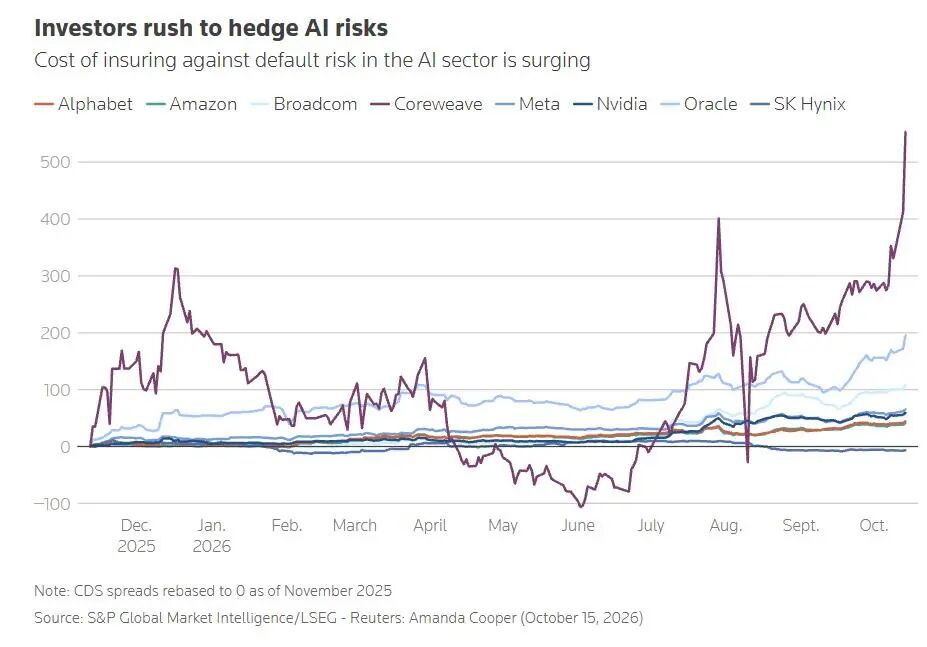
What is more alarming is that the tension in the credit market is spreading, showing that investors are reassessing the debt risks behind AI infrastructure investment. Media reports pointed out that Oracle's 5-year CDS spread has approached 300 basis points on Thursday, rising about 31 basis points in four days this week, and the relevant spreads of Amazon, Google parent company Alphabet and Meta are all at historical highs; SoftBank's 5-year CDS spread widened by 24 basis points in one day; the CDS spreads of NVIDIA, STMicroelectronics and SpaceX also rose significantly.
5-year CDS breaks through 1190 basis points, CoreWeave bonds are sold off
CoreWeave is facing a double blow in its stock and bond markets.
Data from ICE Data Services shows that CoreWeave's 5-year CDS spread rose to 1194.5 basis points in intraday trading on Thursday, hitting a record high, and the corresponding pricing implies that the cumulative default probability in the next five years exceeds 60%. Data from LSEG and S&P Global Market Intelligence shows that CoreWeave's CDS spread broke through 1100 basis points in intraday trading on Thursday, corresponding to a 5-year default risk of about 64%, higher than the level of about 30% a year ago.
CDS is a credit derivative used to hedge debt default risk, and its spread usually rises as the market's concerns about the issuer's debt repayment capacity intensify. However, the default probability implied by CDS depends on the pricing model and relevant assumptions, which does not mean that the company's actual default probability in the next five years has been accurately measured.
The performance of the bond market is equally severe. Bloomberg cited market data that in intraday trading on Thursday, the price of CoreWeave's bond maturing in 2031 with a coupon rate of 9% fell by about 3.3 cents to 79.9 cents per dollar of face value, with the yield rising to 15.6%; another bond with a coupon rate of 9.75% also maturing in 2031 fell by about 2.6 cents to 78.65 cents, with the yield rising to 16.2%.
Reuters reported that CoreWeave's bond maturing in 2032 trades at about 78 cents per dollar of face value on the Tradeweb platform, with a yield of more than 16%. Different bonds have different maturity dates, coupon rates and transaction prices, but all show that investors are demanding higher risk compensation.
A sharp drop in bond prices far below par value and a surge in yields mean that CoreWeave may face higher costs for future financing or refinancing through the bond market.
Brannin McBee, co-founder of CoreWeave, said in a recent interview with the Financial Times that the company hopes to obtain an investment-grade credit rating, so as to open up a wider range of financing channels and even be able to borrow an "unlimited" pool of funds. This goal is in sharp contrast to the current high bond yields: when investors' concerns about debt repayment capacity have not subsided, whether the company can continue to obtain financing at lower costs remains to be tested by the market.
CDS of AI-related enterprises such as Oracle and SoftBank rise, credit risk spreads to the industry
CoreWeave is not the only AI-related enterprise facing pressure from the credit market.
In intraday trading on Thursday, Oracle's 5-year CDS spread was 288 basis points, flat with the previous trading day, but widened by 28 basis points from 260 basis points a week ago; SoftBank's 5-year CDS spread widened by 24 basis points in a single day to 424 basis points. At the same time, the CDS spreads of NVIDIA, STMicroelectronics and SpaceX also rose significantly.
According to data from LSEG and S&P Global Market Intelligence, the CDS spreads of Amazon, Alphabet and Meta have also risen to historical highs, but the overall rising speed is slower than that of Oracle and CoreWeave. The credit insurance costs of these tech giants are also affected by the revaluation of AI investment financing risks.
The CDS spread measures the cost investors need to pay to protect against debt default risk. A wider spread means that the market demands higher risk compensation, but it does not mean that the enterprise is about to default, nor can the CDS spreads of different companies be directly regarded as comparable default probabilities.
The rise in credit insurance costs of many AI-related enterprises reflects that investors are re-examining the financing methods of AI infrastructure investment. The large-scale borrowing needs of enterprises such as Oracle have attracted attention, while CoreWeave, with heavy debt, no profit yet and high dependence on external financing, has become the case with the most concentrated market pressure.
Reuters pointed out that US inflation data was higher than expected and the market's concerns about the future trend of interest rates have intensified, which has aggravated investors' doubts about the return cycle of huge capital expenditure on AI. As the industry increasingly relies on debt rather than free cash flow to finance AI construction, the market focus is shifting from the growth of computing power demand itself to whether relevant enterprises can generate sufficient profits and cash flow in time to cover the rising interest expenses.
Pressured by about 50 billion US dollars of debt, CoreWeave's expansion model is being questioned
The core problem CoreWeave faces is the balance between the growth of capital expenditure, cash flow and financing capacity.
Media reports pointed out that this AI cloud computing company is burdened with nearly 50 billion US dollars in debt and is still in a loss-making state. The company relies on large-scale procurement of NVIDIA GPUs, construction of data centers and expansion of computing power capacity to meet customer needs, and such investments usually require a large amount of capital to be invested before revenue is gradually realized.
CoreWeave has greatly increased capital expenditure to seize the fast-growing AI computing power market. In the stage of strong demand, debt-fueled expansion can help enterprises build infrastructure in advance and use long-term customer contracts to support investment plans. However, data center construction has a long cycle and large equipment investment. Once financing costs rise, projects are delayed or customer demand growth falls short of expectations, enterprises may face funding gaps and debt repayment pressure.
Therefore, CoreWeave's problem is not just the high debt scale, but the market is questioning whether its future cash flow can cover capital expenditure, interest expenses and other operating costs. The rise in bond yields will further raise the threshold for new financing, making this problem more prominent.
CoreWeave's management emphasized that the order reserve is sufficient and believes that the market has misjudged its financial situation. But order reserve is not equivalent to cash already received: long-term contracts can provide a certain degree of revenue visibility, but cannot automatically eliminate risks such as construction cost overruns, delivery delays, changes in financing conditions and customer concentration. What investors need to judge is whether these contracts can eventually be converted into sufficient cash flow and sustainable profits.
Why did NVIDIA step in to "defuse the situation": supplier financing intertwined with customer demand
Jensen Huang publicly released confidence for CoreWeave, behind which is the close business and capital connection between NVIDIA and this AI cloud service provider.
NVIDIA holds about 10% of CoreWeave's shares and is its second largest shareholder. At the same time, CoreWeave is also an important purchaser of NVIDIA GPUs, and its business model relies on purchasing NVIDIA chips, building data centers, and then leasing computing power to AI developers and large technology enterprises.
If CoreWeave's financing is blocked, subsequent data center construction, GPU procurement and computing power delivery may be affected. Even if existing orders are not cancelled immediately, the rise in financing costs may change the project construction rhythm and capital return expectations, which in turn will affect the market's judgment on the growth of NVIDIA's AI demand.
The more sensitive issue is that the arrangement of suppliers investing in customers and customers purchasing supplier products is likely to arouse the market's concern about "circular financing".
Such transactions themselves do not mean improper behavior, but when enterprises rely on borrowing to purchase supplier products while suppliers hold enterprise equity, investors will ask: How much of the growth of the industrial chain comes from the real demand of end customers, and how much relies on financing-driven continuous expansion?
Jensen Huang emphasized that CoreWeave's financing cost is declining, and made it clear that there is no need for NVIDIA to provide backstop, which is not only to maintain the market confidence of important partners, but also to prevent the market from directly interpreting the business connection between the two parties as NVIDIA must bear CoreWeave's debt risk.
However, this statement cannot replace the review of CoreWeave's balance sheet. NVIDIA holding equity does not mean providing a guarantee for its debt, and Jensen Huang's optimistic judgment cannot directly solve the company's financing needs, interest burden and cash flow problems.
Whether AI investment returns can cover huge capital expenditure has become the core issue of the market
CoreWeave's credit turmoil is becoming a stress test for AI infrastructure investment.
Against the background of the rapid growth of generative AI demand, technology enterprises and computing power operators are building data centers on a large scale, trying to seize the future market. But infrastructure investment often precedes revenue realization, especially new cloud service providers that rely on external financing, which need to continuously borrow to purchase GPUs, build computer rooms and pay for energy and operating costs.
When interest rate expectations rise and bond investors demand higher risk compensation, this model will face more rigorous tests. The increase in financing costs will not only compress profits, but also force enterprises to slow down the expansion speed; if the expansion slows down, it may affect future revenue growth and the return on existing investments.
Jim Reid, a strategist at Deutsche Bank, pointed out that this is not the first time that significant market turmoil has been experienced due to concerns about AI, but as the AI capital expenditure cycle is increasingly supported by debt rather than free cash flow, investors must pay more attention to the price signals of the credit market. "Overall, the financing cost related to AI is not high yet, but worrying signs have emerged in some marginal fields."
This judgment highlights the key contradiction faced by the industry: the growth of computing power demand does not automatically mean that computing power operators can obtain sufficient profits; the growth of orders does not necessarily mean that debts can be easily repaid.
For CoreWeave, the real test is whether it can control debt growth, continuously obtain financing, and convert its huge order reserve into sustainable operating cash flow. For NVIDIA and the entire AI industrial chain, the market focus is shifting from "how much more computing power is needed" to "who will pay for computing power construction, and whether these investments can eventually generate sufficient returns".
Jensen Huang tried to calm the market, but the high yield of CoreWeave bonds, the record high credit insurance premium, and the rising CDS spreads of enterprises such as Oracle and SoftBank show that investors' review of the AI financing model is deepening. In the future, the valuation of the AI industrial chain will not only depend on whether the computing power demand can continue to grow, but also increasingly depend on whether enterprises can convert this capital expenditure competition into real and sustainable cash flow at an affordable financing cost.
This article does not constitute personal investment advice and does not represent the position of the platform. The market is risky, investment needs to be cautious, please make independent judgments and decisions.
This article is from the WeChat Official Account "Wall Street News Max", author: Li Dan, published by 36Kr with authorization.