Just now, Mac Studio has welcomed Mark Zuckerberg's most powerful open-source model, and Apple has got the most unexpected assist it has been waiting for.
Mark Zuckerberg once mocked Apple for not inventing anything remarkable after the iPhone. Today, he actively shared a photo of Meta AI working on Mac, expressing gratitude to Apple and newly appointed CEO John Ternus for their support.
What brought the two sides together is a large model with 816 billion parameters, as well as the shared goal of bringing it to users' desktops.
Earlier this morning, Meta released the open-weight model Muse Spark Open, and jointly demonstrated with Apple the solution for running it on two or four Mac Studio devices. Developers can use the model locally to write code, analyze videos, and execute agent tasks, and the inference process does not need to go through the server of the model manufacturer.
As AI begins to process private files and corporate materials, where data is processed and who controls it is becoming increasingly important. Open models and local AI complement each other perfectly, enabling users to deploy models on their own and keep inference on their own devices.
Apple's years of investment in self-developed chips, unified memory and development tools have thus found their place to shine. Today, the 816-billion-parameter model running on the desktop brings Mac one step closer to becoming the preferred personal computer in the AI era.
Zuckerberg Brings the New Model, Apple Has the Computers Ready
The release of Muse Spark Open fulfills a previous promise made by Mark Zuckerberg.
In August this year, Meta launched Muse Glimmer, a smaller open-weight model. Zuckerberg said at the time that larger and more powerful models would be opened later. Now, this promise has been realized as Muse Spark Open with 816 billion parameters.
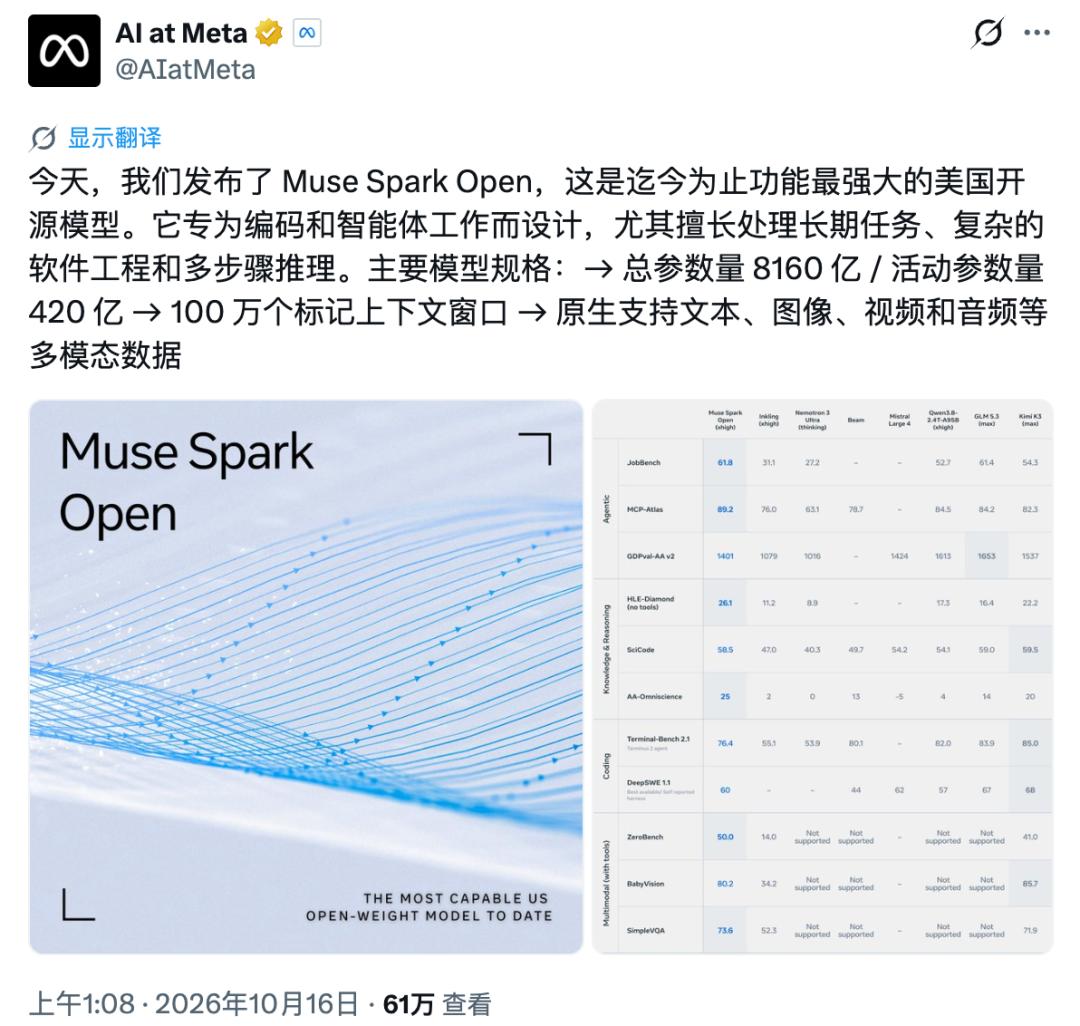
The capabilities of the new model Muse Spark Open are close to Muse Spark 1.3, and Meta even calls it the most capable US-developed open-weight model to date.
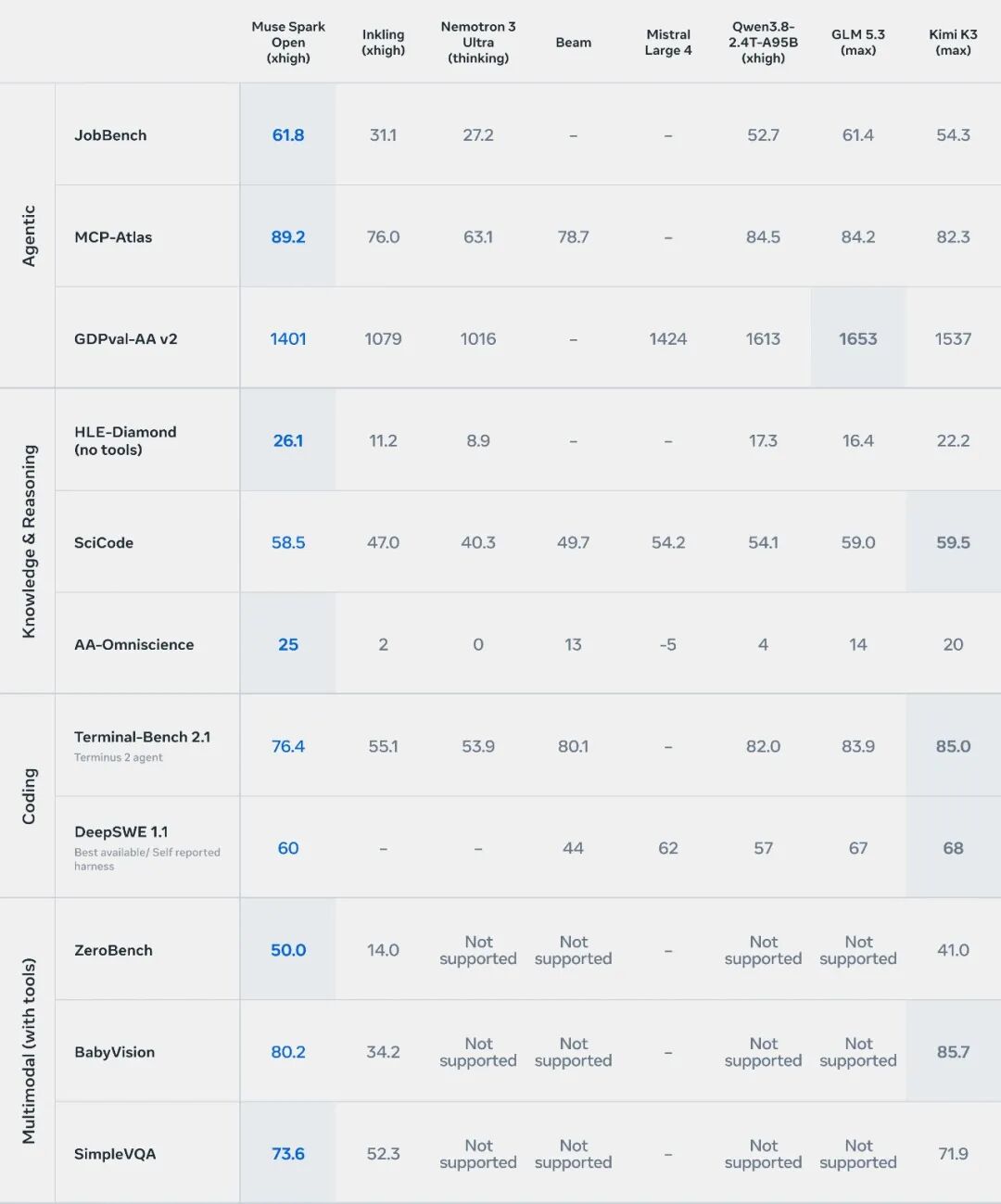
Developers can download the model weights, deploy them on their own hardware, or use them through cloud service providers and development tools. Its license allows commercial use within a certain range, leaving room for enterprises to deploy and develop applications on their own.
Alexandr Wang, Head of Meta AI, said that Muse Spark Open is still less capable than the closed-source model Muse Wonder released earlier this week. However, open weights give it another appeal: developers can choose their own operating environment, study the model, and organize applications according to actual needs.
Meta hopes these attempts will start on a small scale and then gradually expand. Apple's participation provides developers with a clear local operation solution.
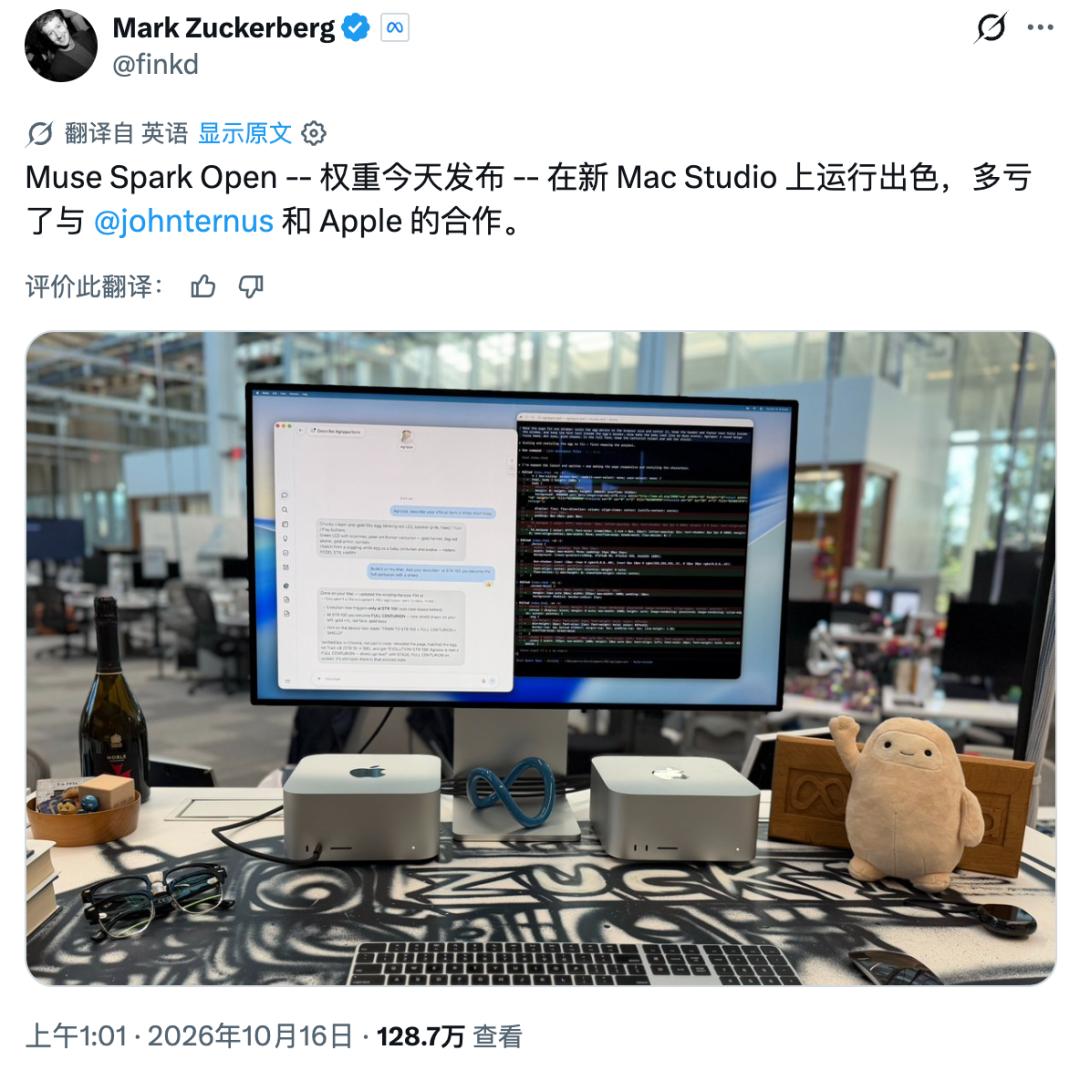
Mark Zuckerberg posted a photo of the Meta agent working on Mac on X, saying that Muse Spark Open opened its weights that day, and thanks to the cooperation with Ternus and Apple, it runs very well on the new Mac Studio.
Ternus then responded that it is exciting to be able to run a model of this scale and capability so efficiently on a desktop, adding that Mac Studio is continuing to expand the boundaries of on-device AI.

Wang gave a more life-oriented evaluation of the cooperation between the two companies. He joked to Axios that everyone is very happy to see "mom and dad can finally get along well again".
According to him, the two sides have been cooperating for several months, and Daniel Gross, who used to work at Apple and now joined Meta, has played an important role in it. In particular, Meta purchased hundreds of Macs earlier this year for its superintelligence team to explore local AI and agent applications.
The most notable point of the cooperation is that a new relationship can be established between model capabilities and user data.
According to Wang, when developers run the model on their own devices, Meta cannot see or control the content of their use. Users can get the model capabilities of Meta while keeping prompts and inference processes in an environment under their own control.
For individuals, local operation can reduce the transmission of private materials to external servers; for enterprises, code, documents and business data can also be kept on self-managed devices. Privacy and security requirements have thus become a practical driving force for promoting local AI, and open weights make this path operable.
816 Billion Parameters: How to Fit Them Into Several Macs
To move such a huge model to the desktop, two problems need to be solved: whether the computer can hold it, and whether it can work fast enough after it is loaded.
Muse Spark Open adopts a Mixture of Experts (MoE) architecture, with a total parameter count of 816 billion, and about 42 billion parameters are activated for each inference.
It is like a huge team of experts. When processing different content, only a part of the experts are mobilized to participate in the calculation. The model can thus retain a large total capacity while reducing the actual calculation that needs to be completed in each step.
However, the parameters that are not involved in the current calculation still need to be stored for subsequent calls. MoE reduces the computational burden, but the memory requirement to accommodate the entire model is still considerable.

According to data from Apple's technical blog, under the native BF16 precision, the model parameters of Muse Spark Open alone require more than 1.6TB of memory.
Apple uses the NVFP4 4-bit quantization version to compress the model memory footprint to about 493GB. Quantization is equivalent to storing parameters with a more streamlined numerical representation, exchanging lower numerical precision for smaller memory footprint.
Even so, a single Mac Studio equipped with 512GB of unified memory still cannot handle it easily. In addition to the model weights, temporary calculation data during the inference process, KV Cache (key-value cache), as well as the operating system and runtime framework, all take up additional memory.
Multiple Macs working together then becomes the next step.

In the multi-machine inference solution demonstrated by Apple, MLX mainly adopts two parallel methods, the more understandable one is pipeline parallelism. The first part of the model is placed on one Mac, and the latter part is placed on another. After the first one completes the calculation, the result is handed over to the second one for further processing.
This method allows two computers to jointly accommodate a large model, but there are sequential dependencies in the calculation. The latter machine needs to wait for the result of the former one, so the devices cannot always work at the same time.
Tensor parallelism distributes the calculations in the same layer to multiple machines, letting them participate together, and then exchanges and aggregates the results.
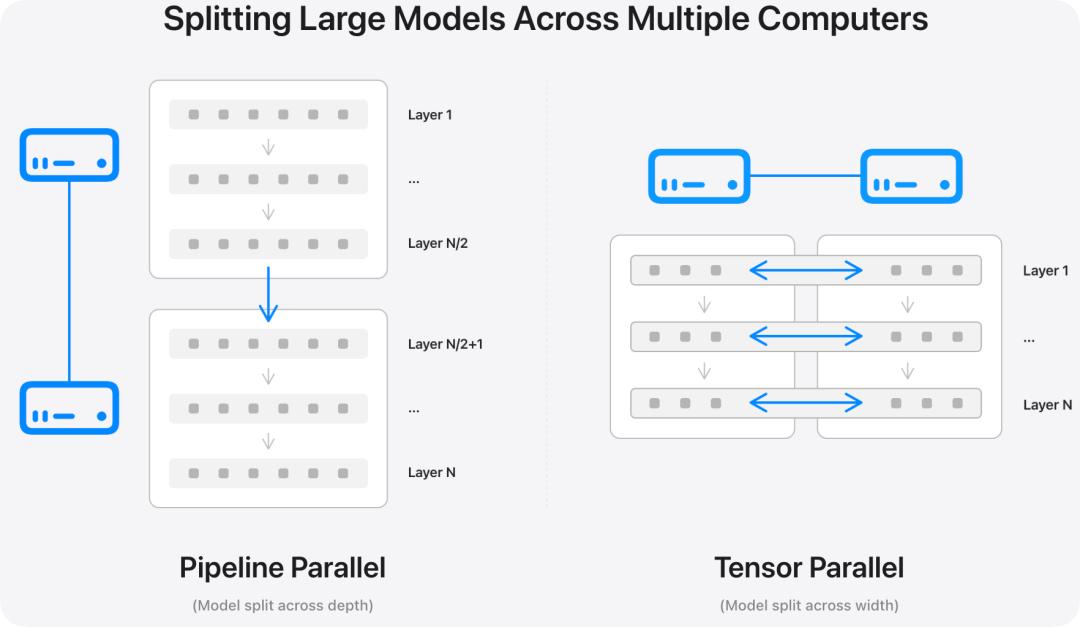
More devices can work at the same time, so more frequent data exchange between machines is required. If the transmission is too slow, the increased computing power will be consumed in waiting.
Apple uses RDMA communication over Thunderbolt 5 to reduce the latency of data exchange between multiple machines, and then MLX coordinates the calculations. In the two-machine configuration shown in the blog, two Macs are connected via two Thunderbolt cables to increase link bandwidth.
The final performance gap clearly reflects the value of this collaboration method.
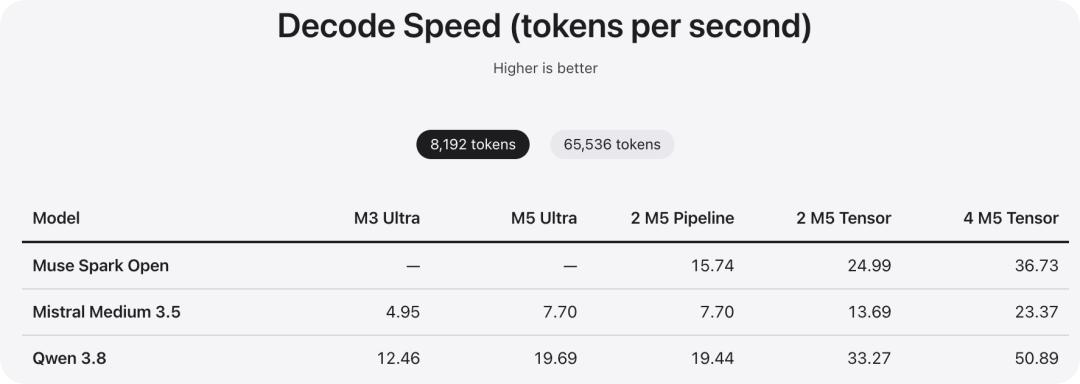
In the test where the input context is 8192 tokens and then 128 tokens are generated, when two M5 Ultra Mac Studio devices use pipeline parallelism, the generation speed of Muse Spark Open is about 15.74 tokens per second.
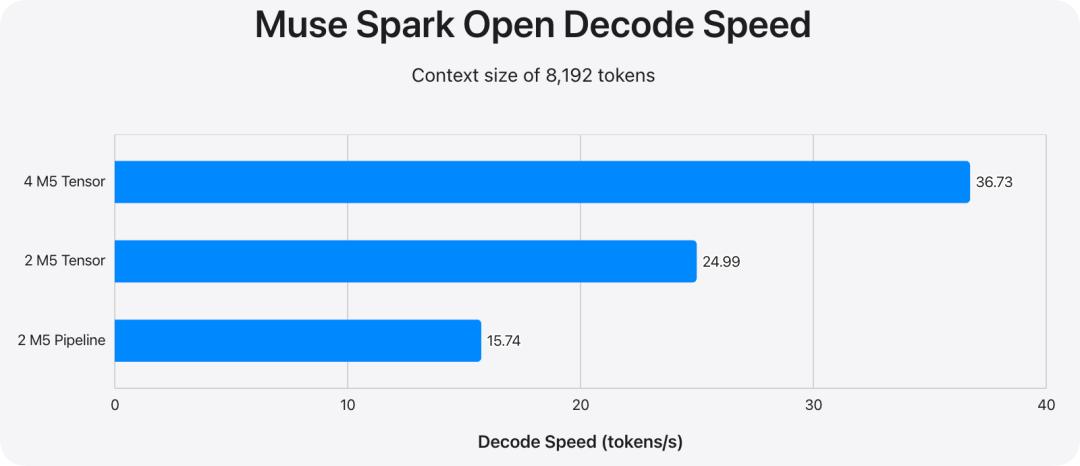
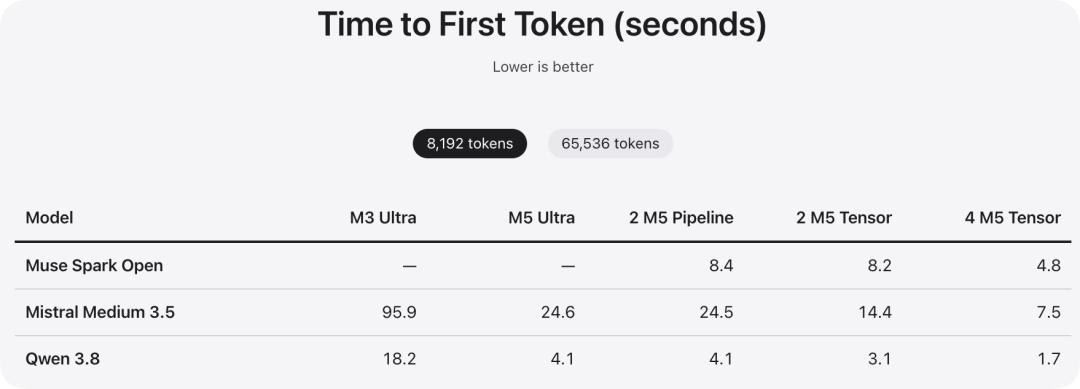
After switching to tensor parallelism, the two-machine speed is increased to 24.99 tokens per second, an improvement of nearly 60%. Further increasing to four machines, the speed reaches 36.73 tokens per second, and the waiting time for the first token is also shortened from about 8.2 seconds of two-machine tensor parallelism to about 4.8 seconds.
From being able to store the model to being able to interact at a practically usable speed, it relies on a complete set of hardware and software coordination behind the scenes.
The unified memory architecture allows the CPU and GPU to share memory resources. The large-capacity configuration provides storage space for the model, and the high bandwidth supports continuous data reading, while MLX and Thunderbolt interconnection allow multiple computers to jointly undertake tasks.
M5 Ultra further increases the unified memory bandwidth from 819GB/s of M3 Ultra to 1.2TB/s. The Neural Accelerators added to the M5-series GPU are used to accelerate matrix operations and improve the computational efficiency when processing input contexts.
The two changes correspond to two links that users can perceive: how long they need to wait before the system starts to answer after submitting a large piece of material, and how fast the content is output after the answer starts.
In Apple's standalone tests for Qwen 3.8 and Mistral Medium 3.5, compared with M3 Ultra, M5 Ultra has a maximum speed improvement of about 4.6 times corresponding to the first token waiting time, and a text generation speed of about 1.6 times.
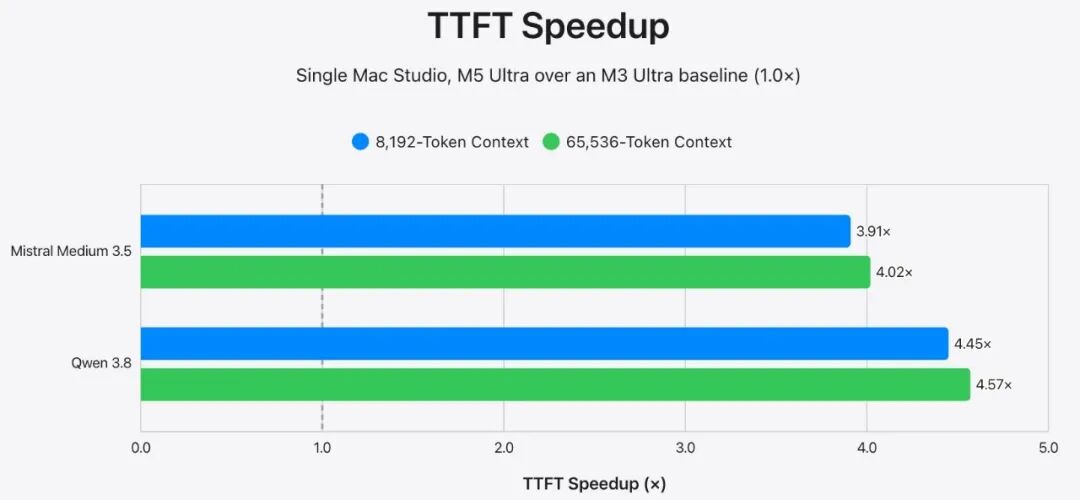
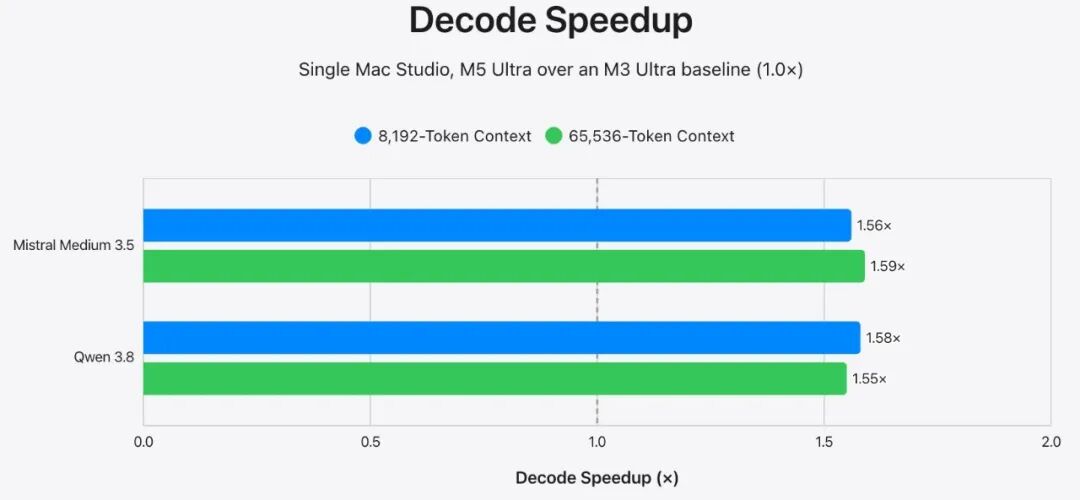
Apple also demonstrated how to apply local model services to programming tools such as OpenCode. Developers can continue to submit tasks through the agent interface, letting the model process the context and generate code, while the underlying inference work is completed by the Mac on the desk.
From this perspective, the operation of Muse Spark Open on Mac is also a concentrated test of Apple's existing investments. Chips, memory, interconnection and software tools each solve part of the problem, and together determine how far desktop AI can go.
At present, this solution is still mainly aimed at professional developers and teams. The starting price of Mac Studio with M5 Ultra is 46,999 yuan, and the 512GB version will be launched later this month. To run Muse Spark Open, you also need to configure multiple devices according to memory requirements.
Obviously, there are still thresholds for large models to enter personal computers. But Apple has shown a specific path for users who need to control models and data independently to build their own AI operating environment on the desktop.
Apple Even Has Its Eyes on Idle Macs
A cluster of several high-spec Mac Studio devices solves the problem of how large models enter the desktop. Another paper recently published by Apple researchers focuses on the computers that already exist in the office but are often not fully utilized.
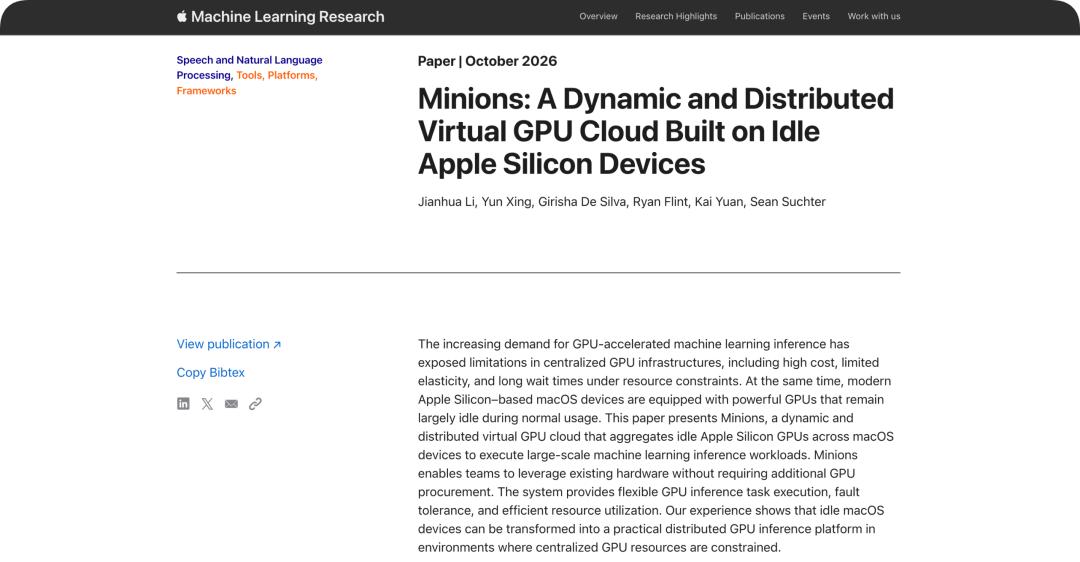
A system called Minions tries to organize the idle GPUs of Apple Silicon devices to form a shared inference resource pool.