Elon Musk has built a "sci-fi supercar" from 2077, and it can fly.
A sci-fi hypercar jointly developed by Tesla and SpaceX has finally been unveiled.
On October 16, Tesla officially held the unveiling and technical demonstration event for the second-generation Roadster at its site in McGregor, Texas, right next to SpaceX's rocket testing facility.
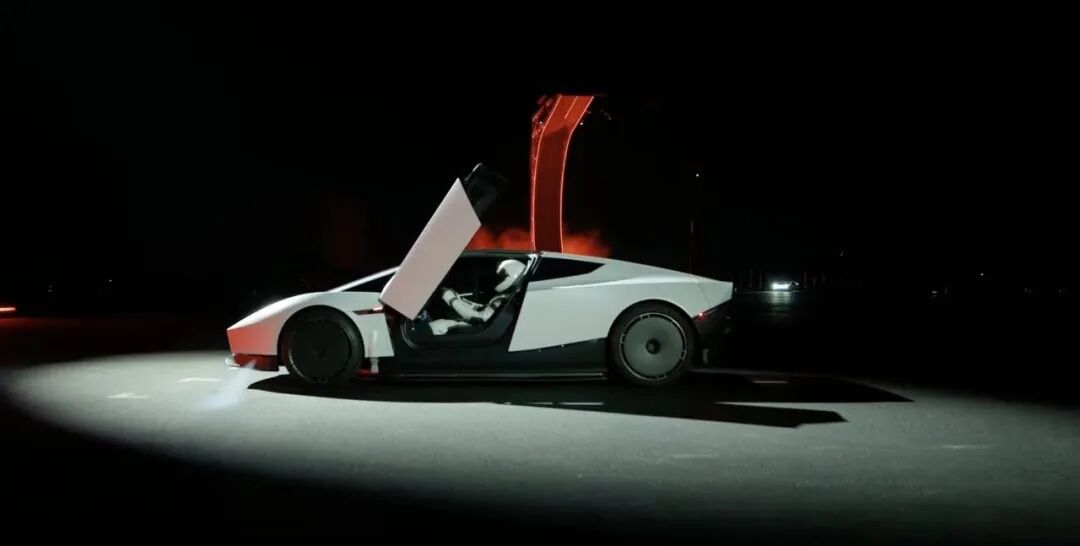
Tesla revealed that the new Roadster is available in three variants: the Performance version, the limited-run Thrust version, and the invite-only Rocket version. The Thrust version can accelerate from 0 to 100 km/h in less than 1 second. Consumers can place orders for the Performance version, which has a nominal range of 483 kilometers, with a deposit of 332,000 yuan, and mass production and delivery are expected to start in 2028.
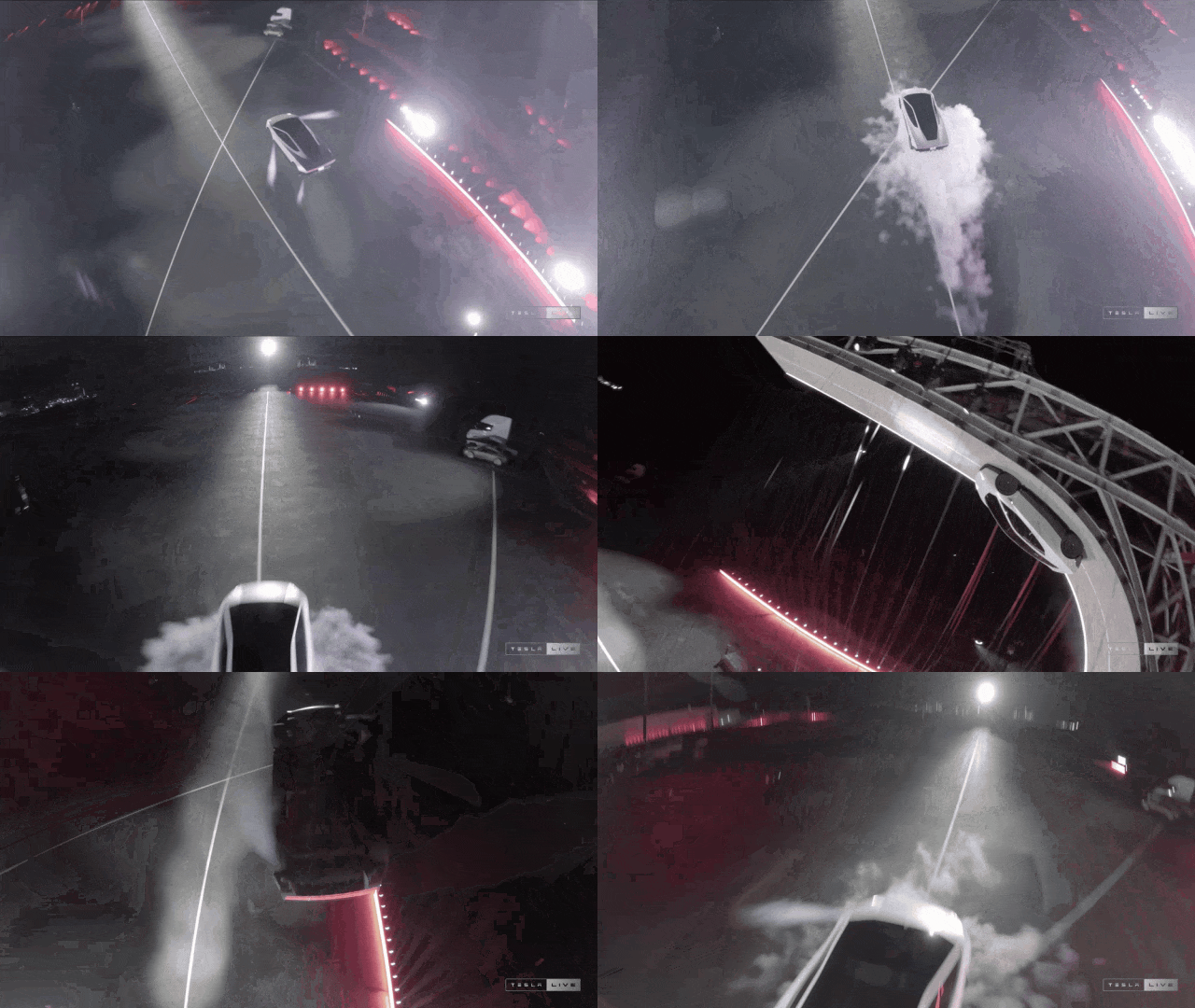
The Rocket version adopts a single-seat track layout, with cold gas thrusters fully developed by SpaceX arranged all around the vehicle. It supports forward, upward and lateral rotational propulsion, giving the car genuine hover and flight capabilities.
To this end, Tesla has specifically applied to the Federal Aviation Administration of the United States for a temporary no-fly zone around the site.
"This is an extraordinary achievement completed through close collaboration between Tesla and SpaceX engineers, something you have never seen in any movie. It's better than any James Bond car," Musk said.
In 2008, the first-generation Roadster, led by Martin Eberhard's team, was built based on the Lotus Elise chassis.
At that time, Musk drew a highly impactful blueprint for the second-generation model: 0-96 km/h (0-60mph) acceleration in 1.9 seconds, a top speed exceeding 402 km/h (250mph), a 998-kilometer (620-mile) range brought by a 200 kWh battery pack, and extreme performance that challenges traditional fuel-powered hypercars.
However, the mass production that was initially promised for 2020 has been delayed again and again. OpenAI CEO Sam Altman once posted a screenshot of his reservation publicly complaining that "the 7.5-year wait is far too long" and applied for a refund.
When talking about this model at the recent All-In Summit, Musk proudly promoted it, saying "It will be a sensation, the excitement will definitely be there, success is not guaranteed, but the spectacle is absolutely guaranteed."
Three Configurations and the Cold Gas Propulsion Breakthrough Technology
It can be said that the core focus of this launch event is Tesla's on-site demonstration of the core performance of the second-generation Roadster and the SpaceX joint suite.
According to the information released by Tesla, the newly launched Roadster includes three completely different configuration forms.
The first is the Performance version, the version that "ordinary" consumers can order.
As the road-legal base model, the Performance version features a two-seat layout, is equipped with an active aerodynamic system and a brand-new multi-mode chassis suction and air extraction system, with 0-100 km/h acceleration in less than 1.6 seconds. This system relies on powerful fans and chassis airflow sealing to adsorb the ground, which can generate enormous downforce even when the vehicle is stationary at zero speed. The theoretical suction force is so strong that it can even stably fix the vehicle upside down on the ceiling.
The second is the Thrust version (limited release). Based on the chassis of the Performance version, it is further equipped with cold gas thrusters driven by high-pressure composite overwrapped pressure vessels (COPV) at the rear of the vehicle. Relying on the powerful air reaction thrust, it pushes the 0-100 km/h acceleration time of the vehicle into less than 1 second (nominal value less than 0.9 seconds).
The last one is the Rocket version (invite only) that shocked the entire audience. This version adopts a single-seat track layout, with cold gas propulsion nozzles deeply developed by SpaceX arranged all around the perimeter of the vehicle, supporting forward, upward and lateral rotational propulsion, giving it genuine hover and flight capabilities, with 0-100 km/h acceleration in less than 0.59 seconds.
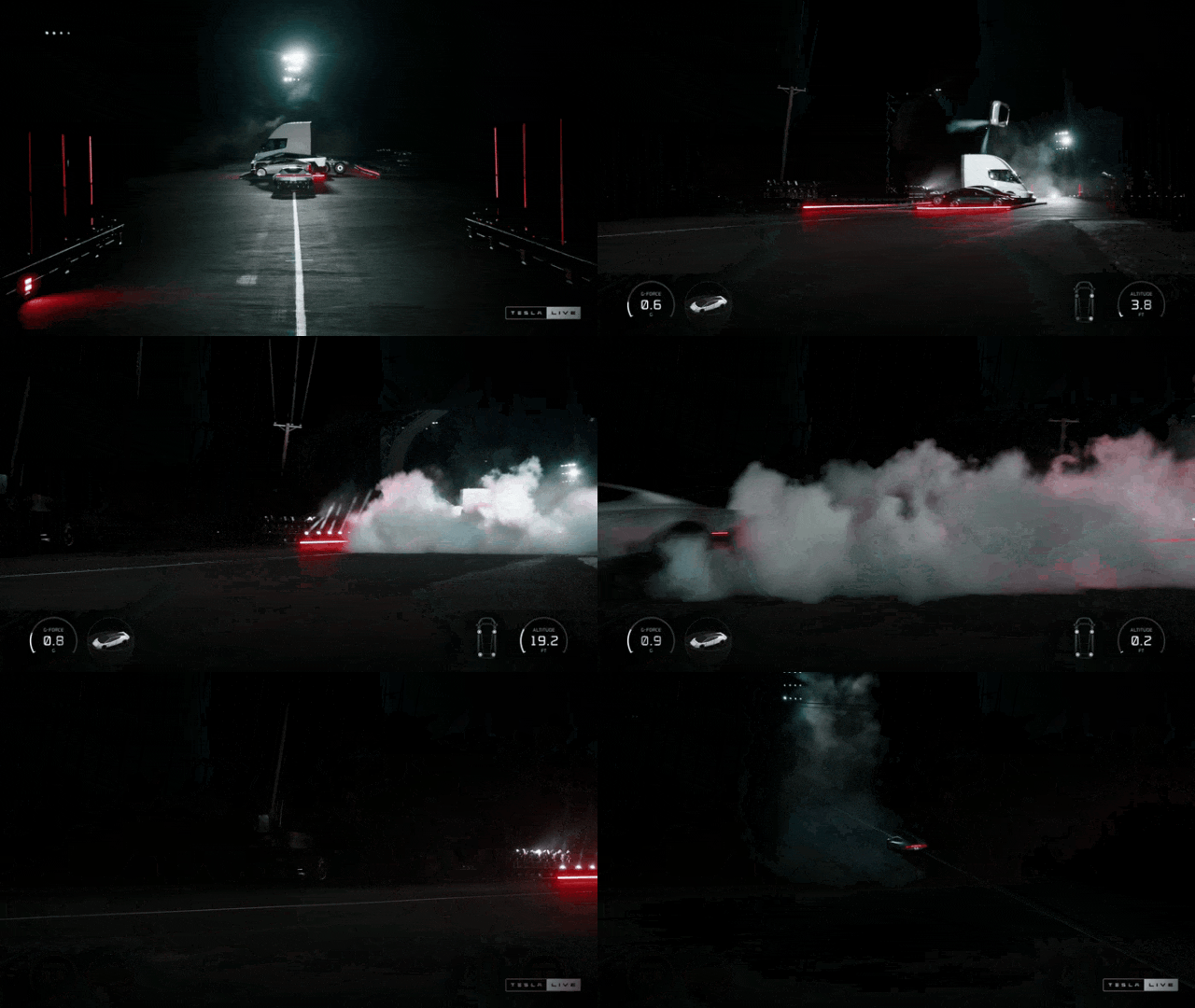
As the official page notes in the very Musk-style language: "So yes, it can fly."
However, the official side also clearly states legal restrictions: this version is not allowed to be used on public roads without approval, and is only limited to private sites and track experiences.
SpaceX Aerospace Technology Spillover
The concept of deep integration of the world's top electric vehicle engineering and top rocket manufacturing brings the engineering details of the Roadster to an unprecedented level.
The rear diffuser area of the vehicle integrates a multi-mode air extraction fan and propulsion nozzles.
The vehicle achieves dynamic pressure through an advanced dual-mode fan system: at low speeds, it draws air through the chassis to tightly adsorb the vehicle to the ground to provide grip, while at high speeds, it automatically opens the channels of the front and rear air intake systems to generate a larger airflow under the vehicle.
At the same time, the vehicle is equipped with a variable-pitch rear wing that can dynamically calculate in real time according to track conditions and automatically adjust downforce. Combined with the Steer-by-Wire Yoke, brake-by-wire and throttle-by-wire systems, the vehicle can break through the physical friction limit of 1.26g of traditional tires when cornering, achieving an astonishing lateral acceleration of more than 2g.
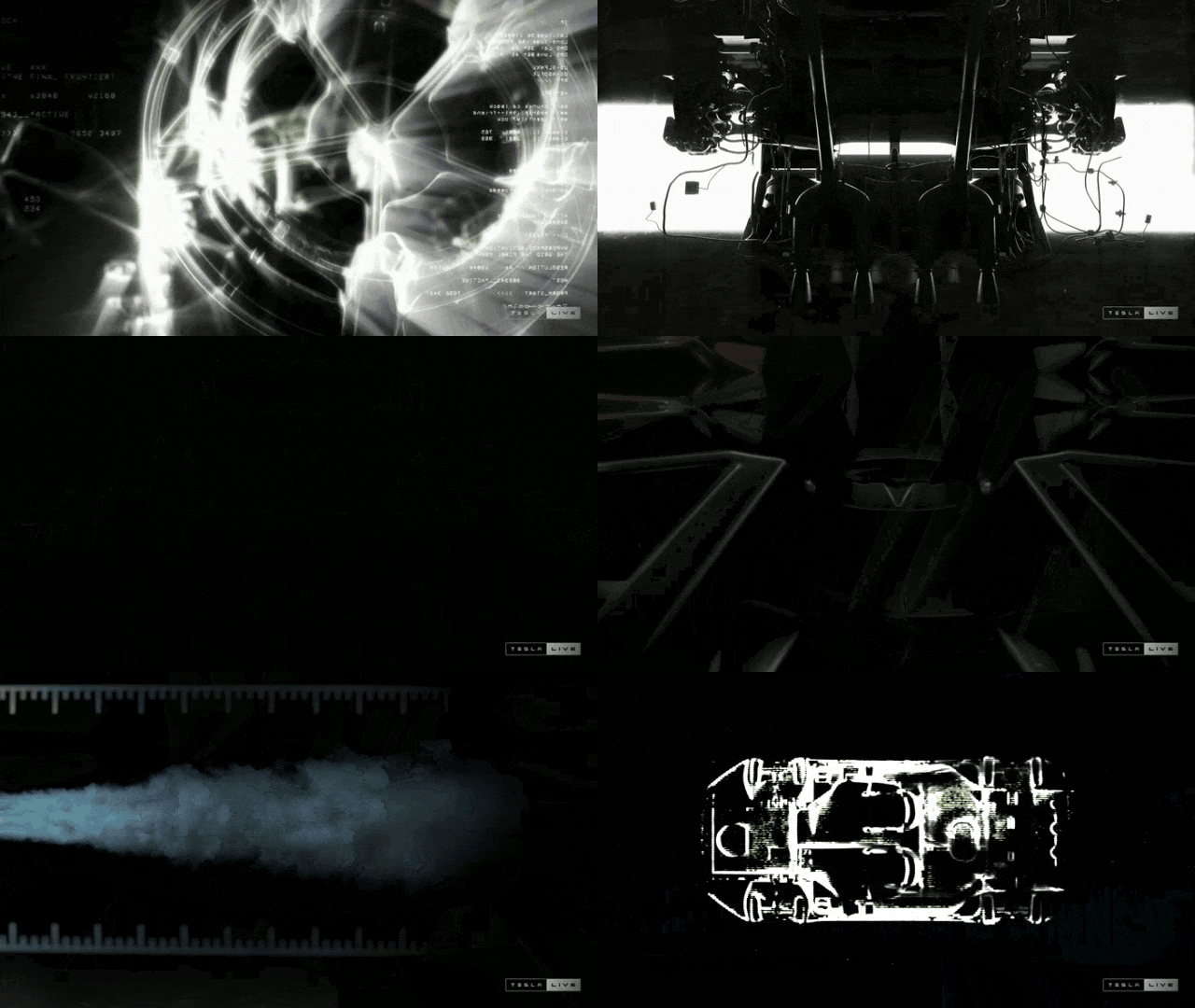
In terms of space and gas circuit architecture, as the engineering team detailed on site, the vehicle is equipped with two carbon fiber wound pressure vessels (COPV) supported by SpaceX technology, with a total volume of 600 liters, which can store about 250 kilograms of high-pressure air, and complete millisecond-level fine adjustment through up to 10 precision micro-actuator nozzles.
This system has the capability of ultra-high pressure self-inflation, and the vehicle can replenish energy at any time and complete various extreme maneuvering actions without relying on traditional special propellant fuels.
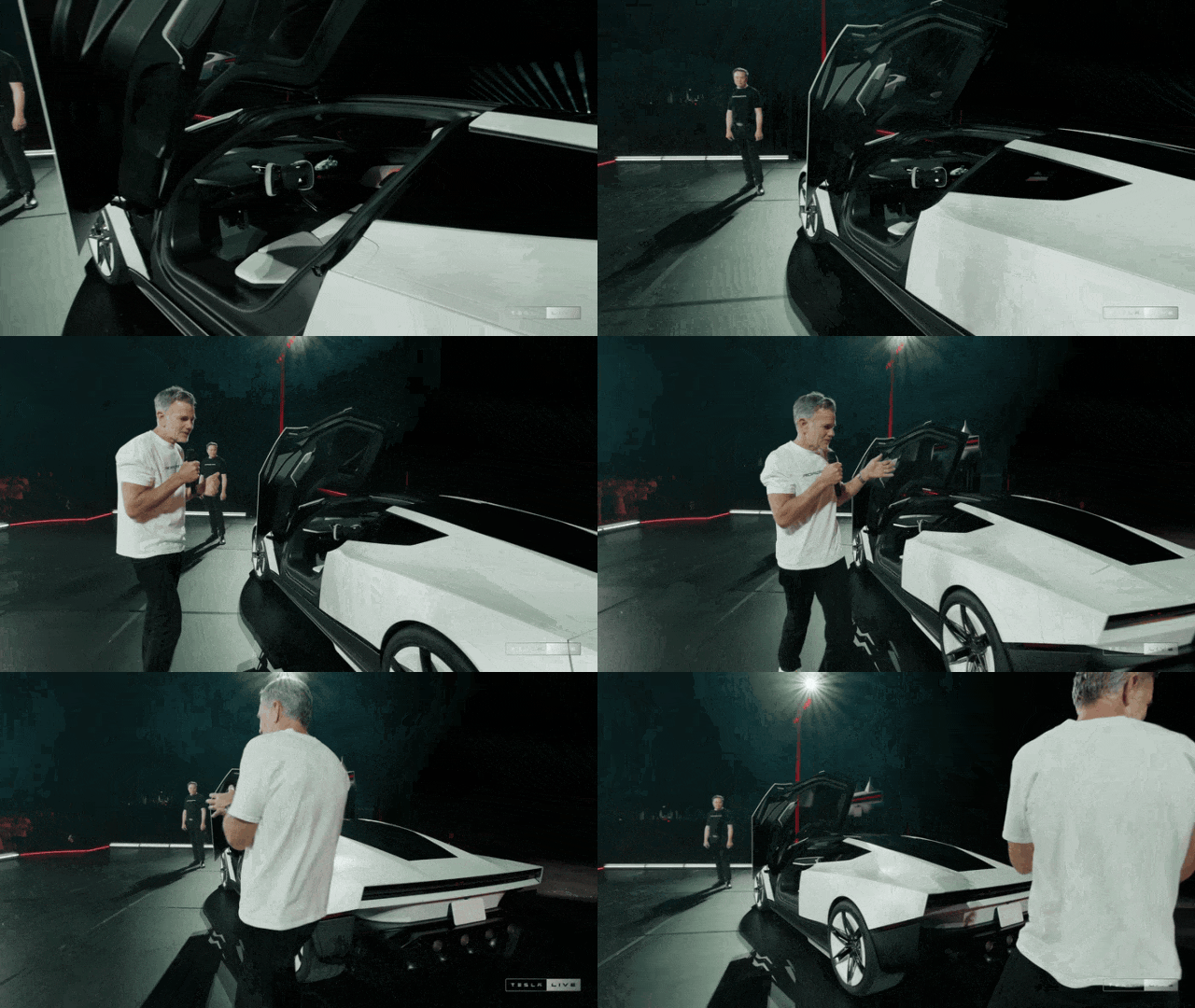
In terms of cockpit interaction and lightweight materials, the new car adopts the Supersonic extreme-speed cockpit concept. The body paint uses the Ano White aerospace-grade coating inspired by deep space radiation protection technology, and the window glass adopts the Gold Glazed coating technology that imitates the visor of astronaut helmets.
The interior is made of classic ultra-white interior trim with gray microfiber material. Two additional small forward-facing displays are installed next to the central main control screen to read the thrust and driving dynamics in real time.
Under the ultimate Mass Control principle, the body seats are directly molded and integrated into the chassis. The whole vehicle extensively uses titanium alloy, magnesium alloy and high-strength carbon fiber to achieve millisecond-level dynamic response under instantaneous high overload impact.
Deposit of 332,000 Yuan, Delivery in 2028
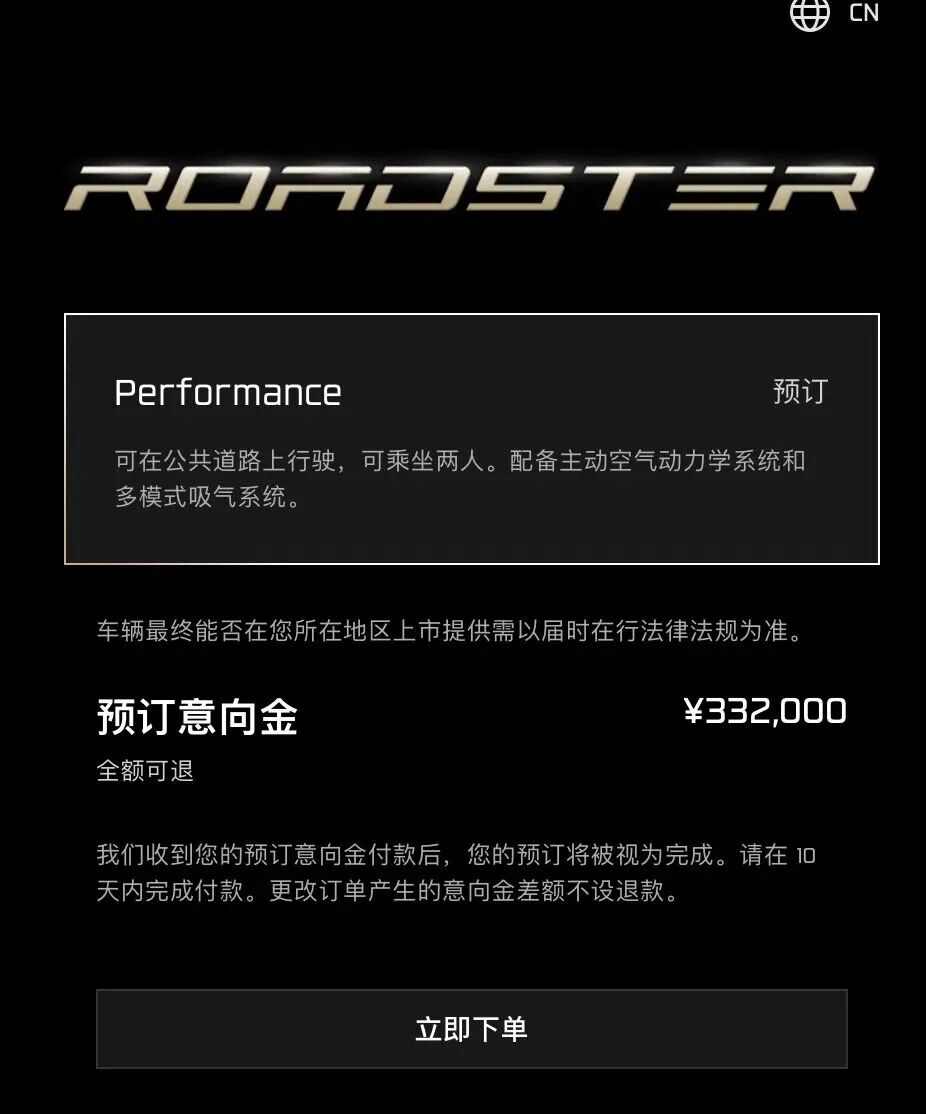
Tesla has re-opened and upgraded its reservation channels, and reservations are accepted in markets including the United States, Canada and China.
When US buyers choose to make a reservation on the official website, they first need to pay a deposit of 5,000 US dollars by credit card, and complete a wire transfer payment of 45,000 US dollars within 10 days (the total reservation threshold is 50,000 US dollars), and this deposit remains fully refundable before the final delivery of the vehicle. The reservation deposit for Chinese users is 332,000 yuan.
In terms of core data, limited by the space squeeze from the in-vehicle high-pressure gas tank and the chassis air extraction system, the latest official announced range of Tesla has been adjusted to more than 483 kilometers (>300 miles).
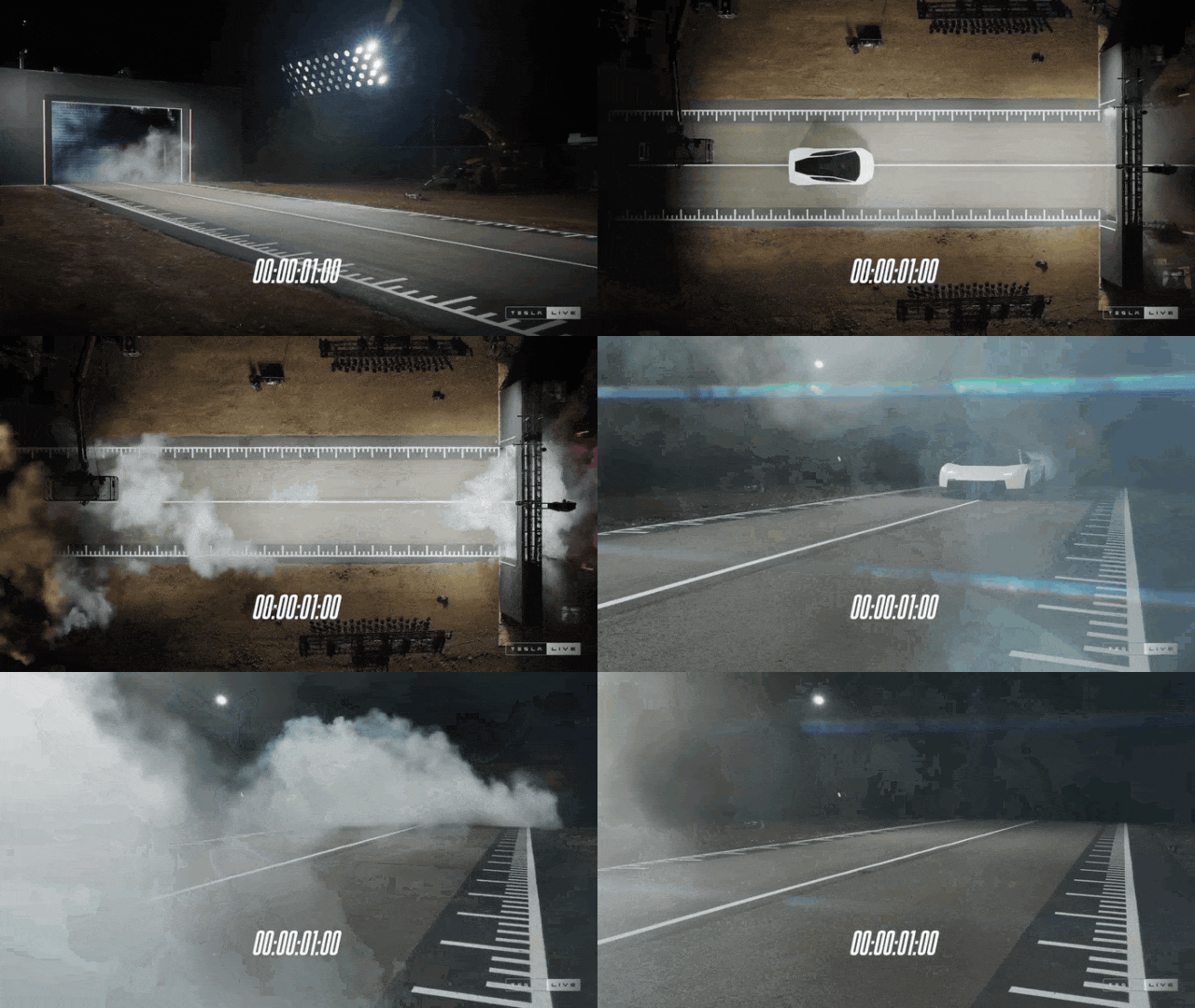
However, the top-level Rocket version, due to its extremely special "flyable/rotatable" physical properties, Tesla said this version is invite-only.
In terms of delivery performance, Musk revealed that it will officially enter the production phase in 2028, and the production and assembly target is still set at Giga Texas.
Why Does Tesla Still Need a Hypercar?
Now that Tesla's business focus has fully shifted to Robotaxi, on-device AI and the humanoid robot Optimus, re-launching a hypercar that relies extremely heavily on driver control has very clear business and strategic logic behind it.
First of all, the Roadster undertakes the role of the flagship brand halo. As a low-output, high-positioning flagship model, hypercars never rely on large-scale sales and direct financial contribution. Its core mission is to establish an unshakable technical benchmark, and provide strong brand premium and technology halo for Tesla's mass consumer models such as the Model 3 and Model Y.
Secondly, it is the ultimate display window for cross-border engineering integration capabilities. Integrating SpaceX's aerospace cold gas propulsion, 600-liter ultra-high pressure COPV gas tank, chassis fan air extraction and steer-by-wire into an electric vehicle directly proves to the outside world Tesla's technical barriers in extreme physical control and engineering integration.
The psychological adjustment effect of the launch event on capital market expectations cannot be underestimated.
Only 6 days after the launch event, Tesla will release its third-quarter financial report. A flagship product that can cause a global sensation and lock in considerable cash flow prepayments undoubtedly gives Tesla a strong shot in the arm on the eve of the financial report release, and re-establishes its irreplaceable image as a technology leader in the capital market.
This article is from the WeChat official account "Tencent Tech", Author: Su Yang, Editor: Xu Qingyang, published with authorization from 36Kr.